Last Updated on June 16, 2026
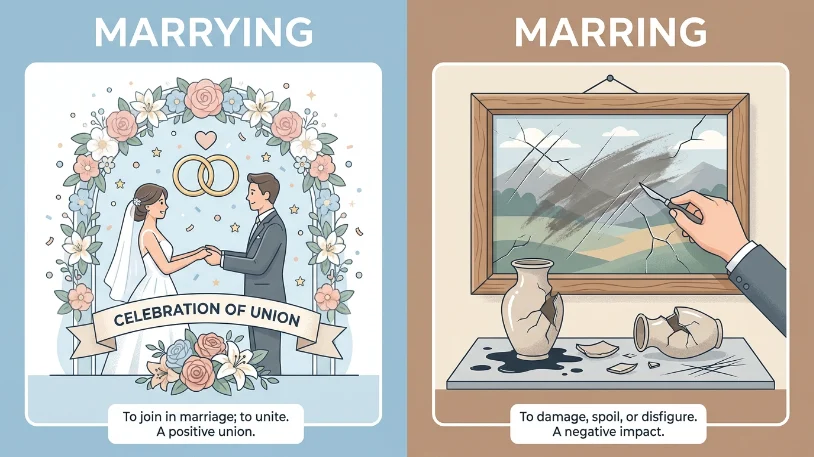
“Marrying” and “marring” sound similar, but they have completely different meanings. “Marrying” relates to marriage or combining things successfully, while “marring” means damaging, spoiling, or ruining something. Understanding the difference helps improve writing clarity, grammar accuracy, and communication.
English has many confusing word pairs, and “marrying or marring” is one of them. They sound almost the same when spoken quickly, which is why many people mix them up while writing. But their meanings are very different.
The word “marrying” is connected to marriage, relationships, or joining things together. On the other hand, “marring” means harming or ruining something that was otherwise good or beautiful.
A single extra letter changes the entire meaning of a sentence. For example:
- “They are marrying next month.”
- “A deep scratch is marring the car’s paint.”
Both sentences use similar sounding words, but the meanings are completely different.
This guide explains the difference between marrying and marring in simple English. You’ll learn meanings, grammar rules, examples, common mistakes, and practical exercises so you can use both words confidently in speaking and writing.
Quick Answer
| Word | Meaning | Example |
|---|---|---|
| Marrying | Getting married or combining | “They are marrying in June.” |
| Marring | Damaging or spoiling | “Noise was marring the event.” |
Simple Trick to Remember
- Marrying = Marriage
- Marring = Messing up
What Does Marrying Mean?
Definition of Marrying
The word “marrying” comes from the verb “marry.” It usually means:
- To enter a marriage
- To become husband and wife
- To combine things successfully
Examples of Marrying in Sentences
- They are marrying next year.
- She is marrying her college friend.
- The designer is marrying modern and traditional styles.
Marrying Beyond Relationships
Many people think marrying only relates to weddings. But it can also mean blending or combining things.
For example:
- The chef is marrying sweet and spicy flavors.
- The company is marrying technology with healthcare.
In these examples, “marrying” means bringing two things together successfully.
What Does Marring Mean?
Definition of Marring
“Marring” comes from the verb “mar.” It means:
- Damaging
- Spoiling
- Ruining the appearance or quality of something
Examples of Marring in Sentences
- Cracks were marring the wall.
- Loud arguments kept marring the celebration.
- The stain is marring the white carpet.
Emotional and Physical Usage
“Marring” can describe both physical damage and emotional disruption.
Physical Damage
- Scratches marring a phone screen
- Dirt marring white shoes
Emotional or Social Damage
- Tension marring a family dinner
- Bad weather marring a wedding event
Marrying or Marring: Key Differences
Meaning Difference
The biggest difference is meaning.
| Word | Main Idea |
|---|---|
| Marrying | Joining together |
| Marring | Ruining something |
Tone Difference
“Marrying” usually has a positive tone.
“Marring” almost always has a negative tone.
Positive Example
- The artist is marrying colors beautifully.
Negative Example
- Poor lighting was marring the painting.
Grammar Difference
Both words are present participles ending in “ing,” but they come from different root verbs.
| Root Verb | Present Form |
|---|---|
| Marry | Marrying |
| Mar | Marring |
Why People Confuse Marrying and Marring
Similar Pronunciation
The two words sound very close in spoken English.
This is especially true in fast conversations.
Spelling Similarity
Only one extra letter separates them:
- marrying
- marring
That small spelling difference changes the meaning completely.
Autocorrect Problems
Sometimes phones or writing tools accidentally replace one word with the other.
This creates embarrassing mistakes like:
- “The scratches are marrying the car.”
- “They are marring next summer.”
Both are incorrect.
Real-World Examples
Wedding Example
Correct:
- Sarah and David are marrying in December.
Incorrect:
- Sarah and David are marring in December.
Why? Because the sentence talks about marriage.
Damage Example
Correct:
- Rain was marring the outdoor concert.
Incorrect:
- Rain was marrying the outdoor concert.
Why? Because rain is ruining the event, not combining with it.
Business Example
Correct:
- The startup is marrying AI with education.
Meaning:
The company is combining two ideas successfully.
Design Example
Correct:
- Dust was marring the furniture’s finish.
Meaning:
The dust was spoiling the appearance.
Advantages of Learning the Difference
Better Writing
Using the correct word improves clarity and professionalism.
Stronger Communication
People understand your message immediately.
Improved Grammar Skills
Learning confusing word pairs builds stronger English foundations.
Better Academic and SEO Writing
Correct grammar helps:
- Bloggers
- Students
- Content writers
- Website owners
Common Mistakes and Corrections
Using “Marring” for Marriage
Incorrect:
- They are marring next month.
Correct:
- They are marrying next month.
Using “Marrying” for Damage
Incorrect:
- Scratches are marrying the table.
Correct:
- Scratches are marring the table.
Confusing Tone
Remember:
- Marrying = positive
- Marring = negative
Easy Memory Tricks
Memory Trick 1
Marrying has “y” like “yes”
- Weddings are usually happy events.
Memory Trick 2
Marring has “mar” like “mark”
- Damage often leaves marks.
Memory Trick 3
Think:
- Marriage joins
- Mar ruins
Regional and Global Usage
American English
Both words are commonly used in:
- News
- Literature
- Daily conversation
British English
The meanings stay the same, though pronunciation may vary slightly.
Professional Writing
“Marring” appears more often in:
- Art reviews
- Design critiques
- Journalism
“Marrying” appears more in:
- Relationship topics
- Business writing
- Creative discussions
Related Word Comparisons
Affect vs Effect
Another commonly confused pair:
- Affect = influence
- Effect = result
Compliment vs Complement
- Compliment = praise
- Complement = complete or match
Lose vs Loose
- Lose = not win
- Loose = not tight
Learning confusing words together improves grammar faster.
Exercises with Answers
Exercise 1
Choose the correct word:
“They are _____ in the spring.”
A. marrying
B. marring
Answer: A. marrying
Exercise 2
“The stain was _____ the fabric.”
A. marrying
B. marring
Answer: B. marring
Exercise 3
“The chef is _____ Italian and Asian flavors.”
A. marrying
B. marring
Answer: A. marrying
Exercise 4
“Noise kept _____ the performance.”
A. marrying
B. marring
Answer: B. marring
Exercise 5
Write your own sentence using “marrying.”
Sample Answer:
The company is marrying creativity with technology.
FAQs
What is the difference between marrying and marring?
“Marrying” means joining in marriage or combining things, while “marring” means damaging or spoiling something.
Is marring a real word?
Yes, “marring” is a real English word that means ruining or damaging appearance or quality.
Can marrying mean combining things?
Yes. “Marrying” can describe blending ideas, styles, flavors, or technologies successfully.
Why do people confuse marrying or marring?
Because both words sound similar and differ by only one letter.
How do you remember marrying vs marring?
Think:
- marrying = marriage
- marring = messing up
Is marring always negative?
Yes, it usually describes damage, flaws, or something unpleasant.
Can marring describe emotional situations?
Yes. For example:
“Tension was marring the celebration.”
Is marrying only used for weddings?
No. It can also mean combining two things successfully.
Which word is more common in daily English?
“Marrying” is more common in everyday conversation.
Can grammar tools confuse marrying and marring?
Yes. Autocorrect and grammar tools sometimes replace one incorrectly.
Conclusion
Understanding the difference between marrying or marring is easier once you focus on meaning instead of pronunciation. Even though the words sound similar, they describe completely opposite ideas.
“Marrying” is positive. It relates to weddings, partnerships, or combining things successfully. “Marring” is negative. It means damaging, spoiling, or reducing quality.
These small grammar differences matter more than people think. A single wrong word can completely change the meaning of a sentence. That’s why writers, students, bloggers, and professionals should learn confusing word pairs carefully.
The easiest way to remember is simple:
- Marrying joins
- Marring ruins
Once you connect each word with its core meaning, using them correctly becomes natural.

Justin Powell is a writer at GramBrix.com who focuses on grammar, clarity and effective communication, helping readers strengthen their language skills.