Last Updated on July 15, 2026
| Quick Answer | Details |
|---|---|
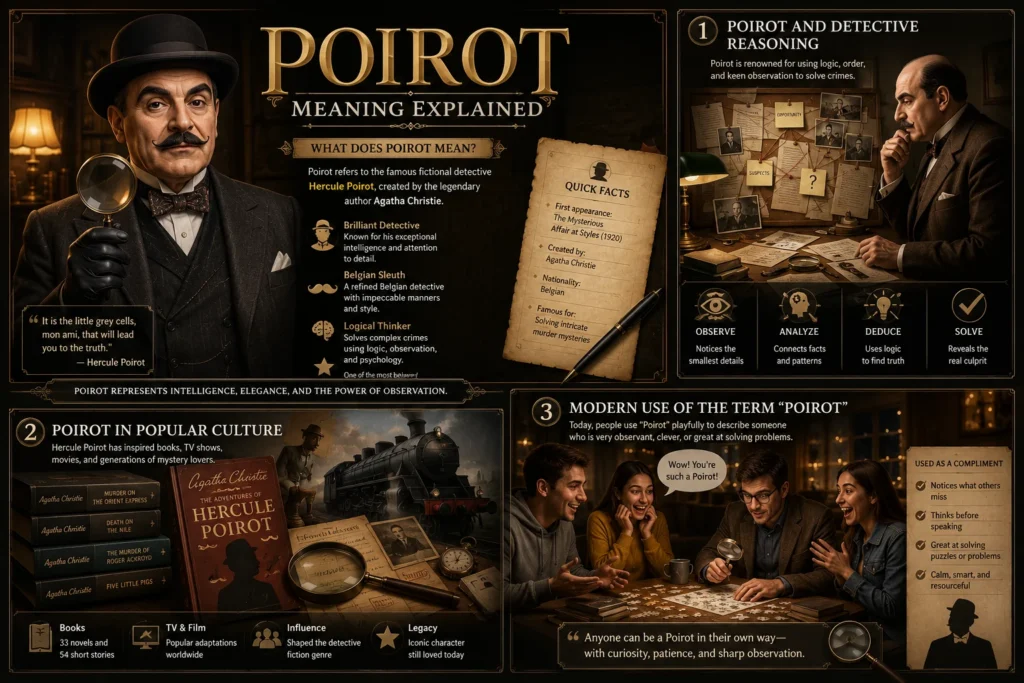
| Meaning of Poirot | Poirot usually refers to Hercule Poirot, the famous fictional Belgian detective created by Agatha Christie. |
| Category | Literary character and cultural reference |
| First Appearance | The Mysterious Affair at Styles (1920) |
| Known For | Solving mysteries through logic, observation, and psychology |
| Common Usage | Detective fiction, crime discussions, and references to highly observant people |
If you’ve searched for “Poirot meaning,” you’re probably wondering whether the word is a name, a character, a slang term, or something else entirely.
In most contexts, Poirot refers to Hercule Poirot, one of the most famous fictional detectives ever created. Agatha Christie introduced him in 1920, and he went on to become one of the most recognizable characters in mystery literature. He appears in dozens of novels and short stories and remains a major influence on detective fiction today. (Agatha Christie)
However, the meaning of “Poirot” extends beyond simply being a character’s name. Over time, people began using it as a cultural reference for someone who is exceptionally observant, analytical, or skilled at solving puzzles.
In this guide, you’ll learn:
- The exact meaning of Poirot
- The history behind the name
- Why the character became famous
- How people use the term today
- Real-life examples and conversations
- Platform-specific usage
- Common misunderstandings
- Frequently asked questions
Quick Answer Box
Meaning: Poirot refers to Hercule Poirot, a fictional Belgian detective created by Agatha Christie.
Context: Literature, television, movies, mystery fiction, and everyday conversations.
Usage: Used when discussing detective stories or describing someone who solves problems through observation and logic.
Platforms: Books, social media, Reddit, YouTube, X, Facebook, WhatsApp, and online mystery communities.
Example:
“You figured out the entire surprise party before anyone told you? You’re basically Poirot.”
Tone: Intelligent, complimentary, literary, and often humorous.
What Does It Mean?
The simplest definition of Poirot is:
Poirot is the surname of Hercule Poirot, a fictional Belgian detective known for solving crimes through logic, psychology, and careful observation.
The character became so famous that many people recognize the name even if they have never read an Agatha Christie novel.
Unlike many fictional detectives who rely heavily on physical evidence, Poirot often focuses on human behavior, motives, and what he famously calls his “little grey cells.” (Agatha Christie)
As a result, the name has evolved into a cultural shorthand for someone who notices details others miss.
Full Definition
The word Poirot functions primarily as a proper noun.
Dictionary-Style Definition
Poirot (noun)
- Hercule Poirot, the fictional Belgian detective created by Agatha Christie.
- Informally, a person who demonstrates exceptional deductive reasoning or investigative skill.
Literary Definition
In literature, Poirot represents the classic detective archetype:
- Intelligent
- Methodical
- Observant
- Detail-oriented
- Logical
- Patient
Cultural Definition
In modern conversation, calling someone “Poirot” often means:
- They solved a mystery.
- They noticed hidden clues.
- They figured something out before everyone else.
- They think like a detective.
Context & Usage
The meaning of Poirot changes slightly depending on context.
Literary Context
In books and literary discussions, Poirot refers specifically to Agatha Christie’s detective character.
Example:
“Poirot is one of the most influential detectives in mystery fiction.”
Entertainment Context
In movies and television, the term refers to adaptations featuring the detective.
Example:
“I watched a Poirot episode last night.”
Informal Conversation
People often compare observant friends to Poirot.
Example:
“You found the mistake immediately. You’re a real Poirot.”
Workplace Context
Employees sometimes use the term humorously.
Example:
“Sarah tracked down the software bug in five minutes. She’s the Poirot of our team.”
Educational Context
Teachers may use the name when students solve problems creatively.
Example:
“Nice detective work, Poirot.”
Real-Life Examples
Example 1: Solving a Mystery
A family notices missing cookies from the kitchen.
One child checks footprints, crumbs, and fingerprints.
The parent laughs and says:
“Look at little Poirot over here.”
Example 2: Office Investigation
A manager cannot determine why a report contains errors.
An employee identifies the source within minutes.
The team jokes:
“We found our office Poirot.”
Example 3: Sports Discussion
A fan predicts a team’s strategy before the game begins.
Friends respond:
“How did you know? You’re turning into Poirot.”
Example 4: Classroom Scenario
A student solves a complex puzzle.
The teacher remarks:
“Poirot would be proud.”
Example 5: Social Gathering
Someone discovers who planned a surprise party.
Friends immediately compare them to Poirot.
Real-Life Conversation Examples
Conversation Example 1
Alex: Who ate the last slice of pizza?
Ryan: Check the empty box in Jake’s room.
Alex: How did you know?
Ryan: I saw the sauce stain on his shirt.
Alex: Okay, Poirot.
Conversation Example 2
Emma: How did you figure out the ending?
Lily: The clues were there from the beginning.
Emma: You’re basically Poirot.
Conversation Example 3
Mark: The Wi-Fi stopped working.
Jason: Someone unplugged the router.
Mark: How did you find that so fast?
Jason: Detective instincts.
Mark: More like Poirot instincts.
Conversation Example 4
Teacher: Who solved the puzzle?
Student: I noticed the hidden pattern.
Teacher: Excellent work, Poirot.
Conversation Example 5
Friend 1: How did you know the surprise wasn’t real?
Friend 2: The story didn’t add up.
Friend 1: That’s such a Poirot answer.
Platform-Specific Meaning
On WhatsApp, people often use Poirot jokingly when someone uncovers hidden information.
Example:
“You found the group surprise already? Poirot strikes again.”
Facebook users may reference Poirot while discussing crime shows, books, or personal investigations.
Example:
“Feeling like Poirot after finding my lost keys.”
Reddit communities frequently mention Poirot in mystery-related discussions.
Example:
“If you like Sherlock Holmes, you’ll probably enjoy Poirot too.”
X (Twitter)
Users often compare themselves to Poirot when predicting outcomes.
Example:
“Called the plot twist in the first ten minutes. Poirot mode activated.”
YouTube
Many mystery channels reference Poirot while analyzing crimes or detective stories.
Example:
“Today’s video explores Poirot’s greatest cases.”
TikTok
TikTok creators sometimes use Poirot as a humorous label for investigative behavior.
Example:
“Me becoming Poirot after hearing one suspicious sentence.”
Alternative Meanings
Although most people mean the detective when they say “Poirot,” there are a few alternative uses.
Character Reference
This remains the primary meaning.
Detective Archetype
Some people use “Poirot” as a symbol of analytical thinking.
Academic References
Researchers occasionally use the name for projects, systems, or methodologies inspired by investigation and deduction.
Pop Culture References
The name appears in adaptations, discussions, memes, and fan communities.
However, the detective meaning remains overwhelmingly dominant.
Related Terms and NLP Variations
People searching for “Poirot meaning” often search for related terms.
Detective-Related Terms
- Detective
- Investigator
- Sleuth
- Crime solver
- Mystery expert
- Analyst
- Observer
Character Comparisons
- Sherlock Holmes
- Miss Marple
- Columbo
- Auguste Dupin
- Father Brown
Semantic Variations
- Hercule Poirot meaning
- Who is Poirot?
- Poirot definition
- Poirot character meaning
- Poirot detective
- Agatha Christie Poirot
- What does Poirot mean?
Synonyms by Context
When used metaphorically, Poirot can mean:
- Problem solver
- Investigator
- Analyst
- Detective-minded person
- Logical thinker
How to Respond or Reply When Someone Calls You Poirot
The best response depends on the tone.
Humorous Response
“I’ll take that as a compliment.”
Confident Response
“The clues were obvious.”
Playful Response
“My little grey cells never rest.”
Modest Response
“I just paid attention.”
Friendly Response
“Someone had to solve the mystery.”
Misinterpretations
Several misunderstandings surround the term.
Misinterpretation 1: Poirot Is a Real Detective
Many people assume Poirot was a historical investigator.
In reality, he is fictional. Agatha Christie created him for her mystery novels. (Agatha Christie)
Misinterpretation 2: Poirot Is an Acronym
It is not an acronym.
It is a surname used for a fictional character.
Misinterpretation 3: Poirot Means Police Officer
Although Poirot once worked in law enforcement within the stories, the word itself does not mean police officer. (Agatha Christie)
Misinterpretation 4: Poirot Equals Sherlock Holmes
Both are detectives, but their methods differ.
Holmes often emphasizes forensic observation.
Poirot frequently emphasizes psychology and human behavior.
Misinterpretation 5: Poirot Is Slang
The term is not traditional internet slang.
Instead, it is a literary and cultural reference.
When NOT to Use It
There are situations where using Poirot may confuse people.
Professional Reports
Avoid casual character references in formal documents.
International Audiences
Not everyone knows the character.
Technical Writing
Use precise terms like:
- Analyst
- Investigator
- Researcher
Instead of:
“He’s a Poirot.”
Serious Legal Discussions
Use professional language rather than fictional comparisons.
Usage Tips
Use It as a Compliment
Most people view comparisons to Poirot positively.
Know Your Audience
Mystery fans usually understand the reference immediately.
Use It Humorously
The name works best in lighthearted situations.
Connect It to Observation
The comparison makes sense when someone notices details others miss.
Avoid Overusing It
Not every problem solver qualifies as a Poirot.
The term works best when someone demonstrates genuine detective-like reasoning.
Why Poirot Became So Famous
Poirot’s popularity comes from several factors.
Unique Personality
He combines intelligence with confidence.
Memorable Appearance
His distinctive mustache became iconic. (Agatha Christie)
Consistent Logic
Readers enjoy following his reasoning process.
Long Literary History
The character appeared in dozens of stories across several decades. (Agatha Christie)
Successful Adaptations
Television and film adaptations introduced Poirot to new generations of fans. (Oxford Learner’s Dictionaries)
Poirot vs Other Famous Detectives
| Detective | Known For |
|---|---|
| Poirot | Psychology and deduction |
| Sherlock Holmes | Observation and forensic reasoning |
| Miss Marple | Understanding human nature |
| Columbo | Persistent questioning |
| Auguste Dupin | Analytical thinking |
Although each detective solves mysteries, Poirot stands out because of his emphasis on human behavior and motive.
FAQs
What does Poirot mean?
Poirot usually refers to Hercule Poirot, Agatha Christie’s famous fictional Belgian detective.
Is Poirot a real person?
No. Poirot is a fictional character created by Agatha Christie. (Agatha Christie)
Why is Poirot famous?
He became famous through bestselling mystery novels, short stories, television series, and films. (Agatha Christie)
What nationality is Poirot?
Poirot is Belgian. (Oxford Learner’s Dictionaries)
What does it mean when someone calls you Poirot?
It usually means they think you are observant, intelligent, or skilled at solving mysteries.
Is Poirot similar to Sherlock Holmes?
Yes, both are detectives. However, Poirot focuses more on psychology and human behavior.
What is Hercule Poirot’s first appearance?
He first appeared in The Mysterious Affair at Styles in 1920. (Agatha Christie)
Is Poirot still popular today?
Yes. Readers, viewers, and mystery fans continue to enjoy the character worldwide. (Agatha Christie)
Can Poirot be used as a compliment?
Absolutely. It often praises someone’s analytical or investigative abilities.
Is Poirot used as slang online?
Not usually. Instead, it functions as a cultural reference or nickname for a detective-minded person.
Conclusion
The meaning of Poirot goes far beyond a simple surname. At its core, the term refers to Hercule Poirot, Agatha Christie’s legendary Belgian detective who became one of the most influential figures in mystery fiction. (Agatha Christie)
Today, people use “Poirot” not only when discussing books, movies, and television but also as a compliment for someone who notices clues, solves problems, and uncovers hidden truths. Therefore, if someone calls you “Poirot,” they are usually recognizing your sharp observation skills, logical thinking, and ability to solve a mystery before everyone else.

Victoria Lane is a grammar-focused writer at GramBrix.com, passionate about helping readers master the rules of language. She provides clear explanations and practical examples that make writing more accurate, polished and confident.