
Last Updated on July 16, 2026
| Term | Meaning |
|---|---|
| Red Herring | Something that distracts attention from the main issue, fact, or argument. |
| Usage | Conversations, debates, mysteries, politics, business, and storytelling. |
| Tone | Neutral, analytical, or critical. |
| Example | “The missing wallet became a red herring because the real issue was identity theft.” |
Have you ever followed a clue that seemed important, only to discover it had nothing to do with the real issue? If so, you’ve encountered a classic red herring.
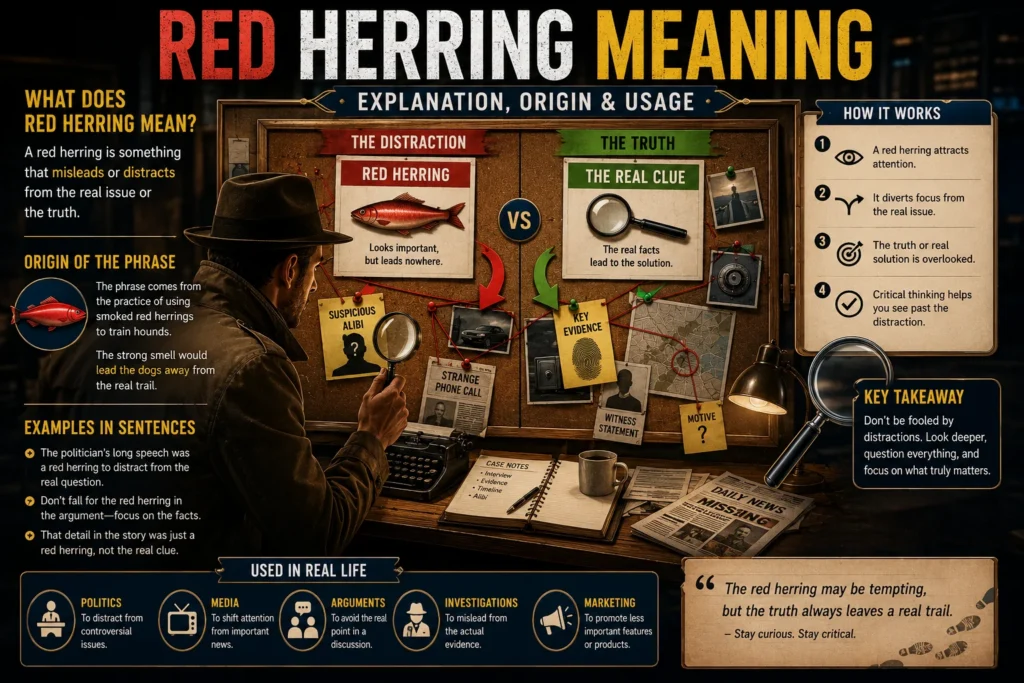
The phrase red herring meaning refers to something that misleads people or diverts attention away from the main point. Writers use red herrings in mystery novels. Politicians sometimes introduce them during debates. Likewise, people encounter them in everyday conversations, investigations, business discussions, and online arguments.
Understanding this expression helps you communicate more clearly and identify distractions before they derail your thinking. Moreover, knowing how red herrings work can improve critical thinking, problem-solving, and decision-making.
In this guide, you’ll learn the complete meaning of red herring, its origin, examples, common uses, misconceptions, related phrases, and practical applications.
Quick Answer Box
| Element | Explanation |
|---|---|
| Meaning | A misleading clue, argument, or piece of information that distracts from the main issue |
| Context | Debates, investigations, mysteries, discussions, media, politics |
| Usage | Used when attention shifts away from the actual topic |
| Common Platforms | Social media, news, business meetings, classrooms, courtrooms |
| Example | “His comment about sales numbers was a red herring during the budget discussion.” |
| Tone | Neutral, critical, analytical |
What Does It Mean?
A red herring is a distraction that pulls attention away from the real issue.
The distraction may be intentional or accidental. However, its effect remains the same. It causes people to focus on something irrelevant instead of addressing the actual problem.
For example:
“The argument about office decorations was a red herring because the real discussion concerned declining profits.”
In this case, office decorations had little connection to the financial issue. Therefore, they distracted everyone from the primary concern.
People often use the phrase when identifying flawed reasoning, misleading clues, or irrelevant information.
Full Definition
A red herring is:
- A misleading clue
- An irrelevant argument
- A distraction from the central issue
- A false lead
- Information that shifts focus away from the truth
The phrase appears in several contexts:
- Logical arguments
- Mystery stories
- Criminal investigations
- Political debates
- Marketing campaigns
- Business discussions
- Everyday conversations
Although the exact form varies, the core concept remains consistent: attention gets diverted from what truly matters.
Context & Usage
The phrase functions differently depending on the situation.
In Conversations
People use “red herring” when someone introduces an unrelated topic.
Example:
“We were discussing customer complaints, but the conversation about office parking became a red herring.”
Here, parking had no direct connection to customer satisfaction.
In Arguments
A red herring often appears as a logical fallacy.
Someone changes the subject instead of addressing the original point.
Example:
Person A: “We need to discuss employee turnover.”
Person B: “What about the company picnic last year?”
The picnic discussion distracts from the real topic.
In Investigations
Detectives frequently encounter misleading evidence.
Sometimes clues appear important but ultimately lead nowhere.
Therefore, investigators must separate genuine evidence from red herrings.
In Storytelling
Authors use red herrings to build suspense.
A mystery novel might point suspicion toward one character. However, the true culprit turns out to be someone else.
As a result, readers remain engaged until the final reveal.
Real-Life Examples
Understanding practical examples makes the phrase easier to recognize.
Conversation Example 1
Sarah: “Why are sales declining?”
Mark: “The office coffee machine needs replacing.”
Sarah: “That’s a red herring. Let’s focus on customer retention.”
Conversation Example 2
Teacher: “Why wasn’t the assignment completed?”
Student: “The classroom temperature was uncomfortable.”
Teacher: “That’s a red herring. Let’s discuss the actual reason.”
Conversation Example 3
Manager: “We exceeded our budget.”
Employee: “The company logo could use an update.”
Manager: “That’s unrelated and serves as a red herring.”
Conversation Example 4
Parent: “Why did you miss curfew?”
Teen: “Everyone else stayed out late.”
Parent: “That’s a red herring. We’re discussing your actions.”
Conversation Example 5
Friend: “Did you forget to send the invitation?”
Friend 2: “The weather forecast changed.”
Friend: “That’s a red herring. What happened to the invitation?”
Platform-Specific Meaning
Although “red herring” remains consistent, people use it differently across platforms.
Social Media
On social media, users often accuse others of introducing red herrings during debates.
For example, someone may change the subject when confronted with facts.
Consequently, commenters might reply:
“That’s a red herring. Answer the original question.”
YouTube
Creators discussing movies, mysteries, or crime stories frequently mention red herrings.
They analyze misleading clues and explain how they affect audience expectations.
Reddit discussions commonly identify logical fallacies.
Users often point out when comments distract from the main topic.
Example:
“Your example is a red herring because it doesn’t address the original argument.”
News Media
Journalists and analysts sometimes describe political statements as red herrings.
The term appears when officials divert attention from important issues.
Business Communication
Business professionals use the phrase during meetings.
It helps teams stay focused on priorities.
Example:
“The discussion about paint colors became a red herring during strategic planning.”
Alternative Meanings
While the primary meaning remains dominant, the phrase can appear in several related ways.
Literary Meaning
In literature, a red herring refers to a false clue.
Authors intentionally place these clues to misdirect readers.
Legal Context
Attorneys may identify irrelevant evidence or arguments as red herrings.
This helps courts focus on material facts.
Debate Context
Debaters use the term to describe irrelevant points designed to shift attention.
Psychological Context
People sometimes create red herrings unconsciously.
They may avoid uncomfortable topics by discussing unrelated matters.
Related Terms / NLP Variations
Many related phrases share similar meanings.
False Lead
A clue that appears useful but ultimately proves incorrect.
Distraction
Anything that shifts attention away from the primary issue.
Misdirection
A deliberate effort to guide attention elsewhere.
Diversion
An alternative focus that interrupts the main discussion.
Smoke Screen
Information intended to conceal the truth.
Decoy
Something designed to attract attention away from a target.
Logical Fallacy
A flaw in reasoning that weakens an argument.
Irrelevant Point
Information unrelated to the issue under discussion.
How to Respond / Reply
Recognizing a red herring helps you respond effectively.
Stay Focused
Politely return to the original topic.
Example:
“That’s interesting, but let’s address the main issue first.”
Ask Clarifying Questions
Questions often expose distractions.
Example:
“How does that relate to the point we’re discussing?”
Redirect the Discussion
Guide the conversation back.
Example:
“Let’s return to the budget concerns.”
Identify the Diversion
When appropriate, mention the red herring directly.
Example:
“That seems unrelated to our current discussion.”
Request Evidence
Evidence often reveals whether information matters.
Example:
“Can you explain how that supports your argument?”
Misinterpretations
Many people misunderstand the phrase.
Mistake 1: Any Mistake Is a Red Herring
Not every incorrect statement qualifies.
A red herring specifically distracts from the main issue.
Mistake 2: Every Side Topic Is a Red Herring
Some side topics provide useful context.
A true red herring lacks meaningful relevance.
Mistake 3: Red Herrings Must Be Intentional
This isn’t true.
People can introduce distractions accidentally.
Mistake 4: Red Herrings Equal Lies
A red herring may involve accurate information.
The issue is relevance, not truthfulness.
Mistake 5: Only Mystery Stories Use Red Herrings
The phrase appears in everyday communication, business, politics, education, and law.
When NOT to Use It
Using the phrase incorrectly can create confusion.
Avoid It When Information Is Relevant
A related point isn’t necessarily a red herring.
Avoid It Without Understanding Context
Sometimes information appears unrelated but later proves important.
Avoid Overusing It
Constantly labeling arguments as red herrings may weaken productive discussion.
Avoid Dismissing Helpful Evidence
Carefully evaluate information before rejecting it.
Avoid Using It as a Debate Shortcut
Instead, explain why the information lacks relevance.
Usage Tips
To use the phrase naturally, follow these guidelines.
Understand the Main Issue First
You must identify the central topic before recognizing a distraction.
Look for Relevance
Ask whether the information directly supports the discussion.
Consider Intent
Although intent isn’t required, understanding motives can provide insight.
Evaluate Evidence
Evidence helps determine whether information matters.
Use the Phrase Precisely
Avoid applying it to every disagreement.
Practice Critical Thinking
Critical thinking helps distinguish meaningful information from distractions.
Learn Common Patterns
Red herrings frequently appear during:
- Political debates
- Online arguments
- Mystery plots
- Business meetings
- Legal proceedings
- Media discussions
Why Writers Love Red Herrings
Writers frequently use red herrings because they increase suspense.
Building Mystery
Readers enjoy solving puzzles.
Therefore, authors provide misleading clues to create uncertainty.
Creating Surprise
A strong red herring makes the final reveal more satisfying.
Increasing Engagement
Readers remain invested while trying to determine the truth.
Strengthening Plot Structure
Well-designed red herrings make stories feel more complex.
Enhancing Character Development
Suspicious behavior can serve as a red herring while revealing character traits.
Red Herring vs Similar Terms
| Term | Meaning | Difference |
|---|---|---|
| Red Herring | Distraction from the issue | Focuses attention elsewhere |
| False Lead | Incorrect clue | Usually found in investigations |
| Decoy | Deliberate distraction | Often intentional |
| Smoke Screen | Conceals truth | Hides information |
| Diversion | Shift in attention | Broader than red herring |
| Misdirection | Manipulates focus | Often strategic |
Common Red Herring Examples in Daily Life
People encounter red herrings more often than they realize.
Workplace Meetings
A discussion about company profits suddenly shifts to office furniture.
Political Debates
A candidate changes topics instead of answering a question.
Family Discussions
Someone redirects attention from responsibility.
Online Arguments
Participants focus on unrelated details.
Classroom Conversations
Students change the subject to avoid difficult questions.
FAQs
What is the simple meaning of red herring?
A red herring is something that distracts attention from the main issue or truth.
Why is it called a red herring?
The phrase originated from practices involving strongly scented smoked fish that could divert attention from a trail.
Is a red herring a logical fallacy?
Yes. In argumentation, a red herring is a recognized logical fallacy.
Can a red herring be true?
Yes. The information may be accurate but still irrelevant.
Is a red herring always intentional?
No. People may introduce distractions accidentally.
How do writers use red herrings?
Authors use misleading clues to create suspense and surprise.
What is a red herring in a mystery story?
It is a clue that appears important but leads readers away from the real solution.
What is the opposite of a red herring?
Relevant evidence or information that directly supports the issue being discussed.
How do I identify a red herring?
Ask whether the information relates directly to the original topic.
Is calling something a red herring rude?
Not necessarily. However, tone matters. Polite explanations usually work best.
Conclusion
The red herring meaning centers on distraction. A red herring shifts attention away from the main issue, whether in conversations, debates, investigations, business meetings, or fictional stories. Although the information may seem important, it ultimately leads people away from what truly matters.
Moreover, recognizing red herrings strengthens critical thinking and communication skills. It helps you stay focused, evaluate relevance, and avoid misleading conclusions. Whether you’re reading a mystery novel, watching a political debate, participating in a meeting, or analyzing an online discussion, understanding this concept allows you to separate genuine evidence from distracting noise.

Kevin Brooks is a grammar specialist at GramBrix.com, dedicated to helping readers understand language rules with clarity and confidence. He simplifies complex grammar concepts through practical examples and easy explanations.