
Last Updated on July 15, 2026
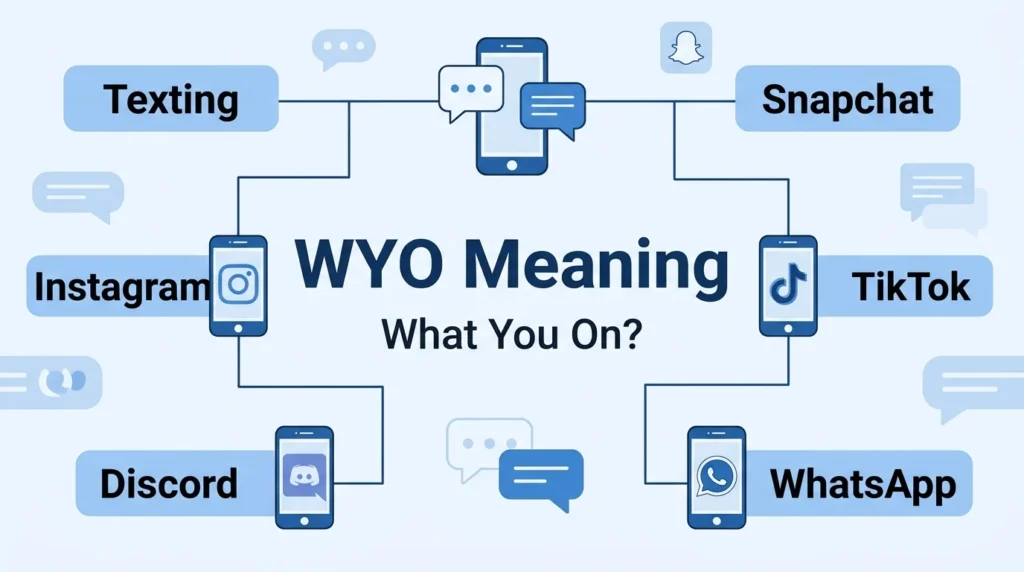
WYO stands for “What You On?” It is a popular internet slang phrase used in texting and on social media to ask what someone is doing, what their plans are, or whether they are available to chat or hang out. The tone is casual, friendly, and commonly used among friends.
If you’ve received a message saying “WYO?”, you’re probably wondering what it means and how you’re supposed to reply. Like many internet abbreviations, WYO has become a common part of online conversations, especially among younger users on platforms like Snapchat, TikTok, Instagram, and text messaging.
Although it looks like a simple three-letter acronym, WYO can have slightly different meanings depending on the conversation. In most situations, it’s a casual way of checking in with someone, asking what they’re currently doing, or seeing if they’re free to talk or meet up.
Understanding the context behind WYO helps you respond naturally and avoid misunderstandings. Whether you’re chatting with close friends, getting to know someone, or simply trying to keep a conversation going, knowing how and when to use this slang makes online communication much easier.
In this guide, you’ll learn:
- The exact meaning of WYO
- What the abbreviation stands for
- How people use it in everyday conversations
- Different contexts where it appears
- Whether it’s friendly, flirty, or casual
- Examples that show its real meaning
Quick Answer Box
| Topic | Answer |
|---|---|
| Meaning | What You On? |
| Definition | Asking what someone is doing or what their plans are |
| Common Context | Casual texting and social media conversations |
| Popular Platforms | Snapchat, Instagram, TikTok, WhatsApp, Messenger, iMessage |
| Tone | Friendly, casual, sometimes flirty depending on context |
| Example | “WYO tonight?” = “What are you doing tonight?” |
What Does WYO Mean?
WYO most commonly means “What You On?”
In everyday internet slang, this phrase is another way of asking:
- What are you doing?
- What’s going on?
- What are your plans?
- Are you busy?
- Are you free right now?
- What are you up to?
Rather than typing a full sentence, people shorten the question to WYO because it’s faster and feels more natural in casual online conversations.
For example:
Friend: WYO?
You: Just watching Netflix.
Here, the sender simply wants to know what you’re doing at that moment.
Another example:
Alex: WYO after work?
Jamie: Nothing planned. Why?
In this conversation, WYO is asking about someone’s availability rather than their exact activity.
Why People Use WYO
Internet slang is designed to make conversations quicker and more relaxed. Instead of writing:
- “What are you doing right now?”
- “Do you have plans?”
- “Are you free?”
people simply type:
WYO?
The abbreviation saves time while keeping the conversation informal and friendly. It’s especially common in fast-moving chats where short messages are the norm.
Is WYO an Acronym or Slang?
Technically, WYO is an internet abbreviation, but most people treat it as texting slang rather than a formal acronym.
Unlike business abbreviations or professional shorthand, WYO is almost exclusively used in casual digital communication.
You’ll commonly see it in:
- Personal text messages
- Snapchat chats
- Instagram DMs
- TikTok comments
- Discord conversations
- Online gaming chats
- Group messages
It is generally not appropriate for professional emails or workplace communication.
Full Definition of WYO
At its core, WYO is a conversational opener that invites someone to share what they’re doing or whether they’re available. Instead of being a literal question every time, it often serves as a friendly way to start a conversation.
Think of it as the digital equivalent of saying:
- “Hey, what’s up?”
- “What are you doing?”
- “Got any plans?”
- “You free?”
- “How’s it going?”
Because it’s flexible, the exact meaning depends on the situation.
WYO as a Check-In
Many people send WYO simply to check in with a friend.
Example:
Taylor: WYO?
Jordan: Just got home from class.
The sender isn’t asking anything complicated—they’re simply starting a conversation.
WYO as an Invitation
Sometimes WYO is actually the beginning of an invitation.
Example:
Chris: WYO tonight?
Morgan: Nothing much.
Chris: Want to grab dinner?
In this case, the question helps determine whether the other person is available before suggesting plans.
WYO as a Conversation Starter
People also use WYO when they don’t have a specific topic in mind but want to keep in touch.
For example:
Sam: WYO?
Alex: Just scrolling TikTok. You?
The message serves as a casual icebreaker that keeps the conversation flowing.
WYO Can Be Flirty
Depending on who’s sending it, WYO may have a slightly flirty tone.
Imagine someone you’ve been talking to sends:
WYO later?
They might simply be asking about your evening, or they may be looking for an opportunity to spend time together.
The meaning comes from the relationship between the people involved rather than the abbreviation itself.
WYO Doesn’t Always Mean Right Now
Although WYO often refers to the present moment, it can also ask about future plans.
For example:
- WYO this weekend?
- WYO after school?
- WYO tomorrow?
- WYO tonight?
In each case, the sender is asking about availability during a specific time rather than what you’re doing at that exact moment.
Common Situations Where WYO Is Used
People frequently use WYO in everyday situations such as:
- Checking whether a friend is free
- Starting a casual conversation
- Making weekend plans
- Asking someone to join a group activity
- Seeing if someone wants to play online games
- Beginning a late-night chat
- Catching up after not talking for a while
- Flirting with someone they’re interested in
Because it’s so versatile, WYO fits naturally into many different conversations without sounding formal or awkward.
Is WYO Friendly or Rude?
In most cases, WYO is friendly and informal. It isn’t considered rude when used with friends, classmates, siblings, or people you already know.
However, because it’s very casual, it may come across as overly informal in professional settings. Sending “WYO?” to your boss, teacher, or a client is generally inappropriate. A more suitable alternative would be:
- “What are you working on today?”
- “Are you available to talk?”
- “Do you have a moment?”
Knowing your audience is important. While WYO feels perfectly natural among friends, it should be avoided in formal communication.
Why WYO Became Popular
The rise of instant messaging and social media encouraged people to communicate with shorter, quicker phrases. Apps like Snapchat and Instagram made brief messages the norm, and abbreviations like LOL, BRB, IDK, IMO, and WYO became part of everyday online language.
Today, WYO is recognized by millions of users as a quick way to ask what someone is doing without typing a full sentence.
Its popularity comes from three simple advantages:
- It’s fast. Three letters replace an entire question.
- It’s casual. The tone feels relaxed and conversational.
- It’s flexible. It works for checking in, making plans, or simply starting a chat.
Whether someone sends “WYO?” in the afternoon, late at night, or before making weekend plans, the abbreviation keeps conversations short while still expressing genuine interest in what the other person is up to.
Context & Usage
The meaning of WYO can change slightly depending on the conversation, but it almost always revolves around asking what someone is doing or whether they’re available. The phrase is intentionally open-ended, making it one of the most flexible abbreviations used in texting and social media.
Unlike some internet slang that has only one fixed meaning, WYO relies heavily on context. The relationship between the people talking, the platform they’re using, and even the time of day can influence how the message is interpreted.
WYO as a Casual Check-In
The most common use of WYO is simply checking in with someone.
Instead of asking, “What are you doing right now?” people shorten it to WYO?
For example:
WYO? Haven’t talked to you all day.
The sender isn’t necessarily looking for a detailed answer—they’re just starting a conversation and showing interest in what you’re doing.
WYO When Making Plans
Many people use WYO before inviting someone somewhere.
Rather than immediately asking, “Do you want to hang out?”, they’ll first see whether you’re free.
Examples include:
- WYO after work?
- WYO tonight?
- WYO this weekend?
- WYO later?
These messages naturally lead into making plans if the other person isn’t busy.
WYO in Friendly Conversations
Friends often send WYO without expecting anything important in return. It’s simply another version of:
- What’s up?
- How’s it going?
- What are you up to?
Example:
Friend: WYO?
You: Just playing video games.
The conversation can continue from there without any pressure.
WYO in Romantic Conversations
When sent by someone you’re dating or interested in, WYO may carry a more personal or flirty tone.
For instance:
WYO tonight? 😊
This could simply be asking about your evening, but it might also be an indirect way of seeing whether you’d like to spend time together.
The emoji, previous conversation, and relationship usually make the intention clear.
WYO in Group Chats
In group messages, WYO often means:
- Is anyone doing anything?
- Who’s free?
- Anyone want to hang out?
Example:
Chris: WYO everyone?
Liam: Watching the game.
Emma: Just finished work.
Sophia: I’m free if you guys want to meet.
WYO During Late-Night Chats
Late-night messages often use WYO as a conversation starter.
Example:
WYO? Can’t sleep lol.
Here, the sender isn’t necessarily asking about plans—they’re simply looking for someone to talk to.
Tone of WYO
The tone depends almost entirely on the situation.
It can be:
- Friendly
- Curious
- Casual
- Relaxed
- Flirty
- Social
It’s rarely aggressive or negative. Most of the time, it’s simply an invitation to continue a conversation.
Real-Life Conversation Examples
The easiest way to understand WYO is to see how people naturally use it in everyday conversations.
Conversation Example 1: Friends Catching Up
Alex: WYO?
Jordan: Just finished the gym.
Alex: Nice! Wanna grab food?
Jordan: Sure, sounds good.
Meaning: Alex is checking whether Jordan is available before suggesting plans.
Conversation Example 2: Making Weekend Plans
Emma: WYO this weekend?
Noah: Nothing planned yet.
Emma: A few of us are going hiking.
Noah: Count me in.
Meaning: WYO is being used to ask about future availability.
Conversation Example 3: Casual Texting
Mia: WYO?
Ava: Watching Netflix lol.
Mia: Same 😂
Meaning: A simple conversation starter between friends.
Conversation Example 4: Flirty Conversation
Ryan: Hey 😊 WYO later?
Olivia: Probably just relaxing.
Ryan: Want to get coffee?
Olivia: I’d like that.
Meaning: WYO acts as an indirect way to ask someone out.
Conversation Example 5: Gaming Friends
Jake: WYO tonight?
Lucas: Nothing.
Jake: Hop on Fortnite.
Lucas: Give me 10 minutes.
Meaning: The sender is checking if their friend is free to play.
Platform-Specific Meaning
Although WYO has the same core definition across most digital platforms, the way people use it varies slightly depending on where the conversation takes place.
Snapchat
Snapchat is one of the most common places you’ll see WYO.
People often send it as a quick snap or chat message to ask:
- What are you doing?
- Are you free?
- Want to keep our Snap streak going?
- Want to hang out?
Because Snapchat conversations are usually short and informal, WYO fits naturally into the platform’s communication style.
Example:
WYO rn?
(“rn” means right now.)
On Instagram, WYO commonly appears in Direct Messages (DMs).
Someone might send:
WYO today?
or
WYO after work?
Here, the goal is usually to start a conversation or make plans.
Influencers and creators may also use WYO in Stories to encourage followers to respond or interact.
TikTok
TikTok users often include WYO in comments, captions, or direct messages.
Examples include:
- WYO after seeing this?
- WYO tonight?
- WYO bro?
In comments, it’s often used humorously or to invite discussion.
On WhatsApp, WYO is mostly used between friends and family members.
Example:
WYO?
Just got home.
Because WhatsApp supports longer conversations, WYO usually serves as an opening message before discussing other topics.
iMessage and SMS Texting
Traditional texting remains one of the biggest places where WYO is used.
Rather than typing:
What are you doing right now?
people simply send:
WYO?
It’s fast, informal, and widely understood among younger generations.
Discord
Discord users often send WYO before starting voice chats or online gaming sessions.
Examples:
- WYO tonight?
- WYO? Join VC.
- WYO? Let’s queue.
In gaming communities, it often means:
“Are you available to play?”
Facebook Messenger
Although Messenger conversations tend to be slightly longer than Snapchat chats, WYO is still common.
Friends use it as a relaxed conversation starter before discussing plans or catching up.
Alternative Meanings of WYO
While “What You On?” is by far the most common definition, WYO can occasionally have different meanings depending on the context. These alternative uses are much less frequent but are worth knowing to avoid confusion.
1. What You’re On
Some people interpret WYO as “What You’re On?”
Rather than asking what someone is doing, this version asks what someone is interested in or involved with.
Example:
WYO these days?
Meaning:
What have you been doing lately?
2. Where You At? (Occasional Misuse)
Some users mistakenly use WYO when they actually mean “Where You At?”
However, this isn’t the standard meaning.
If someone wants to know your location, they usually write:
- WYA
- WYA?
- Where you at?
So if you see WYO, don’t automatically assume they’re asking where you are.
3. What’s Your Opinion?
In certain online discussions or forums, WYO may occasionally stand for “What’s Your Opinion?”
Example:
WYO on the new movie?
Although understandable, this usage is relatively uncommon compared to What You On?
4. Regional or Personal Variations
Like many slang terms, WYO can develop slightly different meanings within friend groups or local communities.
Some people use it interchangeably with:
- What’s up?
- What’s happening?
- What are you into?
- What’s going on?
Even with these slight variations, the overall purpose remains the same: starting a conversation and checking in with someone.
Which Meaning Is Most Common?
If you receive WYO in a text message, Snapchat, Instagram DM, or TikTok chat, there’s a very high chance it means “What You On?”
Unless the surrounding conversation clearly suggests otherwise, this is the meaning you should assume. Understanding the context—such as who sent the message, the platform, and the topic being discussed—will help you interpret it correctly and respond naturally.
Related Terms and Similar Slang
If you’re familiar with WYO, you’ll probably come across other texting abbreviations that have similar meanings. While each has its own nuance, they’re all commonly used to start conversations or ask what someone is doing.
WYA (Where You At?)
Meaning: Asking for someone’s location.
Example:
Alex: WYA?
Jordan: I’m at the mall.
Difference from WYO: WYA asks where someone is, while WYO asks what they’re doing.
WYD (What You Doing?)
Meaning: Asking what someone is currently doing.
Example:
Emma: WYD?
Noah: Studying for my exam.
Difference from WYO: WYD focuses on a person’s current activity, whereas WYO can also refer to future plans or availability.
WSG (What’s Good?)
Meaning: A casual greeting similar to “What’s up?”
Example:
Chris: WSG?
Ryan: Not much, just relaxing.
SUP / WSUP
A shortened version of “What’s up?”
This is one of the oldest texting greetings and is still widely used today.
HBU (How About You?)
Often follows a response.
Example:
Sam: Just got home. HBU?
It keeps the conversation going after answering a question.
HMU (Hit Me Up)
Means contact me, message me, or let me know.
Example:
HMU if you’re free tonight.
WYLL (What You Look Like?)
A newer piece of Gen Z slang commonly used after meeting someone online.
Unlike WYO, it’s specifically asking about appearance.
What’s Up?
Although not an abbreviation, this is probably the closest traditional phrase to WYO.
Both are informal conversation starters used between friends.
How to Respond to WYO
Since WYO simply asks what you’re doing or whether you’re available, there isn’t one “correct” reply. Your response depends on your situation and the type of conversation you want to have.
If You’re Busy
You can answer honestly while keeping the conversation friendly.
Examples:
- Working right now.
- Studying for finals.
- At the gym.
- Running errands.
- Busy at the moment.
If You’re Free
If you’re available, let the other person know.
Examples:
- Nothing much.
- Just relaxing.
- Watching TV.
- Chilling at home.
- Not doing anything.
If You Want to Continue the Conversation
After answering, ask the question back.
Examples:
Just got home. You?
Watching Netflix. WBU?
Nothing much. WYO?
This keeps the conversation flowing naturally.
If You Think They’re Making Plans
Sometimes WYO is simply the beginning of an invitation.
Example:
Them: WYO tonight?
You:
Nothing planned. What’s up?
or
I’m free. What’s the plan?
If You’re Not Interested
You can politely decline without sounding rude.
Examples:
- Just taking it easy tonight.
- Busy today, maybe another time.
- Can’t today, but thanks for asking.
- Maybe later.
Common Misinterpretations
Although WYO is straightforward once you know it, newcomers often misunderstand it.
Mistaking It for WYA
One of the most common mistakes is confusing WYO with WYA.
- WYO = What You On?
- WYA = Where You At?
The first asks about your activity or plans.
The second asks for your location.
Thinking It’s a Formal Acronym
Some people assume WYO has a technical or business meaning because it’s written in capital letters.
In reality, it’s simply casual internet slang.
Assuming It’s Always Flirty
Because WYO is often used between couples or people who like each other, some assume it’s always romantic.
That’s not true.
Friends, classmates, coworkers (informally), siblings, and gaming partners all use WYO in completely non-romantic ways.
Overthinking the Message
Receiving “WYO?” usually doesn’t have a hidden meaning.
Most of the time, the sender is simply asking:
- What are you doing?
- Are you free?
- Want to talk?
There’s usually no deeper message behind it.
When Not to Use WYO
Although WYO is extremely common online, it isn’t appropriate in every situation.
Professional Emails
Avoid using WYO in workplace communication.
Instead of writing:
WYO this afternoon?
Write:
Are you available this afternoon?
or
What are you working on today?
Business Messages
Clients and customers may not recognize internet slang.
Use complete sentences instead.
Academic Writing
School assignments, reports, and research papers should avoid texting abbreviations.
Always write formally.
Formal Introductions
When contacting someone for the first time, WYO can seem overly casual.
A better opening might be:
- Hello, how are you?
- Hope you’re doing well.
- Are you available to chat?
Older Audiences
Not everyone is familiar with texting slang.
If you’re unsure whether someone understands abbreviations, writing the full question avoids confusion.
Usage Tips
Using WYO naturally is easy once you understand the context. These simple tips will help you communicate more effectively.
Know Your Audience
Use WYO with:
- Friends
- Family members
- Classmates
- Gaming friends
- People you regularly text
Avoid using it in professional or formal settings.
Keep the Tone Casual
WYO is meant to sound relaxed.
There’s no need to overcomplicate your message.
Examples:
- WYO?
- WYO later?
- WYO tonight?
These all sound natural.
Add Context When Necessary
Instead of sending only:
WYO?
You can be more specific.
Examples:
- WYO after work?
- WYO this weekend?
- WYO tonight?
- WYO after class?
This makes your question clearer.
Don’t Overuse Slang
Using too many abbreviations in one message can make it difficult to read.
Instead of:
WYO rn lol idk wyd fr
Write:
WYO right now? Want to hang out later?
A balance between slang and complete words makes conversations more natural.
Match the Other Person’s Style
If the other person writes casually, WYO fits perfectly.
If they usually write full sentences, consider doing the same.
Adapting your communication style often leads to smoother conversations.
FAQs
What does WYO mean in texting?
In texting, WYO usually means “What You On?” It’s a casual way of asking what someone is doing or whether they’re free.
What does WYO mean on Snapchat?
On Snapchat, WYO typically asks what someone is doing, whether they’re available to chat, or if they want to hang out.
Is WYO the same as WYD?
No. WYD means “What You Doing?”, while WYO has a broader meaning that can include current activities, future plans, or availability.
Is WYO flirting?
Not necessarily. WYO is commonly used between friends, but it can sound flirty if sent by someone you’re romantically interested in.
How should I reply to WYO?
Reply honestly based on what you’re doing.
Examples include:
- Just relaxing.
- Working right now.
- Nothing much.
- Watching a movie.
Is WYO rude?
No. WYO is generally considered friendly and informal. It only becomes inappropriate in professional or formal situations.
Can WYO mean something else?
Occasionally, people may use WYO to mean “What’s Your Opinion?” or “What You’re On?”, but these meanings are much less common than “What You On?”
Is WYO used by Gen Z?
Yes. WYO is especially popular among Gen Z and younger Millennials on social media and messaging apps, although people of many ages use it in casual online conversations.
Should I use WYO at work?
Generally, no. It’s better to use complete, professional language when communicating with colleagues, managers, or clients.
Why is WYO so popular?
WYO is short, easy to type, and works in many situations. It lets people start conversations, check someone’s availability, or make plans without writing a full sentence.
Conclusion
WYO is one of the most common abbreviations used in modern texting and social media. In most conversations, it stands for “What You On?” and serves as a quick, friendly way to ask what someone is doing, whether they’re available, or if they’d like to chat or make plans.
Its popularity comes from its simplicity and flexibility. Whether you’re messaging on Snapchat, Instagram, TikTok, WhatsApp, Discord, or through regular text messages, WYO helps start conversations in a relaxed and natural way. While it can occasionally have alternative meanings depending on the context, “What You On?” is by far the interpretation you’ll encounter most often.
By understanding the context, recognizing related slang like WYD and WYA, and knowing when it’s appropriate to use informal language, you’ll be able to respond confidently and communicate more naturally in today’s digital conversations.

Victoria Lane is a grammar-focused writer at GramBrix.com, passionate about helping readers master the rules of language. She provides clear explanations and practical examples that make writing more accurate, polished and confident.