
Last Updated on July 11, 2026
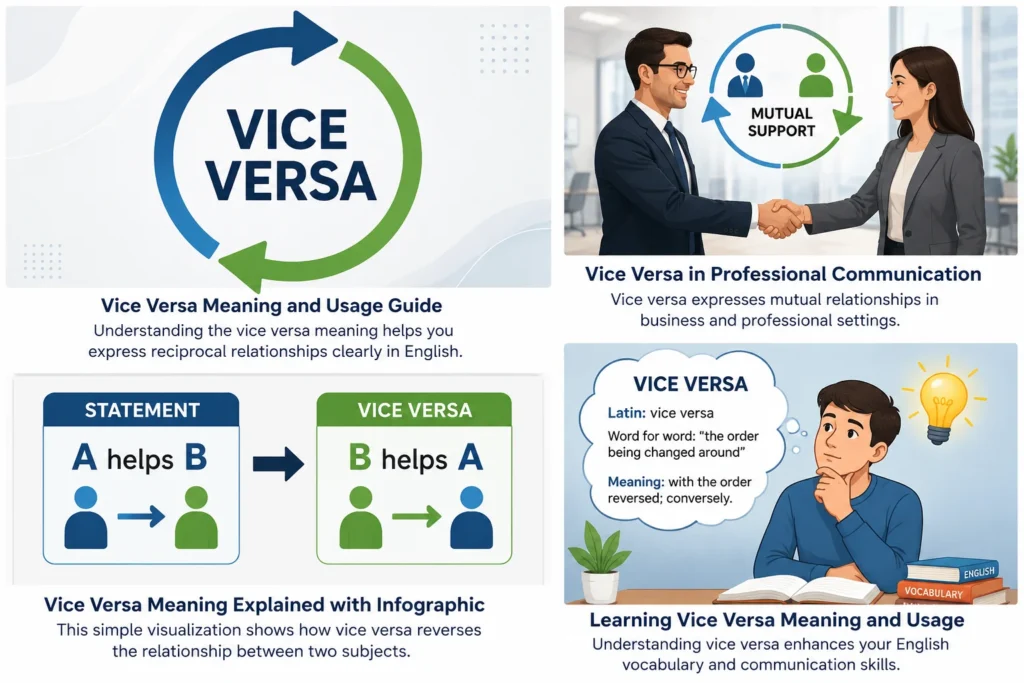
Vice versa is a Latin phrase meaning “the other way around” or “in reverse order.” You use it to indicate that the opposite of a statement you just made is also true. For example, if you say “I trust my manager, and vice versa,” you mean your manager also trusts you. The phrase works in professional, casual, and academic contexts.
Have you ever heard someone say “vice versa” and wondered exactly what they meant? Perhaps you have used it yourself but felt uncertain about whether you were using it correctly. This common phrase appears everywhere, from everyday conversations to business emails and academic writing, yet many people remain unclear about its precise meaning and proper usage.
This comprehensive guide explains everything you need to know about the vice versa meaning. You will learn its definition, correct usage, real-life examples, and common mistakes to avoid. Whether you are a native English speaker or learning English as a second language, this article will help you use “vice versa” with confidence.
Quick Answer Box
| Aspect | Details |
|---|---|
| Meaning | “The other way around” or “in reverse order” |
| Context | Used when the opposite of a statement is also true |
| Usage | Indicates a mutual or reciprocal relationship |
| Platforms | Professional writing, casual conversation, academic work, emails |
| Example | “She helps him with his work, and vice versa.” (He also helps her.) |
| Tone | Neutral, formal or casual depending on context |
What Does Vice Versa Mean?
The vice versa meaning is straightforward once you understand it. Vice versa indicates that the reverse of what you have just said is also true. When you use this phrase, you are essentially saying, “and the opposite is also true” .
For instance, if you say, “People can perform some tasks better than machines can and vice versa,” you mean that machines can perform some tasks better than people can as well . The phrase creates a balanced relationship between two subjects or ideas.
The term originates from Latin, where it literally means “the other way round” or “the position being reversed . It combines “vice,” meaning “change” or “alternation,” with “versa,” meaning “turned . Although it comes from an ancient language, the phrase has become thoroughly naturalized in modern English.
Full Definition
According to major dictionaries, vice versa functions as an adverb. The Oxford Learner’s Dictionary defines it as “used to say that the opposite of what you have just said is also true” . The Britannica Dictionary similarly states it means “used to say that the opposite of a statement is also true .
The Collins Dictionary provides a helpful example: “‘people can perform some tasks better than machines can and vice versa’ means that machines can perform some tasks better than people can” . This highlights how the phrase reverses the relationship between two elements in a statement.
Key Characteristics
The phrase has three distinctive features. First, it always appears after a statement that establishes a relationship between two things. Second, it reverses the order or direction of that relationship. Third, it maintains the same meaning while flipping the subjects.
For example, when you say “The teacher learns from the students and vice versa,” the phrase indicates that the students also learn from the teacher. The relationship of learning flows in both directions.
Context and Usage
Understanding the vice versa meaning also requires knowing when and how to use it correctly. The phrase appears across various contexts, including professional settings, casual conversations, and academic writing.
Professional and Formal Contexts
In business and professional communication, “vice versa” helps express mutual relationships concisely. Rather than saying, “I can help him, and he can help me too,” you can simply say, “I can help him and vice versa.” This makes your writing more efficient and polished.
For example, in a workplace email, you might write, “Our team supports the marketing department and vice versa.” This clearly communicates that both teams support each other.
Casual and Everyday Usage
In everyday conversation, the phrase appears frequently. You might say, “My neighbor looks after my cat when I’m away, and vice versa.” This indicates that you also look after your neighbor’s cat.
The phrase works equally well in formal writing and informal chats. Its versatility makes it a valuable addition to your vocabulary.
Written Communication
In written communication, “vice versa” often appears in legal documents, academic papers, and professional reports. It helps writers avoid repetition while maintaining clarity.
Pronunciation
If you are wondering how to pronounce vice versa correctly, both American and British English offer acceptable variations. American English typically pronounces it as “VYE-suh VER-suh” . British English often uses “VYE-see VER-suh” . Both pronunciations are widely accepted and understood.
Real-Life Examples
Conversation Example 1: Workplace Setting
Manager: “I value your input on our projects.”
Employee: “And I value yours and vice versa. We make a good team.”
Manager: “Absolutely. When we work together, the results are always better.”
Conversation Example 2: Friends Making Plans
Friend A: “You can stay at my place when you visit New York.”
Friend B: “Thanks! You can stay at mine when you come to Chicago and vice versa.”
Friend A: “Deal. It will save us both money on hotels.”
Conversation Example 3: Family Dynamics
Mother: “My daughter teaches me about technology.”
Daughter: “And Mom teaches me about cooking and vice versa.”
Mother: “We both benefit from learning from each other.”
Conversation Example 4: Romantic Relationship
Partner A: “I support your career goals.”
Partner B: “And I support yours and vice versa. We are in this together.”
Partner A: “That is what makes our relationship work.”
Conversation Example 5: Academic Setting
Student: “I learn from my professor.”
Professor: “And I learn from my students and vice versa.”
Student: “That is a great way to think about the teacher-student relationship.”
Platform-Specific Meaning
Business and Corporate Communication
In business contexts, “vice versa” expresses reciprocal relationships between colleagues, departments, or companies. A business proposal might state, “Our company provides software solutions to clients, and vice versa, as we also rely on client feedback to improve our products.”
Social Media
On social media platforms, the phrase appears frequently in comments and posts. A Twitter user might write, “I follow interesting people and vice versa.” An Instagram caption could read, “Support small businesses and vice versa.”
Text Messaging and Chat Apps
In text messages, “vice versa” often gets abbreviated as “VV” in very informal contexts, though the full phrase remains more common. A typical message might say, “I will cover your shift next week and vice versa.”
Academic Writing
In academic contexts, “vice versa” appears in research papers, essays, and scholarly articles. It helps maintain formal tone while expressing complex relationships concisely.
Alternative Meanings and Related Expressions
Similar Phrases
Several English expressions convey similar meaning to “vice versa.” “The other way around” offers a more casual alternative. For instance, “I thought the movie influenced the book, but it was the other way around.”
“Conversely” provides a more formal option. You might write, “Increased sales lead to higher profits, and conversely, higher profits can lead to increased sales.”
“In reverse” works similarly. You could say, “The process works in reverse as well.”
Synonyms
Common synonyms include “contrariwise” and “reciprocally” . While these alternatives exist, “vice versa” remains the most commonly used expression for indicating reversed relationships.
How to Respond When Someone Uses Vice Versa
When someone uses “vice versa” in conversation, you typically respond by acknowledging agreement or adding to their point. Here are common response strategies.
Agreeing and Building
You can affirm the mutual relationship they described. If a colleague says, “We need to listen to our customers and vice versa,” you might respond, “Absolutely, it is a two-way street.”
Providing Clarification
If the meaning seems unclear, you can ask for clarification. You might say, “Could you explain what you mean by ‘and vice versa’ in this context?” This ensures you understand exactly what reciprocal relationship they are describing.
Adding Related Points
You can also expand on their statement. If someone says, “The manager trains new employees and vice versa,” you might add, “Yes, the new employees often bring fresh ideas that benefit the manager too.”
Misinterpretations and Common Mistakes
Mistake 1: Using It Incorrectly
A common error involves using “vice versa” when the relationship is not truly reciprocal. For example, saying “I went to the store and vice versa” makes no sense because the statement does not establish a two-way relationship.
Mistake 2: Confusing with “Versus”
Some people confuse “vice versa” with “versus.” While “versus” means “against,” “vice versa” means “the other way around.” They are entirely different expressions.
Mistake 3: Incorrect Placement
The phrase should appear after you have established a relationship between two things. It cannot stand alone or at the beginning of a sentence.
Mistake 4: Overuse
Although “vice versa” is useful, using it too frequently can make your writing sound repetitive. Vary your vocabulary by using alternatives like “the other way around” or “conversely” when appropriate.
When NOT to Use Vice Versa
Non-Reciprocal Situations
Avoid using “vice versa” when the reverse of your statement is not true. For instance, “Gravity pulls objects down and vice versa” is incorrect because objects do not pull gravity up.
One-Directional Relationships
When describing a one-way process, do not use “vice versa.” A statement like “The teacher instructs the students and vice versa” would only make sense if students also instruct the teacher in a meaningful way.
Comparisons
Avoid using “vice versa” when you are simply comparing two things without establishing a reciprocal relationship. For example, “Apples taste better than oranges and vice versa” is incorrect because the reverse (oranges taste better than apples) expresses a preference, not a reciprocal action.
Usage Tips
Tip 1: Check for Reciprocity
Before using “vice versa,” ensure the reverse of your statement is genuinely true. Ask yourself whether the second item can equally perform the action or share the relationship.
Tip 2: Use It as an Adverb
Remember that “vice versa” functions as an adverb, so it modifies the entire clause. You should not use it as a noun or adjective.
Tip 3: Keep It Simple
Do not overcomplicate your sentences with excessive use of “vice versa.” Use it when it makes your writing clearer and more concise, not when it adds confusion.
Tip 4: Practice in Writing
Try using the phrase in your emails and notes. The more you practice, the more natural it will feel.
Related Terms and NLP Variations
Semantic Relationships
Understanding the vice versa meaning connects to broader vocabulary about relationships and reciprocity. Related terms include “reciprocal,” “mutual,” and “bilateral.”
Lexical Variations
The phrase appears in various forms. British English may use “vice versa” with the pronunciation “vice-ee VER-suh,” while American English prefers “vice-uh VER-suh” .
FAQs
1. What does vice versa literally mean?
The literal translation from Latin is “the position being reversed” or “the other way round” . It combines “vice” meaning “change” and “versa” meaning “turned.”
2. Is vice versa formal or informal?
You can use “vice versa” in both formal and informal settings. It appears in academic writing, business communication, and casual conversation equally .
3. What is an example of vice versa in a sentence?
A classic example is “She helps him, and vice versa,” meaning he also helps her . Another example is “The camera can adjust for a light subject on a dark background, or vice versa” .
4. Is it vise versa or vice versa?
The correct spelling is “vice versa.” “Vise versa” is a common misspelling to avoid. “Vice” means “change” or “alternation” in Latin, while “vise” refers to a clamping tool.
5. Can I use vice versa in formal writing?
Yes, “vice versa” is perfectly acceptable in formal writing. Many style guides and dictionaries endorse its use in academic and professional contexts .
6. How do you pronounce vice versa in English?
American pronunciation is “VYE-suh VER-suh” . British pronunciation is typically “VYE-see VER-suh” . Both are correct.
7. What is the opposite of vice versa?
Since “vice versa” means “the other way around,” its opposite would be “not the other way around” or “one-way.” There is no single word that serves as a direct antonym.
8. Can vice versa be used by itself?
No, “vice versa” should never stand alone. It must follow a statement that establishes a relationship between two things. You cannot start a sentence with “Vice versa” without a preceding clause.
9. Is vice versa an English word or Latin?
The phrase comes from Latin but has been fully adopted into English. Dictionaries now list it as an English expression . It entered English usage in the early 17th century .
10. How do I use vice versa in academic writing?
Use it to express reciprocal relationships concisely. For instance, “The study examined how teachers influence students and vice versa.” This maintains academic tone while avoiding repetition.
Conclusion
Understanding the vice versa meaning enhances both your writing and speaking skills. This versatile Latin phrase allows you to express reciprocal relationships clearly and concisely across multiple contexts. Whether you are writing a professional email, having a casual conversation, or drafting an academic paper, “vice versa” offers a simple way to indicate that the opposite of your statement is also true.
The key to using it correctly lies in ensuring the relationship between your two subjects truly works in both directions. With the examples and explanations provided in this guide, you can now use “vice versa” with confidence.

Kevin Brooks is a grammar specialist at GramBrix.com, dedicated to helping readers understand language rules with clarity and confidence. He simplifies complex grammar concepts through practical examples and easy explanations.