
Last Updated on July 8, 2026
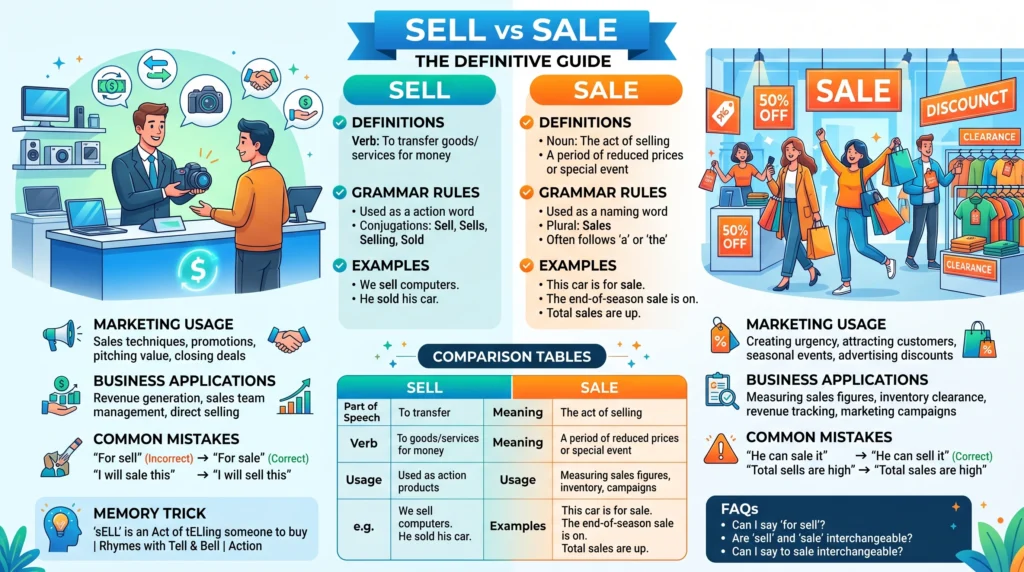
Sell and sale are related words, but they have different meanings and grammatical functions. Sell is a verb that means to exchange goods or services for money. Sale is a noun that refers to the act of selling or a special event where products are offered at discounted prices. Understanding the difference between sell or sale helps improve writing, business communication, marketing content, and everyday English.
The confusion between sell or sale is extremely common because the two words are closely connected.
Both involve buying and selling products, but they serve different roles in a sentence.
Consider these examples:
- I want to sell my car.
- My car is for sale.
Both sentences are correct, but the words cannot be swapped.
For example:
- I want to sale my car. ❌
- My car is for sell. ❌
Understanding when to use sell and when to use sale is important for business writing, advertisements, eCommerce websites, and professional communication.
This guide explains:
- Definitions
- Grammar rules
- Business examples
- Marketing usage
- Common mistakes
- SEO recommendations
- FAQs
Quick Answer
| Word | Part of Speech | Meaning |
|---|---|---|
| Sell | Verb | To exchange something for money |
| Sale | Noun | The act of selling or a discounted event |
Simple Summary
Use sell when describing an action.
Use sale when referring to a thing, event, or transaction.
What Does Sell Mean?
Definition
Sell is a verb that means to give or exchange something for money.
Basic Meaning
When someone sells something, they transfer ownership in return for payment.
Examples
- I want to sell my house.
- She sells handmade jewelry.
- They sold their business.
Everyday Usage
Sell appears frequently in business, marketing, and conversation.
What Does Sale Mean?
Definition
Sale is a noun that refers to the act of selling or a promotional event.
Basic Meaning
A sale can describe:
- A completed transaction
- A discount event
- The exchange of goods for money
Examples
- The sale was completed yesterday.
- The store is having a holiday sale.
- House sale prices increased.
Business Usage
Sale is common in retail, eCommerce, and marketing.
Main Difference Between Sell or Sale
Grammar Function
Sell
Verb (action word)
Sale
Noun (person, place, thing, or concept)
Purpose
Sell
Describes doing something.
Sale
Describes a transaction or event.
Sentence Position
Sell
Usually follows a subject.
Example:
- We sell products online.
Sale
Often follows articles or adjectives.
Example:
- The sale starts tomorrow.
Comparison Table
| Feature | Sell | Sale |
|---|---|---|
| Part of Speech | Verb | Noun |
| Describes Action | Yes | No |
| Describes Event | No | Yes |
| Used in Marketing | Yes | Yes |
| Used in Business Writing | Yes | Yes |
| Commonly Confused | Yes | Yes |
How to Use Sell Correctly
Selling Products
Examples:
- The company sells electronics.
- We sell furniture online.
Selling Services
Examples:
- She sells consulting services.
- The agency sells advertising solutions.
Personal Transactions
Examples:
- I want to sell my bicycle.
- He sold his old laptop.
Online Business
Sell is frequently used on eCommerce websites.
How to Use Sale Correctly
Promotional Events
Examples:
- Summer sale
- Black Friday sale
- Clearance sale
Completed Transactions
Examples:
- The sale closed successfully.
- The property sale was approved.
Retail Marketing
Examples:
- Huge sale this weekend.
- Storewide sale begins Friday.
eCommerce
Sale is a major marketing keyword.
Common Examples of Sell
Real Estate
- We plan to sell the house.
Automotive
- She wants to sell her car.
Business
- The company sells software.
Online Marketplaces
- Many people sell products on the internet.
Common Examples of Sale
Retail Stores
- The holiday sale starts tomorrow.
Online Shopping
- The website offers a flash sale.
Property Transactions
- The home sale was finalized.
Business Deals
- The company announced a major sale.
Why People Confuse Sell and Sale
Similar Pronunciation
The words sound somewhat alike.
Related Meanings
Both involve commercial transactions.
Frequent Marketing Usage
People often see both words together.
Examples:
- For Sale
- Sell Now
Grammar Uncertainty
Writers sometimes forget which word functions as a verb.
Common Mistakes People Make
Using Sale as a Verb
Incorrect:
- I want to sale my car.
Correct:
- I want to sell my car.
Using Sell as a Noun
Incorrect:
- The store is having a sell.
Correct:
- The store is having a sale.
Confusing Marketing Phrases
Incorrect:
- House for sell
Correct:
- House for sale
Business Writing Errors
Incorrect:
- Product sale quickly.
Correct:
- Products sell quickly.
Sell vs Sale in Business Writing
Sell for Action
Examples:
- We sell digital products.
- The company sells worldwide.
Sale for Results
Examples:
- Sales increased this quarter.
- The sale generated revenue.
Professional Communication
Using the correct form improves credibility.
Marketing Copy
Businesses rely heavily on both words.
Sell vs Sale in Advertising
Sell
Call-to-action language.
Examples:
- Sell your old phone today.
- Sell faster with our platform.
Sale
Promotional language.
Examples:
- End-of-season sale.
- Biggest sale of the year.
Conversion Strategy
Both words are common in marketing campaigns.
Which Word Is More Common?
Search Trends
Sale generally receives higher search volume due to retail promotions.
Business Usage
Both words appear frequently.
eCommerce
Sale is heavily used during promotional events.
SEO Importance
Both keywords hold strong search value.
Which Version Is Better for SEO?
Search Intent
Users searching “sell or sale” typically want grammar clarification.
Marketing Keywords
Sale often performs strongly in shopping-related searches.
Business Content
Sell works well in instructional and entrepreneurial content.
SEO Recommendation
Target both terms together while clearly explaining their grammatical difference.
How to Remember the Difference
Sell = Action
Think of sell as something you do.
Sale = Event
Think of sale as something that happens.
Easy Formula
Sell = Verb
Sale = Noun
Memory Trick
If you can replace the word with “action,” use sell.
If you can replace it with “event” or “transaction,” use sale.
Related Word Comparisons
Sells or Sales
Another common business grammar question.
Buy or Purchase
Similar commercial vocabulary.
Affect or Effect
Verb versus noun distinction.
Sell or Sale
One of the most searched business grammar topics.
Exercises With Answers
Exercise 1
Which word is a verb?
Answer: Sell
Exercise 2
Which word refers to a discount event?
Answer: Sale
Exercise 3
Complete the sentence:
I want to _____ my laptop.
Answer: Sell
Exercise 4
Complete the sentence:
The store is having a huge _____.
Answer: Sale
Exercise 5
Which sentence is correct?
Answer: The house is for sale.
FAQs
What is the difference between sell and sale?
Sell is a verb. Sale is a noun.
Can sale be used as a verb?
No. Sale is a noun.
Can sell be used as a noun?
Generally no. Sell functions as a verb.
Is it for sale or for sell?
The correct phrase is for sale.
Is it sell my car or sale my car?
The correct phrase is sell my car.
What does sale mean in business?
It refers to a transaction or promotional event.
What does sell mean in business?
It means exchanging products or services for money.
Which word appears more in marketing?
Both are common, but sale is heavily used in promotions.
Which keyword is better for SEO?
Both have value depending on user intent.
Are sell and sale interchangeable?
No. They have different grammatical functions.
Conclusion
The difference between sell or sale is simple once you understand grammar.
Key takeaways include:
- Sell is a verb.
- Sale is a noun.
- Sell describes an action.
- Sale describes an event or transaction.
- Both words are essential in business and marketing.
The easiest way to remember the distinction is:
Sell = What you do
Sale = What happens
Using the correct word improves grammar, professional writing, advertising copy, and overall communication.

Kevin Brooks is a grammar specialist at GramBrix.com, dedicated to helping readers understand language rules with clarity and confidence. He simplifies complex grammar concepts through practical examples and easy explanations.