Last Updated on August 16, 2026
Unorganized vs disorganized refers to the difference between something that has never been arranged in a structured way and something that has lost its structure or order. “Unorganized” usually describes a natural or neutral lack of system, while “disorganized” suggests a breakdown of an existing system. Understanding this difference helps in communication, learning, productivity, and professional writing.
Have you ever called something unorganized when you really meant disorganized? These words look similar, but they are not always interchangeable. Understanding unorganized vs disorganized can help you describe people, plans, spaces, and systems more accurately.
In simple terms, unorganized usually describes something that lacks organization or has not been arranged into a clear system. Disorganized, however, often suggests that something is poorly arranged, chaotic, or not functioning as it should. The difference may seem small, but it can change the tone of your sentence.
This distinction matters in school, workplaces, everyday conversations, and professional writing. A messy desk, an unclear schedule, or a poorly managed project may be described differently depending on the situation.
In this guide, we will compare unorganized vs disorganized with clear definitions, examples, usage tips, common mistakes, and practical comparisons. By the end, you will know exactly when to use each word.
Quick Answer Overview
The difference between unorganized vs disorganized is simple:
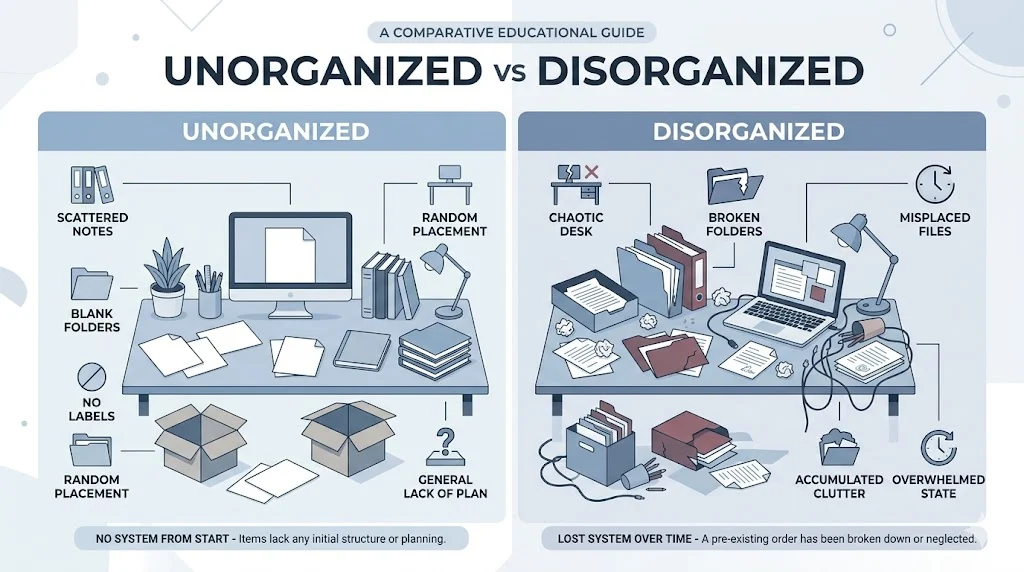
- Unorganized means something has no system or structure from the beginning.
- Disorganized means something once had structure but lost it.
Example:
- A pile of random papers thrown on a table is unorganized.
- A neatly arranged desk that becomes messy over time is disorganized.
Both describe lack of order, but the cause and context are different.
Definition of Unorganized vs Disorganized
What Does Unorganized Mean?
Unorganized refers to something that does not have a planned system, arrangement, or structure. It is neutral in tone.
It often describes:
- Natural or random arrangement
- Absence of planning
- No fixed system from the start
Examples:
- An unorganized group of volunteers
- An unorganized closet with no storage system
- Unorganized data collected without categories
In most cases, unorganized does not suggest failure. It simply means “not arranged.”
What Does Disorganized Mean?
Disorganized means something that was once structured but has lost order.
It often describes:
- Broken systems
- Lost planning
- Decline from order to chaos
Examples:
- A disorganized office after a busy week
- A disorganized student losing track of assignments
- A disorganized event due to poor management
Unlike “unorganized,” this word carries a slightly negative tone because it suggests something went wrong.
Unorganized vs Disorganized Key Differences
Comparison Table
| Feature | Unorganized | Disorganized |
| Meaning | No structure from the start | Structure lost over time |
| Tone | Neutral | Slightly negative |
| Cause | Absence of system | Breakdown of system |
| Example | Random notes in a notebook | A once neat notebook now messy |
| Usage | Descriptive | Critical or evaluative |
Simple Explanation
Think of it like this:
- Unorganized = never arranged
- Disorganized = used to be organized but now messy
This is the core difference in unorganized vs disorganized.
Advantages and Disadvantages
Unorganized Situations
Advantages
- Flexible and free-flowing
- Encourages creativity
- No strict rules
Disadvantages
- Hard to find information
- Time-wasting
- Can feel chaotic
Disorganized Situations
Advantages
- Shows flexibility in changing environments
- May indicate fast-paced activity
Disadvantages
- Loss of productivity
- Confusion and stress
- Poor time management
Real-World Examples of Unorganized vs Disorganized
Education
- Unorganized: A student taking random notes without headings
- Disorganized: A student who had a proper notebook system but stopped maintaining it
Workplace
- Unorganized: A startup with no formal structure yet
- Disorganized: A company with systems that are not followed anymore
Home Life
- Unorganized: A new room with unpacked boxes
- Disorganized: A room that was cleaned but became messy again
Digital Life
- Unorganized: A new phone with no folders created
- Disorganized: A phone that once had organized folders but now has scattered apps
Regional and Global Usage
The terms unorganized vs disorganized are used differently in English-speaking regions.
American English
- “Disorganized” is more commonly used
- “Unorganized” is less frequent but still understood
British English
- Both words are used, but “disorganised” is preferred spelling
Academic Writing
- “Disorganized” is preferred when describing inefficiency or system failure
- “Unorganized” is used in descriptive or neutral contexts
Common Mistakes in Using Unorganized vs Disorganized
Mistake 1: Using them as exact synonyms
Incorrect:
- The office is unorganized because it was messy yesterday
Correct:
- The office is disorganized because it lost its structure
Mistake 2: Using “unorganized” for criticism
Incorrect:
- He is unorganized in his work habits (negative tone intended)
Better:
- He is disorganized in his work habits
Mistake 3: Ignoring context
Many learners forget that context decides meaning. Always ask:
- Was there a system before?
- Is there a loss of order?
Mistake 4: Overusing one term
Writers often use only “disorganized,” even when “unorganized” fits better.
Exercises with Answers
Exercise 1: Choose the correct word
- The files were ______ on the desk from the beginning.
- The classroom became ______ after the exam week.
- A(n) ______ system was used to collect data randomly.
Answers:
- unorganized
- disorganized
- unorganized
Exercise 2: Rewrite the sentences
- The team lost structure after the manager left.
- The notes were never arranged properly.
Answers:
- The team became disorganized after the manager left.
- The notes were unorganized from the beginning.
Exercise 3: Identify the type
- A messy kitchen that was once clean → ______
- A storage room with no labeling system → ______
Answers:
- Disorganized
- Unorganized
Related Concepts and Comparisons
Organized vs Unorganized vs Disorganized
| Term | Meaning |
| Organized | Has structure and system |
| Unorganized | No structure from start |
| Disorganized | Lost structure over time |
Chaos vs Disorganization
- Chaos = total lack of control
- Disorganization = broken system, but still traceable order
Efficiency vs Disorder
- Efficiency requires organization
- Disorder reduces productivity
Practical Usage in Daily Life
Understanding unorganized vs disorganized helps in:
- Writing emails clearly
- Improving workplace communication
- Describing behavior accurately
- Enhancing academic writing
- Improving self-awareness
Example:
Instead of saying:
- “My schedule is bad”
You can say:
- “My schedule is disorganized”
This sounds more precise and professional.
FAQs
What is the main difference between unorganized and disorganized?
Unorganized vs disorganized differs in timing. Unorganized means no system exists from the beginning, while disorganized means a system broke down.
Is unorganized a negative word?
No, unorganized is usually neutral. It simply describes a lack of structure.
Is disorganized always negative?
Mostly yes. Disorganized often implies inefficiency or loss of order.
Can a person be unorganized or disorganized?
Yes. A person can be:
- Unorganized if they never developed a system
- Disorganized if they lost their system over time
Which word is more formal?
Disorganized is generally more formal in academic and professional writing.
Are unorganized and disorganized interchangeable?
No. They are not fully interchangeable because they describe different situations.
What is the noun form of unorganized?
The noun form is lack of organization or disorganization (context-dependent).
Can a business be unorganized or disorganized?
Yes:
- Unorganized business = startup without structure
- Disorganized business = established company with broken systems
How can I remember the difference easily?
Remember:
- Unorganized = never organized
- Disorganized = was organized, now not
Which is more common in English?
Disorganized is more commonly used in everyday English.
Conclusion
The difference between unorganized vs disorganized is small but important. One describes something without any system from the start, while the other describes a system that has lost its order. Understanding this distinction helps you communicate more clearly and professionally.
In daily life, choosing the correct word improves writing, speaking, and thinking. Whether you are describing work, study habits, or personal spaces, using the right term adds accuracy to your message.
To improve your English usage:
- Use unorganized for natural or new lack of structure
- Use disorganized for broken or messy systems
- Always consider context before choosing
Clear language leads to clear thinking, and mastering small differences like this makes your communication stronger and more precise.
Discover more Articles:
- Mustang vs Camaro: Key Differences Explained Clearly For 2026
- Memrise vs Duolingo Comparison Guide 2026: Which Language App Is Better for You?

Victoria Lane is a grammar-focused writer at GramBrix.com, passionate about helping readers master the rules of language. She provides clear explanations and practical examples that make writing more accurate, polished and confident.