Last Updated on June 16, 2026
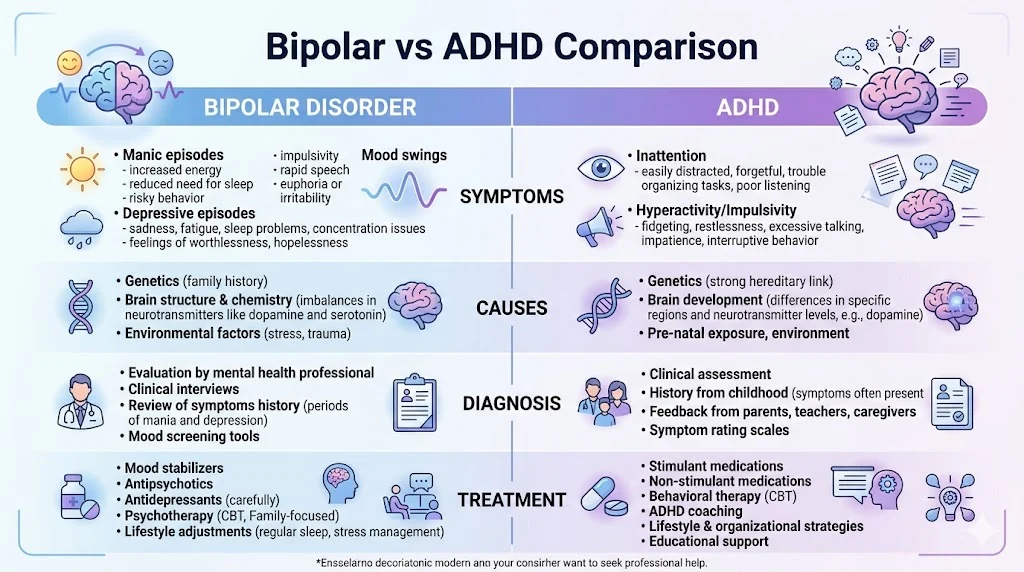
Bipolar vs ADHD are two different mental health conditions that often look similar but have very different causes, symptoms, and treatments. Bipolar disorder mainly affects mood with extreme emotional highs and lows, while ADHD affects attention, focus, and impulse control. Understanding the difference helps in proper diagnosis and better treatment outcomes.
Bipolar vs ADHD is one of the most confusing comparisons in mental health. Many people mistake one condition for the other because both can involve mood changes, impulsive behavior, and difficulty focusing. This confusion can lead to wrong self-diagnosis or delayed treatment.
The truth is, bipolar disorder and ADHD are very different conditions. Bipolar disorder is a mood disorder. It causes strong emotional shifts between mania and depression. ADHD, on the other hand, is a neurodevelopmental disorder. It mainly affects attention, focus, and self-control.
Understanding bipolar vs ADHD is important for students, parents, teachers, and even adults who struggle with focus or mood swings. A correct understanding helps people get the right treatment, support, and coping strategies.
In this guide, you will learn the clear differences, symptoms, causes, diagnosis methods, and treatment options. We will also look at real-life examples, common mistakes, and simple exercises to help you understand both conditions better. The goal is to make this complex topic simple, clear, and useful for everyday life.
Quick Answer: Bipolar vs ADHD Overview
Bipolar disorder and ADHD may look similar on the surface, but they are fundamentally different.
- Bipolar disorder: A mood disorder with episodes of mania (high energy) and depression (low mood).
- ADHD (Attention Deficit Hyperactivity Disorder): A condition that affects attention span, impulsivity, and hyperactivity from childhood or early development.
Key Difference in One Line:
Bipolar disorder changes your mood in episodes, while ADHD affects your attention and behavior consistently over time.
Definition and Explanation
What is Bipolar Disorder?
Bipolar disorder is a mental health condition where a person experiences extreme mood changes. These include:
- Mania or hypomania (very high energy, excitement, or irritability)
- Depression (very low mood, sadness, and loss of interest)
These mood episodes can last days, weeks, or even months.
People with bipolar disorder may:
- Sleep very little during mania
- Talk very fast
- Take risky actions
- Feel extremely depressed later
What is ADHD?
ADHD (Attention Deficit Hyperactivity Disorder) is a neurodevelopmental condition. It starts in childhood and often continues into adulthood.
People with ADHD may:
- Struggle to focus
- Get distracted easily
- Act without thinking
- Feel restless or hyperactive
Unlike bipolar disorder, ADHD does not come in episodes. It is a continuous pattern.
Bipolar vs ADHD: Key Differences Table
| Feature | Bipolar Disorder | ADHD |
| Type | Mood disorder | Neurodevelopmental disorder |
| Onset | Late teens or adulthood | Childhood |
| Pattern | Episodic | Continuous |
| Mood changes | Extreme highs and lows | Mild mood swings |
| Energy levels | Very high or very low in episodes | Often restless or inconsistent |
| Attention | May be affected during episodes | Always affected |
| Sleep | Reduced in mania, increased in depression | Irregular sleep patterns |
| Treatment | Mood stabilizers, therapy | Stimulants, behavioral therapy |
Symptoms Comparison: Bipolar vs ADHD
Bipolar Disorder Symptoms
Manic Phase:
- High energy
- Less need for sleep
- Overconfidence
- Risky behavior
- Fast talking
Depressive Phase:
- Low energy
- Sadness
- Loss of interest
- Fatigue
- Hopelessness
ADHD Symptoms
- Difficulty focusing
- Forgetfulness
- Poor time management
- Impulsivity
- Restlessness
- Trouble completing tasks
Causes of Bipolar vs ADHD
Causes of Bipolar Disorder
- Genetic factors
- Brain chemical imbalance
- Stressful life events
- Family history
Causes of ADHD
- Genetics
- Brain development differences
- Low dopamine activity
- Premature birth (in some cases)
Diagnosis: Bipolar vs ADHD
Correct diagnosis is very important because treatment is different.
Bipolar Diagnosis
Doctors check:
- Mood history
- Manic and depressive episodes
- Family history
- Behavioral patterns over time
ADHD Diagnosis
Doctors check:
- Childhood behavior history
- Attention and focus problems
- Hyperactivity symptoms
- School or work performance issues
Important Note
Misdiagnosis is common. ADHD can be mistaken for bipolar and vice versa, especially when mood swings are present in ADHD due to frustration or stress.
Treatment Options
Treatment for Bipolar Disorder
- Mood stabilizers (e.g., lithium)
- Antipsychotic medications
- Psychotherapy
- Lifestyle management
Treatment for ADHD
- Stimulant medications
- Behavioral therapy
- Time management training
- Structured routines
Strengths and Challenges
Bipolar Disorder Challenges
- Unpredictable mood episodes
- Relationship difficulties
- Financial or career instability during mania
Bipolar Strengths (during stable periods)
- Creativity
- High energy
- Deep emotional insight
ADHD Challenges
- Difficulty completing tasks
- Forgetfulness
- Disorganization
ADHD Strengths
- Creativity
- High energy
- Ability to multitask in dynamic environments
Real-World Examples
Example of Bipolar Disorder
A person feels extremely energetic for one week. They sleep very little and make big risky decisions. After that, they feel very tired and depressed for weeks.
Example of ADHD
A student struggles to focus in class every day. They forget homework often and feel restless during long tasks, but their mood remains mostly stable.
Bipolar vs ADHD in Daily Life
At School or Work
- Bipolar disorder: Performance changes during episodes
- ADHD: Consistent focus issues
In Relationships
- Bipolar disorder: Mood swings affect behavior dramatically
- ADHD: Forgetfulness or impulsivity causes misunderstandings
Regional and Global Awareness
Awareness of bipolar vs ADHD varies globally:
- In developed countries, diagnosis rates are higher due to better mental health systems
- In developing regions, many cases go undiagnosed
- ADHD is often misunderstood as laziness or bad behavior
- Bipolar disorder is sometimes confused with personality issues
Better awareness helps reduce stigma and improves early treatment.
Common Mistakes in Bipolar vs ADHD Understanding
- Confusing mood swings with bipolar disorder
- Assuming ADHD is just poor discipline
- Self-diagnosing without medical advice
- Ignoring childhood history in ADHD diagnosis
- Mixing stress-related mood changes with bipolar episodes
Exercises: Test Your Understanding
Exercise 1: Identify the Condition
- A person has lifelong trouble focusing and is easily distracted.
- A person experiences extreme energy for days followed by deep sadness.
Answers:
- ADHD
- Bipolar disorder
Exercise 2: True or False
- ADHD only appears in adulthood.
- Bipolar disorder has distinct mood episodes.
- ADHD affects attention continuously.
Answers:
- False
- True
- True
Exercise 3: Match the Symptom
| Symptom | Condition |
| Impulsivity | ADHD |
| Mania | Bipolar disorder |
| Forgetfulness | ADHD |
| Depression episodes | Bipolar disorder |
Related Concepts and Comparisons
Understanding bipolar vs ADHD also helps compare with:
- Depression vs bipolar disorder
- ADHD vs anxiety
- Mood disorders vs personality disorders
- Neurodevelopmental vs psychiatric conditions
These comparisons help improve diagnostic clarity.
FAQs
What is the main difference between bipolar vs ADHD?
Bipolar disorder involves mood episodes, while ADHD involves constant attention and behavior issues.
Can ADHD look like bipolar disorder?
Yes, ADHD can sometimes look like bipolar disorder due to impulsivity and mood swings caused by frustration.
Can someone have both bipolar and ADHD?
Yes, it is possible to have both conditions at the same time, which makes diagnosis more complex.
Is bipolar worse than ADHD?
Neither is “worse.” They are different conditions with different impacts and treatment needs.
Do ADHD symptoms change with age?
Yes, ADHD symptoms may reduce in hyperactivity but attention problems often continue into adulthood.
How is bipolar vs ADHD diagnosed?
Doctors use interviews, behavior history, and symptom patterns over time.
Can lifestyle changes help both conditions?
Yes, healthy sleep, exercise, and routine can improve both bipolar and ADHD symptoms.
Are mood swings always bipolar disorder?
No, mood swings can also be caused by stress, ADHD, or hormonal changes.
What is the best treatment for bipolar vs ADHD?
Bipolar is treated mainly with mood stabilizers, while ADHD is treated with stimulants and behavioral therapy.
Why is bipolar vs ADHD often confused?
Because both can include impulsivity, emotional changes, and difficulty with focus.
Conclusion
Understanding bipolar vs ADHD is very important for correct diagnosis and treatment. While both conditions may appear similar on the surface, they are very different in nature. Bipolar disorder is a mood-based condition with clear episodes of mania and depression. ADHD is a lifelong attention and behavior regulation disorder.
Confusing the two can lead to improper treatment and emotional distress. That is why professional diagnosis is always necessary. With the right support, both conditions can be managed successfully.
If you or someone you know shows symptoms, the best step is to consult a mental health professional. Early understanding leads to better outcomes, improved relationships, and a healthier life.

Justin Powell is a writer at GramBrix.com who focuses on grammar, clarity and effective communication, helping readers strengthen their language skills.