Last Updated on July 5, 2026
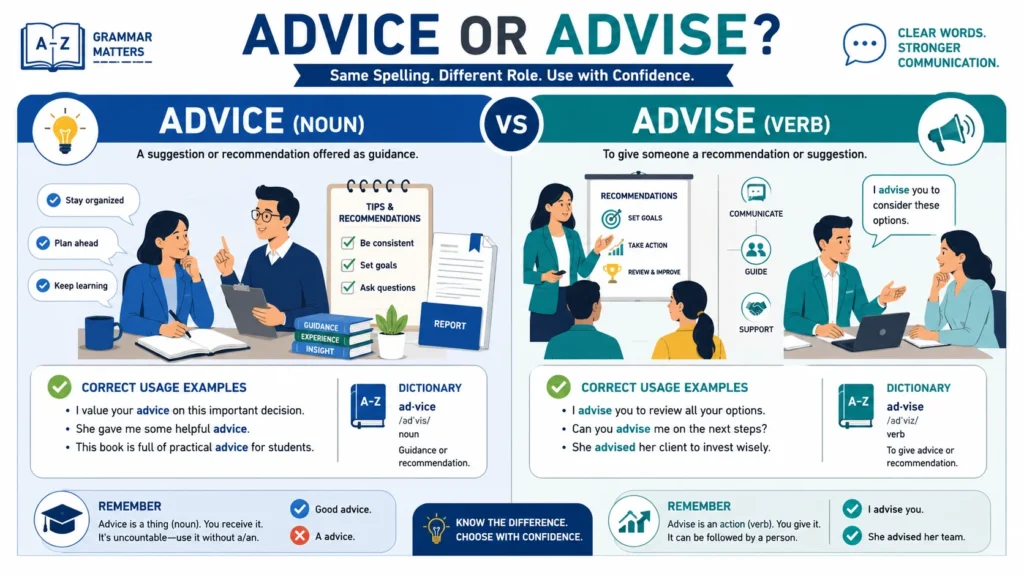
Advice and advise are often confused because they look and sound similar. The key difference is simple: advice is a noun that means guidance or a recommendation, while advise is a verb that means to give guidance or recommend something. Understanding this distinction helps improve both written and spoken English.
Many English learners and native speakers struggle with the difference between advice and advise. These two words are closely related. They share the same meaning family and are only one letter apart. Because of this, people often use them incorrectly in emails, essays, business documents, and everyday conversations.
The confusion becomes even greater because the words sound similar. In fast speech, it can be difficult to hear the difference. However, choosing the correct word is important. Using the wrong form can make your writing appear less professional and may change the meaning of a sentence.
The good news is that the distinction between advice and advise is very simple once you understand their grammatical roles. One word is a thing, and the other is an action.
This guide explains everything you need to know about advice or advise, including definitions, pronunciation, examples, regional usage, common mistakes, exercises, FAQs, and practical tips that will help you use both words correctly every time.
Quick Answer
The simplest way to remember the difference is:
| Word | Part of Speech | Meaning | Example |
|---|---|---|---|
| Advice | Noun | Guidance or recommendation | Thank you for your advice. |
| Advise | Verb | To give guidance or recommendations | I advise you to study more. |
Quick Rule
If you can replace the word with guidance, use advice.
If you can replace the word with recommend, use advise.
Examples:
- She gave me useful advice.
- I advise you to save money.
Understanding Advice and Advise
Although these words are related, they perform different jobs in a sentence.
Think of it this way:
- Advice is the information.
- Advise is the action of giving that information.
Imagine a doctor speaking to a patient.
- The doctor advises the patient.
- The doctor’s recommendation is the advice.
This simple relationship explains nearly every use of the two words.
What Does Advice Mean?
Advice is a noun.
It refers to guidance, recommendations, suggestions, or opinions offered to help someone make a decision.
Definition of Advice
Advice means:
An opinion or recommendation offered as a guide to action.
Examples of Advice
- My teacher gave me valuable advice.
- I need some advice about my career.
- Her advice helped me solve the problem.
- Thank you for your advice.
- Good advice can save time and money.
In each example, advice is a thing that someone receives.
Characteristics of Advice
- It is a noun.
- It represents information or guidance.
- It is usually uncountable.
- It often follows words like give, offer, seek, ask for, and receive.
Examples:
- Give advice
- Offer advice
- Seek advice
- Ask for advice
- Receive advice
What Does Advise Mean?
Advise is a verb.
It means to give guidance, recommendations, or suggestions.
Definition of Advise
Advise means:
To recommend a course of action or provide guidance.
Examples of Advise
- I advise you to arrive early.
- Experts advise regular exercise.
- The lawyer advised her to wait.
- Teachers advise students on career choices.
- Doctors advise patients about healthy habits.
In every example, someone is performing the action of advising.
Characteristics of Advise
- It is a verb.
- It describes an action.
- It often appears with a person or group receiving guidance.
- It may be followed by “to” plus another verb.
Examples:
- Advise someone to study.
- Advise someone to wait.
- Advise someone to save money.
Advice vs Advise Comparison Table
| Feature | Advice | Advise |
|---|---|---|
| Part of Speech | Noun | Verb |
| Meaning | Guidance or recommendation | To give guidance |
| Function | Thing | Action |
| Example | Great advice helped me. | I advise caution. |
| Can Be Plural? | Generally no | Not applicable |
| Used After Give? | Yes | No |
| Used As Action? | No | Yes |
Pronunciation Difference
Another helpful clue is pronunciation.
| Word | Pronunciation |
|---|---|
| Advice | ad VICE |
| Advise | ad VIZE |
Notice the ending sound:
- Advice ends with an s sound.
- Advise ends with a z sound.
Examples:
- Advice = ad-vice
- Advise = ad-vize
This pronunciation difference often helps speakers remember which word they need.
Why People Confuse Advice and Advise
Several factors cause confusion.
Similar Spelling
The words differ by only one letter.
- Advice
- Advise
Similar Meaning
Both relate to guidance and recommendations.
Similar Pronunciation
The beginning sounds are identical.
Grammar Challenges
Many learners struggle with noun and verb distinctions.
Consider these examples:
Incorrect:
- He gave me good advise.
Correct:
- He gave me good advice.
Incorrect:
- I advice you to leave.
Correct:
- I advise you to leave.
Real World Examples of Advice and Advise
Understanding real situations makes the difference easier to remember.
In Business
Advice:
- The consultant provided strategic advice.
Advise:
- The consultant advised the company to expand.
In Healthcare
Advice:
- The doctor gave health advice.
Advise:
- The doctor advised the patient to stop smoking.
In Education
Advice:
- Students often seek academic advice.
Advise:
- Teachers advise students about university choices.
In Finance
Advice:
- Financial advice can improve investment decisions.
Advise:
- Experts advise diversifying investments.
In Personal Relationships
Advice:
- My friend gave relationship advice.
Advise:
- My friend advised me to communicate honestly.
Common Phrases Using Advice
Many fixed expressions use advice.
Popular Examples
- Ask for advice
- Give advice
- Offer advice
- Follow advice
- Ignore advice
- Good advice
- Helpful advice
- Professional advice
- Legal advice
- Financial advice
Sentences:
- I asked for advice before buying a house.
- She followed her mother’s advice.
- Professional advice can prevent mistakes.
Common Phrases Using Advise
Common expressions with advise include:
- Strongly advise
- Highly advise
- Advise against
- Advise someone to
- Advise caution
- Advise patience
Examples:
- Experts advise caution during storms.
- I strongly advise reading the contract.
- Lawyers advise against signing immediately.
Regional and Global Usage
The distinction between advice and advise remains the same worldwide.
American English
American English uses:
- Advice as a noun
- Advise as a verb
Examples:
- She gave good advice.
- I advise waiting.
British English
British English follows the same rule.
Examples:
- The manager offered advice.
- The manager advised caution.
Australian English
Australian English also uses the same distinction.
Examples:
- Seek professional advice.
- Experts advise preparation.
Canadian English
Canadian English follows identical grammar rules.
Examples:
- His advice was useful.
- He advised us to continue.
No major English-speaking region changes this rule.
Advantages and Disadvantages of Each Word
Since advice and advise serve different purposes, they are not competitors. However, understanding their strengths can help.
Advantages of Advice
- Clearly refers to guidance.
- Common in professional writing.
- Useful in formal communication.
- Easy to recognize as a noun.
Disadvantages of Advice
- Often confused with advise.
- Cannot function as an action word.
Advantages of Advise
- Clearly expresses action.
- Useful in instructions and recommendations.
- Common in professional and academic writing.
Disadvantages of Advise
- Frequently misspelled as advice.
- Pronunciation may confuse learners.
Common Mistakes and Corrections
Here are some of the most frequent errors.
| Incorrect | Correct |
|---|---|
| I advice you to leave. | I advise you to leave. |
| She gave me good advise. | She gave me good advice. |
| Can you advice me? | Can you advise me? |
| His advise was helpful. | His advice was helpful. |
| The lawyer gave legal advise. | The lawyer gave legal advice. |
Memory Trick
Remember:
- Advice = Noun
- Advise = Verb
Or:
- C in advice = counsel (noun)
- S in advise = suggest (verb)
Advice and Advise in Professional Writing
Professional communication requires correct usage.
Business Emails
Correct:
- I would appreciate your advice on this matter.
Correct:
- I advise reviewing the report before submission.
Reports
Correct:
- Expert advice supports this strategy.
Correct:
- Analysts advise caution regarding market volatility.
Academic Writing
Correct:
- The professor provided valuable advice.
Correct:
- Researchers advise further investigation.
Advice and Advise in Everyday Conversation
These words appear regularly in daily life.
Examples:
- Can you give me some advice?
- I advise taking an umbrella.
- Thank you for the advice.
- Parents often advise their children.
Because they are so common, mastering them improves everyday communication.
Related Concepts and Comparisons
Several word pairs create confusion similar to advice and advise.
Practice vs Practise
| Word | Function |
|---|---|
| Practice | Noun |
| Practise | Verb (British English) |
Device vs Devise
| Word | Function |
|---|---|
| Device | Noun |
| Devise | Verb |
Licence vs License
| Word | Function |
|---|---|
| Licence | Noun |
| License | Verb |
Like advice and advise, these pairs involve noun and verb distinctions.
Grammar Rules for Advice
Advice Is Usually Uncountable
Correct:
- I need advice.
Incorrect:
- I need an advice.
Correct:
- She gave me some advice.
Counting Advice
When counting pieces of advice, use expressions such as:
- A piece of advice
- Two pieces of advice
- Several pieces of advice
Examples:
- Let me give you a piece of advice.
- She shared three pieces of advice.
Grammar Rules for Advise
Advise Plus Object
Correct:
- I advise students regularly.
Advise Plus Object and Infinitive
Correct:
- I advise students to study daily.
Advise Against
Correct:
- Doctors advise against smoking.
Exercises with Answers
Exercise 1
Choose the correct word.
- My teacher gave me good ______.
- I ______ you to save money.
- Thank you for your ______.
- Experts ______ caution.
- Her ______ helped me succeed.
Answers
- Advice
- Advise
- Advice
- Advise
- Advice
Exercise 2
- Can you advice me?
- He gave useful advise.
- I advice waiting.
- Their advise was excellent.
- She advice her team carefully.
Answers
- Can you advise me?
- He gave useful advice.
- I advise waiting.
- Their advice was excellent.
- She advised her team carefully.
Exercise 3
Fill in the blanks.
- The doctor ______ me to exercise more.
- The doctor’s ______ improved my health.
- Lawyers often ______ clients.
- I appreciate your ______.
- Experts ______ planning ahead.
Answers
- Advised
- Advice
- Advise
- Advice
- Advise
Advanced Usage and Nuances
As your English improves, you may encounter more sophisticated uses.
Formal Language
Advice:
- Independent legal advice
- Professional financial advice
Advise:
- We advise immediate action.
- We advise against further delays.
Passive Voice
- Customers were advised to wait.
- Employees were advised of the changes.
Official Notices
Many official notices use advise.
Examples:
- We advise passengers to arrive early.
- Authorities advise caution.
When to Use Advice
Use advice when referring to:
- Recommendations
- Suggestions
- Guidance
- Opinions
- Instructions received from others
Examples:
- Career advice
- Financial advice
- Parenting advice
- Medical advice
- Travel advice
When to Use Advise
Use advise when describing the act of giving guidance.
Examples:
- Advise customers
- Advise patients
- Advise investors
- Advise students
- Advise employees
Quick Memory Tricks
Here are easy ways to remember.
Trick One
Advice = Thing
Advise = Action
Trick Two
Advice contains ice.
You can receive advice like you receive information.
Trick Three
Advise contains ise.
Many English verbs end with similar sounds.
Trick Four
Ask yourself:
“Am I talking about guidance or giving guidance?”
- Guidance = advice
- Giving guidance = advise
FAQs
What is the difference between advice and advise?
Advice is a noun meaning guidance, while advise is a verb meaning to give guidance.
Is advice a noun or a verb?
Advice is always a noun.
Is advise a noun or a verb?
Advise is always a verb.
Can I say “an advice”?
No. Advice is generally uncountable. Say “some advice” or “a piece of advice.”
How do I remember advice or advise?
Remember that advice is the guidance itself, while advise is the action of giving guidance.
Which is correct: “Please advice” or “Please advise”?
“Please advise” is correct because you are asking someone to provide guidance.
Can advice be plural?
Normally, no. Use phrases such as “pieces of advice” instead.
What does “advise against” mean?
It means to recommend not doing something.
Example:
- Doctors advise against smoking.
Is the advice and advise rule the same in British and American English?
Yes. Both varieties follow the same grammar distinction.
Why do people confuse advice and advise?
They have similar spelling, pronunciation, and meanings, making them one of the most commonly confused word pairs in English.
Can professionals use advice and advise interchangeably?
No. Professional writing requires the correct grammatical form. Advice is the noun, and advise is the verb.
Conclusion
The difference between advice and advise is straightforward once you understand their grammatical roles. Advice is a noun that refers to guidance, recommendations, or suggestions. Advise is a verb that describes the act of giving that guidance. Although the two words look very similar and share related meanings, they cannot be used interchangeably.
A simple way to remember the distinction is to think of advice as the information and advise as the action. You receive advice, seek advice, or follow advice. On the other hand, you advise someone, advise caution, or advise against a particular action.
When writing emails, reports, academic papers, or everyday messages, taking a moment to check whether you need a noun or a verb can prevent mistakes. Practice using both words in real sentences, review the examples in this guide, and apply the memory tricks provided. With regular use, choosing between advice or advise will become automatic, helping you communicate more clearly and professionally.

Justin Powell is a writer at GramBrix.com who focuses on grammar, clarity and effective communication, helping readers strengthen their language skills.