Last Updated on July 8, 2026
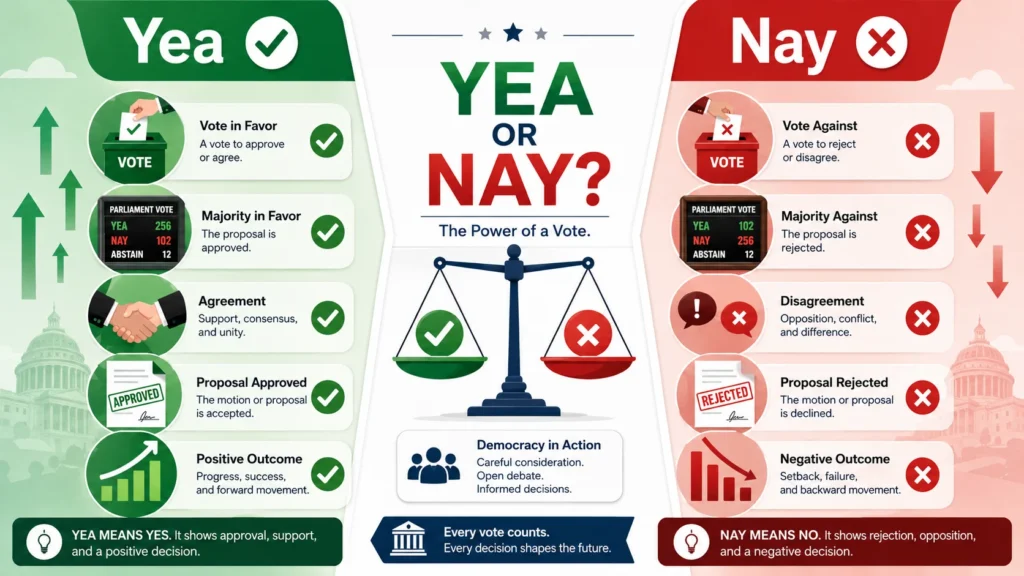
Yea or nay are two words used to express agreement or disagreement. Yea means “yes” or approval, while nay means “no” or rejection. Today, these words are most common in formal voting, historical texts, and the popular phrase “yea or nay,” which means making a clear choice between two options.
The phrase “yea or nay” has been used for centuries. You may hear it in movies, political debates, formal meetings, or everyday conversations when someone wants a simple answer. Even though the phrase sounds familiar, many people are unsure about the meaning of yea and nay.
Some people think yea is just an old spelling of yeah. Others believe nay means “maybe” or “not sure.” These misunderstandings can lead to mistakes in writing and speech.
Understanding yea or nay is useful because the phrase still appears in modern English. It is often used when a decision must be made. Whether you are reading historical documents, following government votes, writing professionally, or improving your English skills, knowing the difference between these words can help.
This guide explains everything about yea or nay, including definitions, history, examples, advantages and disadvantages of using the phrase, regional usage, common mistakes, practice exercises, comparisons, FAQs, and practical tips for correct usage.
Quick Answer
The simple answer is:
| Word | Meaning | Modern Equivalent |
|---|---|---|
| Yea | Yes, approval, agreement | Yes |
| Nay | No, rejection, disagreement | No |
The phrase “yea or nay” means:
“Yes or no?”
Example:
Will the company approve the proposal? Give us a yea or nay.
Meaning:
Will the company approve or reject the proposal?
What Does Yea Mean?
Yea is an old English word meaning yes, approval, or agreement.
It is most often used in:
- Formal votes
- Parliamentary procedures
- Historical writings
- Religious texts
- Traditional expressions
Examples:
- The members voted yea on the proposal.
- The committee gave a yea vote.
- The motion passed because most members voted yea.
In these examples, yea means approval.
Origin of Yea
The word comes from Old English and has been part of the language for many centuries. Before modern English standardized the word yes, yea was commonly used as a positive response.
Today, it survives mainly in formal and traditional settings.
What Does Nay Mean?
Nay means no, refusal, disagreement, or rejection.
It is often used in:
- Formal voting
- Historical documents
- Literary works
- Traditional expressions
Examples:
- Several members voted nay.
- The proposal received more nays than yeas.
- The council issued a nay vote.
In each example, nay means opposition or rejection.
Origin of Nay
Like yea, nay comes from Old English. It was widely used before modern English settled on the simpler word no.
Today, it remains common in voting procedures and formal contexts.
Understanding the Phrase Yea or Nay
The phrase “yea or nay” asks for a clear decision.
It leaves no room for uncertainty.
Examples:
- Are we moving forward with the project? Yea or nay?
- Do you support the proposal? Yea or nay?
- Is the budget approved? Give me a yea or nay answer.
The phrase emphasizes that only two choices exist:
- Approval
- Rejection
This makes it useful in decision making.
Yea vs Yeah
One of the biggest sources of confusion is the similarity between yea and yeah.
| Word | Meaning | Usage |
|---|---|---|
| Yea | Yes, approval | Formal |
| Yeah | Informal version of yes | Casual speech |
Examples:
Correct
- The board voted yea.
- Yeah, I can help you.
Incorrect
- The board voted yeah.
In formal voting, yea is the correct word.
Yea vs Yes
Many people wonder whether yea and yes are identical.
While they have similar meanings, they are not always interchangeable.
| Feature | Yea | Yes |
|---|---|---|
| Formal voting | Common | Rare |
| Everyday speech | Rare | Very common |
| Historical texts | Common | Less common |
| Modern conversation | Unusual | Standard |
Example:
Formal vote:
- 20 voted yea and 5 voted nay.
Everyday conversation:
- Yes, I agree.
Nay vs No
Just as yea relates to yes, nay relates to no.
| Feature | Nay | No |
|---|---|---|
| Formal voting | Common | Rare |
| Daily conversation | Rare | Very common |
| Historical writing | Common | Less common |
| Modern communication | Unusual | Standard |
Example:
Formal:
- The members voted nay.
Everyday:
- No, I disagree.
Why Is Yea or Nay Still Used Today?
Even though modern English prefers yes and no, yea or nay remains popular because it:
- Sounds formal
- Creates emphasis
- Reflects tradition
- Simplifies decision making
- Adds dramatic effect
Examples:
Business meeting:
- We need a yea or nay decision before Friday.
Politics:
- Legislators cast their yea or nay votes.
Media:
- The public is waiting for a yea or nay answer.
Advantages and Disadvantages of Using Yea or Nay
Advantages
Clear Meaning
The phrase presents only two options.
Formal Tone
It sounds professional in official settings.
Historical Significance
It connects modern language to centuries of tradition.
Useful in Voting
It clearly records approval and rejection.
Disadvantages
Can Sound Old-Fashioned
Many people rarely use these words.
Potential Confusion
Some readers mistake yea for yeah.
Limited Everyday Use
Most conversations use yes and no instead.
May Seem Overly Formal
Using it casually can sound unusual.
Real World Examples of Yea or Nay
Government Voting
Legislatures often record votes as:
- Yeas: Votes in favor
- Nays: Votes against
Example:
- The bill passed with 65 yeas and 35 nays.
Company Board Meetings
Board members may vote:
- Yea to approve
- Nay to reject
Example:
- The acquisition received a unanimous yea vote.
Community Organizations
Committees often use the terms during formal proceedings.
Example:
- Members voted yea on the budget proposal.
Everyday Conversation
Sometimes people use the phrase humorously.
Example:
- Pizza tonight? Yea or nay?
Historical Background of Yea and Nay
The words have deep roots in English history.
During the Middle Ages, speakers used different words to answer questions depending on how those questions were phrased.
Over time:
- Yea evolved into a formal affirmative vote.
- Nay evolved into a formal negative vote.
- Yes and no became the dominant everyday alternatives.
Despite these changes, parliamentary systems preserved the traditional words.
That is why many governments still record votes as yeas and nays.
Regional and Global Usage
United States
The phrase often appears in:
- Congress
- State legislatures
- Formal votes
Examples include:
- Yeas and nays were recorded.
- The motion passed by a yea vote.
United Kingdom
Traditional parliamentary language frequently uses similar formal voting terminology.
Canada
Legislative bodies often record affirmative and negative votes formally.
Australia and New Zealand
Formal institutions may use the words, although everyday speech relies on yes and no.
General Global English
Outside official settings, most English speakers prefer:
- Yes
- No
However, the phrase yea or nay remains widely recognized.
Common Situations Where Yea or Nay Appears
Voting Sessions
The most common usage.
Legal Proceedings
Certain formal records may include the terms.
Corporate Governance
Boards often record voting outcomes.
Historical Literature
Older books frequently contain these words.
Journalism
Reporters sometimes use the phrase metaphorically.
Example:
- Investors await a yea or nay decision from regulators.
Comparison Table: Yea, Nay, Yes, No, and Yeah
| Word | Meaning | Formality | Common Today |
|---|---|---|---|
| Yea | Approval | High | Limited |
| Nay | Rejection | High | Limited |
| Yes | Approval | Standard | Very common |
| No | Rejection | Standard | Very common |
| Yeah | Informal yes | Low | Very common |
Common Mistakes with Yea or Nay
Confusing Yea with Yeah
Incorrect:
- The committee voted yeah.
Correct:
- The committee voted yea.
Using Nay as Maybe
Incorrect:
- Nay means uncertain.
Correct:
- Nay means no.
Using Yea in Casual Conversation
Unusual:
- Yea, I went to the store.
Better:
- Yes, I went to the store.
- Yeah, I went to the store.
Mixing Formal and Informal Language
Incorrect:
- The board voted yeah and nay.
Correct:
- The board voted yea and nay.
How to Remember the Difference
A simple memory trick:
Yea = Yes
Both start with a positive sound.
Think:
Yea = Yes = Approval
Nay = No
Both express rejection.
Think:
Nay = No = Disapproval
Memory phrase:
“Yea means yes. Nay means no.”
Related Concepts and Comparisons
Agree or Disagree
Modern equivalent:
- Agree = Yea
- Disagree = Nay
Approve or Reject
Business equivalent:
- Approve = Yea
- Reject = Nay
For or Against
Political equivalent:
- For = Yea
- Against = Nay
Pass or Fail
Decision equivalent:
- Pass = Yea
- Fail = Nay
Yea and Nay in Literature
Writers often use these words to create a formal or historical tone.
Example:
- The king asked his council for a yea or nay response.
This usage helps readers feel transported to another era.
Fantasy novels, historical fiction, and religious texts frequently use these terms.
Yea and Nay in Politics
Politics remains one of the strongest modern uses.
When a law is proposed:
- Legislators vote yea to support it.
- Legislators vote nay to oppose it.
Example:
| Vote Type | Meaning |
|---|---|
| Yea | Support |
| Nay | Opposition |
Results may be announced as:
- 52 yeas, 48 nays.
Yea and Nay in Business Decisions
Businesses sometimes use the phrase to encourage quick decisions.
Examples:
- Give me a yea or nay by tomorrow.
- The executives need a yea or nay vote.
- Investors want a yea or nay answer.
The phrase signals urgency and clarity.
Exercises with Answers
Exercise 1
Choose the correct word.
- The committee voted _____ on the proposal.
- Most members voted _____ against the measure.
- We need a _____ or nay answer.
Answers
- yea
- nay
- yea
Exercise 2
Replace the modern word with the traditional equivalent.
- Yes
- No
- Approval
- Rejection
Answers
- Yea
- Nay
- Yea
- Nay
Exercise 3
Correct the sentence.
- The board voted yeah.
- Nay means maybe.
- The proposal received ten yeah votes.
Answers
- The board voted yea.
- Nay means no.
- The proposal received ten yea votes.
Exercise 4
Fill in the blanks.
- Yea means ______.
- Nay means ______.
- The phrase yea or nay means ______.
Answers
- yes
- no
- a clear decision between approval and rejection
Advanced Understanding of Yea or Nay
At a deeper level, yea or nay represents binary decision making.
A binary decision has only two possible outcomes:
- Accept
- Reject
Examples include:
- Loan approval
- Legislative votes
- Project authorization
- Contract acceptance
Because of this, the phrase has survived in modern English despite its age.
It perfectly expresses the need for a direct answer.
When Should You Use Yea or Nay?
Use it when:
- Discussing formal votes
- Writing about politics
- Referring to historical documents
- Requesting a clear decision
- Creating a formal tone
Avoid it when:
- Writing casual messages
- Having everyday conversations
- Speaking informally with friends
In those cases, yes and no work better.
FAQs
What does yea or nay mean?
Yea or nay means yes or no. It asks for a clear decision or response.
Is yea the same as yeah?
No. Yea is a formal word meaning approval, while yeah is an informal version of yes.
Does nay mean maybe?
No. Nay means no, rejection, or disagreement.
Where is yea or nay commonly used?
The phrase is common in voting, government proceedings, board meetings, and formal decision making.
Can I use yea instead of yes?
Technically yes, but it may sound old-fashioned. In everyday English, yes is usually preferred.
Can I use nay instead of no?
You can, but it is uncommon in modern conversation. It is mainly used in formal or historical contexts.
Why do governments use yea and nay?
Many governments preserve traditional voting language. A yea vote indicates support, while a nay vote indicates opposition.
What is the difference between yea or nay and yes or no?
The meaning is the same. However, yea or nay sounds more formal, traditional, and emphatic.
Is yea or nay still relevant today?
Yes. The phrase remains common in politics, business decisions, legal settings, and formal discussions.
How can I remember the meaning of yea and nay?
Remember this simple rule: Yea equals yes. Nay equals no. This memory trick works in almost every situation.
Conclusion
The phrase “yea or nay” has survived for centuries because it communicates a simple idea clearly and effectively. Yea means approval, agreement, or support, while nay means rejection, disagreement, or opposition. Together, they create a straightforward way to express a decision between two options.
Although everyday English now relies mostly on yes and no, the traditional words still play an important role in government votes, board meetings, legal proceedings, historical texts, and formal discussions. They also appear in the common expression “yea or nay,” which asks for a direct answer without uncertainty.
For most casual conversations, using yes and no is the best choice. However, understanding yea or nay will help you read historical documents, follow political discussions, and communicate more effectively in formal contexts. The easiest rule to remember is simple: yea means yes, and nay means no. Once you know that distinction, using and understanding the phrase becomes effortless.

Victoria Lane is a grammar-focused writer at GramBrix.com, passionate about helping readers master the rules of language. She provides clear explanations and practical examples that make writing more accurate, polished and confident.