
Last Updated on August 19, 2026
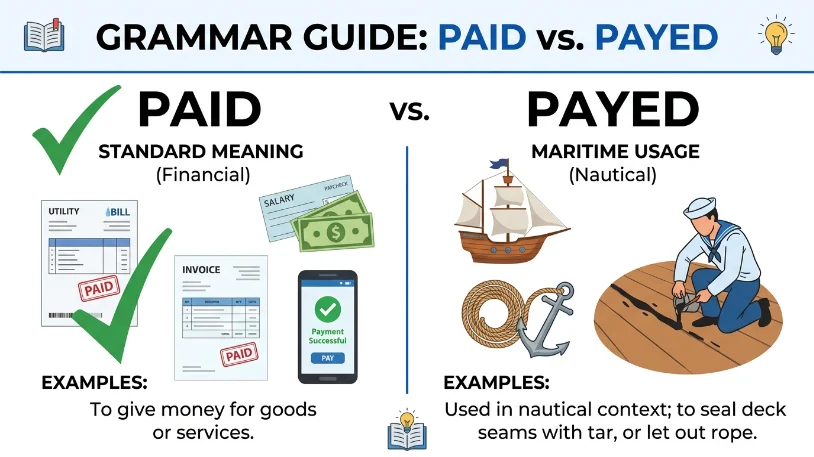
“Paid” is the correct past tense and past participle of the verb “pay” in almost all situations. “Payed” is a rare word used mainly in nautical contexts, such as sealing a ship’s deck with tar. If you’re talking about money, bills, salaries, or transactions, always use “paid.”
Many English learners and even native speakers get confused about paid or payed. At first glance, “payed” seems like it should be correct because many English verbs form their past tense by adding “-ed.” Words like played, stayed, and prayed follow that pattern.
However, the verb pay is different.
The correct past tense of pay is usually paid, not payed. This small spelling difference causes thousands of grammar mistakes in emails, blog posts, social media captions, academic papers, and business communication.
If you’ve ever wondered whether to write I paid the bill or I payed the bill, you’re not alone. Understanding the difference can improve your writing, help you avoid embarrassing mistakes, and make your English look more professional.
In this guide, you’ll learn exactly when to use paid, when payed is technically correct, common mistakes people make, and practical examples to help you remember the rule forever.
What Is the Difference Between Paid and Payed?
What Does “Paid” Mean?
Paid is the standard past tense and past participle of the verb pay.
It refers to giving money for something, settling a debt, compensating someone, or fulfilling a financial obligation.
Examples:
- I paid the electricity bill yesterday.
- She paid for dinner.
- The company paid its employees on time.
- We have already paid the invoice.
In everyday English, this is the form you should use almost every time.
What Does “Payed” Mean?
Payed is a real English word, but it is rarely used.
Traditionally, it refers to nautical activities such as:
- Sealing a ship with tar
- Letting out rope or cable
- Coating seams to make a vessel waterproof
Examples:
- The sailors payed the deck seams with tar.
- The crew carefully payed out the rope.
Unless you’re discussing ships, sailing, or maritime history, you probably won’t need the word payed.
Why Is Paid Correct Instead of Payed?
English contains many irregular verbs.
Most verbs become past tense by adding -ed:
| Present | Past |
| Walk | Walked |
| Jump | Jumped |
| Call | Called |
However, some verbs follow different patterns:
| Present | Past |
| Say | Said |
| Pay | Paid |
| Lay | Laid |
The verb pay belongs to this irregular group.
That’s why:
✅ Pay → Paid
❌ Pay → Payed
Even though “payed” looks logical, standard English grammar considers it incorrect in most situations.
When Should You Use Paid?
Financial Transactions
Whenever money changes hands, use paid.
Examples:
- I paid cash for the laptop.
- She paid her rent early.
- They paid the contractor last week.
Salaries and Wages
Examples:
- Employees were paid on Friday.
- He is well paid for his work.
- The company paid bonuses this year.
Bills and Expenses
Examples:
- Have you paid the electricity bill?
- We paid our taxes.
- She paid the hospital charges.
Online Payments
Examples:
- The customer paid through PayPal.
- I paid using my credit card.
- The order was paid successfully.
When Is Payed Actually Correct?
Maritime and Nautical Usage
The word payed survives mainly in nautical English.
Historically, sailors used it when discussing ropes, cables, and waterproofing ships.
Examples:
- The sailors payed out the anchor line.
- The wooden hull was payed with tar.
- The crew payed the seams before departure.
Historical Literature
You may encounter payed in:
- Maritime novels
- Naval records
- Historical documents
- Sailing manuals
Outside these contexts, it is rarely appropriate.
Paid vs Payed Comparison Table
| Feature | Paid | Payed |
| Standard English | Yes | Rare |
| Financial Context | Yes | No |
| Business Writing | Yes | No |
| Academic Writing | Yes | No |
| Everyday Conversation | Yes | No |
| Nautical Usage | No | Yes |
| Modern Usage Frequency | Very High | Very Low |
The table makes the answer simple:
If money is involved, use paid.
Real World Examples of Paid and Payed
Example in Business Writing
Correct:
The client paid the invoice yesterday.
Incorrect:
The client payed the invoice yesterday.
Example in School Writing
Correct:
My parents paid for my education.
Incorrect:
My parents payed for my education.
Example in E-Commerce
Correct:
The customer has paid for the order.
Incorrect:
The customer has payed for the order.
Example in Sailing
Correct:
The sailors payed out the rope slowly.
Here, payed is appropriate because it refers to rope handling.
Common Mistakes People Make
Assuming Every Verb Uses -ed
Many learners see:
- Play → Played
- Stay → Stayed
Then assume:
- Pay → Payed
This is incorrect because pay is irregular.
Trusting Spellcheck Too Much
Some spellcheck tools recognize “payed” as a valid word because it exists in nautical English.
That doesn’t mean it is correct in your sentence.
Using Payed in Business Emails
One of the most common mistakes is writing:
I have payed the invoice.
Correct version:
I have paid the invoice.
Copying Incorrect Social Media Content
Many social media posts contain grammar mistakes.
Always verify spelling using trusted grammar resources.
How to Remember the Difference
A simple trick is:
Money = Paid
If money, bills, salaries, rent, invoices, purchases, or payments are involved, use paid.
Think of this sentence:
I paid for what I purchased.
Both words contain the letters ai.
This memory trick helps many learners remember the correct spelling.
Related Grammar Concepts
Paid vs Paying
Examples:
- I paid the bill yesterday.
- I am paying the bill now.
Paid vs Unpaid
Examples:
- Paid internship
- Unpaid internship
Paid vs Compensation
Examples:
- The employee was paid fairly.
- The employee received compensation.
Pay vs Paid
| Form | Example |
| Pay | I pay monthly. |
| Paid | I paid yesterday. |
| Paying | I am paying now. |
Understanding these forms improves both spoken and written English.
Practice Exercises With Answers
Exercise 1
Choose the correct word:
I _____ the restaurant bill last night.
Answer: Paid
Exercise 2
Choose the correct word:
The company _____ all employees on time.
Answer: Paid
Exercise 3
Choose the correct word:
The sailors _____ out the rope.
Answer: Payed
Exercise 4
Choose the correct word:
She has already _____ the invoice.
Answer: Paid
Exercise 5
True or False:
“Payed” is normally used when talking about money.
Answer: False
Frequently Asked Questions
Is it paid or payed for money?
Use paid whenever you’re talking about money, bills, purchases, wages, or financial transactions.
Why is paid correct and not payed?
Because pay is an irregular verb. Its past tense is paid, not payed.
Can I say I payed the bill?
No. The correct sentence is I paid the bill.
Is payed a real word?
Yes. However, it is mainly used in maritime and nautical contexts.
What is the past tense of pay?
The past tense of pay is paid.
How do you spell paid correctly?
The correct spelling is paid when referring to money or payment.
Why does spellcheck sometimes accept payed?
Because payed exists as a rare nautical term, although it is usually wrong in everyday writing.
Is paid an irregular verb?
Yes. The verb pay follows an irregular past tense pattern.
What is the difference between paid and payed in grammar?
Paid is the standard past tense of pay. Payed is a specialized nautical term.
Which is more common: paid or payed?
Paid is overwhelmingly more common in modern English.
Conclusion
The debate over paid or payed is actually quite simple once you understand the rule. In nearly every situation involving money, bills, salaries, purchases, invoices, or financial transactions, paid is the correct word. It is the accepted past tense and past participle of the verb pay and should be used in professional writing, academic work, business communication, and everyday conversations.
The word payed is not technically wrong, but it belongs to a very specific nautical context involving ships, ropes, and waterproofing techniques. Most people will never need to use it.
If you’re unsure, remember one simple rule: when money is involved, always choose paid. Following this guideline will help you avoid one of the most common spelling mistakes in English and make your writing appear more polished and professional.
Whether you’re writing an email, creating website content, posting on social media, or completing schoolwork, using the correct form demonstrates attention to detail and strong language skills.

Justin Powell is a writer at GramBrix.com who focuses on grammar, clarity and effective communication, helping readers strengthen their language skills.