
Last Updated on June 17, 2026
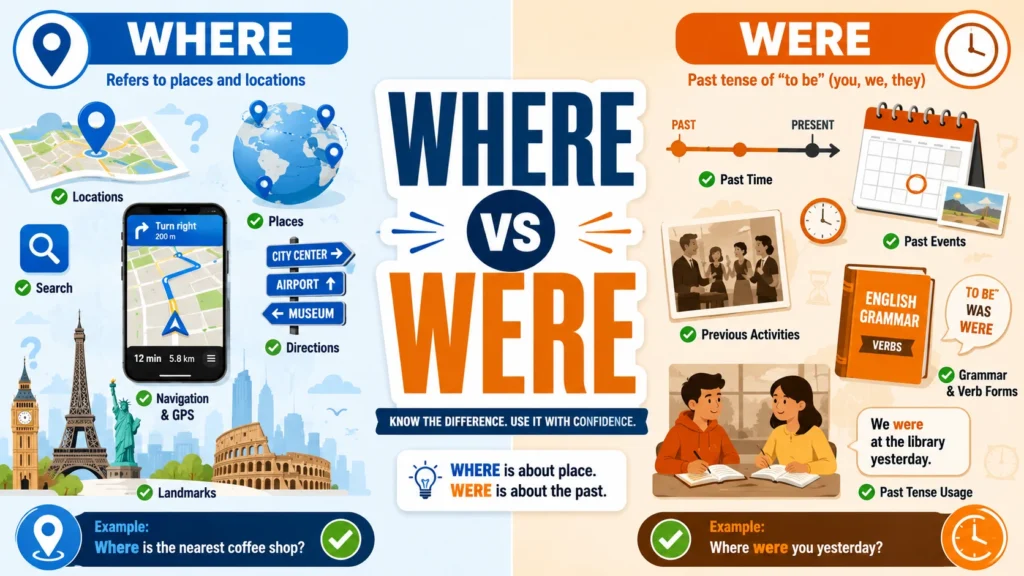
“Where” and “were” are commonly confused words because they look and sound similar. “Where” refers to a place, location, or position, while “were” is the past tense form of the verb “are.” Understanding the difference between where or were helps improve writing, speaking, and grammar accuracy.
The confusion between where or were is one of the most common grammar mistakes in English. These two words look similar. They also sound alike in some accents. Because of this, many learners and even native speakers occasionally use the wrong one.
Knowing when to use where and when to use were is important. A small spelling mistake can completely change the meaning of a sentence. For example, writing “Were are you going?” instead of “Where are you going?” makes the sentence grammatically incorrect.
The good news is that the difference is simple. Where is usually related to a location or place. Were is a verb used to describe something in the past. Once you understand this basic rule, it becomes much easier to choose the correct word.
In this guide, you will learn the meanings, uses, examples, common mistakes, regional differences, exercises, and practical tips for mastering where or were in everyday English.
Quick Answer: Where or Were?
| Word | Part of Speech | Meaning | Example |
|---|---|---|---|
| Where | Adverb, conjunction, pronoun | Refers to a place or location | Where is my phone? |
| Were | Verb | Past tense of “are” | They were happy yesterday. |
Simple Rule
Ask yourself:
Are you talking about a place?
- Use where
Are you talking about something in the past?
- Use were
Examples:
- Where do you live?
- We were at home yesterday.
Understanding Where
What Does “Where” Mean?
The word where refers to a location, place, position, or destination.
It is commonly used in questions and statements involving places.
Examples:
- Where is the nearest hospital?
- Where did you put the keys?
- I know where she works.
- Tell me where you are.
In every example, the word relates to a place or location.
Types of Where Usage
Asking About Location
Examples:
- Where is the library?
- Where are my shoes?
- Where do you work?
Referring to a Place
Examples:
- This is the house where I grew up.
- The city where she lives is beautiful.
Indicating Position
Examples:
- Stand where I can see you.
- Sit where you feel comfortable.
Memory Trick for Where
Notice that where contains the word here.
Where = Here = Place
If the sentence involves a location, where is usually the correct choice.
Example:
- Where are you?
- Here I am.
This connection makes the word easier to remember.
Understanding Were
What Does “Were” Mean?
Were is the past tense form of the verb are.
It describes actions, conditions, or situations that happened in the past.
Examples:
- They were tired.
- We were late.
- The children were excited.
- You were right.
In each sentence, were functions as a verb.
Types of Were Usage
Past Tense Statements
Examples:
- We were at the beach.
- They were busy yesterday.
Past Conditions
Examples:
- The roads were wet.
- The rooms were clean.
Hypothetical Situations
Examples:
- If I were rich, I would travel the world.
- If she were here, she would help.
In formal English, were is often used in hypothetical situations even with singular subjects.
Memory Trick for Were
Think about the word are.
Were is simply the past form of are.
Examples:
Present:
- They are happy.
Past:
- They were happy.
If the sentence talks about the past, were may be the correct choice.
Where or Were: Side-by-Side Comparison
| Feature | Where | Were |
|---|---|---|
| Meaning | Place or location | Past tense of are |
| Part of Speech | Adverb, pronoun, conjunction | Verb |
| Refers To | Position or destination | Past events or conditions |
| Used in Questions | Often | Rarely |
| Time Related | No | Yes |
| Example | Where is John? | John and Mary were here. |
Real World Examples of Where or Were
Understanding grammar becomes easier when you see practical examples.
At School
Correct:
- Where is the classroom?
- The students were studying.
Incorrect:
- Were is the classroom?
- The students where studying.
At Work
Correct:
- Where is the meeting room?
- We were discussing the project.
Incorrect:
- Were is the meeting room?
- We where discussing the project.
While Traveling
Correct:
- Where is the hotel?
- We were in Paris last summer.
Incorrect:
- Were is the hotel?
- We where in Paris last summer.
Online Communication
Correct:
- Where did you find that article?
- They were online yesterday.
Incorrect:
- Were did you find that article?
- They where online yesterday.
Why People Confuse Where or Were
Several factors contribute to the confusion.
Similar Spelling
Both words contain the letters:
- W
- E
- R
The letter arrangement is very similar.
Similar Pronunciation
In many accents, the pronunciation sounds close.
Examples:
- Where
- Were
Fast speech can make the difference difficult to hear.
Typing Errors
Many mistakes happen when typing quickly.
Examples:
- Where → Were
- Were → Where
Spellcheck tools do not always catch these mistakes because both words are valid English words.
Learning English as a Second Language
English learners often focus on vocabulary first and grammar later.
Because both words are common, they can be mixed up easily.
Advantages and Disadvantages of Learning the Difference
Advantages
Better Writing
Correct grammar improves clarity.
More Professional Communication
Employers and teachers notice accurate language use.
Improved Exam Performance
Grammar tests often include questions about commonly confused words.
Greater Confidence
Knowing the correct usage helps you communicate clearly.
Disadvantages of Ignoring the Difference
Confusing Sentences
Example:
- Were are you?
This sentence does not make sense.
Reduced Credibility
Frequent grammar mistakes may make writing appear less professional.
Lower Academic Scores
Grammar errors can affect grades.
Miscommunication
Readers may misunderstand your message.
Common Mistakes with Where or Were
Mistake 1
Incorrect:
- Were is my phone?
Correct:
- Where is my phone?
Reason:
The sentence asks about a location.
Mistake 2
Incorrect:
- We where happy yesterday.
Correct:
- We were happy yesterday.
Reason:
The sentence describes a past condition.
Mistake 3
Incorrect:
- Where you at the party?
Correct:
- Were you at the party?
Reason:
The sentence refers to the past.
Mistake 4
Incorrect:
- I remember were we met.
Correct:
- I remember where we met.
Reason:
The sentence refers to a place.
Mistake 5
Incorrect:
- Where they tired?
Correct:
- Were they tired?
Reason:
The sentence asks about a past condition.
Easy Method to Choose Between Where or Were
Follow this simple process.
Step 1
Ask:
Am I talking about a place?
If yes, choose where.
Example:
- Where is the restaurant?
Step 2
Ask:
Am I talking about the past?
If yes, choose were.
Example:
- We were at the restaurant.
Step 3
Replace the Word
Try replacing the word with:
- Location → where
- Past form of are → were
This quick check often solves the problem immediately.
Regional and Global Usage
American English
Both where and were are used exactly as defined by standard English grammar.
Examples:
- Where are you going?
- They were there yesterday.
British English
The usage rules remain the same.
Examples:
- Where is the train station?
- We were waiting for the bus.
Australian English
No significant difference exists.
Examples:
- Where can I park?
- They were already inside.
Canadian English
The grammar remains identical.
Examples:
- Where is the office?
- We were ready.
Global English Learners
English learners worldwide often confuse these words because of pronunciation similarities, but grammar rules remain consistent everywhere.
Related Concepts and Comparisons
Understanding similar grammar pairs can help reinforce the distinction between where or were.
Where vs Wear
| Word | Meaning |
|---|---|
| Where | Location |
| Wear | Put on clothing |
Examples:
- Where is your jacket?
- I wear a jacket every day.
Were vs We’re
| Word | Meaning |
|---|---|
| Were | Past tense verb |
| We’re | Contraction of “we are” |
Examples:
- We were happy.
- We’re happy.
There vs Their vs They’re
These words are also commonly confused.
| Word | Meaning |
|---|---|
| There | Place |
| Their | Ownership |
| They’re | They are |
Examples:
- Put it over there.
- Their car is new.
- They’re coming soon.
Where vs There
Both refer to location but serve different purposes.
Examples:
- Where are you?
- I am over there.
Sentence Patterns with Where
Question Form
- Where are you?
- Where do they live?
- Where is the office?
Relative Clause Form
- This is the town where I was born.
- The restaurant where we ate was excellent.
Indirect Question Form
- I know where she works.
- Tell me where they went.
Sentence Patterns with Were
Simple Past
- We were happy.
- They were ready.
Past Continuous Helper
- They were working.
- We were studying.
Conditional Mood
- If I were president, I would improve education.
- If he were here, he would agree.
Advanced Grammar Notes
Why “If I Were” Is Correct
Many learners ask why we say:
- If I were you
instead of:
- If I was you
Formal grammar uses were for hypothetical situations.
Examples:
- If I were taller, I would play basketball.
- If she were here, she would help.
This is called the subjunctive mood.
Where in Complex Sentences
Examples:
- I remember the place where we first met.
- Nobody knows where the missing document is.
The word continues to indicate location even in longer structures.
Practice Exercises: Where or Were
Choose the correct word.
Exercise 1
_____ is my backpack?
Answer: Where
Exercise 2
They _____ very excited about the trip.
Answer: Were
Exercise 3
Do you know _____ she lives?
Answer: Where
Exercise 4
The students _____ studying all evening.
Answer: Were
Exercise 5
_____ did you buy that book?
Answer: Where
Exercise 6
We _____ not ready for the meeting.
Answer: Were
Exercise 7
Can you tell me _____ the station is?
Answer: Where
Exercise 8
The roads _____ closed yesterday.
Answer: Were
Exercise 9
_____ are my glasses?
Answer: Where
Exercise 10
They _____ at the airport this morning.
Answer: Were
Mini Quiz
Choose the correct option.
1. _____ did you park the car?
A. Where
B. Were
Answer: A. Where
2. We _____ tired after the game.
A. Where
B. Were
Answer: B. Were
3. Do you know _____ he works?
A. Where
B. Were
Answer: A. Where
4. They _____ waiting outside.
A. Where
B. Were
Answer: B. Were
5. _____ is the nearest bank?
A. Where
B. Were
Answer: A. Where
FAQs
What is the difference between where or were?
Where refers to a place or location, while were is the past tense form of are.
How do I remember where or were?
Remember that where contains here, which relates to a place. Were is related to are, making it a verb.
Can where and were ever mean the same thing?
No. They have completely different meanings and grammatical functions.
Is “where are you” correct?
Yes. It asks about a person’s location.
Is “were are you” correct?
No. The correct phrase is where are you.
Why do people confuse where or were?
The words have similar spelling and pronunciation, making them easy to mix up.
When should I use were in a sentence?
Use were when describing past actions, situations, conditions, or hypothetical scenarios.
Can where be used in statements and not just questions?
Yes. Example: This is the house where I grew up.
Why do we say “if I were you”?
This is a formal grammatical structure called the subjunctive mood, used for hypothetical situations.
Are where or were used differently in American and British English?
No. The grammar rules are the same in both American and British English.
How can I stop making mistakes with where or were?
Ask yourself whether the sentence refers to a place or a past situation. This simple check usually identifies the correct word.
Conclusion
Understanding the difference between where or were is an important step toward better English grammar. Although the words look similar and may sound alike in some accents, their meanings are completely different. Where relates to location, place, or position, while were is the past tense form of are and describes past actions, conditions, or situations.
A simple memory trick can help. If the sentence involves a place, choose where. If it involves the past, choose were. This rule works in most situations and helps eliminate common grammar mistakes.
Regular practice is the best way to master these words. Read carefully, write often, and complete grammar exercises whenever possible. Pay special attention when proofreading emails, essays, reports, and social media posts. Even small corrections can significantly improve clarity and professionalism.
By applying the tips, examples, and exercises in this guide, you can confidently choose between where or were and communicate more accurately in both spoken and written English.

Kevin Brooks is a grammar specialist at GramBrix.com, dedicated to helping readers understand language rules with clarity and confidence. He simplifies complex grammar concepts through practical examples and easy explanations.