Last Updated on July 23, 2026
AI checkers use machine learning to analyze text perplexity and burstiness, estimating the probability of machine authorship. However, accuracy typically ranges from 65% to 85%, and false positives are common, especially for non-native English speakers. The best tools include Copyleaks for enterprise, GPTZero for free checks, and Originality.ai for publishers. No detector is perfect, and human judgment remains essential for accurate content verification.
The rise of generative AI has completely transformed how we create and consume content. ChatGPT exploded onto the scene in late 2022, and within months, AI-generated text became practically indistinguishable from human writing. This created an unexpected problem. How do you tell the difference?
Enter the AI checker.
These detection tools promise to separate human-written content from machine-generated text with impressive accuracy. But do they actually deliver? And more importantly, can you trust the results they give you?
Let’s cut through the marketing hype and explore what these tools really do, how they work, and why even the best AI detector has some serious blind spots.
What Exactly Is an AI Checker?
An AI checker is a software tool that analyzes written text and estimates the probability that an artificial intelligence system generated it. Think of it like a digital detective that looks for telltale signs of machine authorship.
But here’s a crucial distinction you need to understand. An AI content checker is not the same thing as a plagiarism checker. They serve completely different purposes.
Plagiarism checkers scan text against existing databases of published content. They look for exact or near-exact matches. If you copy a paragraph from Wikipedia and paste it into your document, a plagiarism tool will flag that match.
AI detection tools work differently. They don’t need a database of existing content. Instead, they analyze the text itself for statistical patterns and structural characteristics that suggest artificial intelligence authorship. Even if the text is 100% original and has never appeared anywhere online, an AI checker can still flag it as machine-generated.
This distinction matters because many people conflate the two concepts. When someone asks for an “AI plagiarism checker,” they usually mean an AI detection tool, not a traditional plagiarism scanner.
How AI Checkers Actually Work
Understanding what happens behind the scenes will help you interpret results more intelligently. These tools rely on sophisticated machine learning models trained on massive datasets of human and AI writing.
The Training Process
Developers feed millions of text samples into neural networks. Half come from human authors, and half come from various AI models like GPT, Claude, and Gemini. The system learns to identify subtle differences between the two categories.
This isn’t a simple checklist of “AI uses certain words” or “AI writes in a certain style.” The detection models analyze dozens of linguistic features simultaneously to build a probability profile.
The Two Key Metrics
Every AI detector relies on two foundational concepts to make its determination.
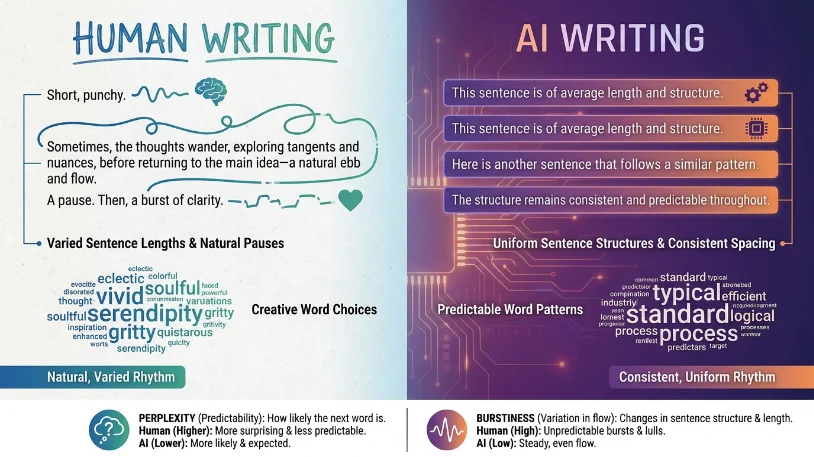
Perplexity
This term comes from information theory. In plain English, perplexity measures how predictable the text is. AI models generate text by calculating the most statistically likely next word at each step. This means AI-generated content tends to have low perplexity. The word choices follow predictable patterns.
Human writing, on the other hand, tends to have higher perplexity. We make unexpected word choices. We use creative metaphors. We break grammatical rules for effect. These unpredictable elements make human text harder for a statistical model to anticipate.
Burstiness
This metric assesses variation in sentence structure. Humans naturally mix up their writing rhythm. We write a short, punchy sentence. Then we follow it with a longer, more complex one that includes dependent clauses and parenthetical asides. This variation creates a natural flow that feels distinctly human.
AI-generated text often exhibits low burstiness. Sentences tend to be uniformly structured and of similar length. The rhythm feels monotonous because the model doesn’t naturally vary its construction patterns.
Think of it this way. Perplexity measures the complexity of word choices, while burstiness measures the variation in sentence architecture.
The Technical Approaches
Beyond the core metrics, detection tools employ several technical methods.
Statistical Detection
This is the classic approach. The system counts various features of the text including word frequencies, n-gram patterns (common sequences of words), punctuation usage, and syntactic structures. It compares these counts to the expected patterns for human and AI writing.
Machine Learning Classifiers
Modern detectors use sophisticated models like fine-tuned BERT or RoBERTa transformers. These deep learning systems analyze text holistically, examining semantic relationships and contextual patterns that simpler statistical methods might miss.
Watermarking (The Future of Detection)
Some researchers and companies are exploring cryptographic watermarking for AI-generated text. The idea involves embedding an invisible, verifiable signal into the text at the moment of generation. This signal would later allow anyone to confirm the AI origin.
However, and this is important, no major LLM provider including OpenAI, Anthropic, Google, or Meta has publicly implemented this technique for their public-facing models. The technology exists in research papers but not in real-world deployment.
The Accuracy Problem: Why You Can’t Always Trust the Score
Here’s where things get complicated. The reality is that AI detection accuracy falls far short of what many tools claim.
The Real Numbers
Most reputable detectors report accuracy between 65% and 85% in ideal conditions. Let me be blunt about this. That means even the best tools misclassify 15% to 35% of the text they analyze.
Some companies claim “99% accuracy” or even “99.9% accuracy.” These claims are marketing spin, not scientific reality. Independent testing consistently demonstrates that detection accuracy drops significantly when analyzing text from diverse sources, writing styles, and subject matters.
The False Positive Problem
A false positive occurs when the detector flags human-written content as AI-generated. This is a serious issue with real consequences.
Students have received failing grades because an AI checker flagged their original essays. Freelance writers have lost clients because detection tools mistakenly labeled their work as machine-generated. Content creators have faced false accusations of dishonesty.
Research has shown that these false positives disproportionately affect certain groups. Studies indicate that non-native English speakers receive higher AI probability scores than native speakers writing about the same topics. The detectors mistake their more formal, less idiomatic English for AI output.
The False Negative Problem
A false negative occurs when AI-generated text slips through undetected. This happens constantly.
If you take AI-generated content and lightly edit it, paraphrase it, or simply run it through a paraphrasing tool, detection rates plummet. Even simple techniques like changing a few words per sentence, varying sentence lengths, and adding personal anecdotes can defeat most detectors.
A Practical Example
Let’s say you feed a piece of text into an AI checker. The tool returns a score of “78% AI probability.” Many people interpret this as “78% of this text was written by AI.” That’s incorrect.
The score actually means “our model estimates a 78% probability that this text originated from an AI system.” It’s a statistical probability, not a percentage breakdown of the content itself.
The Best AI Checkers in 2026
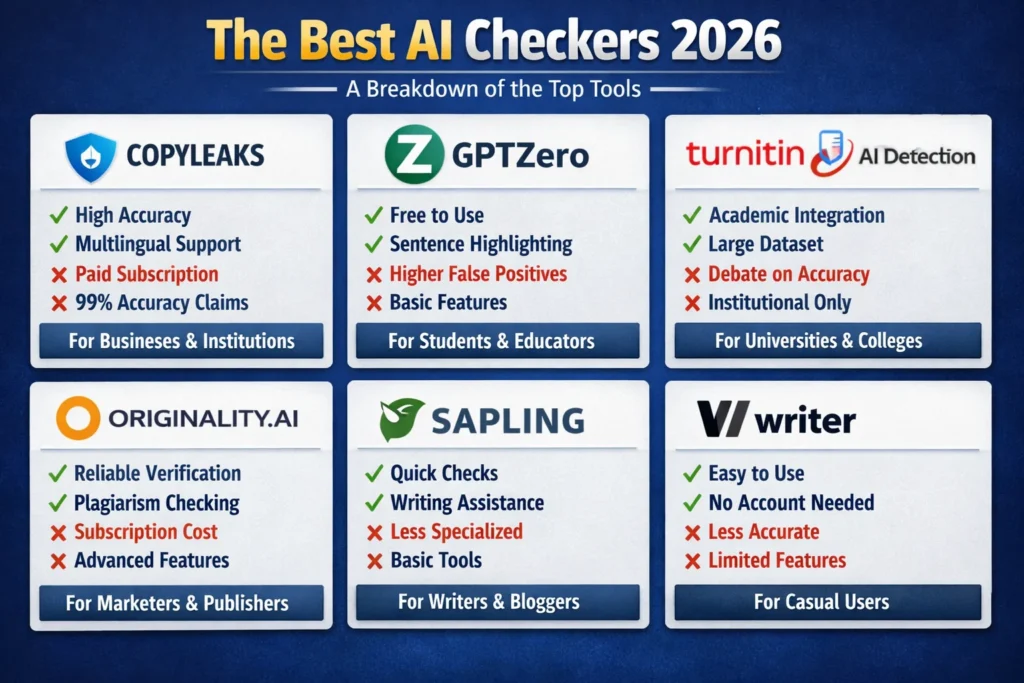
No single tool dominates the market, and each has strengths and weaknesses. Here’s an honest breakdown of the major players.
Copyleaks AI Detector
Copyleaks positions itself as the enterprise-grade solution. It uses a combination of machine learning and natural language processing techniques.
Strengths: High accuracy in controlled tests, integration with existing enterprise workflows, multilingual support.
Weaknesses: It’s a paid subscription service. The claimed “99% accuracy” rate isn’t consistently validated in independent testing.
Best for: Businesses and institutions that need to scan large volumes of content at scale.
GPTZero
GPTZero gained popularity as the free option for students and educators. It provides sentence-level highlighting to show which specific parts of the text appear AI-generated.
Strengths: Free to use, simple interface, provides detailed breakdowns at the sentence level.
Weaknesses: Lower accuracy than premium alternatives. Tends toward higher false positive rates. Limited advanced features.
Best for: Students doing quick checks and educators who need a basic screening tool.
Turnitin AI Writing Detection
Turnitin already dominates the academic plagiarism checking market, so their AI detection integration is a natural extension.
Strengths: Integrated into existing academic workflows. Familiar interface for educators. Access to a massive training dataset.
Weaknesses: Accuracy is a subject of ongoing debate. Concerns about false positives with ESL students. Requires institutional subscription.
Best for: Universities and colleges that already use Turnitin.
Originality.ai
Originality.ai built its reputation serving content marketers and publishers who need to verify their writers aren’t using AI.
Strengths: Highly reliable for content verification. Combines plagiarism checking with AI detection. Excellent for publishing workflows.
Weaknesses: Subscription pricing. Not designed for casual users. Feature set may be overkill for basic needs.
Best for: Content marketing agencies, publishers, and SEO teams.
Sapling AI Detector
Sapling takes a slightly different approach, focusing on writing assistance and detection as part of a broader toolkit.
Strengths: Good for quick checks. Integration with writing assistance features. Decent accuracy.
Weaknesses: Less specialized than dedicated detection tools. Limited advanced features.
Best for: Writers who want a quick, integrated detection option.
Writer AI Content Detector
Writer offers a straightforward detection tool that’s easy to access.
Strengths: Easy to use. Good for basic checks. No account required for limited use.
Weaknesses: Less accurate than premium alternatives. Limited features and reporting.
Best for: Quick spot checks and casual users.
Comparison Table
| Feature | Copyleaks | GPTZero | Turnitin | Originality.ai | Sapling | Writer |
|---|---|---|---|---|---|---|
| Price | Paid | Free | Paid (institutional) | Paid | Freemium | Freemium |
| Accuracy Rating | High | Moderate | Moderate | High | Moderate | Moderate |
| Sentence-Level Analysis | Yes | Yes | Limited | Yes | Yes | Limited |
| Plagiarism Checking | Yes | No | Yes | Yes | No | No |
| Best For | Enterprise | Students | Academia | Publishers | Writers | Quick Checks |
Real-World Applications
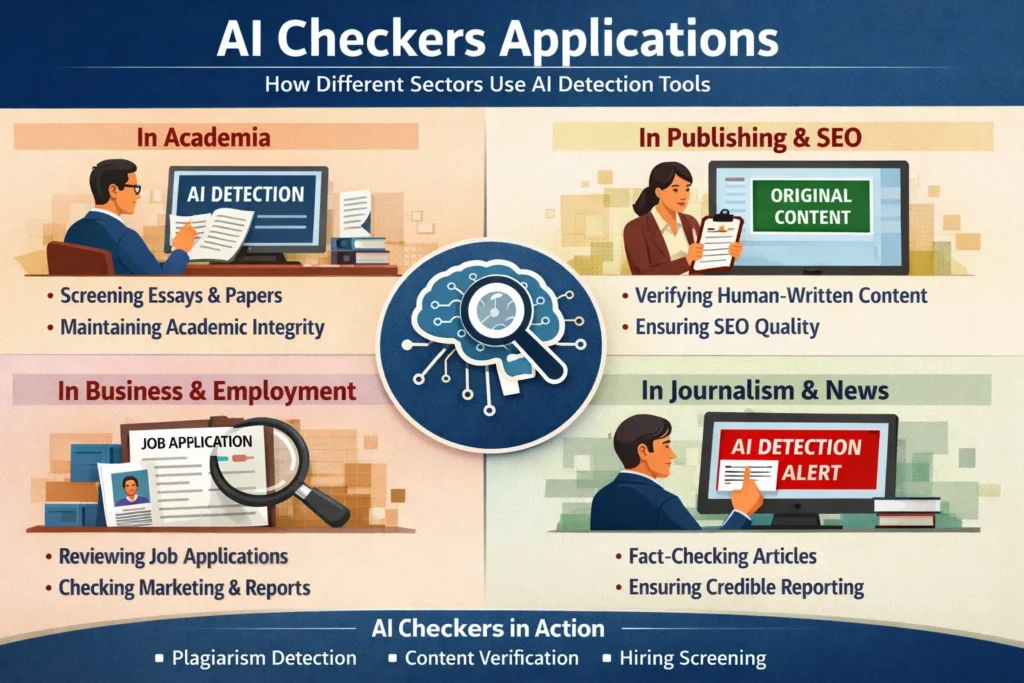
AI checkers have found their way into various industries and use cases. Here’s how different groups actually use them.
In Academia
Universities have adopted AI detection as a tool for maintaining academic integrity. Professors use these systems to screen student essays, research papers, and other assignments.
The approach varies widely. Some institutions treat AI detection results as definitive proof of misconduct. Others view them as a starting point for investigation, requiring further evidence before pursuing disciplinary action.
This inconsistency creates confusion and stress for students. If you’re a student, you should understand your institution’s specific policies. Some schools explicitly allow AI assistance with proper attribution. Others prohibit it entirely.
In Publishing and SEO
Content managers and editors use AI checkers to verify that freelancers and staff writers produce original human content. This is especially important in SEO, where Google has updated its guidance to clarify that AI-generated content isn’t inherently problematic if it provides value.
However, many publishers still prefer human-written content for brand voice, authenticity, and search quality. Detection tools help them maintain those standards.
In Business and Employment
Companies increasingly use AI detection when reviewing job applications, marketing copy, and internal reports. Some HR departments screen cover letters and writing samples.
The ethical implications are significant. If you’ve ever used AI to help polish a cover letter, you might face disqualification. Many companies haven’t yet developed clear policies about AI assistance in the hiring process.
In Journalism and News
News organizations face a unique challenge with AI detection. They need to verify that submitted content isn’t AI-generated but also need to avoid false accusations that could damage their credibility.
Some publications have banned AI-generated content entirely. Others allow it for specific tasks like data analysis or summary generation but require human oversight.
The Arms Race Continues
The relationship between AI generators and AI detectors is a classic adversarial dynamic. As one improves, the other must adapt.
AI models are getting better at mimicking human writing. The latest versions of GPT and Claude produce text that’s increasingly difficult to distinguish from human writing even for detection systems.
Detection tools respond by developing more sophisticated algorithms. They analyze more features, train on larger datasets, and incorporate newer techniques.
This creates a perpetual cycle. Neither side will definitively win because both are evolving simultaneously.
What the Future Holds
Looking ahead, several trends will shape the AI detection landscape.
Improved Accuracy Through Specialization
We’ll likely see detectors trained on specific domains and use cases. A detector trained specifically for academic writing will perform better on research papers than a general-purpose tool.
Integration With Authoring Platforms
Detection will increasingly happen at the point of creation. Writing platforms and word processors will include built-in detection that analyzes text as you type.
Better Watermarking Implementation
If major AI providers implement cryptographic watermarks, detection will become much more reliable. However, widespread adoption remains uncertain.
Regulatory Frameworks
Governments and educational institutions are developing policies around AI disclosure and detection. These regulations will influence how detection tools are used and interpreted.
Practical Tips for Using AI Checkers
If you’re going to use these tools, approach them strategically.
Never rely on a single detector. Run your text through multiple tools and compare results. If three detectors give different scores, you’ll have a better sense of the uncertainty.
Understand the false positive risk. If you’re a student, document your writing process. Keep drafts and notes to demonstrate your work was original.
Use detection as a screening tool, not a final judgment. A flag should trigger further review, not an automatic conclusion of wrongdoing.
Consider the context. A marketing blog post and an academic research paper have different expectations. A detection flag means different things in different situations.
Stay current. Detection technology changes rapidly. The tools you used six months ago may have different capabilities today.
The Human Element
Here’s the bottom line. AI checkers are imperfect tools that provide probabilistic assessments, not definitive answers.
The most effective approach combines technology with human judgment. Use detectors as data points, not as the final decision-maker. A skilled human editor can spot AI patterns that detectors might miss and can also recognize the creative, nuanced writing that detectors might falsely flag.
The best defense against false accusations is maintaining a clear record of your writing process. If you create original content, document your research, save your drafts, and be transparent about your methods.
AI detection will continue evolving, but the fundamental principle remains unchanged. Authentic, thoughtful human expression creates value in ways that AI-generated text can’t fully replicate. Your genuine voice is your greatest asset, and that’s something no detection tool can diminish.
What to Do When You Get a Flag
If an AI detector flags your content, don’t panic. Here’s a sensible approach.
Review the flagged sections. Most tools provide sentence-level analysis. Identify which parts generated the highest probability scores.
Consider possible explanations. Did you use AI for brainstorming or outlining? Did you incorporate AI-generated suggestions? Even human-written content can trigger detectors.
Document your process. If you need to demonstrate original authorship, gather evidence including drafts, outlines, and research notes.
Get a second opinion. Run the text through other detectors. Discrepancies between tools suggest the flag may be unreliable.
Be transparent. If you did use AI assistance, disclose it honestly. Many institutions and employers accept AI use with proper attribution.
Frequently Asked Questions
What is an AI checker and how does it work?
An AI checker is a software tool that analyzes written text to determine the likelihood that artificial intelligence generated it. These tools examine linguistic patterns including perplexity (predictability of word choices) and burstiness (variation in sentence structure). Machine learning models trained on millions of human and AI writing samples compare your text against known patterns. The tool then returns a probability score estimating the chance of AI authorship. This is completely different from plagiarism checking, which looks for exact text matches in existing databases.
Are AI checkers accurate and can I trust the results?
Accuracy varies significantly across tools and contexts. Most reputable detectors achieve 65% to 85% accuracy in controlled testing, but real-world performance often falls lower. Claims of 99% accuracy are marketing hype rather than scientific reality. False positives occur frequently, especially with text from non-native English speakers, creative writing, and technical content. False negatives happen just as often when lightly edited AI text slips through undetected. Use these tools as screening indicators rather than definitive proof, and always apply human judgment to flagged content.
Can AI checkers detect ChatGPT and other AI models?
Yes, most modern AI checkers can detect text from ChatGPT, Claude, Gemini, and other major language models with varying success. The detection works because these models share similar statistical patterns and structural characteristics. However, newer models produce increasingly human-like text that’s harder to identify. Tools like GPTZero and Originality.ai specifically train on outputs from multiple AI systems. Detection becomes significantly less reliable when text has been paraphrased, edited, or combined with human writing. No tool can definitively identify every AI-generated piece of content.
Is there a free AI checker I can use without signing up?
Yes, several free options exist for quick checks. GPTZero offers free detection with sentence-level analysis, though accuracy is lower than premium alternatives. Writer’s AI Content Detector provides basic checks without requiring an account. Sapling offers a freemium model with limited free usage. These tools work well for spot checks but lack the advanced features and higher accuracy of paid solutions. For professional or academic purposes requiring reliable results, consider premium options like Copyleaks or Originality.ai which provide more robust detection capabilities.
Why do AI checkers flag human-written content as AI-generated?
False positives happen for several reasons. Formal writing styles, technical jargon, and structured academic language often resemble AI patterns. Non-native English speakers receive disproportionately higher AI scores because their writing tends to follow more predictable grammatical structures. The detector’s training data may lack sufficient examples from diverse writing styles. Creative, concise, or highly structured human writing can trigger detection algorithms. Simple fixes include adding personal anecdotes, varying sentence length dramatically, and using more idiomatic expressions. Always review flagged content manually before drawing conclusions.
Final Thoughts
AI checkers serve a useful purpose in our increasingly AI-mediated world. They provide a starting point for evaluating content authenticity and maintaining standards in various contexts.
But they’re not magic. They don’t provide absolute certainty. They’re statistical tools with significant limitations, and understanding those limitations is essential for using them responsibly.
The next time you run your writing through an AI checker, remember what it actually measures and what it can’t tell you. Use it as one data point among many. And never forget that the ultimate judge of content quality remains human intelligence.

Justin Powell is a writer at GramBrix.com who focuses on grammar, clarity and effective communication, helping readers strengthen their language skills.