
Last Updated on July 17, 2026
| Term | Meaning |
|---|---|
| Implosion | A process in which an object collapses inward because of external pressure or internal weakness |
| Opposite Of | Explosion |
| Common Contexts | Science, engineering, business, emotions, social media |
| Example | “The submarine suffered an implosion under extreme pressure.” |
| Tone | Technical, descriptive, metaphorical |
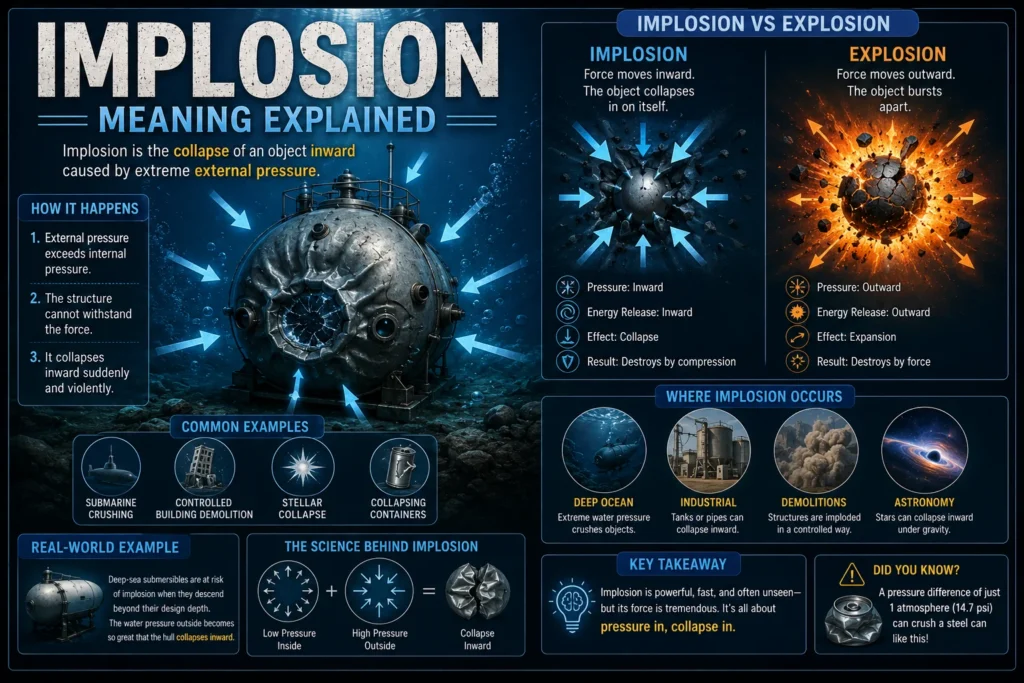
An implosion occurs when something collapses inward instead of bursting outward. In science, it happens when external pressure exceeds an object’s ability to withstand it. In everyday language, implosion can also describe the sudden internal collapse of a person, company, relationship, team, or organization.
The word implosion gained widespread attention after several major news events involving deep-sea vessels, structural failures, and business collapses. However, the term has existed for centuries and carries meanings far beyond science.
Many people understand what an explosion looks like. A blast pushes energy outward. An implosion does the opposite. It forces matter inward.
Because of this unique characteristic, the word appears in multiple fields, including:
- Physics
- Engineering
- Military science
- Psychology
- Business
- Politics
- Social media discussions
Today, people often use implosion both literally and metaphorically. For example, a submarine can implode under pressure. Likewise, a company can experience an internal implosion due to poor leadership.
This comprehensive guide explains the complete implosion meaning, its scientific foundations, emotional interpretations, modern usage, examples, and common misconceptions.
Quick Answer Box
| Element | Explanation |
|---|---|
| Meaning | Inward collapse caused by pressure |
| Type | Scientific and metaphorical term |
| Opposite | Explosion |
| Common Context | Physics, engineering, business, emotions |
| Example | “The organization suffered an internal implosion.” |
| Tone | Serious, technical, dramatic |
| Platforms | News, social media, educational content |
What Does Implosion Mean?
At its simplest, implosion means a violent or rapid collapse inward.
Unlike an explosion, where force moves outward from a center point, an implosion causes material to move toward the center.
For example:
“The structure imploded under extreme pressure.”
In this sentence, external forces caused the object to collapse inward.
The word can also describe non-physical situations.
Example:
“The startup experienced an implosion after leadership conflicts.”
Here, implosion refers to internal breakdown rather than physical collapse.
Therefore, the central idea behind implosion is inward destruction or collapse.
Full Definition of Implosion
The meaning varies depending on context.
Scientific Definition
In science, implosion occurs when outside pressure becomes stronger than the object’s internal resistance.
As a result, the object collapses inward.
Example:
“The vessel imploded deep underwater.”
Engineering Definition
Engineers use implosion to describe controlled inward collapses.
For example:
- Building demolitions
- Structural failures
- Pressure vessel collapses
Emotional Definition
People sometimes use implosion to describe emotional breakdown.
Example:
“Years of stress led to an emotional implosion.”
Business Definition
Companies can implode when internal problems destroy operations.
Example:
“The company imploded after executive disputes.”
Social Definition
Groups, organizations, or communities may implode because of internal conflict.
Example:
“The movement imploded due to disagreements.”
The Origin and History of Implosion
The word derives from Latin roots.
The prefix im- means inward.
The root plodere means to strike or clap.
Over time, scientists adopted the term to describe inward-directed forces.
Initially, the word appeared primarily in technical discussions.
However, journalists and writers later expanded its use into everyday language.
Consequently, modern English uses implosion both literally and metaphorically.
How Implosion Works Scientifically
Understanding the science helps clarify the meaning.
External Pressure Exceeds Internal Pressure
An object contains internal pressure.
Meanwhile, external forces push against it.
If external pressure becomes overwhelming, collapse begins.
Inward Compression
Instead of bursting outward, the structure compresses inward.
This inward movement defines an implosion.
Rapid Energy Release
Although implosion moves inward, significant energy still exists.
Therefore, implosions can be extremely destructive.
Structural Failure
The object’s material can no longer resist force.
Consequently, collapse occurs.
Implosion vs Explosion
Many people confuse these terms.
Implosion
Characteristics:
- Moves inward
- Caused by external pressure
- Compresses toward center
- Collapses internally
Example:
“The vessel imploded underwater.”
Explosion
Characteristics:
- Moves outward
- Caused by internal pressure release
- Expands away from center
- Produces outward force
Example:
“The tank exploded.”
Quick Comparison
| Implosion | Explosion |
|---|---|
| Inward collapse | Outward burst |
| External pressure dominates | Internal pressure dominates |
| Compression | Expansion |
| Collapse toward center | Expansion away from center |
Therefore, the direction of force represents the biggest difference.
Context and Usage of Implosion
The word appears in many settings.
Scientific Context
Scientists discuss implosion when studying pressure systems.
Example:
“The chamber experienced an implosion.”
Engineering Context
Engineers use the term during demolition projects.
Example:
“The building underwent a controlled implosion.”
Business Context
Business leaders often describe internal collapse as implosion.
Example:
“Management failures triggered an implosion.”
Political Context
Political commentators sometimes use the term metaphorically.
Example:
“The campaign imploded before election day.”
Personal Context
People occasionally describe emotional struggles using the term.
Example:
“He suffered an emotional implosion.”
Emotional Meaning of Implosion
Although implosion began as a scientific term, people frequently use it emotionally.
In emotional contexts, implosion often suggests:
- Internal stress
- Hidden pressure
- Suppressed emotions
- Mental exhaustion
- Self-destruction
For example:
“She kept everything inside until she finally imploded.”
The statement suggests overwhelming emotional pressure.
Therefore, emotional implosion usually involves inward suffering rather than outward conflict.
Real-Life Examples of Implosion
Understanding real situations makes the concept easier to grasp.
Example 1: Deep-Sea Vessel
A submersible travels to extreme depths.
External water pressure increases dramatically.
The hull fails.
The vessel implodes.
Example 2: Building Demolition
Engineers strategically remove support structures.
The building collapses inward.
This controlled process creates an implosion.
Example 3: Business Collapse
Executives argue continuously.
Employees leave.
Investors lose confidence.
Eventually, the company implodes.
Example 4: Relationship Breakdown
Partners avoid discussing problems.
Pressure builds internally.
The relationship eventually implodes.
Example 5: Personal Burnout
Someone suppresses stress for years.
Mental pressure accumulates.
Eventually, emotional collapse occurs.
Conversation Examples
Conversation Example 1
Sarah: What happened to the company?
Jake: It basically imploded.
Sarah: Because of competition?
Jake: Mostly because of internal problems.
Conversation Example 2
Chris: Why are scientists discussing implosion?
Emma: The vessel collapsed inward under pressure.
Conversation Example 3
Ryan: The campaign ended suddenly.
Taylor: It imploded after multiple scandals.
Conversation Example 4
Alex: Why did the friendship end?
Sophia: Years of unresolved issues caused it to implode.
Conversation Example 5
Mark: He seems overwhelmed.
Grace: He’s dealing with an emotional implosion.
Platform-Specific Meaning of Implosion
Different platforms use the term differently.
Implosion on Social Media
On X, Facebook, and Threads, people often use implosion metaphorically.
Examples include:
- Celebrity scandals
- Corporate failures
- Political crises
- Public controversies
Example:
“The brand’s reputation imploded overnight.”
Implosion on TikTok
TikTok creators frequently use implosion in storytelling videos.
Common topics include:
- Mental health
- Relationships
- Career setbacks
- Life lessons
Example:
“My entire plan imploded in one week.”
Implosion on YouTube
Educational creators often explain scientific implosions.
Topics include:
- Physics
- Ocean pressure
- Structural engineering
- Building demolitions
Implosion in News Media
Journalists commonly use the word when describing:
- Corporate collapse
- Political failures
- Financial disasters
- Technical accidents
Implosion in Online Communities
Forum users frequently use the term to describe internal group conflict.
Example:
“The community imploded after leadership disputes.”
Alternative Meanings of Implosion
The word carries several related meanings.
Physical Collapse
The original meaning.
Example:
“The container imploded.”
Internal Failure
Common business usage.
Example:
“The organization imploded.”
Emotional Breakdown
Psychological usage.
Example:
“She experienced an emotional implosion.”
Social Disintegration
Group-related usage.
Example:
“The movement imploded.”
Sudden Self-Destruction
General metaphorical usage.
Example:
“The project imploded.”
Related Terms and NLP Variations
Search engines and AI systems associate implosion with numerous related concepts.
Important semantic variations include:
- Inward collapse
- Structural failure
- Compression
- Internal collapse
- Pressure failure
- Building demolition
- Emotional breakdown
- Corporate collapse
- Organizational failure
- Internal conflict
- Self-destruction
- Catastrophic failure
- Structural compression
- Breakdown
- Collapse
- Destruction
- Pressure damage
- System failure
- Organizational crisis
- Controlled demolition
These related terms help search engines understand broader user intent.
How to Respond When Someone Uses Implosion
Responses depend on context.
If It Refers to Science
Response:
“The object collapsed inward because of pressure.”
If It Refers to Business
Response:
“It sounds like internal issues caused the failure.”
If It Refers to Emotions
Response:
“That sounds like a period of intense stress.”
If It Refers to Politics
Response:
“Internal conflict appears to have caused the collapse.”
If It Refers to Relationships
Response:
“Unresolved problems often create that kind of breakdown.”
Common Phrases Using Implosion
Several expressions feature the word.
Emotional Implosion
Internal psychological collapse.
Example:
“Years of pressure led to emotional implosion.”
Corporate Implosion
Business failure caused by internal problems.
Example:
“The company suffered a corporate implosion.”
Political Implosion
Collapse of a political movement or campaign.
Example:
“The administration faced political implosion.”
Organizational Implosion
Failure within a group.
Example:
“The nonprofit experienced organizational implosion.”
Controlled Implosion
Planned inward demolition.
Example:
“Engineers completed a controlled implosion.”
Misinterpretations of Implosion
Many misconceptions exist.
Misinterpretation 1: Implosion Means Explosion
These terms are opposites.
Misinterpretation 2: Implosions Are Always Physical
People frequently use the term metaphorically.
Misinterpretation 3: Implosion Requires Violence
Some implosions occur gradually.
Misinterpretation 4: Only Buildings Implode
People, companies, teams, and relationships can metaphorically implode.
Misinterpretation 5: Implosion Always Happens Instantly
Pressure can build slowly before collapse occurs.
Edge Cases and Special Uses
Certain situations require additional interpretation.
Financial Implosion
Economic systems can implode because of debt or poor management.
Celebrity Implosion
Media outlets often describe public reputation collapses this way.
Sports Team Implosion
Teams may implode after internal conflict.
Technology Startup Implosion
Internal leadership issues often trigger this usage.
Creative Writing
Authors use implosion to symbolize psychological collapse.
Therefore, context remains essential.
When NOT to Use Implosion
Avoid using the term for minor setbacks.
Examples include:
- Small mistakes
- Routine disagreements
- Temporary delays
- Minor inconveniences
Instead of:
“My lunch plans imploded.”
Use:
“My lunch plans changed.”
Therefore, reserve implosion for major collapses or failures.
Usage Tips for Using Implosion Correctly
Focus on Inward Collapse
The defining feature is inward failure.
Consider Scale
Implosion usually suggests something significant.
Match the Context
Scientific and metaphorical meanings differ.
Avoid Overuse
The word carries dramatic weight.
Remember the Opposite
Explosion moves outward.
Implosion moves inward.
This distinction helps ensure accuracy.
FAQs About Implosion Meaning
What does implosion mean in simple words?
Implosion means collapsing inward because of pressure or internal failure.
What is the opposite of implosion?
The opposite is explosion, which pushes force outward.
Can people implode emotionally?
Yes. People often use implosion to describe emotional breakdown caused by internal stress.
What causes an implosion?
In physical systems, external pressure exceeds internal resistance.
Is implosion always physical?
No. The term also describes emotional, business, political, and social collapse.
What is a controlled implosion?
It is a planned inward collapse, usually used in building demolition.
Why do submarines implode?
Extreme water pressure can exceed the vessel’s structural limits.
Can companies implode?
Yes. Internal conflicts, poor leadership, and financial issues can cause corporate implosion.
Is implosion a scientific term?
Yes. Scientists and engineers use it to describe inward collapse caused by pressure.
Why is implosion used metaphorically?
Because many failures result from internal pressure rather than external attacks.
Conclusion
The implosion meaning centers on one core idea: collapse inward rather than outward. In science, implosion occurs when external pressure overwhelms a structure. In everyday language, the term describes internal breakdowns within people, relationships, organizations, businesses, and political movements.
Because of its powerful imagery, implosion has become one of the most effective words for describing collapse caused by internal pressure. Whether discussing deep-sea engineering, emotional stress, corporate failure, or social conflict, the concept remains the same.
Therefore, whenever you encounter the word implosion, think of hidden pressure building beneath the surface until something can no longer hold together and collapses inward.

Victoria Lane is a grammar-focused writer at GramBrix.com, passionate about helping readers master the rules of language. She provides clear explanations and practical examples that make writing more accurate, polished and confident.