
Last Updated on July 24, 2026
An AI text humanizer transforms machine generated content to sound like natural human writing. It works by analyzing and modifying specific patterns that make AI text recognizable, including overused vocabulary, uniform sentence structure, predictable grammar, and statistical signatures. Humanization techniques include empathy first prompting, sentence variation, real world example injection, strategic imperfection, and voice matching. The goal isn’t to deceive but to create more engaging, readable content that connects with actual readers. While AI detection tools exist, they’re increasingly fragile against advanced humanization techniques. The most effective approach combines technology with human editing for the best results.
Maybe it’s the way every sentence marches forward with the same rhythm. Or perhaps it’s those overused phrases that scream “machine” to anyone paying attention. Whatever it is, you know this content needs to sound more human before it reaches your audience.
Humanizing AI content isn’t just about tricking detectors. It’s about creating writing that actually connects with real people. This guide walks you through everything you need to know about how to humanize AI text effectively, from understanding why AI sounds robotic to implementing proven techniques that work.
What Does It Mean to Humanize AI Text?
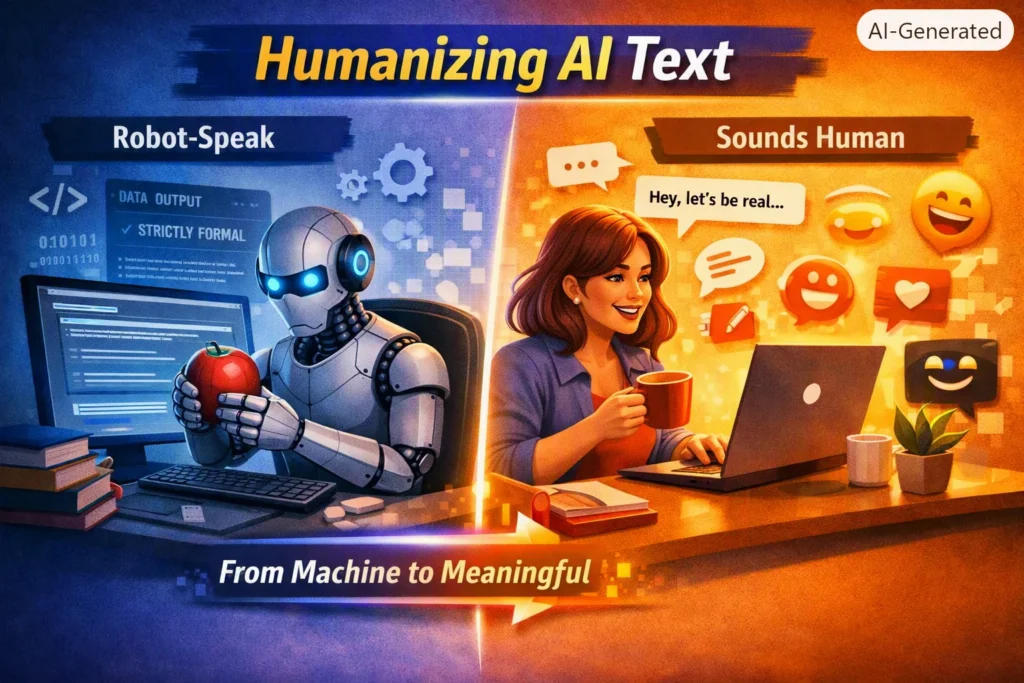
Humanizing AI text means transforming machine-generated content so it reads like a thoughtful person wrote it. This goes beyond simple paraphrasing. You’re fundamentally shifting the tone, rhythm, vocabulary, and structure to match natural human communication patterns.
Think about how you actually talk. You use contractions. You pause. You change your mind mid-sentence. You crack jokes. You repeat yourself for emphasis. These seemingly imperfect qualities are precisely what make human writing engaging.
An AI text humanizer aims to inject these qualities back into content that started as sterile machine output. The goal isn’t perfection. The goal is connection.
Why AI-Generated Content Sounds Robotic
Understanding why AI text sounds unnatural helps you fix it. The problem runs deeper than just vocabulary choices.
The Statistical Pattern Problem
Large language models work by predicting the next most likely word based on training data. This creates predictable patterns. A 2025 study published in the Proceedings of the National Academy of Sciences analyzed these patterns extensively.
The researchers found that instruction-tuned models like ChatGPT produce text that’s significantly denser and more noun-heavy than human writing. Here’s what they discovered:
| Pattern | How Often in AI Text |
|---|---|
| Present participial clauses (“leaning on his expertise…”) | 2-5x more than humans |
| Nominalizations (turning verbs into nouns) | 1.5-2x more than humans |
| Agentless passive voice | Half the rate of humans |
These patterns create a distinct fingerprint. AI tries to sound authoritative but ends up sounding formulaic. The vocabulary choices follow similar predictable paths.
The Vocabulary Red Flag
Certain words appear in AI text at rates that would be statistically impossible for human writers. AI detection researchers at GPTZero compiled a list of major offenders:
- “Provide a valuable insight” appears 182x more in AI text
- “Left an indelible mark” appears 111x more
- “A stark reminder” appears 88x more
- “A nuanced understanding” appears 77x more
- “Significant role in shaping” appears 70x more
Using “tapestry” as a metaphor? You’re practically broadcasting that an LLM wrote your content.
The Uniformity Problem
A 2025 study in Humanities and Social Sciences Communications used Burrows’ Delta to compare human and AI creative writing. The findings were striking:
Human-authored texts form broader, more heterogeneous clusters, reflecting the diversity of individual expression. In contrast, LLM outputs display a higher degree of stylistic uniformity, clustering tightly by model.
Even GPT-4, despite its sophistication, retains a detectable stylistic signature. The uniformity comes from how these models train—they optimize toward a “most likely” output that averages out the quirks that make human writing unique.
How AI Detectors Actually Work
To effectively humanize AI content, you need to understand how detection systems operate. This knowledge helps you target specific patterns.
Two Main Detection Approaches
Passive Detection examines intrinsic textual features:
- Surface patterns like word frequency and sentence length
- Statistical regularities like perplexity and burstiness
- Stylistic markers like grammatical patterns and vocabulary choices
Active Detection embeds signals during generation:
- Watermarking subtly modifies token selection
- Semantic retrieval compares content against known AI samples
Why Detectors Are Fragile
Here’s the uncomfortable truth: AI detectors are surprisingly easy to bypass. Research at EMNLP 2025 introduced the Contrastive Paraphrase Attack (CoPA). This method uses off-the-shelf LLMs to generate text that consistently evades detection.
Even more dramatic research presented at NeurIPS 2025 showed that adversarial paraphrasing reduced detection rates by an average of 87.88% across multiple systems.
The implication: Detection tools are fighting a losing battle. The same technology that creates AI text can also help it evade detection. This makes the humanization process about more than just “fooling the detector.”
7 Proven Strategies to Humanize AI Content
These strategies target the specific patterns researchers have identified. Each one addresses a different aspect of what makes AI text sound machine-generated.
1. Start With Empathy-First Prompts
Most people approach AI prompting like they’re issuing commands. This yields generic, robotic output. Instead, frame your prompts with context and emotional intelligence.
Weak prompt: “Write a blog post about SEO tips”
Effective prompt: “Write a blog post like a kind, helpful SEO strategist giving time-saving advice to a burnt-out marketing team that’s behind on content deadlines”
This shift changes everything. The AI now generates content with a specific audience, emotion, and context in mind. The output naturally sounds more human because the prompt itself contains human elements.
2. Break Predictable Patterns
AI loves formulaic structures. Your job is to disrupt them systematically.
Look for these common offenders:
- Transitional phrases like “In today’s fast-paced world”
- Perfect parallel structures that humans rarely use
- Overused em-dashes (those long dashes AI adores)
- Crutch words like “leverage,” “unleash,” and “ensure”
Example substitution:
- AI original: “It’s worth noting that leveraging these strategies will ensure optimal results.”
- Humanized: “These strategies work. We’ve tested them ourselves.”
The second version uses shorter sentences, active voice, and personal experience. It sounds like someone actually talking.
3. Vary Your Sentences Dramatically
Burstiness—the variation between long and short sentences—is one of the strongest markers of human writing.
AI-generated text tends toward consistent sentence lengths. Real human writing has rhythm:
A short, punchy sentence. Then a longer, more complex one that meanders through a thought before landing on its point. And then maybe another short one.
This variation reflects how we actually think. We don’t produce perfectly balanced sentences in our heads. We have bursts of insight, followed by longer explanations, followed by quick conclusions.
Try this exercise: Read your content aloud. If every sentence takes about the same breath length, you need more variation.
4. Inject Real-World Specificity
AI has training data. It doesn’t have personal experience. This difference shows up clearly in generic, vague language.
What AI produces:
“Our clients saw significant improvements in their metrics after implementing these strategies.”
What humans write:
“One client, a boutique hotel chain, boosted their direct bookings by 34% within two months. Their marketing director told us, ‘We’d tried everything else. This finally moved the needle.'”
The human version includes specific numbers, a direct quote, and a concrete example. These details create trust and engagement.
Ways to add specificity:
- Customer anecdotes (with permission)
- Behind-the-scenes moments
- Internal team wins and struggles
- Specific numbers from your actual experience
- Failure stories that led to learning
5. Edit Like a Human, Not a Grammar Bot
Your editing workflow matters. A layered approach works best:
- AI generates a rough draft
- You edit for tone, voice, and authenticity (not just grammar)
- Run through grammar tools lightly (perfection itself is suspicious)
- Have a colleague read for “is this actually how we talk?”
The key insight: editing AI content differs from editing human content. You’re systematically undoing machine patterns, not just fixing typos.
Common AI patterns to edit out:
- Overly complex sentences simplified
- Perfect parallel structures broken up
- Formal vocabulary replaced with conversational alternatives
- Passive voice converted to active where appropriate
6. Use Imperfection Strategically
Humans ramble. We make bad jokes. We contradict ourselves. And weirdly, that makes us more relatable.
Try incorporating:
- Light humor (“Not gonna lie, we almost gave up on this project…”)
- Strategic hesitation (“This might sound counterintuitive, but…”)
- Work-in-progress admissions (“We’re still learning what works here”)
- Self-deprecation (“We definitely made some mistakes along the way”)
These small touches signal authenticity in ways that perfect writing never can. They show a real person behind the words.
7. Match Your Specific Voice
The “one-size-fits-all human voice” doesn’t exist. Your brand’s voice is your competitive advantage.
Create a brand voice guide that includes:
- Tone rules (formal vs. casual, humorous vs. serious)
- Taboo phrases to avoid
- “Sounds like” analogies (e.g., “Think Apple, not Samsung”)
- Preferred sentence structures
- Vocabulary preferences
A law firm needs a different “human voice” than a lifestyle blog. Matching your specific voice creates consistency and authenticity.
The Humanization Tool Ecosystem
Several tools now exist specifically for humanizing AI content. Each takes a different approach.
| Tool | Approach | Voice Levels | Setup Required |
|---|---|---|---|
| Lynote.ai | Translation chain + LLM rewriting | Multiple tiers | Zero (web-based) |
| Humanize Chrome Extension | Targeted prompt engineering | 8 voice levels | Browser extension |
| Hastewire | Pattern-level rewriting | 4 writing styles | Chrome extension |
How Lynote.ai Works
The Standard Pipeline demonstrates sophisticated humanization technology:
- LLM rewrites text in Chinese (breaking English statistical patterns)
- Another LLM rewrites from Chinese to Japanese (second structural shift)
- Google Translate moves it to Finnish (linguistic disruption)
- Niutrans translates back to English (cross-engine reconstruction)
Why this works: two different neural machine translation engines introduce compounding structural changes. No single engine’s fingerprint survives.
Results from testing: The Standard pipeline achieved a 9.1/10 expert quality score with 100% key information retention across 50 test pairs.
What These Tools Actually Do
Most AI humanizer tools target specific patterns:
| Pattern Targeted | How Tools Address It |
|---|---|
| Predictable vocabulary | Synonym substitution with contextual awareness |
| Uniform sentence structure | Length and rhythm randomization |
| Formal tone | Conversational alternatives suggested |
| Overused phrases | Pattern detection and replacement |
| Statistical signatures | Structural rewriting at multiple levels |
The best tools don’t just swap synonyms. They restructure content at the sentence and paragraph level.
The Ethics of Humanizing AI Content
Before implementing these techniques, consider the broader context.
What Humanization Is Not
Humanizing AI content isn’t about deception. It’s about bridging a gap between what AI produces and what readers genuinely connect with.
A researcher from the Carnegie Mellon team explained the distinction well:
“I care that my doctor’s notes are accurate. I don’t really care if they’re in the voice of my doctor. But if I’m writing a job application letter where I want to stand out, that matters a great deal.”
Purpose matters. Using humanization for marketing content that readers expect to be polished differs from submitting humanized work as your own in an academic setting.
The Academic Integrity Question
Stylometric analysis has clear limitations when applied to students. As one researcher noted:
“Students are not stylistically coherent subjects. Their writing evolves across time and task, reflecting shifting competencies, disciplinary norms, and sometimes the invisible labour of support structures like grammar checkers, tutors, or peer feedback.”
Detection systems are ethically fraught. They assume a stable “authentic self” that doesn’t exist, especially for developing writers.
A Better Frame
Think of humanization not as “cheating detection” but as “making content that actually serves readers.”
When you humanize effectively, you’re not hiding AI use. You’re ensuring the final product provides value, connection, and genuine insight. The tool becomes invisible, and the message takes center stage.
Advanced Techniques for Different Content Types
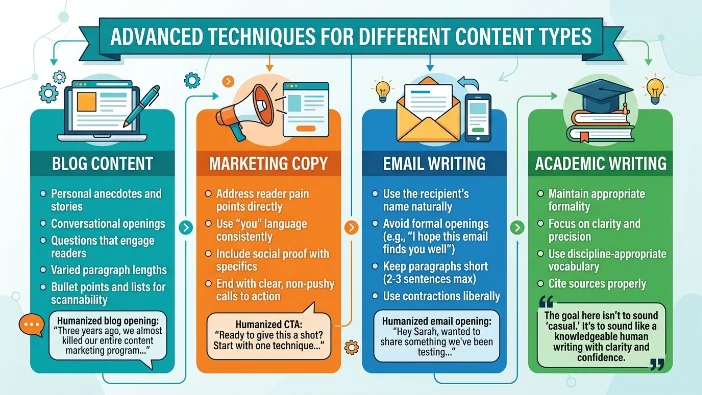
Different content types require different humanization approaches.
Blog Content
Blogs benefit most from:
- Personal anecdotes and stories
- Conversational openings
- Questions that engage readers
- Varied paragraph lengths
- Bullet points and lists for scannability
Humanized blog opening:
“Three years ago, we almost killed our entire content marketing program. We were publishing 20 posts a month, and traffic was flat. Our CEO looked at the numbers and asked a simple question: ‘What are we actually doing here?'”
Marketing Copy
Marketing copy needs to feel human while still being persuasive:
- Address reader pain points directly
- Use “you” language consistently
- Include social proof with specifics
- End with clear, non-pushy calls to action
Humanized CTA:
“Ready to give this a shot? Start with one technique from this list. Test it on your next piece. See if you notice the difference.”
Email Writing
Emails should sound like one person writing to another:
- Use the recipient’s name naturally
- Avoid formal openings like “I hope this email finds you well”
- Keep paragraphs short (2-3 sentences max)
- Use contractions liberally
Humanized email opening:
“Hey Sarah, wanted to share something we’ve been testing. It’s a bit unconventional, but the results have been surprising.”
Academic Writing
Academic contexts require more nuance:
- Maintain appropriate formality
- Focus on clarity and precision
- Use discipline-appropriate vocabulary
- Cite sources properly
The goal here isn’t to sound “casual.” It’s to sound like a knowledgeable human writing with clarity and confidence.
Measuring Success
How do you know your humanization efforts are working?
Readability Metrics
Track these metrics to measure improvement:
| Metric | What It Measures | Target |
|---|---|---|
| Flesch Reading Ease | Sentence and word complexity | 60-70 for general audiences |
| Flesch-Kincaid Grade Level | US grade level needed | 8-10 for broad accessibility |
| Average Sentence Length | Variation indicator | Mix of 5-25 words |
| Passive Voice Percentage | Active vs. passive | Under 10% ideal |
Engagement Signals
Watch for real-world indicators:
- Time on page (longer indicates better engagement)
- Scroll depth (readers continuing further)
- Social shares (sharing indicates connection)
- Comments (conversation indicates resonance)
- Conversion rates (action indicates persuasion)
The Ultimate Test
The most important metric: Does your content sound like a thoughtful, intelligent person explaining something to a friend?
Read it aloud. Ask someone else to read it. If it feels stilted or unnatural, keep working.
Common Mistakes to Avoid
Even with the right strategies, pitfalls exist.
Overcorrection
Trying too hard to sound human can backfire. Excessive slang, forced humor, or unnatural casualness feels just as fake as robotic AI text.
Instead: Aim for natural authenticity. Write like you talk, not like you’re trying to impress.
Ignoring Context
Humanization varies by context. What works for a TikTok caption fails for a financial report. Match your approach to your audience and purpose.
Forgetting the Core Message
Humanization should enhance clarity, not obscure it. Never sacrifice substance for style.
Relying Solely on Tools
Tools help, but they don’t replace human judgment. A tool can swap synonyms. Only a human can determine if the meaning remains intact and the voice stays authentic.
Implementation Checklist
When you’re ready to apply these techniques:
- [ ] Audit your current AI outputs. Highlight overused words and repetitive structures.
- [ ] Create a brand voice guide. Define your tone, taboo phrases, and “sounds like” references.
- [ ] Craft empathy-first prompts. Stop writing commands; write with context and audience awareness.
- [ ] Edit in layers. Address grammar first, then voice, then authenticity.
- [ ] Add specific examples. Share real stories, customer wins, and behind-the-scenes moments.
- [ ] Vary sentence length dramatically. Short. Then long. Then maybe a medium one for contrast.
- [ ] Choose your tools carefully. Match the tool to the content type and your specific needs.
- [ ] Test with real readers. Ask for feedback on whether the content sounds natural.
- [ ] Iterate based on feedback. Humanization is an ongoing process.
The Future of AI Text Humanization
The technology continues evolving rapidly. Here’s what’s emerging:
Real-Time Humanization
Some tools now offer real-time rewriting as you type. This makes the humanization process seamless rather than an extra step.
Context-Aware Rewriting
Advanced tools consider the specific context, audience, and purpose of each piece. They don’t apply the same rules universally.
Voice Preservation
New techniques focus on preserving a specific brand voice rather than creating generic “human” text. This makes content more distinctive and authentic.
Multilingual Humanization
As AI generates content in more languages, humanization techniques adapt to linguistic patterns in each language.
The Bottom Line
Humanizing AI content isn’t about deception. It’s about connection. Your readers deserve content that engages them, respects their time, and communicates clearly. AI can help produce that content faster. But the human touch transforms it from adequate to excellent.
Start with one technique from this guide. Apply it to your next piece. Notice the difference. Then add another technique. Over time, the process becomes natural, and your content becomes more genuinely human.
The goal isn’t to create content that “passes as human.” It’s to create content that actually serves humans. When you do that, the detection concerns become secondary. Your readers won’t care whether a machine or a person wrote something. They’ll care whether it was worth their time.
And that’s the humanization that actually matters.
Infographic: The AI Humanization Process
| Stage | What Happens | Key Techniques |
|---|---|---|
| 1. Detection | Identify AI patterns | Auditing, pattern recognition |
| 2. Structural Rewriting | Change sentence flow | Variation, restructuring |
| 3. Vocabulary Shifting | Replace overused words | Synonym awareness, context checking |
| 4. Voice Matching | Apply brand voice | Style guides, consistent tone |
| 5. Specificity Injection | Add real details | Examples, anecdotes, numbers |
| 6. Human Editing | Final refinement | Reading aloud, peer review |
| 7. Testing | Verify naturalness | Reader feedback, engagement metrics |
FAQs
What does it mean to humanize AI text?
Humanizing AI text means transforming machine-generated content so it reads like a thoughtful person wrote it. This involves changing sentence structure, vocabulary, tone, rhythm, and adding specific details that make the writing feel authentic and engaging rather than robotic and formulaic.
Can AI detectors detect humanized text?
The short answer is sometimes. But detection tools are becoming less reliable. Research shows adversarial techniques can reduce detection rates by over 85%. More importantly, high-quality humanization focuses on creating genuinely good content rather than just tricking detectors. When you write for humans first, detection becomes secondary.
Is using an AI humanizer considered cheating?
That depends entirely on context. Using humanization to create better marketing content that serves your audience? That’s smart. Using it to pass off AI-generated work as your own in academic settings? That’s problematic. The ethics depend on your purpose and transparency.
How do I make ChatGPT text sound more human?
Start with empathy-first prompting. Instead of “write a blog post,” try “write a blog post like a kind expert explaining this to a friend.” Then edit for overused patterns. Vary your sentence lengths. Add specific examples and personal anecdotes. Remove formulaic transitions and crutch words. The seven strategies in this guide provide a complete framework.
What are the best AI humanizer tools?
Tools like Lynote.ai, Humanize Chrome Extension, and Hastewire each take different approaches. Lynote uses translation chain technology for structural rewriting. Humanize offers eight voice levels through prompt engineering. Hastewire focuses on pattern-level rewriting. The best tool depends on your specific needs and content type.
How long does it take to humanize AI content?
That depends on your process. A simple blog post might take 15-30 minutes with the right approach. Longer, more complex content could take an hour or more. The more you practice, the faster you get. Many content teams now build humanization into their standard workflow rather than treating it as an extra step.
Can humanized AI content rank well in search engines?
Yes, provided the content offers genuine value. Search engines like Google reward content that serves users well. Humanized content typically performs better because it engages readers longer, encourages sharing, and builds trust. Just ensure you’re humanizing for quality, not just to game the system.
What’s the difference between paraphrasing and humanizing?
Paraphrasing just changes the words while keeping the same structure. Humanizing goes deeper. It restructures sentences, changes rhythm, adds personality, injects specifics, and matches a consistent voice. Humanization is paraphrasing with a purpose: making content sound genuinely human.
Do I need to disclose that I used AI?
Transparency builds trust. Many creators now include notes like “This post was drafted with AI assistance and then extensively edited by humans.” For marketing content, readers often appreciate the honesty. For academic or professional contexts, check your institution or organization’s policies.
How can I test if my content sounds human?
Read it aloud. Does it sound like something you’d actually say? Ask a colleague to read it without telling them it was AI-generated. Do they notice anything odd? Check your engagement metrics. Time on page and comments often indicate whether content resonates. If something feels off, trust that instinct and keep refining.
Your Next Steps
- [ ] Pick one technique from this guide
- [ ] Apply it to your next piece of content
- [ ] Compare the before and after
- [ ] Ask someone else to read both versions
- [ ] Build a workflow that makes humanization routine
The gap between AI-generated and human-written content is narrowing. But the human element remains irreplaceable. Your voice, your experience, and your genuine connection with readers are what make content truly valuable.
Use the tools. Apply the techniques. But never forget who you’re writing for: real people who deserve content that respects their time and intelligence.
Conclusion
The rise of AI writing tools hasn’t diminished the value of human communication. If anything, it’s made it more precious. Readers crave authenticity. They can spot generic content from a mile away, even if they can’t articulate exactly what feels off.
Humanizing AI text isn’t about deception. It’s about respect. Respect for your readers’ time. Respect for their intelligence. And respect for the fundamental human desire to connect with other humans.
The strategies in this guide work because they target real patterns in how AI generates text. But they work best when you combine them with your own judgment, experience, and voice. No tool can replace your understanding of your audience. No algorithm knows your brand like you do.

Victoria Lane is a grammar-focused writer at GramBrix.com, passionate about helping readers master the rules of language. She provides clear explanations and practical examples that make writing more accurate, polished and confident.