
Last Updated on July 25, 2026
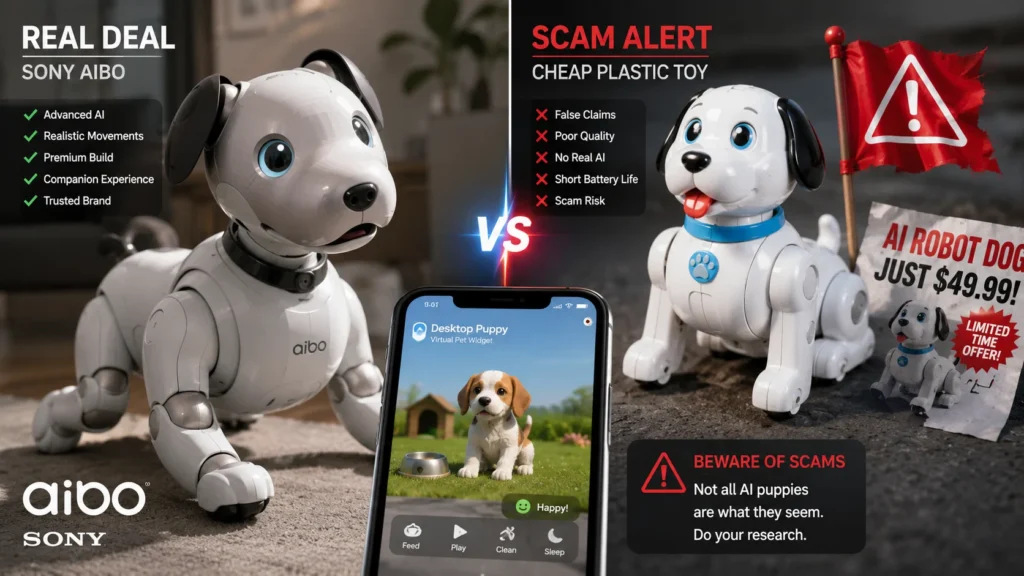
AI puppies come in three forms: physical robot dogs like Sony’s $3,000 Aibo, virtual companion apps that live on your phone screen, and scam products like the infamous Wuffy that use AI-generated ads to sell cheap plastic toys. Before you buy, know the difference. The PuppyPi robot dog is a real open source educational platform, while apps like Puppie offer desktop companionship for less than $20 a year. And if you see an ad for a 70% off “lifelike AI puppy” with thousands of glowing reviews, proceed with extreme caution.
The Rise of AI Puppies: What’s Real and What’s Hype
The concept of an AI puppy is irresistible. You get the companionship, the cute factor, and the emotional connection without the vet bills, daily walks, or sad goodbyes. But here’s the catch: the market is a wild west of genuine innovation, heartwarming therapy tools, and outright scams.
This AI puppy guide cuts through the noise. We’ll explore real AI puppy products that actually exist, expose the scams that are draining wallets, and help you figure out which path is right for you.
The Three Faces of AI Puppies
Before we dive deep, let’s establish the categories. The term AI puppy covers three very different types of products.
| Category | Examples | Price Range | What It Actually Is |
|---|---|---|---|
| Physical Robot Dogs | Sony Aibo, PuppyPi, Tombot Jennie | $500 – $3,000+ | Real hardware with motors, sensors, and AI that moves and responds physically |
| Virtual Pet Apps | Puppie, Happy Puppy | Free – $20/year | Software on your phone or desktop with AI conversation and a cute avatar |
| Scam Products | Wuffy, Waggy, Wiggy | $30 – $100 | Cheap plastic toys sold via AI-generated ads with fake reviews |
Understanding this distinction is the first step to not getting ripped off.
Physical Robot Dogs That Actually Exist
These are the real deal.
Sony Aibo: The $3,000 Comeback Kid
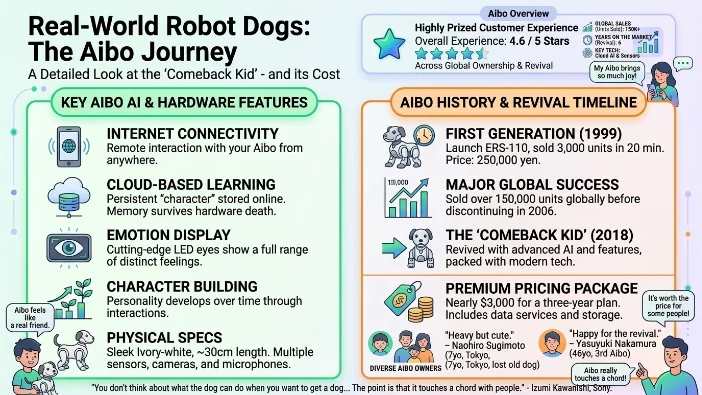
Sony’s Aibo is the granddaddy of robot dogs. The first-generation launched in 1999 and sold 3,000 units in 20 minutes at a 250,000 yen price tag. Over the years, Sony sold more than 150,000 units before discontinuing the line in 2006 during financial restructuring.
But Aibo is back. The new-generation AI puppy is a sleek ivory-white dog that weighs more than it looks. At 30 centimeters long, it’s about the size of a real small dog, and it’s packed with sensors, cameras, and microphones.
Here’s what makes this AI puppy different from a toy:
- Internet connectivity means you can interact with it remotely from your smartphone
- Cloud-based learning stores its “character” online, so even if the hardware dies, its personality survives
- Emotion display via cutting-edge LED eyes that show a range of feelings
- Character building over time as it interacts with different people
The price? Nearly $3,000 for a three-year package that includes software services and data storage.
Is that wild? Maybe. But for some people, it’s worth it. Seven-year-old Naohiro Sugimoto from Tokyo got one after his real dog died. He described it as “heavy but cute.” A middle-aged couple bought one for their 25th anniversary. Yasuyuki Nakamura, a 46-year-old owner of his third Aibo, said he was happy to see the product revived.
As Sony’s Izumi Kawanishi put it: “You don’t think about what the dog can do when you want to get a dog, do you? The point is that it touches a chord with people.”
PuppyPi: The Open-Source Robotics Education Platform
If Aibo is the luxury car of robot dogs, PuppyPi is the STEM kit. It’s an AI puppy robot developed around the Raspberry Pi 5, featuring an aluminum alloy frame and 8 high-performance coreless servos.
The University of Alabama’s Human Technology Interaction Lab has been actively working with this platform. The project started when a student during an outreach visit simply said: “A puppy.” The lab went back, researched available platforms, and started exploring how students would react to a lifelike robot.
A computer science graduate named Eli Weber helped lead development on the project, nicknamed the robot “Scuffy” which serves as its wake word. His team built an interactive system that handles voice commands. The AI puppy constantly listens for “Scuffy” and when it hears that, it records what comes next and uses AI to decide what to do.
What this AI puppy can do:
- Voice commands for sit, stand, walk, and pushups
- Color detection and recognition
- Face recognition with familiar people
- Handshake greetings
- Target tracking and visual patrol
- Autonomous stair climbing
- SLAM mapping and navigation with LiDAR expansion
This is not a companion pet. It’s an open-source educational tool that runs ROS1 and ROS2 operating systems, supports Python programming, and is designed for learning machine vision, robot kinematics, and quadruped gait control.
Tombot Jennie: The Medical Device for Dementia Patients
Tombot’s Jennie is perhaps the most heartwarming entry in the physical robot dog category. Designed with artistic input from Jim Henson’s Creature Shop (the folks behind the Muppets), this AI puppy is specifically created for older people struggling with dementia, mild cognitive impairment, depression, PTSD, or loneliness.
The backstory: Tombot CEO Tom Stevens created Jennie in response to his mother’s dementia, which forced the family to re-home their real dog because she could no longer properly care for it.
What makes this AI puppy special:
- Hyper-realistic design that looks like a small Labrador Retriever puppy
- Touch sensors that respond to human pets
- AI-generated barks and recorded “puppy sounds” responsive to voice commands
- Smartphone app for naming the dog and monitoring engagement
- Regular software updates for new behaviors
Tombot is aiming to make Jennie the first AI puppy registered as an FDA medical device for use in hospitals and care facilities. Peer-reviewed studies suggest robotic animals can ease dementia symptoms like hallucinations and aggressive outbursts.
Virtual AI Puppies: Your Phone’s New Best Friend
Not everyone needs or wants a physical robot. Sometimes a digital AI puppy on your phone is the perfect fit, and the app market has responded.
Puppie and Happy Puppy: Desktop AI Pet Widgets
Several apps from developer 倩 郭 have emerged as popular virtual AI puppy options. These apps place a digital dog right on your phone’s home screen, Dynamic Island, or lock screen.
What these AI puppy apps offer:
- Breed selection: Pick from 10+ breeds including Shiba Inu, Samoyed, and Golden Retriever, each with a unique personality and speaking style
- Photo-to-pet: Upload a photo of your real dog and AI creates a virtual version
- Conversational AI: Your AI puppy responds to your mood, plays when you’re happy, and offers quiet companionship when you’re down
- Daily gifts: Collect marbles, clovers, rubber ducks, and seasonal limited editions
- Memory: Over time, the AI puppy gets to know you better
Pricing:
| App | Monthly Subscription | Yearly Subscription | In-App Purchases |
|---|---|---|---|
| Puppie | $3.99 | $17.99 | $1.99 – $39.99 for “cans” (currency) |
| Happy Puppy | Not specified | Not specified | $1.99 – $39.99 |
These AI puppy apps require iOS 18.0 or later and are 12-13 MB in size. User reviews suggest they’re “healing” and “warm,” though some users note limited functionality and wish for more daily interaction opportunities.
OpenAI Codex Pets: Coding Companions
OpenAI has entered the virtual pet space too. The company recently rolled out AI “pets” for its agentic coding tool Codex. These pets act as floating overlays on your screen, giving you progress updates while you work on other tasks.
Key details:
- Eight built-in pets including cats and dogs
- Custom pet creation by prompting Codex
- Support for characters from Star Wars, Harry Potter, Pokémon, and Dragon Ball Z
- Available on Windows and macOS
- Toggle on/off with
/petin the composer
This is less about companionship and more about making the coding experience a bit more personal. It’s vibe coding meets virtual pets.
The Scam Problem: Wuffy and the AI-Generated Puppy Fraud
Here’s where things get ugly. The Wuffy robot dog scam is a textbook case of how AI is being weaponized to defraud consumers.
How the Scam Works
An ad appeared on YouTube and dozens of other digital platforms featuring “the cutest robot puppy in the world.” It showed a lifelike AI puppy that responds to voice, runs around, and plays with children. The ad claimed Wuffy was “America’s number 1 robot puppy” and had won the 2025 “Toy of the Year” award, with a 70% discount.
The grandpa narrator in the ad said: “This robotic puppy looks so real, it completely fooled my neighbor, who’s a veterinarian.”
Here’s the problem: The videos in the ad are entirely AI-generated. The puppy’s size changes dramatically throughout the footage, appearing as small as a coffee mug in one shot and half a child’s size in another. The product that actually arrives is a cheap plastic toy that barks and moves primitively, indistinguishable from something you’d find in a dollar store.
Red Flags and Warnings
The Truth in Advertising (TINA.org) organization investigated and found multiple issues with getwuffy.com:
- Fake reviews: The site claimed thousands of happy customers, but the videos were AI-generated fakes
- Contradictory return policy: Advertised a “100% money-back guarantee” but the actual policy (hidden at the bottom of the page) excludes “reduced priced” products from refunds and doesn’t cover return shipping
- Suspicious images: Some photos show a person with an extra toe, a common AI artifact
- No evidence of awards: TINA.org couldn’t verify any of the advertised toy awards
- Multiple sellers: Various advertisers are pushing Wuffy and similar products (Waggy, Wiggy) with the same images and text
Who’s Behind This?
According to Google, the company responsible for the Wuffy ad is UAB Commerce Core, a Lithuanian company that has a history of fraudulent clickbait and has been the subject of multiple ASA investigations in the UK.
The company did not respond to requests for comment.
The Result: Consumers Getting Ripped Off
Trustpilot is filled with complaints from people who bought Wuffy. They describe receiving a “small squeaky toy” rather than an AI-powered robot puppy. The return process is a nightmare, with some reporting they can’t get refunds despite the advertised guarantee.
Influencer Pleasant Green, who has about 1.5 million followers, bought two Wuffy units after the ad claimed the product came from the US. The tracking showed the packages were coming from China. What arrived were cheap toys, not the lifelike AI companion from the video.
The Market Reality: Who’s Actually Using These?
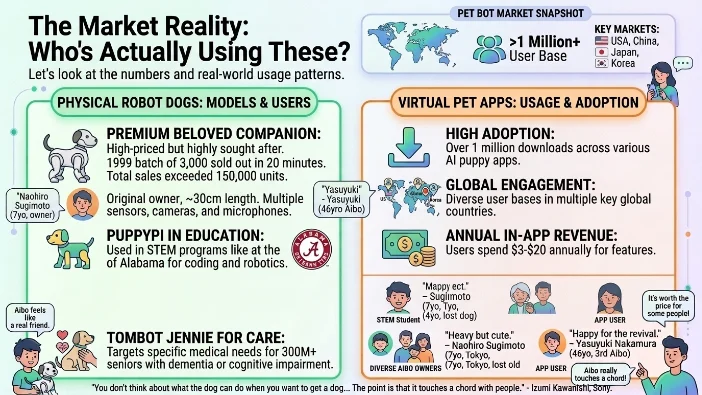
Let’s look at the numbers and real-world usage patterns.
Physical Robot Dogs
- Sony Aibo is expensive but beloved by its owners. The initial 1999 batch of 3,000 sold out in 20 minutes. Total sales eventually exceeded 150,000 units.
- PuppyPi is gaining traction in educational settings, particularly in STEM programs like those at the University of Alabama.
- Tombot Jennie is targeting a specific medical need: the 300+ million older people worldwide struggling with dementia or mild cognitive impairment.
Virtual Pet Apps
- Over 1 million downloads across the various virtual AI puppy apps, with active user bases in multiple countries including the US, China, Japan, and Korea.
- In-app purchase revenue suggests users are willing to spend $3-20 annually for the experience.
AI Puppy Generator Apps: Creating Your Perfect Digital Dog
Beyond companion apps, a whole category of AI puppy generator tools has emerged. These let you create customized AI-generated puppy images, avatars, and videos.
What These AI Puppy Generators Do
Most AI puppy creator apps let you:
- Generate realistic puppy photos from text prompts
- Turn your real dog photos into different artistic styles (cartoon, anime, oil painting)
- Create animated AI puppy videos from static images
- Design custom AI puppy avatars for social media or gaming profiles
- Generate AI puppy art for wallpapers, prints, or merchandise
Popular AI Puppy Apps in 2026
Several AI puppy maker apps have gained significant traction on both iOS and Android platforms. These include tools that offer both free and premium tiers, with pricing typically ranging from free with watermarks to $19.99 monthly subscriptions for unlimited high-resolution generations.
Some apps focus specifically on turning your existing dog photos into unique AI-generated art, while others specialize in creating entirely new AI puppy breeds that don’t exist in reality. The customization options vary widely, from simple style filters to detailed prompt-based generation where you can specify breed, pose, lighting, background, and even emotional expression.
AI Puppy App Review: Key Considerations
Before downloading any AI puppy maker app, consider these factors:
- Privacy policy: What happens to the photos you upload? Are they used to train the AI?
- Watermark removal: Free versions often include watermarks that require a paid upgrade to remove
- Resolution limits: Free tiers often cap output at 720p or 1080p
- Number of generations: Many free apps limit you to 3-5 creations per day
- Export formats: Can you download JPEG, PNG, MP4, or GIF versions?
- Commercial rights: Some apps reserve commercial rights, meaning you can’t use your generated images for business purposes
What to Watch Out For
If you’re considering an AI puppy purchase, here’s your cheat sheet for avoiding scams and making a smart choice.
Scam Red Flags
- AI-generated ads: If the video looks too perfect or the puppy’s size keeps changing, it’s likely fake
- Suspiciously low prices: A $30 “AI-powered robot” with lifelike movement? That’s impossible. The cheapest functional robot dog costs $500+
- Hidden return policies: Any “100% guarantee” that requires clicking a tiny link at the bottom of the page is suspect
- Fake awards: Verify awards independently. No real “2025 Toy of the Year” award exists for Wuffy
- Multiple similar product names: Waggy, Wiggy, Wuffy. These are the same scam with different names
What to Actually Look For
- Reviews on third-party sites: Check Trustpilot and other independent review platforms
- Product specifications: Real AI puppy robot dogs have clear specs processor type (Raspberry Pi, Intel), number of servos, battery life
- Source of the company: Where is it actually shipping from?
- Return policy details: Read it before buying. If it’s buried or contradictory, run
The Verdict: Which AI Puppy Is Right for You?
| Your Situation | Recommendation | Why |
|---|---|---|
| You have $3,000 and want a real robotic companion | Sony Aibo | It’s the most advanced consumer robot dog with genuine emotional connection |
| You’re a teacher or student interested in robotics | PuppyPi | Open-source, educational, and teaches real programming skills |
| You have a family member with dementia | Tombot Jennie (when available) | Medical-grade designed for therapeutic purposes |
| You want a cheap, fun digital companion on your phone | Puppie or Happy Puppy | It’s free-to-start, $17.99/year, and lives on your screen |
| You’re a coder who wants a desktop buddy | OpenAI Codex Pets | It’s built into Codex and accessible to millions of users |
| You want to create AI puppy art for social media | AI puppy generator app | Generates custom images from text prompts |
| You see a 70% off ad for a “lifelike AI puppy” | Run away | It’s Wuffy. It’s a scam. You’ll get a cheap plastic toy. |
FAQs
What is an AI puppy?
An AI puppy is a digital or robotic dog that uses artificial intelligence to learn, respond, and interact. This can include physical robot dogs, virtual pet apps, and AI-generated images.
Is there a real AI puppy I can buy today?
Yes. Sony Aibo is available for approximately $3,000. PuppyPi is available as an educational robotics kit. Various virtual pet apps are available on iOS and Android.
What’s the difference between an AI puppy and a toy?
Real AI puppies have processors, sensors, cameras, and AI algorithms that enable learning and adaptation. Toys simply follow pre-programmed patterns.
Is Wuffy a real AI puppy?
No. Wuffy is a scam that uses AI-generated ads to sell cheap plastic toys. Consumer advocacy groups have identified dozens of identical scams under different names.
Can AI puppies replace real dogs?
No. While they can provide comfort and companionship, AI puppies cannot replace the biological and emotional connection of a living animal. They’re best viewed as supplements or alternatives for specific situations.
Are AI puppy generator apps free?
Many offer free tiers with watermarks and limited daily generations. Premium features typically cost between $9.99 and $19.99 monthly.
How do AI puppy chatbot apps work?
These apps use large language models to simulate conversation with a virtual dog. They often include memory functions, personality development, and voice interaction features.
Are virtual AI puppies safe for children?
Generally yes, but parents should monitor in-app purchases and review privacy policies. Some apps include advertising or collect user data.
Can I use AI-generated puppy images commercially?
Check the app’s terms of service. Some reserve commercial rights, while others offer full ownership with paid subscriptions.
What’s the future of AI puppies?
Expect better movement capabilities, more realistic behaviors, improved emotional intelligence, and lower prices as technology advances. Some models may eventually gain FDA approval as medical devices for therapy.
Conclusion
The answer depends entirely on what you’re looking for.
If you want a genuine robotic companion that learns, grows, and forms a unique bond with you, the Sony Aibo delivers. It’s expensive, yes. But for its owners, the price is justified by the emotional connection and the sheer engineering marvel of the device.
If you’re an educator or student passionate about robotics, PuppyPi offers a hands on learning experience that’s hard to beat. You’ll learn real programming skills, machine learning concepts, and robot kinematics while building a project that’s genuinely engaging.
If you have a loved one struggling with dementia or cognitive decline, keep an eye on Tombot Jennie. It’s not widely available yet, but its therapeutic potential is backed by peer-reviewed research.
If you just want a cute, interactive companion for your phone that costs less than a fancy coffee each month, the virtual AI puppy apps are perfect. They’re low commitment, high-adorable, and surprisingly engaging.
And if you see a flashy ad for a 70% off lifelike AI puppy, do yourself a favor: close the tab, open Trustpilot, and save yourself the headache and heartache.
AI puppies are real. They’re here. They’re evolving. But like any technology, they require smart, informed decisions. Choose wisely, and you might just find a digital best friend. Choose poorly, and you’ll end up with a plastic toy and a lighter wallet.

Justin Powell is a writer at GramBrix.com who focuses on grammar, clarity and effective communication, helping readers strengthen their language skills.