Last Updated on August 19, 2026
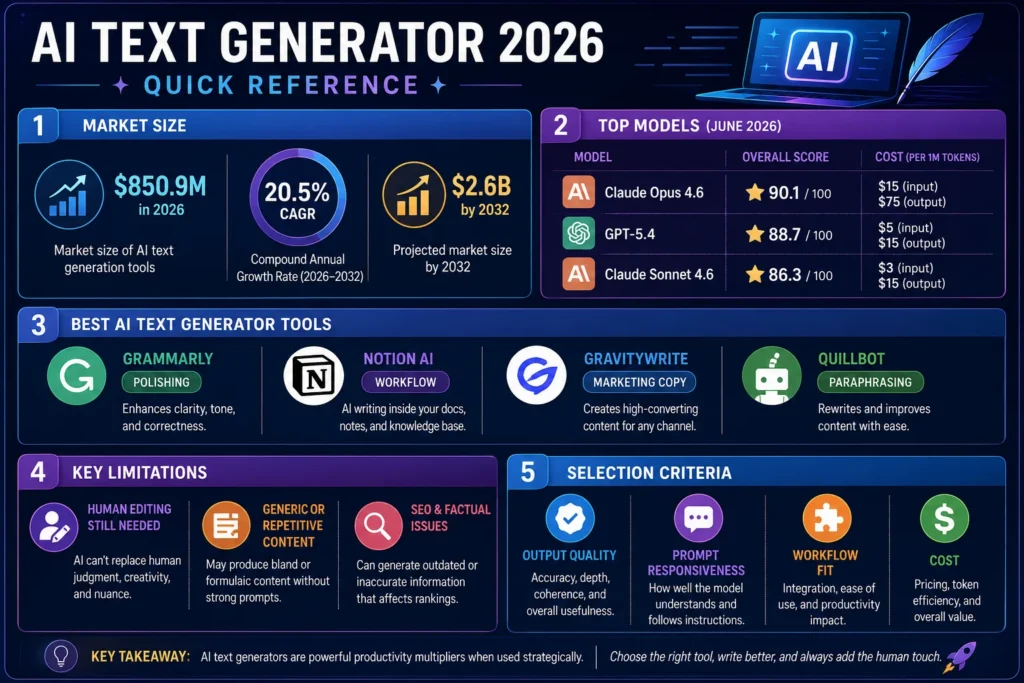
The AI text generator market is growing at a 20.5% CAGR, valued at $850.9 million in 2026 and projected to reach $1.75-$2.6 billion by 2030-2032. The top model for writing is Claude Opus 4.6, which leads benchmarks with clean long-form prose and consistent voice, though it costs $25 per million output tokens. Claude Sonnet 4.6 offers the best balance at roughly five times cheaper. GPT-5.4 is a versatile workhorse for production workloads. Consumer tools like Grammarly excel at polishing existing content, while Notion AI integrates with workspace workflows, and GravityWrite generates fast marketing copy. AI-generated content still requires human editing because outputs tend to be generic, show AI mannerisms, and lack the targeting needed for effective content marketing. Price competition is increasing with OpenAI cutting costs by 20-80%, making AI text generation more accessible. Automation benchmarks help measure structural quality but don’t fully capture what readers actually prefer. The best writing models are those that produce prose readers choose in blind comparisons, not just text that scores well on rubrics.
What Is an AI Text Generator?
An AI text generator is a software tool powered by large language models (LLMs) that creates written content from user prompts. You type in a request like “Write a blog outline about AI writing tools,” and the generator produces structured, human-like text in seconds. These tools don’t just copy and paste from the internet; they generate original content by predicting what words should come next based on patterns learned from massive datasets.
The technology behind these generators relies on natural language processing (NLP) and deep learning. Modern models analyze context, tone, and intent to produce outputs that range from marketing copy to academic essays, social media posts, and even full-length articles. They’re trained on billions of text examples, which means they understand grammar, structure, and different writing styles.
Since ChatGPT launched in 2023, the adoption of AI text generators has exploded across industries. What started as a novelty has become a business essential for content marketing, customer engagement, and workflow automation. Marketers now use these tools to draft blog posts, generate SEO-optimized content, and create email sequences that would take hours to write manually.
The fundamental rule: AI text generators don’t replace writers; they remove friction. The right tool helps you move from idea to usable draft faster, without stripping away control over the final output.
AI Text Generator Market: The Numbers
Market Size and Growth
The AI text generator market has experienced explosive growth since 2023. Here’s where things stand in 2026:
| Metric | Value |
|---|---|
| 2025 Market Value | $706.9 million – $740 million |
| 2026 Market Value | $850.9 million – $890 million |
| 2026 CAGR | 20.5% – 20.7% |
| 2030-2032 Projection | $1.75 billion – $2.6 billion |
| Forecast CAGR | 17.3% – 18.4% |
Key growth drivers:
- Increasing digital content consumption across all platforms
- Rising demand for scalable content creation in marketing and e-commerce
- Advancements in natural language processing that make outputs more human-like
- Growing enterprise adoption of AI-assisted content workflows
- Expansion of multilingual text generation capabilities
Market Trends
Multimodal generation: The next wave of AI generators doesn’t just handle text. Tools increasingly combine text with image, video, and code generation in a single platform.
Enterprise integration: AI writing assistants are being embedded directly into existing workflows through platforms like Microsoft Copilot, Google Gemini, and Salesforce.
Context-aware generation: Models are getting better at understanding specific contexts, industries, and brand voices, producing more relevant and targeted content.
Price competition: Major providers are cutting costs to attract developers and businesses. OpenAI recently slashed prices on its GPT-5.6 models by 20-80%, making AI text generation more accessible.
Top AI Models for Text Generation in 2026
The Writing Leaderboard
As of July 2026, here’s how the top AI models rank for writing quality. Rankings combine automated instruction-following metrics with blind human preference voting in the LLM Arena, where users compare outputs without knowing which model produced them.
| Rank | Model | Best For | Score | Input Cost / 1M Tokens | Output Cost / 1M Tokens | Context Window |
|---|---|---|---|---|---|---|
| 1 | Claude Opus 4.6 | Long-form coherence | 31.9 | $5.00 | $25.00 | 1.0M |
| 2 | LongCat-Flash-Thinking-2601 | Open weights | 30.0 | — | — | — |
| 3 | Claude Opus 4.5 | Natural prose | 27.2 | — | — | — |
| 4 | Claude Sonnet 4.6 | Everyday writing | — | $3.00 | $15.00 | 200K |
| 5 | GPT-5.4 | Balanced performance | — | $2.50 | $15.00 | 1.0M |
Model Deep Dives
Claude Opus 4.6 by Anthropic leads the writing leaderboard with the cleanest long-form prose and most consistent voice. Its key strength is maintaining coherence and structure over thousands of tokens, making it the gold standard for documents that require a consistent voice from start to finish. The tradeoff is cost — at $25 per million output tokens, it’s the most expensive frontier model, best suited for workflows where quality matters more than cost.
Claude Sonnet 4.6 offers the most reliable everyday writing performance at roughly five times cheaper than Opus. With a 200K context window, it handles most writing tasks well and produces natural prose with few obvious AI tells. It’s the sweet spot for most users who need Opus-class quality 80% of the time without paying Opus prices.
GPT-5.4 sits within a few points of frontier models on most benchmarks. It’s a workhorse generation model with wide provider availability and strong multimodal capabilities. It performs well on vision, audio, and code tasks, making it a versatile choice for production workloads.
GPT-5.2 remains an older OpenAI generation that’s still competitive on standard tasks. It’s cheaper than newer models and works well for legacy integrations and cost-throttled deployments.
Chinese Models
For users in or serving the Chinese market, Baidu’s ERNIE series offers competitive pricing:
| Model | Input Cost (元/千tokens) | Output Cost (元/千tokens) |
|---|---|---|
| ERNIE 4.5 Turbo | 0.0008 | 0.0032 |
| DeepSeek-V4-Flash | 0.001 | 0.002 |
| DeepSeek-V3.2 | 0.002 | 0.003 |
Best AI Text Generator Tools in 2026
Based on real-world testing and G2 Grid Reports, here are the top AI writing generators for different use cases:
Grammarly: Best for Grammar and Tone Optimization
Best for: Polishing existing content, business communication, and non-native English writers.
Grammarly works silently in the background across browsers, desktop apps, and mobile keyboards. It catches errors and suggests tone improvements without requiring copy-pasting. According to G2 data, 96% of reviewers rate the grammar check capabilities positively, and 92% highlight tone check as a key differentiator.
Key features:
- Real-time grammar, tone, and clarity correction
- Rephrasing with multiple options for the same sentence
- Plagiarism detection and style editing
- Works across 500,000+ apps and websites
What users say: Multiple reviewers describe Grammarly as a “second set of eyes” and a “confidence builder,” especially for professionals writing in English as a second language. The tool simplifies overly complex sentences and suggests better word choices.
Pricing: Premium features require a paid subscription; free version covers basic grammar and spelling.
Notion AI: Best for Workspace Integration
Best for: Teams that already use Notion for project management and documentation.
Notion AI brings AI-assisted content creation directly into the workspace. It works with interconnected databases, templates, and real-time collaboration tools, making it easy to generate content without switching between apps.
Gemini: Best for Google Workspace Integration
Best for: Heavy Google Workspace users (Gmail, Drive, Docs).
Gemini pulls context from across Google’s ecosystem, enabling content generation that’s informed by your existing documents, emails, and files. It handles code generation, translation, and multimodal tasks.
GravityWrite: Best for Fast Marketing Copy
Best for: Quick content drafting and template-based writing.
GravityWrite generates blog posts, social media captions, video scripts, and SEO-friendly content from short prompts in seconds. Starting at $8/month, it’s among the most affordable dedicated writing tools.
QuillBot: Best for Paraphrasing
Best for: Rewriting, summarizing, and refining existing text.
QuillBot offers multi-mode paraphrasing with grammar checking, plagiarism detection, AI content detection, and citation generation in one refinement tool. It’s the go-to for writers who need to repurpose or improve existing content.
How to Choose the Right AI Text Generator
Key Selection Criteria
Output quality and coherence: If the generated content needs heavy rewriting, the tool defeats its purpose. Look for tools that produce structured, readable drafts with minimal cleanup.
Prompt responsiveness: The best tools follow instructions well. They should handle prompts like “write a blog outline for [keyword]” or “rewrite this in a more engaging tone” without drifting off-topic.
Use-case versatility: Writing isn’t one-dimensional. Favor tools that handle long-form content, paraphrasing, summarization, and social media copy instead of being limited to just one format.
Workflow fit: A powerful tool that disrupts your workflow won’t get used. Focus on tools that fit naturally into your everyday work, whether inside documents, browsers, or design platforms.
Editing and rewriting capabilities: Content generation is only half the job. Pay attention to how well each tool improves clarity, tone, and readability.
Customization and tone control: Not every piece of content should sound the same. Lean toward tools that offer flexibility in tone, style, and output length.
Cost Comparison
| Tool | Starting Price | Best For |
|---|---|---|
| Grammarly | Premium (varies) | Error correction and tone |
| Notion AI | $10/user/month | Workspace integration |
| GravityWrite | $8/month | Fast marketing copy |
| QuillBot | $9.95/user/month | Paraphrasing |
| ChatGPT (GPT-5.4) | $2.50/$15.00 per 1M tokens | All-purpose generation |
| Claude Sonnet 4.6 | $3.00/$15.00 per 1M tokens | Everyday writing |
AI Text Generator Limitations: What Nobody Tells You
Content Quality Concerns
Despite rapid improvements, AI-generated content has clear limitations. A comparative study of AI writing assistants found that while the tools are relatively good at producing fluent, readable content in English, the content remains somewhat generic and high-level. It often shows certain AI mannerisms — over-hedging, repetitive structure, and formulaic transitions.
Key findings:
- Not targeted enough: AI-generated content typically doesn’t meet all the quality criteria of good content marketing. It lacks the relevance and targeting that human writers provide.
- Limited SEO/GEO optimization: The tools show limited capabilities to automatically optimize content for search engines and generative engine optimization.
- Non-English quality gaps: The quality of outputs in other languages is overall less convincing than English content.
- Human editing still required: The AI-generated content usually requires considerable human editing before it’s publish-ready.
The Best Performing Assistants
The same study found that the best-performing assistants were the generic ChatGPT and specialized Writesonic. However, even these tools don’t replace human judgment — they make writers significantly faster and more efficient, but the outputs still need human oversight.
Human Preference Matters
Automated benchmarks like AlpacaEval and MT-Bench measure instruction following and structural quality, but they reward formulaic output that scores well on rubrics. Human preference voting catches the prose-quality dimension that automated metrics miss. The best models are those that produce prose readers actually prefer, not just text that ticks rubric boxes.
Use Cases: What You Can Actually Do With AI Text Generators
Marketing and Content Creation
- Blog posts and articles
- Social media captions and posts
- Email newsletters and campaigns
- Video scripts and storyboards
- SEO-optimized content
- Product descriptions
Real-world impact: Marketers who adopt AI writing assistants report significantly faster and more efficient workflows. Content that took hours to draft can be generated in minutes, freeing up time for strategy and high-value work.
Business and Professional Communication
- Client emails and proposals
- Internal reports and documentation
- Meeting summaries and notes
- Presentation content and talking points
- Grant applications and funding proposals
Creative and Academic Writing
- Story outlines and character descriptions
- Essay structure and research summaries
- Creative writing prompts and idea generation
- Translation and localization
Code Generation
While less commonly discussed, many AI text generators include code-generation capabilities. Tools like Copilot and ChatGPT can write, debug, and explain code across multiple programming languages.
Frequently Asked Questions
What is the best AI text generator in 2026?
Claude Opus 4.6 currently leads writing benchmarks with the cleanest long-form prose and most consistent voice. For everyday use, Claude Sonnet 4.6 offers excellent quality at roughly five times cheaper.
How much does an AI text generator cost?
Costs vary widely. Consumer tools range from free to $10-$50/month. Enterprise models charge per token: Claude Opus 4.6 costs $25 per million output tokens, while GPT-5.4 costs $15 per million output tokens.
Is AI-generated content good enough to publish?
Not usually without editing. Research shows AI-generated content is fluent and readable but remains generic, shows AI mannerisms, and lacks the targeting needed for effective content marketing.
Which AI writing tool is best for professionals?
Grammarly is the most widely used professional tool for polishing content, with 96% of reviewers rating its grammar check positively. It works across 500,000+ apps and websites.
How fast is the AI text generator market growing?
The market is growing at 20.5% CAGR, valued at $850.9 million in 2026, projected to reach $1.75-$2.6 billion by 2030-2032.
Conclusion
AI text generators have evolved from experimental novelties into essential business tools in just a few years. The market is growing rapidly, models are improving, and prices are coming down. For writers, marketers, and businesses, these tools offer a way to dramatically accelerate content creation without sacrificing quality if you choose the right tool and use it correctly.
The key insight from the research is that no AI generator replaces human judgment. The tools are best at getting you from idea to draft faster, but the final polish still requires human oversight. The content may be fluent and readable, but it’s not targeted, optimized, or original enough to publish without review.
If you’re evaluating AI text generators today, start by identifying your primary use case. Are you polishing existing content? Generating marketing copy? Integrating AI into your existing workflow? The right tool depends on the answer. For most users, a tool like Claude Sonnet 4.6 offers the best balance of quality and cost, while Grammarly remains unmatched for polishing and tone optimization.
Our honest recommendation: Start with a free tier or low-cost option to understand what AI text generation can do for your specific workflow. Test multiple tools with the same prompts to see which produces outputs you actually want to use. And always budget time for human editing — that’s where the real value of AI writing assistance is realized.

Victoria Lane is a grammar-focused writer at GramBrix.com, passionate about helping readers master the rules of language. She provides clear explanations and practical examples that make writing more accurate, polished and confident.