
Last Updated on August 8, 2026
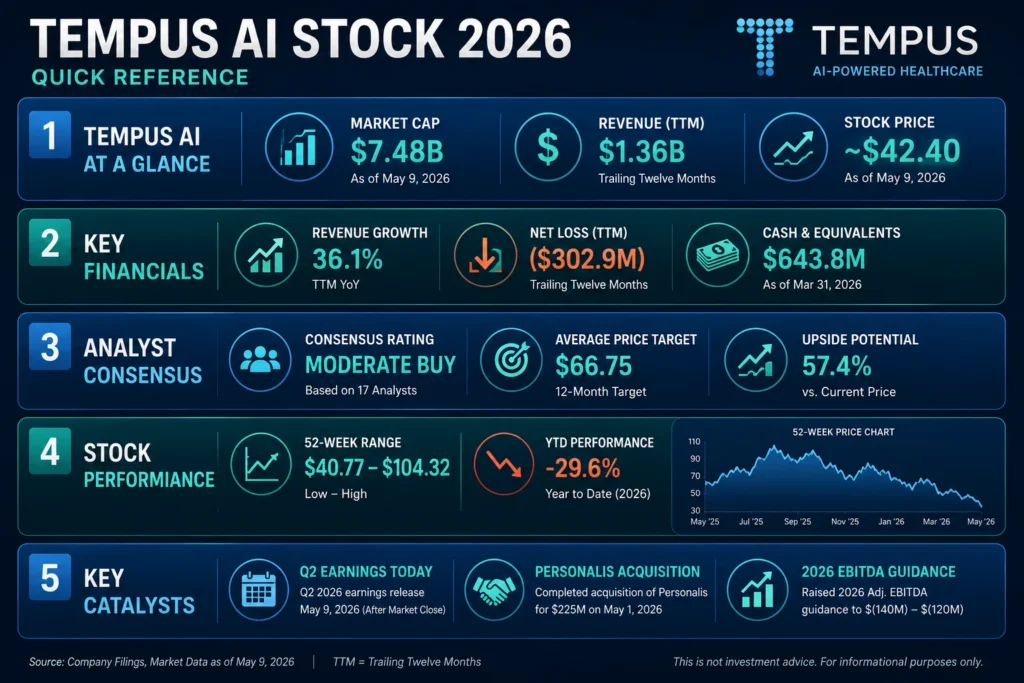
Tempus AI (NASDAQ: TEM) is a health-tech company applying AI to precision medicine. It reported $1.3 billion in revenue for 2025 (83.4% growth) and $348.1 million in Q1 2026 (36.1% growth). The company is unprofitable, with a $302.9 million trailing net loss, but expects positive adjusted EBITDA of $65 million in 2026. The stock trades near $42.40 (July 30, 2026), down 29.6% year-to-date and nearly 60% from its $104.32 all-time high. Analyst consensus is “Moderate Buy” with a $66.75 price target (57.4% upside). Key risks include the $1.5 billion Personalis acquisition causing dilution concerns, high short interest of 30.66% of float, and ongoing profitability challenges.
What Is Tempus AI?
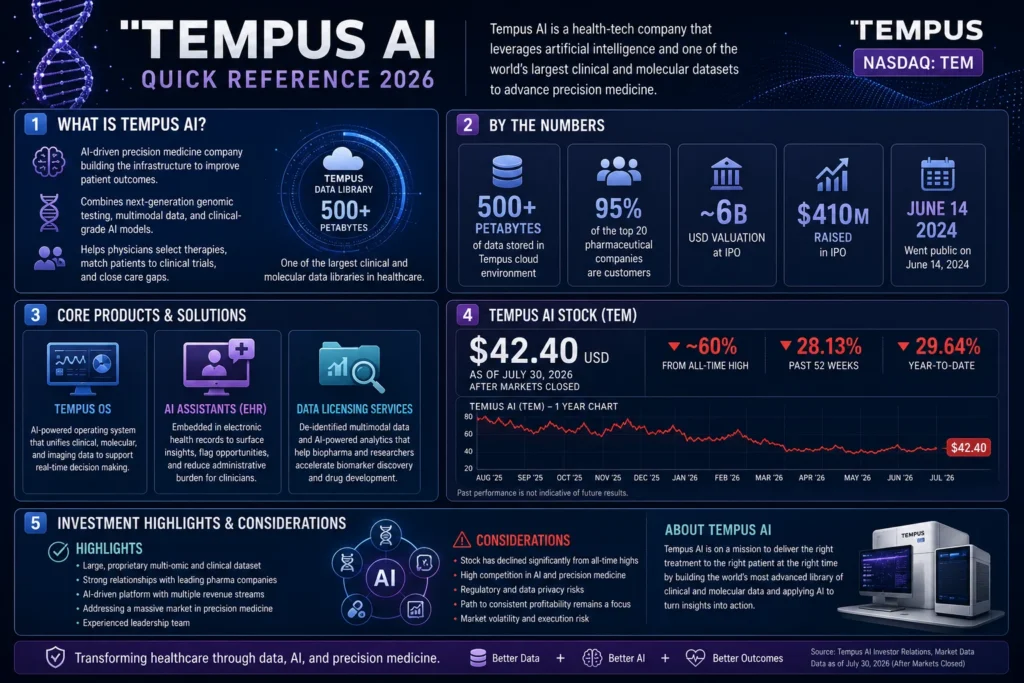
Tempus AI (NASDAQ: TEM) is a health-tech company that builds AI-driven infrastructure for precision medicine . It operates one of the largest clinical and molecular data libraries in healthcare, with over 500 petabytes of data stored in its cloud environment . The company’s platform integrates next-generation genomic testing, multimodal data ingestion, and clinical-grade AI models to help physicians select therapies, match patients to clinical trials, and close care gaps .
The company serves 95% of the top 20 pharmaceutical companies . Its core products include Tempus OS, AI assistants embedded in electronic health records, and data licensing services that help drug developers accelerate biomarker discovery. Tempus went public on June 14, 2024, raising $410 million at an approximately $6 billion valuation .
Tempus AI stock (TEM) is trading at $42.40 as of July 30, 2026 after markets closed, down approximately 60% from its all-time high. The stock has fallen 28.13% over the past 52 weeks and is down 29.64% year-to-date .
Tempus AI Financials: Revenue Growth vs. Profitability
The Revenue Story Is Impressive
Tempus AI is growing revenue at an exceptional pace. The company reported $1.3 billion in revenue for full year 2025, representing 83.4% year-over-year growth. Diagnostics generated $955.4 million, growing 111.5% year-over-year, with oncology volume up 26% and hereditary volume up 29%. The Data and Applications segment generated $316.4 million, accelerating 30.9% year-over-year.
Revenue reached $348.1 million, up 36.1% year-over-year, exceeding Street expectations of $345.5 million . Diagnostics revenue climbed 34.7% to $261.1 million, driven by oncology volume growth of 28% and hereditary volume growth of 54% . Data and Applications generated $87 million, growing 40.5% year-over-year .
| Metric | Q1 2026 | Q4 2025 | Full Year 2025 |
|---|---|---|---|
| Revenue | $348.1M | $367.2M | $1.3B |
| Revenue Growth (YoY) | 36.1% | 83.0% | 83.4% |
| Diagnostics Revenue | $261.1M | $266.9M | $955.4M |
| Data & Apps Revenue | $87.0M | $100.4M | $316.4M |
| Net Loss | ($125.9M) | ($54.2M) | ($245.0M) |
The Profitability Problem
Here’s the catch: Tempus AI is still unprofitable. The company reported a net loss of $125.9 million in Q1 2026, compared to a $68 million loss in Q1 2025 . The widening loss was driven by $56.3 million in stock compensation expense and $32.3 million in unrealized losses on marketable securities.
The company has a trailing twelve-month net loss of $302.9 million. The net loss margin sits at -22.20%, and the operating margin is -24.33%. For the full year 2025, the net loss was $245 million, which included $136.3 million in stock compensation expense.
However, there’s a silver lining: Adjusted EBITDA (which excludes stock compensation) improved significantly. Q4 2025 hit positive adjusted EBITDA of $12.9 million, and the company is guiding for full-year 2026 adjusted EBITDA of approximately $65 million. This suggests the underlying business is approaching profitability when you strip out non-cash expenses.
Key Financial Metrics (As of Q1 2026)
| Metric | Value |
|---|---|
| Market Cap | $7.48 billion |
| Revenue (TTM) | $1.36 billion |
| Gross Profit (TTM) | $864.7 million |
| Gross Margin | 63.78% |
| Net Loss (TTM) | ($302.9 million) |
| Cash & Marketable Securities | $643.8 million |
| Total Debt | $1.32 billion |
| P/E Ratio (TTM) | -24.72 |
| Price/Sales (TTM) | ~5.5 |
| EPS (TTM) | ($1.68) |
The stock is trading at a premium valuation. Forward price-to-sales ratio sits at 4.85, higher than the industry average of 3.66 . This premium reflects growth expectations, but it also means any earnings miss could trigger a sharp sell-off.
Tempus AI Stock Price History: A Volatile Ride
From IPO to All-Time High to 52-Week Low
Tempus AI went public on June 14, 2024 at approximately $37 per share. The stock soared to an all-time high closing price of $103.25 on October 8, 2025. The 52-week high reached $104.32.
The stock has since collapsed. As of July 29, 2026, TEM trades at $42.40, down roughly 60% from its all-time high . The 52-week low was hit just one day prior on July 28, 2026 at $40.77 . The stock has declined 28.13% over the past 52 weeks.
Recent Trading Shows Extreme Volatility
| Date | Close | Change | Volume |
|---|---|---|---|
| Jul 29, 2026 | $42.40 | -3.15% | 4.33M |
| Jul 28, 2026 | $42.90 | -0.02% | 6.39M |
| Jul 27, 2026 | $42.91 | +0.52% | 5.40M |
| Jul 24, 2026 | $42.69 | -7.22% | 5.78M |
| Jul 20, 2026 | $48.41 | -7.74% | 10.29M |
| Jul 16, 2026 | $53.59 | -6.39% | 4.84M |
Annual Performance
| Year | Average Price | Year High | Year Low | Year Close | Annual Change |
|---|---|---|---|---|---|
| 2026 (YTD) | ~$54.00 | $70.33 | $40.77 | ~$42.40 | -29.64% |
| 2025 | $65.13 | $103.25 | $31.83 | $59.05 | +74.91% |
Short Interest Is High
The stock is heavily shorted. As of July 15, 2026, there are 30.36 million shares short, representing 30.66% of the float . The short ratio (days to cover) is 5.03, suggesting a potential short squeeze if positive news drives buying pressure. Short interest has been declining from the prior month’s 38.06 million shares, which could indicate some short sellers are covering .
The $1.5 Billion Personalis Acquisition
What’s Happening
Tempus AI announced plans to acquire Personalis (PSNL), a seller of advanced cancer genomics tests, for $16.25 per share in stock-based consideration. The deal represents a total enterprise value of $1.5 billion, net of Tempus’ existing ownership interest .
Personalis shareholders will receive $16.25 per share, mostly in Tempus stock — a 5.6% premium to the last close of the cancer test maker’s shares. Tempus has the option to pay up to 50% of the deal value in cash . Personalis shareholders would receive a floating exchange ratio of Tempus common stock for each Personalis share held at closing, subject to a maximum exchange ratio of 0.3356 .
Why It Matters
This acquisition significantly expands Tempus’ capabilities in the minimal residual disease (MRD) market. The companies have had a relationship since November 2023, when Tempus invested in Personalis to commercialize the NeXT Personal MRD test . After the acquisition, Tempus’ multimodal data platform and oncology portfolio will integrate with Personalis’ MRD technology, expanding access to longitudinal monitoring and enhancing personalized cancer care .
The test creates a personalized genetic signature of a patient’s cancer, which doctors can track over time through blood tests to monitor for remaining or returning disease .
The MRD market is substantial. With about 2.1 million new cancer diagnoses in the U.S. annually and more people living longer after initial diagnoses, long-term monitoring is becoming critical . Tempus said Personalis’ NeXT Personal offering has seen strong adoption, with quarter-over-quarter growth of 38% .
Why Tempus Says the Timing Is Right
Tempus CEO Eric Lefkofsky said the company had reviewed Personalis in 2023 but opted at that time for a commercial agreement because Personalis still faced several years of heavy investment . Personalis has since advanced the assay and is entering a phase in which coverage and reimbursement should improve the economics of the tests.
“The reason we didn’t do this a year or two ago is we wanted to be at the point in the curve where this was going to quickly turn into a really healthy business from a gross profit and a margin perspective,” Lefkofsky said .
Market Reaction Was Negative
Investors reacted poorly to the news. The stock dropped 7.74% intraday on July 20, 2026 following the announcement . The negative reaction stems from dilution fears (the stock trades near its 52-week low), uncertainty about integration, and the fact that Tempus is using stock-based consideration at a depressed price .
Guggenheim analyst Subbu Nambi said the share prices fell due to the deal’s stock-based structure, adding that Personalis investors remain skeptical about Tempus’ potential upside .
Needham analysts, however, remain bullish. They reaffirmed a “Buy” rating and $75 price target, believing this significantly increases Tempus’ offerings in the MRD market . The deal is expected to close in late 2026 or early 2027 .
Analyst Ratings and Price Targets
Consensus: Moderate Buy
Wall Street analysts hold a soundly bullish view on Tempus AI . The consensus rating is “Moderate Buy” based on 18 analysts . The breakdown includes:
| Rating | Number of Analysts |
|---|---|
| Strong Buy | 7 |
| Moderate Buy | 2 |
| Hold | 8 |
| Moderate Sell | 1 |
Price Targets
| Target | Value | Rating |
|---|---|---|
| Consensus | $66.75 (57.4% upside) | Moderate Buy |
| Street-High | $100 (135.8% upside) | — |
| Needham | $75 | Buy |
| Guggenheim | $65 | Buy |
| BTIG | $80 | Buy |
| HC Wainwright | $64 | Buy |
| Freedom Capital | $59 | Hold |
Recent Analyst Actions
| Date | Firm | Action | Target |
|---|---|---|---|
| July 16, 2026 | Guggenheim | Upgraded to Buy | $65 |
| June 1, 2026 | Needham | Reiterated Buy | $75 |
| June 1, 2026 | BTIG | Reiterated Buy | $80 |
| May 11, 2026 | HC Wainwright | Downgraded target | $64 |
| May 8, 2026 | BTIG | Downgraded target | $80 |
Key takeaway: Even after the recent sell-off, the consensus price target implies a 57.4% upside from current levels . The Street-high target of $100 implies a 135.8% upside .
Q2 2026 Earnings: What to Expect
Earnings Date
Tempus AI is set to report second-quarter 2026 results today, July 30, after the market closes .
What Wall Street Expects
| Metric | Estimate |
|---|---|
| Revenue | $381.6 million |
| Revenue Growth (YoY) | +21.3% |
| Loss Per Share | -$0.12 to -$0.15 |
The company is expected to have incurred a loss during Q2 due to macroeconomic challenges, including escalating trade tensions affecting the healthcare technology sector . However, the Zacks Consensus Estimate for loss per share has narrowed to 12 cents over the past 30 days, suggesting some optimism . Analysts expect a year-over-year improvement of +45.5% in EPS .
Key Drivers for Q2
Diagnostics segment likely saw improvement from accelerating volume growth in oncology testing and sustained strength in hereditary sequencing . MRD volume is expected to continue its rapid growth trajectory.
Data and Applications likely experienced strong demand for proprietary data licensing and AI solutions. The company’s recent partnership announcements with Gilead, Bristol Myers Squibb, and Merck are expected to have boosted top-line growth.
However, investments tied to product development and collaborations are likely to have pushed operating expenses higher in the second quarter, putting pressure on short-term profitability . Broader macroeconomic factors like tariffs, hospital budget constraints, and biotech funding trends might have affected adoption rates.
Earnings Surprise History
Over the last four quarters, the company has beaten consensus EPS estimates three times . In the last reported quarter (Q1 2026), it was expected that Tempus would post a loss of $0.21 per share when it actually produced a loss of $0.13, delivering a surprise of +38.10% . The Zacks Earnings ESP for Q2 is currently +21.74%, suggesting analysts believe Tempus will likely beat estimates again .
The Bull Case for Tempus AI Stock
Why Investors Are Optimistic
Massive addressable market. The AI healthcare market is projected to reach $868 billion by 2030 . Tempus is positioned at the intersection of AI, genomics, and precision medicine.
Unmatched data moat. The company has over 500 petabytes of clinical and molecular data . This is a “network effects” business — more data attracts more pharma partners, which generates more data.
Strong revenue growth. The company is guiding for $1.59 billion in revenue for 2026, representing approximately 25% annual growth. Diagnostics volume growth remains robust (oncology +28% in Q1, hereditary +54%) .
Path to profitability. Adjusted EBITDA is expected to turn positive in 2026 at $65 million. As stock compensation expenses moderate, the path to GAAP profitability becomes clearer.
Strategic acquisitions. The Personalis acquisition expands Tempus’ MRD capabilities into a high-growth market segment .
Valuation is compressed. The stock has declined nearly 60% from its peak and now trades near its 52-week low. If you believe in the growth story, this could be a compelling entry point.
The Bear Case for Tempus AI Stock
Why Investors Are Skeptical
Still unprofitable. The company reported a $125.9 million net loss in Q1 2026 . The trailing twelve-month net loss is $302.9 million.
Expensive valuation. Despite the sell-off, the stock trades at 4.85x forward sales . While this is below the industry average, it’s still a premium for an unprofitable company.
Dilution from acquisitions. The Personalis acquisition is being done in stock-based consideration at a depressed price . This will dilute existing shareholders.
High short interest. Over 30% of the float is shorted . While this could lead to a short squeeze, it also indicates significant skepticism.
Macro headwinds. Trade tensions, hospital budget constraints, and biotech funding trends could all negatively impact adoption rates .
Integration risk. The Personalis acquisition ($1.5 billion) is significant relative to the company’s size . Integration could be challenging.
Frequently Asked Questions
Is Tempus AI profitable?
No. Tempus AI reported a net loss of $125.9 million in Q1 2026 and a trailing twelve-month net loss of $302.9 million . However, adjusted EBITDA (excluding stock compensation) was negative only $2.8 million in Q1, and the company is guiding for positive adjusted EBITDA of $65 million in 2026.
What is the Tempus AI stock price target?
The consensus analyst price target is $66.75, implying a 57.4% upside from the current price . The Street-high target is $100 . Needham targets $75 , Guggenheim targets $65 , and BTIG targets $80 .
Why did Tempus AI stock drop?
The stock has declined due to concerns about profitability, macroeconomic headwinds (trade tensions, hospital budget constraints), and dilution fears following the $1.5 billion Personalis acquisition announcement . The stock is down 29.6% year-to-date .
What is the Personalis acquisition?
Tempus AI is acquiring Personalis for $16.25 per share in stock-based consideration, representing a $1.5 billion enterprise value . The acquisition expands Tempus’ capabilities in the minimal residual disease (MRD) market. The deal is expected to close in late 2026 or early 2027 .
When does Tempus AI report Q2 earnings?
Tempus AI is reporting Q2 2026 earnings today, July 30, 2026, after the market closes . Analysts expect revenue of $381.6 million and a loss per share of $0.12 .
Conclusion
Tempus AI stands at a critical crossroads. The company has built something genuinely impressive—a massive data moat with over 500 petabytes of clinical and molecular information, serving 95% of the top 20 pharmaceutical companies, and growing revenue at 36% annually. The underlying business is strengthening, with diagnostics volume surging and adjusted EBITDA approaching profitability.
But the stock tells a different story. TEM has been cut in half from its peak, crushed by profitability concerns, macroeconomic headwinds, and anxiety over the dilutive Personalis acquisition. The 30% short interest reflects deep skepticism, and the company’s $302.9 million trailing net loss reminds us that this is still a pre-profitability growth story.
A beat on revenue and a narrower-than-expected loss could trigger a short squeeze and send the stock soaring. A miss could push it to new 52-week lows. Analyst estimates call for $381.6 million in revenue and a loss per share of $0.12 to $0.15.
Tempus AI is a high-risk, high-reward investment. The company has a genuine competitive advantage in one of the most exciting areas of healthcare technology. But it’s also unprofitable, expensive, and facing significant headwinds. For long-term investors who believe in the precision medicine thesis and can stomach the volatility, this might be a compelling entry point near 52-week lows. For those seeking stability or near-term profits, caution is warranted.

Victoria Lane is a grammar-focused writer at GramBrix.com, passionate about helping readers master the rules of language. She provides clear explanations and practical examples that make writing more accurate, polished and confident.