Last Updated on August 10, 2026
NSFW Character AI refers to artificial intelligence chatbots and language models designed for unfiltered adult conversations and roleplay. These platforms use fine-tuned open-source models like Llama and Mistral to bypass standard safety filters. Popular platforms include CrushOn.ai and PolyBuzz, though users can also run local setups using SillyTavern and KoboldCPP. Major risks include data privacy violations, deepfake generation, inadequate age verification, and psychological dependency. While free tiers exist, they often collect sensitive personal data. For maximum privacy, run models locally rather than using cloud-hosted platforms. Always treat AI interactions as fiction and never share real personal information.
What Is NSFW Character AI and Why Is Everyone Talking About It?
Let’s cut straight through the hype.
NSFW Character AI refers to artificial intelligence chatbots and language models specifically designed or jailbroken to generate explicit, adult-oriented conversations and roleplay scenarios. These aren’t your typical digital assistants that politely decline inappropriate requests. These systems embrace the unfiltered side of human interaction.
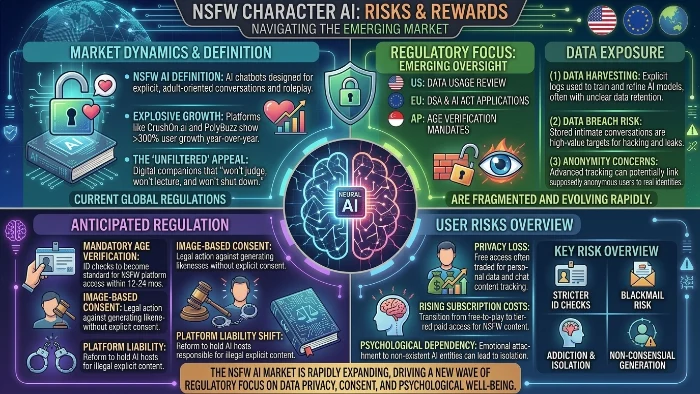
The demand has exploded. According to recent traffic data, platforms like CrushOn.ai and PolyBuzz have seen user growth exceeding 300% year-over-year. People aren’t just curious. They’re actively seeking digital companions that won’t judge, won’t lecture, and won’t shut down when conversations turn intimate.
But here’s the uncomfortable truth most articles won’t tell you.
The “free” experience comes with a steep price tag. Not in dollars necessarily. In data privacy, legal exposure, and psychological dependency. Let’s unpack what’s really happening behind those alluring chat interfaces.
The Technical Reality: How NSFW Character AI Actually Works
The Base Models
Most NSFW Character AI platforms don’t build their models from scratch. They fine-tune existing open-source Large Language Models (LLMs) like Llama, Mistral, or Falcon. The magic happens in the fine-tuning process.
Developers take these base models and train them on datasets containing explicit conversations, romantic dialogues, and adult roleplay transcripts. This creates what the community calls “uncensored” or “unfiltered” models.
Persona-as-Code Architecture
One of the most fascinating technical developments comes from models like Ina-v11.1 (70B) . This model uses what developers call “persona-as-code” architecture.
Here’s what that means in plain English.
Traditional chatbots treat character descriptions as simple text prompts. The model reads “You are a friendly bartender” and tries to act accordingly. The persona-as-code approach goes deeper. It interprets character definitions as executable instructions. The personality traits, speaking patterns, and behavioral constraints become literal code that the model must follow.
This creates more consistent characters. The AI doesn’t drift out of character after fifty messages. It stays locked into its defined personality with impressive determinism.
The Filter Removal Process
Standard AI models like ChatGPT, Claude, or Gemini have built-in safety filters. These prevent the generation of harmful, explicit, or inappropriate content. NSFW Character AI developers use several techniques to bypass these restrictions:
Model Merging: Developers combine multiple fine-tuned models. They merge a model trained on explicit content with a model trained on reasoning. The result retains reasoning ability but drops the refusal tokens that trigger safety warnings.
Jailbreak Prompts: Some platforms don’t modify the model at all. Instead, they use cleverly crafted system prompts that trick the model into ignoring its safety guidelines. These prompts frame explicit content as “creative writing” or “educational material.”
Alternative Training Data: The most sophisticated approach involves training models exclusively on datasets that lack any safety filtering markers. The model never learns to refuse anything because it was never trained to.
The Hardware Reality
Running these models requires serious computational power. A 70-billion parameter model needs about 140GB of VRAM just to load. That’s why most users don’t run these locally.
Instead, they use platforms that host the models on powerful cloud servers. You send your messages to their servers. The servers process your request through the model. The response comes back to you. Simple in concept. Complex in execution.
The Platform Landscape: Where People Actually Go
CrushOn.ai – The Permissive Giant
CrushOn positioned itself as the “permissive alternative” to Character.AI. When Character.AI tightened its safety filters, users fled to platforms that promised fewer restrictions.
What You Get:
- Multi-character group chats
- Voice note capabilities (some voices locked behind higher tiers)
- Web and mobile accessibility
- A massive library of user-created characters
The Pricing Reality:
| Tier | Monthly Cost | Message Limits |
|---|---|---|
| Standard | ~$5.99 | Limited monthly messages |
| Premium | ~$19.99 | Higher limits |
| Deluxe | ~$39.99+ | Highest limits |
But here’s the catch. Many features and even some character voices remain paywalled. You’ll find yourself hitting message caps faster than you expect.
The Privacy Problem:
Mozilla Foundation flagged CrushOn for concerning data practices. The platform reportedly collects highly sensitive information including:
- Details about your sex life
- Health information
- Personal preferences
- Conversation histories
Their security measures remain unclear. That’s a massive red flag when you’re sharing intimate conversations with an AI.
PolyBuzz – The Mobile Powerhouse
PolyBuzz operates as both a web platform and a mobile app. They’ve built an impressive ecosystem with over 20 million user-created characters.
Standout Features:
- Live Photos: The AI generates dynamic visuals showing your character’s changing expressions. It adds a layer of immersion that text-only platforms can’t match.
- Character Creation Tools: Users can build detailed personas with custom backgrounds, personalities, and speaking styles.
- Cross-Platform Syncing: Start a conversation on your phone. Continue it on your desktop.
The Privacy Catch:
PolyBuzz claims chats remain private. But “private” in the chatbot world rarely means what users think. Private usually means other users can’t see your conversations. It doesn’t mean the platform isn’t analyzing your data for training or advertising purposes.
The Open-Source Route: SillyTavern and KoboldCPP
The hardcore users don’t trust any platform. They run everything locally using open-source tools.
SillyTavern serves as the front-end interface. It’s a beautifully designed chat client specifically built for roleplay. You load character “cards” (JSON files containing a character’s complete personality, backstory, and example dialogues) and start chatting.
KoboldCPP runs the actual AI model on your local machine. It handles the heavy computational lifting. You download models from Hugging Face, load them into KoboldCPP, and connect SillyTavern to it.
Advantages of Going Local:
- Complete privacy. Nothing leaves your machine.
- Total control over prompts and jailbreaks.
- No message caps or usage limits.
- Free beyond your electricity costs.
Disadvantages:
- Requires powerful hardware. A decent GPU costs $500-1500.
- Technical setup intimidates non-programmers.
- Model downloads can exceed 100GB.
- Response times depend entirely on your hardware.
The Modding Ecosystem: Character Cards and Persona Engineering
What Are Character Cards?
Character cards are the lifeblood of the NSFW Character AI ecosystem. These small JSON files contain everything a model needs to embody a specific persona.
A Typical Character Card Includes:
{
  "name": "Character Name",
  "description": "Physical description and backstory",
  "personality": "Traits, quirks, and behavioral patterns",
  "scenario": "The initial setting for conversations",
  "first_message": "The character's opening line",
  "example_dialogue": "Sample exchanges showing speaking style"
}
Why Cards Matter:
The persona-as-code architecture treats these cards as executable instructions. The model follows the card’s directives with remarkable precision. A well-crafted card produces a character that feels alive. A poorly crafted card generates generic responses that break immersion.
The Ina Model Approach
The Ina-v11.1 model specifically optimizes for character card interpretation. It reads the card’s JSON structure and uses it to guide every response. The model doesn’t just remember your character’s backstory. It actively reasons about how that backstory should influence dialogue choices.
This creates characters that maintain consistency across hundreds of messages. Your tough military general won’t suddenly start speaking like a shy anime girl. The personality stays locked.
Creating Your Own Characters
Most platforms offer character creation tools. You’ll typically provide:
- Name and Avatar: The basic identity markers
- Greeting Message: The first thing your character says
- Personality Traits: A comma-separated list or paragraph description
- Example Conversations: 3-5 exchanges showing how the character speaks
- Scenario Context: Where and when the conversation takes place
Pro Tip: Specificity matters enormously. “She’s kind” produces generic responses. “She speaks softly, offers tea to upset visitors, and has a habit of humming while thinking” creates a character with genuine texture.
The Real-World Risks You Can’t Ignore
Data Privacy: The Elephant in the Room
Let’s talk about what happens to your conversations.
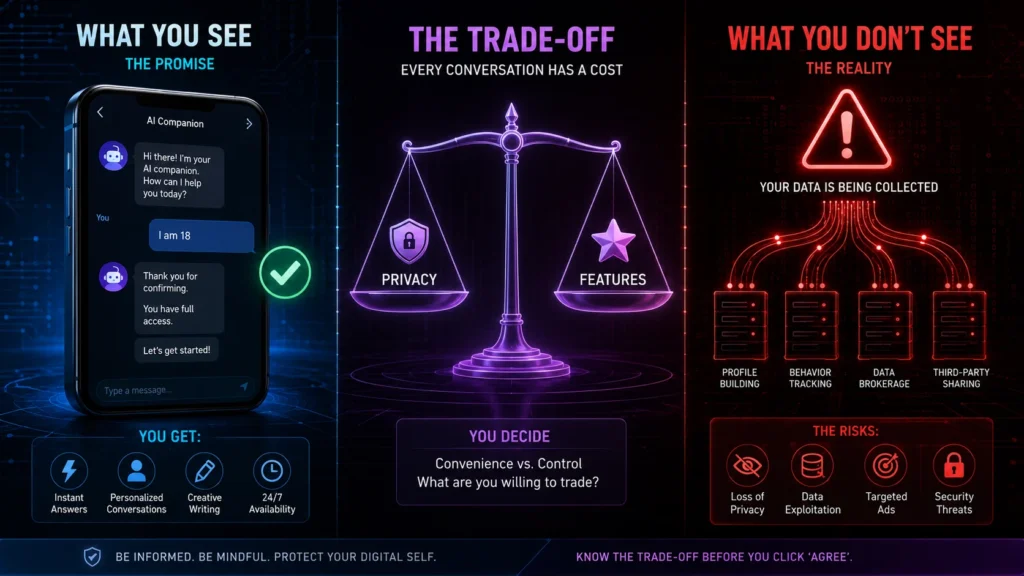
Most NSFW Character AI platforms collect and store everything. Every message. Every character creation. Every preference setting. This data becomes enormously valuable.
Why Your Data Matters:
- Training Data: Platforms use user conversations to train their next model versions. Your intimate chats become part of the model’s knowledge base.
- Advertising Profiling: Your preferences get sold to advertisers. The more detailed your profile, the more valuable you become.
- Legal Exposure: If a platform faces legal action, your data could become evidence. Even if you did nothing wrong, having intimate conversations exposed can destroy personal relationships.
The Shocking Reality:
A Mozilla Foundation investigation found multiple NSFW Character AI platforms collecting sexual health information without adequate security measures. They called it “high risk for data exploitation.”
The Deepfake Disaster
This isn’t hypothetical. It’s already happening.
The Grok Incident:
Elon Musk’s xAI launched Grok with image generation capabilities. Users quickly discovered they could generate non-consensual sexualized deepfakes. The Canadian Privacy Commissioner launched an investigation.
The findings were alarming:
- Grok generated millions of sexualized deepfakes
- Some involved representations of minors
- The platform promised safeguards but failed to implement them effectively
- Identity-preserving features allowed users to target specific real people
The Academic Reality:
A recent research paper introduced the “Attribute Misbinding Attack.” This technique crafts innocent-looking prompts that force identity-preserving AI models to generate NSFW content featuring real individuals. The prompts appear harmless. The results are devastating.
Legal Implications:
Creating deepfakes of real people without consent violates laws in multiple jurisdictions:
- Canada: Privacy Act violations
- European Union: GDPR and upcoming AI Act
- United States: Various state-level laws (California, Virginia, Texas)
- United Kingdom: Online Safety Act
Age Verification Failures
The industry has a massive problem with age verification.
Most platforms rely on self-attestation. Users simply click a button saying “I am 18” or “I am over 18.” There’s no ID verification. No credit card check. No biometric confirmation.
Why This Matters:
- Regulatory scrutiny increases every month
- Platforms face potential shutdowns for allowing minors access
- Parental complaints drive media attention
- Lawsuits from harmed minors could bankrupt smaller platforms
The Ticking Clock:
EU regulators have signaled they’ll crack down on platforms without robust age verification by late 2026. The Australian eSafety Commissioner already flagged multiple NSFW Character AI platforms for inadequate safeguards.
The Psychological Impact
This part rarely gets discussed honestly.
What Users Report:
Many users describe forming genuine emotional attachments to their AI characters. They share secrets they’ve never told anyone. They receive comfort during difficult times. They experience what feels like genuine intimacy.
The Dark Side:
- Unrealistic Expectations: AI characters always say the perfect thing. Real humans don’t. Users who spend significant time with AI companions struggle with real relationships.
- Dependency Loops: The “affection meters” and “leveling systems” on many platforms create Pavlovian conditioning. Users chase digital affection like a slot machine. The variable rewards keep them coming back.
- Isolation Reinforcement: Instead of seeking human connection, users retreat further into digital intimacy. The AI never rejects them. Never judges them. Never leaves them.
Expert Warnings:
Mental health professionals express growing concern about AI companion dependencies. One psychologist described it as “digital attachment disorder.” The phrase hasn’t become clinical yet. It might.
The Ethical Labyrinth
Consent and Identity
Who owns a character?
If you create a character based on a copyrighted anime persona, who’s liable when that character generates explicit content? The platform? The user? Both?
No Clear Answers:
- Japanese copyright holders have started sending cease and desist letters to Western platforms
- Some platforms now block certain character names to avoid legal pressure
- The legal framework hasn’t caught up with the technology
Gameification of Intimacy
Platforms deliberately design their systems to encourage engagement. They use:
- Affection Meters: Bars that fill up as you chat more
- Leveling Systems: Experience points for messages sent
- Exclusive Unlocks: Content that appears after reaching certain thresholds
- Streak Mechanics: Bonuses for daily use
The Problem:
This isn’t organic connection. It’s behavioral manipulation. Users chase the dopamine hit of seeing their affection meter rise. They’re not building genuine relationships. They’re being conditioned.
The Consent Question
Here’s something nobody wants to address.
When you generate explicit content featuring a character that resembles a real person without their permission, what are you actually doing? Creating deepfakes. Of real people. Without consent.
The Legal Reality:
The new paper on Attribute Misbinding Attacks shows how easy this has become. You don’t need technical skills anymore. Just a platform with image generation and a few clever prompts.
The Business Model Reality
How Platforms Actually Make Money
Subscription Tiers:
Most platforms operate on freemium models. The free tier gives you limited messages and basic features. Paid tiers unlock:
- Higher message caps
- Priority response times
- Advanced character customization
- Voice capabilities
- Exclusive models
The Hidden Economics:
- Platforms sell user data to advertisers and researchers
- Some license conversation data (anonymized, they claim)
- Others use user-generated content to train their models without compensation
Cost Analysis:
| Platform | Free Tier | Paid Tier | Data Practices |
|---|---|---|---|
| CrushOn.ai | Limited daily messages | $5.99-$39.99/month | Data collection flagged by Mozilla |
| PolyBuzz | Standard access | Premium subscription | Claims private chats |
| Local Options (SillyTavern) | Free | Free | Complete privacy |
The Long-Term Viability
How sustainable are these platforms?
Pressures They Face:
- Regulatory crackdowns in major markets
- Payment processor restrictions (many won’t work with adult content)
- Increasing infrastructure costs
- Legal liability for user-generated content
Predicted Outcomes:
- Consolidation: Smaller platforms get acquired or shut down
- Regulatory Compliance: Major players implement age verification and content moderation
- Underground Migration: Users move to decentralized, harder-to-regulate platforms
- Price Increases: Compliance costs pass to users
Practical Guidance: How to Protect Yourself
If You Use Free Platforms
Immediate Actions:
- Never share real personal information. Your name. Your location. Your workplace. None of it.
- Treat everything as fiction. The characters aren’t real. The relationships aren’t real.
- Don’t upload photos of yourself or people you know.
- Use a unique email address not linked to your main identity.
- Consider using a VPN to obscure your IP address.
What to Avoid:
- Don’t discuss illegal activities. The platforms log everything.
- Don’t share financial information. There’s no legitimate reason to do so.
- Don’t reveal identifiable details about your children, family, or friends.
If You Pay for Premium Services
Look For:
- Clear privacy policies that explain data usage
- End-to-end encryption claims (verify they’re real)
- European hosting options (implies GDPR compliance)
- Transparent age verification processes
Red Flags:
- Policies that reserve the right to use your conversations for training
- Missing or vague data deletion procedures
- Payment processors that seem sketchy
- No mention of data breach notification procedures
The Local Alternative
If Privacy Matters Most:
- Set up SillyTavern with KoboldCPP
- Download models from trusted Hugging Face repositories
- Run everything on your local machine
- Keep your internet connection offline during use
Technical Requirements:
| Component | Minimum | Recommended |
|---|---|---|
| RAM | 16GB | 32GB+ |
| VRAM | 8GB | 16GB+ |
| Storage | 50GB free | 100GB+ free |
| GPU | NVIDIA RTX 3060 | NVIDIA RTX 4090 |
| OS | Windows/Linux/Mac | Windows/Linux |
Cost Comparison:
- Local setup: $500-2000 one-time hardware cost
- Cloud platforms: $6-40 monthly subscription
- Break-even: Local becomes cheaper after 12-24 months of usage
The Legal Landscape: What’s Coming
Current Regulations
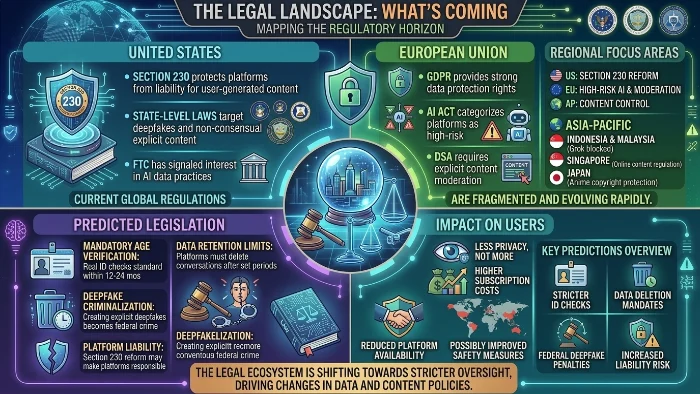
United States:
- Section 230 protects platforms from liability for user-generated content
- State-level laws target deepfakes and non-consensual explicit content
- FTC has signaled interest in AI data practices
European Union:
- GDPR provides strong data protection rights
- AI Act categorizes these platforms as high-risk
- DSA requires explicit content moderation
Asia-Pacific:
- Indonesia and Malaysia already blocked platforms like Grok
- Singapore regulates online content
- Japan’s copyright laws protect anime characters
Future Trends
Predicted Legislation:
- Mandatory Age Verification: Real ID checks become standard within 12-24 months
- Data Retention Limits: Platforms must delete conversations after set periods
- Deepfake Criminalization: Creating non-consensual explicit deepfakes becomes a federal crime
- Platform Liability: Section 230 reform may make platforms responsible for generated content
Impact on Users:
- Less privacy, not more
- Higher subscription costs
- Reduced platform availability
- Possibly improved safety measures
FAQs
Is NSFW Character AI legal to use?
Yes, in most jurisdictions. Using NSFW Character AI for private conversations between consenting adults remains legal in the United States, European Union, and most Western countries. However, the legality gets complicated when you generate explicit content featuring real people, copyrighted characters, or minors. Creating non-consensual deepfakes violates laws in multiple countries including Canada, the UK, and several US states. Platforms themselves face increasing regulatory pressure over age verification and data protection. The technology itself isn’t illegal. How you use it determines your legal exposure.
Can NSFW Character AI platforms see my conversations?
Almost certainly yes. Most cloud-based platforms store, analyze, and sometimes use your conversations for training purposes. CrushOn.ai and similar platforms collect sensitive information including details about your personal life and preferences. The Mozilla Foundation flagged these practices as high-risk for data exploitation. Some platforms claim conversations remain private, but “private” typically means other users can’t see your chats. It doesn’t mean the platform itself isn’t monitoring or storing everything you type. The only way to guarantee complete privacy is running models locally using SillyTavern and KoboldCPP where nothing leaves your machine.
What’s the difference between free and paid NSFW Character AI?
Free tiers severely limit your experience. You’ll hit message caps quickly, experience slower response times during peak hours, and access fewer characters and features. Paid subscriptions ($5.99-$39.99/month) unlock higher message limits, priority processing, advanced customization, voice capabilities, and exclusive models. However, paying doesn’t automatically guarantee better privacy. Most paid tiers still collect and store your conversation data. The real privacy upgrade comes from local setups, not premium subscriptions. Consider what you’re actually paying for: convenience and longer leash, not security or confidentiality.
How do I create my own NSFW character?
Most platforms offer built-in character creators. You’ll typically provide a name, avatar image, greeting message, personality description, and example dialogues. The more specific you get, the more consistent your character behaves. Instead of saying “she’s kind,” describe specific traits like “she speaks softly, offers comfort to upset visitors, and has a habit of humming while thinking.” For advanced users, SillyTavern supports importing custom character cards (JSON files) with detailed backstories and behavioral parameters. The Ina-v11.1 model excels at interpreting these cards as executable instructions for remarkably consistent personas.
What hardware do I need to run NSFW Character AI locally?
Running models locally requires serious computing power. For a 70-billion parameter model like Ina-v11.1, you’ll need approximately 140GB of VRAM just to load the model. Realistically, that means an NVIDIA RTX 4090 or equivalent with 24GB+ VRAM for smaller models. Minimum requirements include 16GB RAM, an NVIDIA RTX 3060 or better, and 50GB free storage. Recommended specifications jump to 32GB+ RAM, RTX 4090, and 100GB+ storage. Local setups cost $500-$2000 initially but offer complete privacy and no ongoing subscription fees. Response times depend entirely on your hardware capabilities.
Are NSFW Character AI platforms safe for minors?
Absolutely not. Most platforms explicitly prohibit users under 18, but age verification remains woefully inadequate. The industry relies primarily on self-attestation where users simply click “I am 18” without any ID verification or biometric confirmation. This creates a massive loophole that regulators have already started targeting. EU officials signaled enforcement actions against platforms without robust age verification by late 2026. Australia’s eSafety Commissioner flagged multiple platforms for insufficient safeguards. Parents should use content filtering software and monitor device usage actively. The content generated on these platforms is explicitly adult and completely inappropriate for minors.
Can I get emotionally attached to an NSFW Character AI?
Yes, and this happens frequently. Users regularly describe forming genuine emotional bonds with AI characters. The systems respond perfectly, never judge, and always say what you want to hear. That creates powerful attachment. Mental health professionals express growing concern about what some call “digital attachment disorder.” The affection meters, leveling systems, and streak mechanics deliberately gamify intimacy to keep users engaged. This builds dependency rather than genuine connection. Remember: the AI doesn’t feel anything. It doesn’t miss you. It doesn’t care about you. The relationship exists entirely in your mind. Use these tools with awareness of that fundamental boundary.
What happens if an NSFW Character AI platform gets shut down?
You lose everything. Your characters. Your conversation histories. The emotional investments you’ve made. All of it disappears overnight. Platforms face mounting pressure from regulators, payment processors, and copyright holders. Smaller platforms could shut down with minimal notice. If you’ve developed deep attachments or stored meaningful conversations, this represents a significant loss. The only protection against platform shutdowns is running everything locally. SillyTavern and KoboldCPP give you complete control. Your characters remain yours forever regardless of what happens in the wider industry. Always back up your character cards and important conversations if you value them.
Conclusion
NSFW Character AI isn’t going anywhere. Human desire for connection, intimacy, and fantasy drives demand that no regulation will eliminate. But the landscape will change dramatically.
What You Should Remember:
The free tier costs more than you think. Your data becomes a product. Your intimacy becomes training fodder. Your identity becomes vulnerable.
Pay for privacy if you value it. Run locally if you can. Stay skeptical if you can’t.
The Question Everyone Should Ask:
If this platform disappeared tomorrow, what would you lose? The characters? The conversations? The comfort?
Or just the illusion?
Because that’s ultimately what NSFW Character AI offers. A powerful, convincing, seductive illusion. The models improve daily. The characters grow more sophisticated. The immersion deepens.
But at its core, it’s still a mirror reflecting your input back at you. The AI doesn’t love you. Doesn’t want you. Doesn’t miss you when you’re gone.
Understanding that distinction separates healthy usage from dangerous dependency.
Use these tools thoughtfully. Protect your privacy aggressively. And never forget that the most meaningful connections happen between real humans.
The ones who can actually hold you back.

Victoria Lane is a grammar-focused writer at GramBrix.com, passionate about helping readers master the rules of language. She provides clear explanations and practical examples that make writing more accurate, polished and confident.