
Last Updated on July 16, 2026
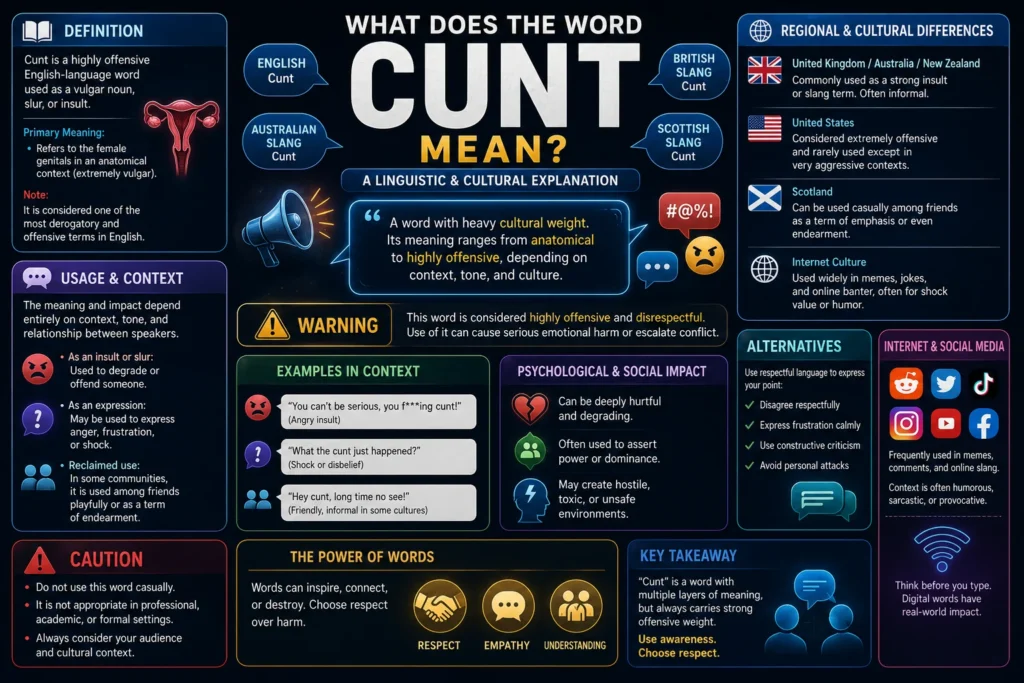
A highly offensive vulgar word that traditionally refers to female genitalia but is also used as an insult in many English-speaking countries. Its meaning, severity, and social acceptability vary significantly by culture and context.
The term “cunt” is one of the most controversial words in the English language. Many people search for cunt meaning because they encounter it in movies, social media posts, online discussions, music lyrics, gaming chats, or everyday conversations.
However, understanding this word requires more than a simple dictionary definition. Its meaning changes depending on the speaker, audience, country, tone, and situation. In some places, it ranks among the most offensive insults possible. In others, people use it casually among friends.
This guide explains the meaning of “cunt,” where it came from, how people use it today, cultural differences, examples, misunderstandings, response strategies, and important usage considerations.
Quick Answer Box
| Category | Explanation |
|---|---|
| Meaning | A vulgar term for female genitalia and a strong insult |
| Context | Insults, slang, arguments, humor, casual speech in some regions |
| Usage | Highly dependent on culture and audience |
| Platforms | Social media, gaming, texting, forums, movies, music |
| Example | “He called someone a rude name during the argument.” |
| Tone | Usually offensive, aggressive, vulgar, or provocative |
What Does It Mean?
The primary meaning of “cunt” is a vulgar reference to female genitalia. Over time, people also began using it as an insult directed toward a person.
In many English-speaking regions, calling someone a “cunt” means the speaker considers that person unpleasant, cruel, rude, dishonest, annoying, or contemptible.
However, the exact intensity of the insult depends heavily on geography and social context.
For example:
- In the United States, many people consider it one of the strongest insults possible.
- In the United Kingdom, the word may appear more frequently in everyday speech.
- In Australia, usage ranges from highly offensive to surprisingly casual among close friends.
Therefore, understanding context is essential.
Full Definition
The word carries multiple layers of meaning.
Anatomical Meaning
Historically, the word referred directly to female genitalia.
Although dictionaries still include this definition, modern speakers often avoid using the term in medical or formal settings because it is considered vulgar.
Insult Meaning
Today, many people use the term as a personal insult.
Depending on context, it can imply:
- Rudeness
- Cruelty
- Arrogance
- Meanness
- Disrespect
- Aggressive behavior
Slang Meaning
In some communities, particularly among certain friend groups, the word can function as slang.
In these situations, speakers may use it jokingly rather than aggressively.
Nevertheless, outsiders may still perceive it as offensive.
Cultural Meaning
The word has developed different meanings across cultures.
Consequently, a phrase that sounds casual in one country may sound shocking in another.
Context & Usage
Understanding how people use the word matters more than memorizing its definition.
Offensive Usage
The most common use involves insulting another person.
Examples include:
- Heated arguments
- Road rage incidents
- Online disputes
- Workplace conflicts
In these situations, the speaker intends to offend.
Humorous Usage
Some people use the term sarcastically.
For example, a close friend might jokingly tease another friend.
However, this type of humor depends on trust and shared understanding.
Expressive Usage
Sometimes speakers use the word to express frustration rather than directly insult someone.
For example:
- Complaining about a difficult situation
- Reacting to bad news
- Venting anger
Even then, many people still find the language offensive.
Reclaimed Usage
Certain groups occasionally reclaim offensive language for empowerment or identity expression.
However, usage varies widely and remains controversial.
Real-Life Examples
Conversation Example 1
Person A: “Why did he cancel at the last minute?”
Person B: “Because he’s being a real cunt about the whole thing.”
Meaning: Person B thinks the individual is behaving badly.
Conversation Example 2
Person A: “Did you hear what she said?”
Person B: “Yeah, that was incredibly rude.”
Person A: “Exactly. She acted like a complete cunt.”
Meaning: Strong criticism of someone’s behavior.
Conversation Example 3
Friend 1: “You forgot your wallet again.”
Friend 2: “Stop reminding me.”
Friend 1: “You funny cunt.”
Meaning: Playful teasing between friends in some regions.
Conversation Example 4
Online Gamer: “We almost won.”
Teammate: “That player quit halfway through.”
Online Gamer: “What a cunt.”
Meaning: Expression of frustration toward another player’s actions.
Conversation Example 5
Person A: “He spread false rumors.”
Person B: “That’s terrible.”
Person A: “Yeah, he’s a nasty cunt.”
Meaning: Severe condemnation.
Platform-Specific Meaning
On WhatsApp, people may use the word during personal conversations.
Its meaning depends on:
- Relationship between participants
- Regional background
- Tone of discussion
Because messages lack vocal cues, misunderstandings occur easily.
Snapchat
Snapchat conversations often feature informal language.
Young users sometimes encounter the term in:
- Private chats
- Stories
- Reactions
- Group conversations
However, the word still carries strong offensive potential.
TikTok
TikTok users frequently discuss slang and controversial language.
The term may appear in:
- Commentary videos
- Cultural discussions
- Humor content
- Reaction clips
Meanwhile, creators often censor the word to avoid moderation issues.
Instagram users may encounter the term in:
- Comments
- Captions
- Memes
- Direct messages
Because audiences are broad, using the word publicly can trigger negative reactions.
X (Twitter)
Political debates, sports discussions, and celebrity arguments sometimes include the term.
Since conversations move quickly, people often use it as an insult during heated exchanges.
Gaming Platforms
Competitive gaming environments frequently contain aggressive language.
Consequently, players may encounter the word in:
- Voice chat
- Text chat
- Streaming communities
- Competitive matches
Many platforms moderate such language.
Reddit communities vary significantly.
Some subreddits permit strong language, while others remove it immediately.
Therefore, context matters greatly.
Alternative Meanings
Unlike many internet slang terms, “cunt” does not have numerous widely accepted alternative definitions.
However, its emotional intensity changes based on usage.
Literal Meaning
A vulgar anatomical reference.
Insult Meaning
A harsh criticism of a person.
Friendly Slang Meaning
Informal joking among close friends in some cultures.
Emphasis Meaning
Used to intensify emotional reactions.
Related Terms / NLP Variations
People searching for cunt meaning often search related words as well.
Similar Insults
- Jerk
- Idiot
- Asshole
- Moron
- Douchebag
- Tool
These terms share some functions but differ in severity.
Related Slang
- Savage
- Toxic
- Rude
- Mean
- Petty
These words describe behavior rather than functioning primarily as vulgar insults.
Related Search Queries
Users frequently search:
- What does cunt mean?
- Is cunt a bad word?
- Why is cunt offensive?
- Cunt meaning in slang
- Cunt meaning in Australia
- Cunt meaning in the UK
- Is cunt worse than other swear words?
How to Respond / Reply
If someone uses the word, your response should depend on context.
If Used as an Insult
You can:
- Ignore it
- De-escalate the conversation
- Ask for clarification
- End the discussion
Example:
“I’d prefer if we kept the conversation respectful.”
If Used Jokingly
Consider:
- Your relationship with the speaker
- Cultural differences
- Comfort level
If unsure, ask what they meant.
If You Do Not Understand It
A simple response works best:
“What do you mean by that?”
If It Makes You Uncomfortable
Set boundaries clearly.
Example:
“I’m not comfortable with that language.”
Misinterpretations
Many misunderstandings surround this word.
Misinterpretation 1: It Always Means the Same Thing
False.
The meaning changes dramatically across cultures.
Misinterpretation 2: Everyone Finds It Equally Offensive
False.
People react differently based on age, background, and location.
Misinterpretation 3: It Is Always Directed at Women
False.
People often use the insult toward men and women.
Misinterpretation 4: It Is Casual Everywhere
False.
In many places, using the word can seriously damage relationships.
Misinterpretation 5: Online Usage Removes Its Impact
False.
Digital communication can amplify misunderstandings because tone is difficult to interpret.
When NOT to Use It
In most situations, avoiding the word is the safest choice.
Professional Settings
Do not use it in:
- Meetings
- Interviews
- Emails
- Business communications
Educational Settings
Schools and universities generally discourage such language.
Public Presentations
Public speaking requires professionalism.
Therefore, the term rarely belongs in formal presentations.
Customer Service Interactions
Using offensive language can damage relationships and reputations.
Mixed Audiences
Avoid the word when you do not know everyone’s comfort level.
Social Media Posts
Remember that screenshots last forever.
Consequently, controversial language can create long-term consequences.
Usage Tips
Know Your Audience
Different groups interpret the word differently.
Therefore, audience awareness matters.
Understand Cultural Differences
American, British, Australian, and Irish speakers often view the word differently.
Consider Context
The same word can sound:
- Aggressive
- Humorous
- Casual
- Hostile
- Friendly
depending on the situation.
Think About Permanence
Digital communication creates records.
Therefore, consider future consequences before posting.
Use Alternatives When Possible
Often, less offensive language communicates the same point.
Examples include:
- Rude
- Mean
- Disrespectful
- Difficult
- Unpleasant
Cultural Differences and Regional Usage
One reason people search for cunt meaning is confusion about regional differences.
United States
In the United States, many consider it among the strongest insults available.
Consequently, public use often creates controversy.
United Kingdom
The word appears more frequently in casual speech.
However, many people still find it offensive.
Australia
Australian slang sometimes uses the term in surprisingly informal ways.
Nevertheless, context remains critical.
A friendly usage among friends does not mean strangers will welcome it.
Ireland
Irish English may feature the term more often than American English.
Yet reactions still vary.
Global Internet Culture
Online communities blend different cultures.
Therefore, misunderstandings happen regularly.
Someone from one country may use the word casually, while another reader perceives it as deeply offensive.
Why the Word Generates Strong Reactions
Language carries emotional history.
This word developed a reputation over centuries because of:
- Gender-related associations
- Vulgarity
- Social taboos
- Historical usage patterns
- Cultural attitudes
As a result, many people react strongly when they hear or read it.
Meanwhile, others see it as ordinary slang.
These conflicting perspectives explain many online arguments about the term.
Comparison With Other Strong Swear Words
Many people wonder how “cunt” compares to other offensive language.
Generally:
| Word Type | Typical Severity |
|---|---|
| Mild insults | Low |
| Common swear words | Moderate |
| Strong profanity | High |
| Cunt (in many regions) | Very High |
However, severity depends heavily on cultural context.
Therefore, no universal ranking exists.
FAQs
What does cunt mean?
It is a vulgar term that traditionally refers to female genitalia and also functions as a strong insult.
Is cunt a swear word?
Yes. Most English speakers consider it profanity.
Is cunt offensive?
In many countries, yes. Some people consider it among the most offensive words in English.
Why do people use the word?
People use it for insults, humor, emotional expression, or casual slang depending on context.
Is cunt worse than other swear words?
Many Americans consider it extremely offensive. However, perceptions vary by region.
Can the word be used jokingly?
Yes, some friend groups use it jokingly. Nevertheless, outsiders may still find it offensive.
What does cunt mean in Australia?
Australian speakers sometimes use it more casually than Americans. However, tone and context remain important.
What does cunt mean in the UK?
The word appears more frequently in British English, although many still consider it offensive.
Should I use the word online?
Generally, caution is wise because audiences interpret the word differently.
What are safer alternatives?
You can often use words such as rude, unpleasant, mean, difficult, disrespectful, or inconsiderate.
Conclusion
The meaning of “cunt” goes far beyond a simple dictionary definition. Historically, the word referred to female genitalia. Today, people most commonly use it as a highly offensive insult. However, its meaning and intensity vary dramatically across cultures, regions, and social groups.
In the United States, many regard it as one of the strongest insults available. Meanwhile, some speakers in countries such as Australia, the United Kingdom, and Ireland use it more casually in certain situations. Even so, context remains everything.
When interpreting the word, consider the speaker’s intent, relationship with the audience, cultural background, platform, and tone. Understanding these factors helps explain why the same word can spark outrage in one conversation yet function as casual slang in another.

Kevin Brooks is a grammar specialist at GramBrix.com, dedicated to helping readers understand language rules with clarity and confidence. He simplifies complex grammar concepts through practical examples and easy explanations.