Last Updated on July 16, 2026
| Quick Answer | Details |
|---|---|
| Word | Vendetta |
| Part of Speech | Noun |
| Primary Meaning | A prolonged feud or desire for revenge against a person, family, or group |
| Common Context | Personal conflicts, politics, history, media, and everyday conversation |
| Tone | Serious, emotional, and often negative |
| Example | “The rivalry turned into a vendetta that lasted for years.” |
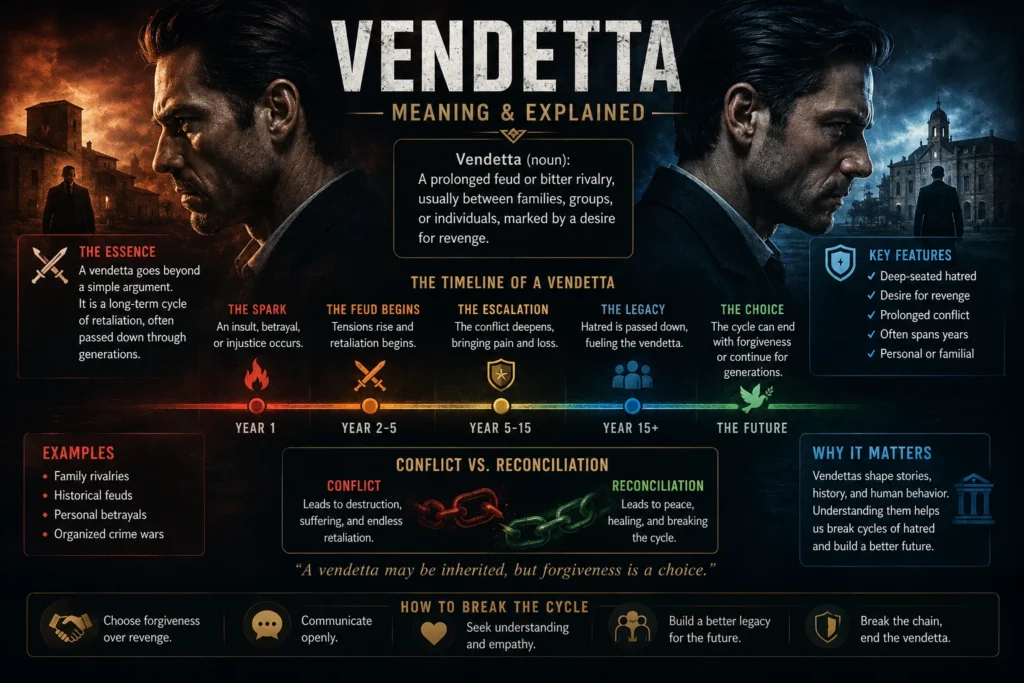
The word vendetta often appears in movies, news stories, political discussions, and everyday conversations. People use it when describing a deep, ongoing conflict fueled by anger, revenge, or personal resentment. Unlike a simple disagreement, a vendetta usually involves a long-term commitment to retaliation.
Many people search for vendetta meaning because they encounter the term in books, television shows, social media discussions, or historical references. While the word originally referred to family feuds, its modern usage has expanded significantly.
Today, a vendetta can describe anything from a decades-long family dispute to a personal campaign against someone in a workplace, organization, or public setting.
This guide explains the complete meaning of vendetta, its history, usage, examples, cultural significance, modern interpretations, and frequently asked questions.
Quick Answer Box
Meaning: A vendetta is a prolonged feud, grudge, or campaign of revenge against someone.
Context: Personal conflicts, family disputes, politics, business rivalries, and social situations.
Usage: Used when someone seeks ongoing retaliation or holds a long-lasting grudge.
Platforms: News media, social media, books, movies, podcasts, and everyday conversations.
Example: “After years of disagreements, their conflict became a personal vendetta.”
Tone: Serious, emotional, and often negative.
What Does It Mean?
A vendetta is a long-running conflict driven by revenge, resentment, or hostility toward a person, family, group, or organization.
Unlike a brief argument, a vendetta often lasts for months, years, or even generations. The key feature is persistence. One party remains determined to seek revenge or continue the conflict.
For example:
- A family feud lasting decades may become a vendetta.
- A politician repeatedly targeting a rival might be accused of pursuing a vendetta.
- A business owner constantly trying to undermine a competitor may appear to have a vendetta.
Therefore, the term suggests more than ordinary disagreement. It implies a deeper emotional commitment to retaliation.
Full Definition
The dictionary definition of vendetta generally describes:
A prolonged and bitter feud, often involving revenge, retaliation, or hostility between individuals, families, or groups.
Historically, the term referred to blood feuds where families sought revenge for injuries or deaths suffered by relatives.
Today, however, people often use the word metaphorically.
Modern definitions include:
- Personal grudge
- Revenge campaign
- Ongoing feud
- Bitter rivalry
- Hostile pursuit of retaliation
Consequently, vendetta has become a powerful word that signals intense and long-lasting conflict.
Context and Usage
People use vendetta in many different situations.
Personal Relationships
In personal life, vendetta often describes someone who cannot let go of a conflict.
Examples include:
- Former friends seeking revenge
- Family members involved in prolonged disputes
- Neighbors engaged in years of hostility
For instance:
“After their friendship ended, he turned the disagreement into a vendetta.”
Politics
Political commentators frequently use the term.
Examples:
- Attacks against opponents
- Long-running political rivalries
- Targeted campaigns
People may say:
“The investigation looked more like a political vendetta than a neutral inquiry.”
Business
Business conflicts occasionally become personal.
Examples include:
- Corporate rivalries
- Competitive retaliation
- Reputation attacks
Therefore, journalists often use vendetta when describing unusually aggressive business disputes.
Sports
Athletes and fans sometimes use the term figuratively.
Example:
“The team seemed motivated by a vendetta after last year’s loss.”
Entertainment
Movies, novels, and television shows frequently revolve around vendettas because revenge creates strong emotional narratives.
Emotional Meaning Behind Vendetta
The emotional dimension distinguishes vendetta from ordinary conflict.
A disagreement focuses on a specific issue.
A vendetta often becomes personal.
Common emotions associated with vendettas include:
- Anger
- Resentment
- Betrayal
- Bitterness
- Obsession
- Revenge
Consequently, the word carries strong emotional weight.
When someone says a person has a vendetta, they usually suggest the conflict has moved beyond logic and become emotionally driven.
Origin and History of the Word Vendetta
The word originates from the Italian language.
Italian Roots
Vendetta comes from the Italian word meaning:
Revenge
Historically, certain regions of Italy experienced family feuds that lasted generations.
When one family member suffered harm, relatives often sought retaliation.
As a result, revenge cycles continued for decades.
Historical Family Feuds
These traditional vendettas often involved:
- Honor disputes
- Land conflicts
- Family rivalries
- Blood feuds
Over time, the concept became widely known outside Italy.
Entry into English
English speakers adopted the term during the nineteenth century.
Eventually, its meaning broadened beyond family revenge.
Today, most people use it metaphorically rather than literally.
Real-Life Examples
Understanding vendetta meaning becomes easier through examples.
Example 1: Workplace Conflict
An employee feels unfairly treated.
Instead of addressing the issue professionally, they spend years trying to damage a coworker’s reputation.
Others may describe this behavior as a vendetta.
Example 2: Political Rivalry
Two politicians disagree for years.
One continuously attacks the other regardless of the issue.
Observers may call it a political vendetta.
Example 3: Family Feud
Two relatives argue over inheritance.
The conflict spreads across generations.
This situation closely resembles the traditional meaning of vendetta.
Example 4: Business Competition
A company repeatedly targets a rival through lawsuits and public criticism.
Commentators might describe the campaign as a vendetta.
Example 5: Social Circle Dispute
A former friend continuously spreads rumors after a falling out.
People may view the behavior as a personal vendetta.
Platform-Specific Meaning
Different online platforms use the word in slightly different ways.
X (Twitter)
Users often use vendetta during discussions involving:
- Politics
- Celebrities
- Sports
- Public controversies
Example:
“Honestly, this feels like a vendetta rather than fair criticism.”
Reddit users frequently discuss:
- Workplace disputes
- Family drama
- Relationship conflicts
- Community disagreements
The word often appears in storytelling and advice forums.
People commonly use vendetta when discussing:
- Local disputes
- Community politics
- Personal conflicts
YouTube
Commentators use vendetta to describe:
- Celebrity feuds
- Historical conflicts
- Sports rivalries
- Movie storylines
TikTok
Creators often use the term humorously.
Examples include:
- “My cat has a vendetta against my curtains.”
- “My alarm clock has a vendetta against me.”
In these cases, users exaggerate for comedic effect.
Alternative Meanings
Although revenge remains central, vendetta can have several nuances.
Literal Vendetta
A genuine long-term feud involving revenge.
Political Vendetta
A campaign targeting political opponents.
Personal Vendetta
An individual grudge against someone.
Corporate Vendetta
Aggressive business retaliation.
Humorous Vendetta
A playful exaggeration used online.
Example:
“My printer has a vendetta against important documents.”
Related Terms and NLP Variations
People searching for vendetta meaning often explore related words.
Synonyms
- Feud
- Grudge
- Revenge
- Retaliation
- Hostility
- Resentment
- Rivalry
- Conflict
- Retribution
- Payback
Closely Related Terms
- Blood feud
- Personal grudge
- Revenge campaign
- Ongoing conflict
- Bitter dispute
Opposites
- Forgiveness
- Reconciliation
- Peace
- Resolution
- Harmony
Vendetta vs Revenge
These terms overlap but differ.
| Vendetta | Revenge |
|---|---|
| Long-term conflict | Single retaliatory action |
| Often ongoing | Often temporary |
| Emotional commitment | Specific response |
| Can involve multiple events | Usually one event |
| May last years | Often shorter duration |
A person can seek revenge once.
A vendetta usually involves repeated actions over time.
Vendetta vs Grudge
People frequently confuse these terms.
Grudge
A grudge involves lingering resentment.
Someone may quietly hold negative feelings.
Vendetta
A vendetta involves active pursuit.
The individual often takes actions against the target.
Therefore, every vendetta includes a grudge, but not every grudge becomes a vendetta.
Vendetta in Popular Culture
The concept appears frequently in entertainment because revenge stories attract audiences.
Movies
Many films center on vendettas.
Common themes include:
- Justice
- Betrayal
- Redemption
- Revenge
Television
Long-running series often use vendettas to create dramatic tension.
Literature
Classic literature contains countless vendetta-driven characters.
Video Games
Many game narratives begin with a personal vendetta.
The protagonist seeks revenge after suffering a loss.
Conversation Examples
Conversation Example 1: Workplace
Employee A: Why does he criticize everything I do?
Employee B: Honestly, it feels like he has a vendetta against you.
Conversation Example 2: Politics
Reporter: Why is the senator focusing on this issue again?
Analyst: Critics say it’s become a political vendetta.
Conversation Example 3: Friends
Friend 1: They’re still arguing after three years.
Friend 2: That’s not an argument anymore. That’s a vendetta.
Conversation Example 4: Sports
Fan 1: The team looked extra motivated tonight.
Fan 2: They played like they had a vendetta after last season.
Conversation Example 5: Social Media
User 1: Why does that creator keep making videos about the same person?
User 2: Ngl, it seems like a vendetta at this point.
How to Respond or Reply
When someone uses the word vendetta, your response depends on context.
If Discussing a Conflict
You might ask:
- Why do you think it’s a vendetta?
- How long has the conflict lasted?
- Is there a history behind it?
If Someone Accuses Another Person
You could respond:
- That seems excessive.
- Maybe they’re holding a grudge.
- It does look personal.
If Used Humorously
You might reply:
- Sounds like a serious rivalry.
- That’s one determined enemy.
- Your printer really has it out for you.
Misinterpretations
Several misconceptions surround the word.
Mistake 1: Any Disagreement Is a Vendetta
Not every argument qualifies.
Vendettas involve ongoing hostility.
Mistake 2: Vendetta Always Means Violence
Modern usage often describes nonviolent conflicts.
Mistake 3: Only Families Can Have Vendettas
Historically true in many cases.
However, modern usage includes individuals, organizations, and governments.
Mistake 4: Vendetta and Revenge Are Identical
Vendetta usually refers to a broader, longer conflict.
When NOT to Use It
Avoid using vendetta when describing:
- Minor disagreements
- Brief arguments
- One-time criticism
- Temporary conflicts
- Routine competition
Using the word too loosely weakens its meaning.
Therefore, reserve it for situations involving sustained hostility or revenge.
Usage Tips
Consider the Intensity
Vendetta suggests serious emotions.
Use it when the conflict feels unusually personal.
Understand the Duration
The longer the conflict lasts, the more appropriate the term becomes.
Avoid Overuse
Not every rivalry qualifies as a vendetta.
Consider Tone
Because the word carries negative implications, use it carefully in professional settings.
Recognize Figurative Uses
Online communities often use the term humorously.
Context determines whether the speaker is serious.
Edge Cases and Modern Usage
Language evolves, and vendetta now appears in many unusual situations.
Online Communities
Users sometimes exaggerate minor inconveniences.
Example:
“My Wi-Fi has a vendetta against video calls.”
Gaming
Gamers may describe recurring competition as a vendetta.
Sports Commentary
Analysts sometimes frame rivalries as vendettas for dramatic effect.
Workplace Humor
Coworkers may jokingly claim office equipment has a vendetta against them.
Although these examples are playful, they still reflect the idea of persistent opposition.
FAQs
What is the exact meaning of vendetta?
A vendetta is a prolonged feud, grudge, or campaign of revenge against a person, family, group, or organization.
Is vendetta a positive or negative word?
It is generally negative because it relates to hostility, revenge, and ongoing conflict.
Does vendetta mean revenge?
Not exactly. Revenge can be a single act, while a vendetta usually involves a long-term pursuit of retaliation.
What is a personal vendetta?
A personal vendetta refers to an individual’s ongoing grudge or revenge campaign against someone.
What is a political vendetta?
A political vendetta involves targeting a political rival due to personal hostility or long-standing conflict.
Can a vendetta be nonviolent?
Yes. Modern usage often refers to nonviolent conflicts, criticism, or persistent opposition.
Where does the word vendetta come from?
It comes from Italian and originally meant revenge.
Is vendetta commonly used today?
Yes. People use it in news reports, social media, entertainment, and everyday conversation.
What is the difference between a feud and a vendetta?
A feud involves conflict between parties. A vendetta specifically emphasizes revenge and personal hostility.
Can the word be used humorously?
Yes. Many people use it jokingly to describe recurring frustrations or minor rivalries.
Conclusion
The vendetta meaning goes far beyond a simple disagreement. It describes a prolonged feud, deep grudge, or ongoing pursuit of revenge directed toward an individual, family, group, or organization. Historically, the term referred to family blood feuds, especially in Italy. However, modern usage includes personal conflicts, political rivalries, business disputes, and even humorous online exaggerations.
Moreover, the word carries strong emotional implications. It suggests resentment, retaliation, and persistence over time. Therefore, people often use it when a conflict becomes deeply personal and continues long after the original dispute.
Whether you encounter the term in history books, news articles, social media discussions, movies, or everyday conversations, understanding the meaning of vendetta helps you recognize the difference between a temporary disagreement and a long-lasting campaign driven by revenge.

Victoria Lane is a grammar-focused writer at GramBrix.com, passionate about helping readers master the rules of language. She provides clear explanations and practical examples that make writing more accurate, polished and confident.