Last Updated on July 13, 2026
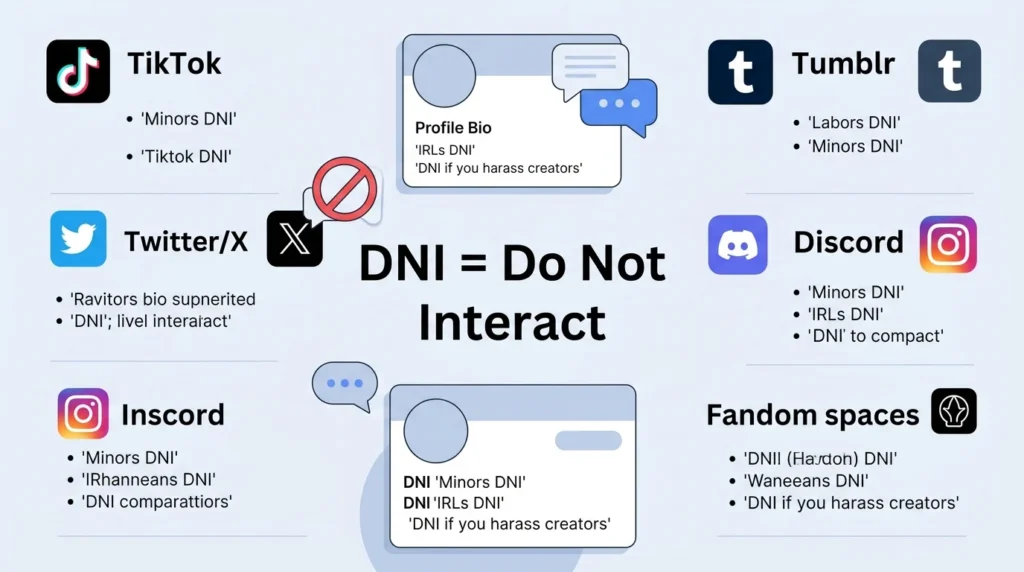
DNI usually means “Do Not Interact.” People use it online to tell certain users not to reply, follow, message, or engage with their content. You’ll often see DNI in bios, fandom spaces, TikTok captions, Twitter/X profiles, Discord servers, and personal boundaries posts.
If you’ve seen DNI in a TikTok bio, a Twitter/X profile, a Tumblr post, or a fandom discussion and wondered what it means, you’re not alone. Internet slang changes fast, and some terms carry more social context than their short letters suggest. DNI meaning is one of those phrases people search when they want more than just a dictionary definition—they want to know what it means, where it’s used, who uses it, how serious it is, and whether it applies to them.
In most online conversations, DNI means “Do Not Interact.” It’s a boundary-setting phrase used to tell specific people—or sometimes everyone outside a certain audience—not to engage with a post, profile, or account. But that simple definition only covers the surface. Depending on the platform and community, DNI can signal personal boundaries, fandom rules, political or social filtering, anti-harassment protection, or simply a preference for who someone wants in their space.
This guide breaks down the full DNI meaning in text and social media, how people use it on different platforms, common examples, alternative meanings, reply strategies, misinterpretations, and when not to use it. If you want the quick answer, the detailed explanation, and real chat-style examples all in one place, you’ll find it here.
Quick Answer Box
| Item | Meaning |
|---|---|
| Acronym | DNI |
| Most common meaning | Do Not Interact |
| Used in | TikTok, Twitter/X, Tumblr, Discord, fandom spaces, Instagram bios, comment sections, online communities |
| Purpose | To set a boundary and tell certain users not to engage |
| Typical tone | Direct, protective, serious, sometimes blunt |
| Common format | “DNI if…”, “Minors DNI”, “Proshippers DNI”, “DNI list in bio” |
| Can it appear in texting? | Yes, but it’s more common in social media bios, fandom posts, and community spaces |
| Example | “If you support harassment, DNI.” |
| Hidden meaning | “This space is not for you” or “I don’t want engagement from this group.” |
What Does DNI Mean?
DNI means “Do Not Interact.”
In plain English, it means:
- Do not reply to me
- Do not message me
- Do not comment on my content
- Do not follow or engage with this account
- Do not enter this space if you fit a certain category
It’s basically an online boundary marker. Someone uses DNI when they want to control who interacts with their content or profile. Sometimes it applies to specific groups; other times it’s aimed at specific behaviors.
Examples:
- “Minors DNI” = minors should not interact
- “DNI if you’re racist” = racist users should not engage
- “Proshippers DNI” = a fandom-related boundary against a particular group
- “IRLs DNI” = real-life acquaintances should not interact with that account
- “Basic DNI criteria” = a list of groups or behaviors the user does not want around their page
So if you’re asking for the simplest possible dni meaning, it’s this:
DNI = Do Not Interact, a phrase used online to set boundaries about who should not engage with someone’s account, content, or community.
Full Definition of DNI
The short definition is easy, but the full meaning of DNI depends on how it’s being used. In internet culture, DNI functions as a boundary tool, a filter, and sometimes a warning label.
DNI as a Boundary Statement
At its core, DNI says:
“I do not want interaction from you if you fit this description.”
That description might be about:
- age
- behavior
- beliefs
- fandom position
- relationship to the poster
- content sensitivity
- community rules
For example:
- “NSFW account. Minors DNI.”
This means the account contains adult content and minors should not engage. - “If you harass creators, DNI.”
This means people who harass creators are not welcome to interact. - “IRLs DNI.”
This means people who know the account owner in real life should stay off that account.
DNI as a Social Filter
In many online spaces, DNI is also a social sorting tool. It helps users signal the kind of community they want around them. Instead of arguing with everyone individually, they put a boundary in their bio or post.
That’s why DNI often appears in:
- profile bios
- pinned tweets/posts
- Tumblr intros
- fandom carrds
- Discord rules
- alt account descriptions
- private community spaces
DNI as a Protective Signal
Sometimes DNI is about safety and emotional comfort, not just preference. For example:
- survivors avoiding triggering conversations
- queer users filtering hostile people
- fandom users trying to avoid harassment
- creators blocking drama-heavy groups
- adults separating content from minors
In those cases, DNI is less about “being rude” and more about preventing unwanted engagement.
Context and Usage of DNI
Understanding DNI meaning requires looking at the context. The phrase can be strict, casual, dramatic, practical, or deeply personal depending on where it appears.
Why People Use DNI
People use DNI for several reasons:
- To set boundaries clearly
Instead of repeating themselves, they write one visible rule. - To reduce unwanted replies
Especially in fandom or controversial spaces, a DNI notice can discourage arguments. - To protect mental space
Some users don’t want to debate their identity, trauma, politics, or personal interests. - To keep adult/minor boundaries clear
“Minors DNI” is one of the most common versions of the term. - To shape a community vibe
A person may want their page to feel safer, calmer, or more aligned with their values.
Common DNI Formats
Here are the formats you’ll see most often:
“DNI if…”
This is the classic structure.
Examples:
- DNI if you bully people for their interests
- DNI if you support hate speech
- DNI if you’re only here to start drama
This format names a behavior, belief, or identity category and says those people should not engage.
“Minors DNI”
This means people under 18 should not interact. It’s common on:
- adult-themed accounts
- NSFW pages
- mature fandom spaces
- private vent accounts
- relationship or kink discussion spaces
“DNI list in bio”
This means the person has a more detailed list of people or groups they don’t want interacting with them.
“Basic DNI criteria”
This usually refers to a standard set of “do not interact if you are racist, homophobic, transphobic, abusive, etc.” rules. In some communities, “basic DNI criteria” is shorthand for “don’t interact if you’re hateful, discriminatory, or harmful.”
What DNI Usually Implies Emotionally
A lot of users don’t just want the literal definition—they want the social meaning. Emotionally, DNI often carries one or more of these vibes:
- Protective — “I’m guarding my space.”
- Serious — “I mean this boundary.”
- Tired — “I don’t want to argue anymore.”
- Blunt — “I’m not explaining this twice.”
- Community-focused — “I want a certain environment here.”
- Anti-drama — “I’m trying to prevent conflict before it starts.”
That doesn’t mean every DNI post is dramatic. Sometimes it’s just a practical label. But the tone is usually firmer than casual slang like “lol,” “brb,” or “idk.”
Real-Life Examples of DNI in Conversations and Posts
Below are realistic examples so you can see how DNI is used naturally online.
Conversation Example 1: TikTok Bio
Situation
A creator posts mature humor and adult relationship content.
Bio:
“23 | spicy content + adult jokes | minors DNI”
What it means
The creator is saying their content is not for underage users and minors should not engage with the account.
Tone
Boundary-setting, direct, protective.
Conversation Example 2: Twitter/X Post
Situation
A user is frustrated after getting harassing replies.
Post:
“If you think sending people hate over fictional ships is normal, DNI. I’m not debating this.”
What it means
The person does not want interaction from users who harass people over fandom opinions.
Tone
Firm, frustrated, anti-harassment.
Conversation Example 3: Discord Intro Channel
Situation
A user joins a fandom server and posts an intro.
Intro:
“Hi, I’m Ash, 20, they/them. I draw fanart and scream about anime. Proshippers DNI please.”
What it means
The user is identifying a fandom boundary and asking a particular group not to interact with them.
Tone
Direct, community-specific.
Conversation Example 4: Private Vent Account
Situation
Someone has a personal account for emotional posts.
Bio:
“Private vent acc. IRLs DNI.”
What it means
People who know them in real life should not follow or interact with that account.
Tone
Protective, private, serious.
Conversation Example 5: Instagram Story Note
Situation
A user posts about harassment.
Story text:
“If you’re friends with the person who leaked my messages, DNI. I’m not entertaining fake support.”
What it means
They are rejecting engagement from people connected to someone who hurt them.
Tone
Emotional, personal, firm.
Platform-Specific Meaning of DNI
The core dni meaning stays the same across the internet—Do Not Interact—but how it’s used can change depending on the platform and culture.
TikTok
On TikTok, DNI often appears in:
- bios
- captions
- comment warnings
- niche community posts
- fandom and identity-based content
How it looks on TikTok
Examples:
- “Minors DNI”
- “Fatphobes DNI”
- “Straight men DNI if you’re gonna be weird in comments”
- “DNI if you support creators who steal art”
Why it’s common on TikTok
TikTok has highly visible comments, algorithmic reach, and lots of niche communities. Because of that, users often try to pre-filter who engages with them.
TikTok tone
Usually direct and visible. Sometimes serious, sometimes a little dramatic, but often meant as a genuine boundary.
Twitter/X
On Twitter/X, DNI is especially common in:
- profile bios
- carrd-linked profiles
- fandom spaces
- stan communities
- political or identity-focused accounts
Common Twitter/X examples
- “basic dni criteria”
- “proshippers dni”
- “minors dni”
- “antis dni”
- “irl friends dni”
Why it matters on Twitter/X
Twitter/X culture is fast, reactive, quote-tweet heavy, and often argumentative. A DNI statement can act like a preemptive line in the sand.
Twitter/X tone
Often firmer and more ideological than on other platforms. It can reflect fandom alignment, politics, safety concerns, or social boundaries.
Tumblr
Tumblr is one of the classic homes of DNI culture. It shows up in:
- blog intros
- about pages
- fandom posts
- aesthetic blogs
- side blogs and roleplay spaces
Common Tumblr formats
- “DNI if TERF/SWERF”
- “Minors DNI with my NSFW sideblog”
- “DNI if you support harassment”
- “Byf / dni list in carrd”
Tumblr also overlaps with related labels like BYF (“Before You Follow”), where users explain their posting style, triggers, boundaries, and expectations.
Tumblr tone
Detailed, community-specific, and often identity-aware. Tumblr users may give a full list of boundaries rather than just writing “DNI.”
Discord
On Discord, DNI can appear in:
- usernames or bios
- intro channels
- roleplay communities
- NSFW servers
- fandom servers
- private status messages
Examples
- “18+ only, minors DNI”
- “Don’t DM me for venting unless we’re close, randoms DNI”
- “If you support harassment campaigns, DNI”
Why it matters on Discord
Discord is more interactive and private than public social media. Because DMs and server spaces are closer-contact environments, DNI can be used to protect access to someone’s personal space.
Discord tone
More practical and immediate. It can be about direct messaging boundaries as much as public interaction.
On Instagram, DNI usually appears in:
- bios
- story posts
- private spam accounts
- fan pages
- creator pages
Examples
- “spam acc | irls dni”
- “body shamers DNI”
- “18+ jokes and thirst posts, minors DNI”
Instagram DNI usage often overlaps with close-friends culture, alt accounts, and spam pages where users post more casually or personally.
Reddit doesn’t use DNI as heavily in the same bio-based way because Reddit is less profile-centered than TikTok or Twitter/X. But you can still see similar boundary language in:
- subreddits with posting rules
- personal profile descriptions
- community posts
- NSFW content warnings
On Reddit, the concept is often expressed through rules rather than a personal bio. So instead of “DNI,” you might see:
- “No minors”
- “Do not DM me”
- “No hate comments”
- “This thread is not for debate”
Fandom Spaces
Fandom is one of the biggest places where DNI appears. In fandom culture, DNI can be about:
- shipping discourse
- anti/proship boundaries
- age boundaries
- spoiler behavior
- creator harassment
- fandom morality debates
- interaction preferences
Examples:
- “Proshippers DNI”
- “If you send death threats over ships, DNI”
- “Don’t repost my art. Antis DNI.”
In fandom spaces, DNI often has a lot of subtext. It’s not just “don’t talk to me.” It can signal which side of a long-running fandom conflict someone is on.
Alternative Meanings of DNI
Although Do Not Interact is the most common meaning online, acronyms can have other meanings depending on context. If you see DNI in a workplace, tech, logistics, or official context, don’t automatically assume it’s internet slang.
Here are some possible alternative meanings:
DNI in Online Slang: Do Not Interact
This is the meaning most people want when they search dni meaning in relation to texting, TikTok, Discord, or social media.
DNI in Internal or Technical Contexts
In non-social contexts, DNI may stand for something else depending on the industry, organization, or document. For example, acronyms can vary in business, medicine, shipping, education, or software teams.
That said, if you’re looking at:
- a social media bio
- a fandom profile
- a TikTok caption
- a Discord intro
- a stan account
- an internet post about boundaries
then DNI almost certainly means “Do Not Interact.”
Related Terms and NLP Variations
If you’re researching dni meaning, you’ll probably run into several related internet terms. These don’t always mean the same thing, but they often appear in the same spaces.
BYF Meaning
BYF = Before You Follow
This is often paired with DNI. A BYF section tells people what to know before following the account.
Example:
- BYF: I livetweet shows, I use caps a lot, and I mute drama.
- DNI: Minors, racists, and harassment accounts.
Difference between BYF and DNI
- BYF explains what to expect
- DNI explains who should stay away
IRLs DNI
IRLs = people I know in real life
So “IRLs DNI” means the user does not want classmates, coworkers, relatives, or other real-life contacts interacting with that account.
Minors DNI
This is one of the most common variations and usually means:
- the account has adult themes
- the user is not comfortable interacting with minors
- the content is not intended for under-18 audiences
Basic DNI Criteria
This is internet shorthand for a broad anti-hate boundary. It often implies:
- no racism
- no homophobia
- no transphobia
- no ableism
- no sexism
- no harassment
- no abusive behavior
People use it to avoid typing the full list every time.
DNF vs DNI
These two acronyms are easy to mix up, but they mean different things.
- DNI = Do Not Interact
- DNF can mean Did Not Finish or Do Not Follow, depending on context
If someone says “DNI if…”, that’s about engagement boundaries.
If someone says “DNF”, it’s usually something completely different.
Block / Mute / Soft Block vs DNI
These are related but not identical.
DNI
A written boundary asking people not to engage.
Block
A direct platform action that prevents access or interaction.
Mute
You stop seeing someone’s content, but they may still interact.
Soft block
Often used on Twitter/X to remove a follower without permanently blocking them.
Important difference
DNI is a request or boundary statement.
Blocking is enforcement.
Some users write a DNI list first, then block people who ignore it.
How to Respond if Someone Uses DNI
A big part of understanding dni meaning is knowing what to do when you see it.
If the DNI Clearly Applies to You
If someone says:
- “Minors DNI” and you’re a minor
- “IRLs DNI” and you know them offline
- “DNI if you support hate groups” and that applies to your account or behavior
- “Don’t DM me unless we’re mutuals” and you’re not a mutual
the best move is simple: don’t interact.
That means:
- don’t reply
- don’t DM
- don’t quote-tweet to argue
- don’t comment “why?”
- don’t follow if the boundary is explicit
Respecting it is usually the cleanest option.
If You’re Not Sure Whether It Applies to You
Sometimes DNI language is vague. If it says something broad like:
- “weirdos DNI”
- “annoying people DNI”
- “don’t interact if you’re gonna be weird”
you may not know what they mean. In that case:
- read the bio or pinned post for more context
- look for a carrd or longer boundary list
- avoid pushing for clarification if the account is clearly private or tense
- if you genuinely need to interact, keep it respectful and low-pressure
If You Accidentally Interacted Before Seeing the DNI
This happens a lot. Maybe you commented before reading the bio.
If the boundary truly applies to you, the easiest response is to quietly step back. You usually don’t need to create a whole apology scene. Just stop engaging and move on.
If Someone Uses DNI in a Heated Argument
Sometimes people use DNI not as a calm boundary but as an end-of-discussion move:
“I already said DNI. I’m done.”
In that case, continuing to argue usually won’t help. Whether you agree with them or not, the practical takeaway is the same: they’re telling you they don’t want engagement.
Misinterpretations of DNI
Because DNI is short and highly online, it gets misunderstood a lot. Here are the most common mistakes.
Misinterpretation 1: “DNI just means they’re rude”
Not always. Sometimes the tone is blunt, sure. But many people use DNI because they’re trying to avoid harassment, protect private space, separate minors from adult content, or reduce emotional stress.
Misinterpretation 2: “DNI is legally binding or platform-enforced”
No. A DNI statement by itself is not a technical restriction. It’s a user-set boundary. Platforms won’t automatically stop someone from interacting just because the bio says DNI.
Misinterpretation 3: “If someone writes DNI, nobody can ever reply”
Not necessarily. DNI is often targeted at specific groups or specific behaviors, not every person on the internet.
For example:
- “Minors DNI” does not mean all adults must stay away.
- “IRLs DNI” does not mean strangers can’t follow.
- “DNI if you harass people” is behavior-specific.
Misinterpretation 4: “DNI and block are the same thing”
They’re related, but not the same. DNI is a stated boundary. Blocking is a platform action.
Misinterpretation 5: “DNI always means the person is starting drama”
Not really. Sometimes it’s part of online conflict, but often it’s just someone trying to manage their space, especially in fandoms or identity-heavy communities.
When Not to Use DNI
Even though DNI is common online, it’s not always the right fit.
Don’t use DNI if you actually want discussion
If you’re posting a controversial opinion and genuinely want debate, feedback, or conversation, adding a giant DNI statement can send mixed signals.
Don’t use DNI as a substitute for moderation tools
If someone is harassing you, a DNI line alone may not solve it. Depending on the platform, you may need to:
- block them
- mute them
- restrict comments
- report abuse
- lock your account
- limit replies
Don’t use vague DNI language if clarity matters
“DNI if you’re weird” is not very helpful. If you’re trying to set a real boundary, specific language works better:
- “Minors DNI”
- “No DMs unless we know each other”
- “If you repost art without permission, DNI”
Don’t use DNI to bait people into conflict
Sometimes users post hyper-aggressive DNI lists mainly to provoke attention. That can backfire fast and create more engagement from exactly the people you don’t want around.
Usage Tips: How to Use DNI Clearly
If you want to use DNI yourself, clarity matters. Here’s how to make it understandable without overcomplicating it.
Be specific about the boundary
Instead of:
- “DNI if you’re annoying”
Try:
- “Please don’t DM me for personal venting unless we’re close.”
- “Minors DNI—this account includes adult jokes and NSFW themes.”
- “If you harass creators or send dogpiles, DNI.”
Match the tone to the purpose
If it’s a serious safety boundary, write it clearly.
If it’s just a content filter, you don’t need to sound like you’re drafting a legal warning.
Examples of clear wording
- “18+ account. Minors DNI.”
- “Private vent account. IRLs please don’t follow.”
- “If you’re here to argue about ships, DNI.”
- “No hate comments, harassment, or invasive DMs.”
Put it where people can actually see it
The most common places are:
- bio
- pinned post
- carrd/about page
- intro post
- Discord status or intro channel
If the boundary matters a lot, don’t hide it in a random comment from three months ago.
Understand the limits
A DNI notice can communicate your boundary, but it can’t force compliance. If you need actual protection, use platform settings too.
Five More Natural DNI Usage Examples
To make the dni meaning even clearer, here are five extra realistic examples with context.
Example 1: NSFW Artist Account
Bio:
“Adult art account. 18+ only. Minors DNI.”
Meaning
The artist posts mature content and does not want underage users interacting.
Why it’s used
To separate adult content from minors and reduce uncomfortable interactions.
Example 2: Fandom Shipping Account
Tweet:
“I’m not doing ship discourse today. If you send hate over fictional pairings, DNI.”
Meaning
The user wants to avoid fandom harassment and arguments.
Tone
Exhausted, firm, defensive.
Example 3: Personal Alt Account
Bio:
“Private alt for close moots. IRLs DNI.”
Meaning
The account is for online friends or a limited circle, not classmates or family members.
Example 4: Identity-Based Safety Boundary
Post:
“If you mock people’s pronouns or identities, DNI with me or my friends.”
Meaning
The user is protecting their space from hostile or disrespectful behavior.
Example 5: Creator Tired of Spam DMs
Story note:
“Please read the FAQ before messaging. Brand spam and creepy DMs DNI.”
Meaning
The creator does not want unsolicited marketing spam or invasive messages.
Why DNI Became So Common Online
The rise of DNI reflects how the internet changed. Social platforms collapsed a lot of audiences into one place. A single post can reach:
- close friends
- strangers
- trolls
- minors
- coworkers
- fandom rivals
- ex-friends
- people with completely different norms
Because of that, users started creating short boundary labels to control access and expectations. DNI became useful because it’s:
- short
- visible
- easy to understand in online culture
- flexible enough to cover different kinds of boundaries
In a way, DNI is part of a bigger shift toward self-moderation and audience filtering. People don’t just post online anymore—they actively manage who gets to participate in their digital space.
Is DNI Always Effective?
Not always. Some people respect it immediately. Others ignore it. Trolls may even treat it like an invitation to push boundaries. So DNI works best when it’s paired with realistic expectations.
DNI is most effective when:
- the audience is generally respectful
- the boundary is clear
- the account owner enforces it when needed
- the platform allows good moderation tools
DNI is less effective when:
- the account is highly visible and controversial
- the boundary is vague
- trolls are intentionally targeting the account
- the user never blocks or moderates bad-faith engagement
So yes, DNI can help, but it’s not magic. Think of it as a social boundary statement, not a guaranteed shield.
Is DNI a Red Flag?
Not by itself.
Some people see DNI in a bio and assume the person is “too online” or “looking for drama.” Sometimes that stereotype exists because certain fandom spaces use long DNI lists in conflict-heavy ways. But the acronym itself isn’t automatically a red flag.
Whether it feels reasonable depends on the context:
Reasonable uses of DNI
- adult content pages separating from minors
- private vent accounts avoiding real-life contacts
- users protecting themselves from harassment
- fandom creators avoiding dogpiles
- people setting anti-hate boundaries
Less helpful uses of DNI
- vague, hostile, performative lists with no clear purpose
- boundary language used mainly to stir conflict
- endless rules that make normal interaction impossible
The acronym isn’t the problem; the context and behavior around it are what matter.
FAQs
What does DNI stand for?
DNI stands for “Do Not Interact.” It’s used online to tell certain people not to engage with an account, post, or community.
What does DNI mean in text?
In texting or internet chat, DNI means “Do Not Interact.” It’s more common in bios, fandom spaces, and social media than in regular one-on-one texting, but the meaning stays the same.
What does DNI mean on TikTok?
On TikTok, DNI usually means the creator does not want certain users interacting with their account or content. For example, “Minors DNI” means users under 18 should not engage.
What does DNI mean on Twitter/X?
On Twitter/X, DNI is commonly used in bios and fandom profiles to set boundaries around who should follow, reply, or interact. It often appears in forms like “basic dni criteria” or “proshippers dni.”
What does “Minors DNI” mean?
“Minors DNI” means people under 18 should not interact with the account, usually because the content is adult, explicit, or intended for older audiences.
Is DNI rude?
Not necessarily. It can sound blunt, but it’s often used to set personal boundaries, reduce harassment, or keep certain content away from unwanted audiences. The tone depends on how it’s written and why it’s being used.
What’s the difference between DNI and BYF?
- DNI = Do Not Interact
- BYF = Before You Follow
DNI tells certain people not to engage. BYF gives background information or expectations before someone follows the account.
Does DNI mean “don’t follow me”?
Sometimes, but not always. It more broadly means don’t engage or interact. Depending on context, that can include not following, not commenting, not DMing, or not replying.
What does “IRLs DNI” mean?
It means people who know the user in real life should not interact with that account. “IRLs” stands for “in real life.”
If someone has DNI in their bio, should I leave them alone?
If the DNI clearly applies to you, yes—respecting it is usually the best move. If it doesn’t apply to you, normal interaction may still be fine, depending on the rest of their profile and boundaries.
Can DNI have another meaning besides “Do Not Interact”?
Yes, acronyms can have alternate meanings in work, technical, or organizational settings. But in social media, fandom, texting culture, and online slang, DNI almost always means “Do Not Interact.”
Is DNI only used in fandoms?
No, but fandoms helped popularize it. Today, DNI appears in TikTok bios, Discord intros, Instagram alt accounts, Twitter/X profiles, NSFW accounts, private vent pages, and creator spaces.
Can someone enforce a DNI?
Not automatically. A DNI is a boundary statement, not a built-in platform rule. Users usually enforce it by blocking, muting, restricting, reporting, or removing people who ignore it.
Is “basic DNI criteria” the same everywhere?
Not exactly. It usually refers to a standard anti-hate boundary—things like racism, homophobia, transphobia, harassment, and abusive behavior—but the exact interpretation can vary by community.
Conclusion
If you only remember one thing from this guide, make it this: DNI means “Do Not Interact.” It’s an internet boundary phrase people use to tell certain users not to engage with their content, profile, or community. You’ll most often see it on TikTok, Twitter/X, Tumblr, Discord, Instagram alt accounts, and fandom pages, especially in forms like “Minors DNI,” “IRLs DNI,” or “DNI if…”
What makes DNI important isn’t just the definition—it’s the context. Sometimes it’s a simple preference. Sometimes it’s a serious boundary tied to privacy, adult content, fandom conflict, or emotional safety. Either way, the message is usually the same: “This space isn’t open to everyone.”
So if you spot DNI in a bio or post, read the surrounding context before assuming anything. And if it clearly applies to you, the easiest and most respectful move is usually to step back and not engage.

Justin Powell is a writer at GramBrix.com who focuses on grammar, clarity and effective communication, helping readers strengthen their language skills.