
Last Updated on August 1, 2026
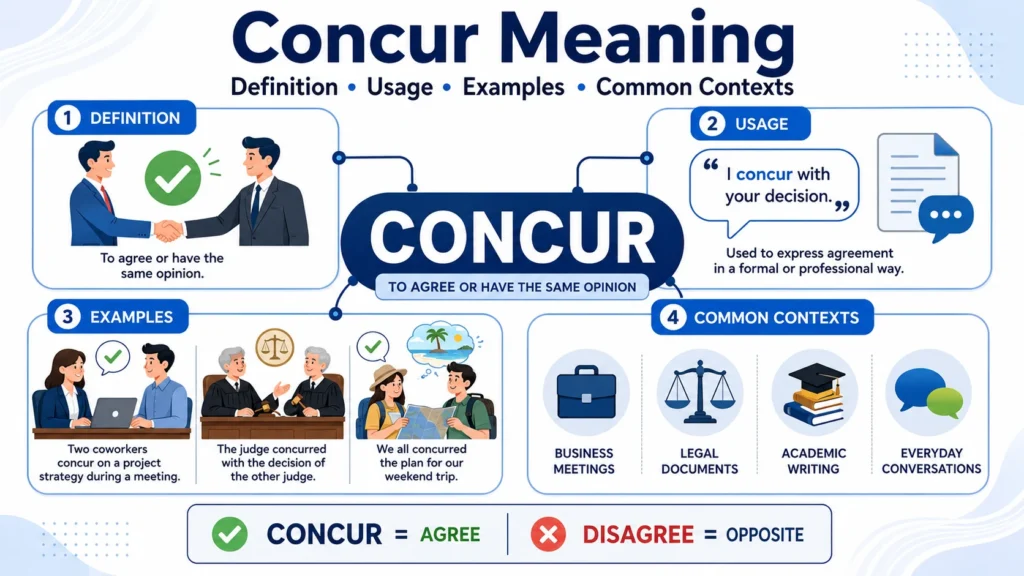
Concur means to agree with someone, share the same opinion, or happen at the same time as something else. In everyday English, it most often means “I agree.” In formal, academic, and workplace contexts, it can also mean two events occurring together.
If you’ve seen the word concur in an email, meeting note, report, or online discussion and wondered what it actually means, you’re not alone. The word sounds formal, but the idea behind it is simple. In most situations, concur meaning is to agree with someone’s opinion, statement, suggestion, or conclusion.
For example, if a coworker says, “We should delay the launch until testing is complete,” and you respond, “I concur,” you’re saying “I agree.” This is why many people search for i concur meaning or meaning i concur when they encounter the phrase in professional or formal communication.
But there’s more to it than that.
The meaning of concur extends beyond simple agreement. The word can also be used in a second sense: to happen at the same time or occur together. This meaning appears more frequently in academic writing, research papers, historical discussions, legal documents, medical literature, and other forms of formal English.
In standard dictionaries, the concur meaning in English has two primary definitions:
- To agree with a person, opinion, decision, or statement.
- To occur simultaneously or exist together with another event or circumstance.
For instance:
- “I concur with your recommendation.” (I agree.)
- “Several factors concurred to create the outcome.” (Several factors occurred together.)
Because of these two meanings, context is important when interpreting the word.
Many English learners also look up to concur meaning when studying formal vocabulary. As a verb, concur generally indicates agreement, support, or alignment with a viewpoint. Similarly, concur with meaning refers to agreeing with a person, idea, proposal, or conclusion.
The word appears in several grammatical forms:
- Concur – present tense
- Concurs – third-person singular present tense
- Concurred – past tense and past participle
For example:
- “She concurs with the committee’s recommendation.”
- “The board concurred with the final decision.”
Understanding concurs meaning and concurred meaning helps learners recognize the word in different sentence structures and professional contexts.
Another common question is do you concur meaning. When someone asks, “Do you concur?”, they are simply asking whether you agree with a statement, proposal, assessment, or decision.
For example:
- “The report recommends delaying the project. Do you concur?”
- Meaning: “Do you agree with that recommendation?”
According to major English dictionaries and style authorities, concur is considered a formal but widely accepted word in business, academic, legal, and professional communication. While it often serves as a more formal alternative to agree, it should be used when the tone or context calls for precise and professional language.
In this guide, you’ll learn:
- The exact concur meaning
- The meaning of concur in different contexts
- How it is used in everyday English and formal writing
- The difference between concur, agree, approve, and consent
- Real conversation examples
- Workplace, academic, and text-based usage
- Common mistakes and misinterpretations
- When to use concur and when not to use it
This article is designed to be both human-friendly and answer-engine friendly. Whether you’re writing, reading, studying, or trying to understand a message, you’ll gain a complete and reliable understanding of the word, its meanings, and its correct usage in modern English.
Quick Answer Box
| Topic | Answer |
| Word | Concur |
| Main meaning | To agree with someone or share the same opinion |
| Second meaning | To happen at the same time as something else |
| Tone | Usually formal, professional, academic, or polished |
| Common use | Emails, meetings, reports, legal writing, academic writing |
| Simple replacement | Agree |
| Example | “I concur with your recommendation.” |
| Everyday meaning | “I agree with what you said.” |
| Platform usage | More common in email, workplace chats, reports, and formal posts than casual texting |
| Best response if someone says it | “Thanks, glad we’re aligned,” or simply continue the conversation since they’re showing agreement |
What Does Concur Mean?
At its core, concur is a verb. It has two main meanings in English.
Concur meaning #1: To agree
This is the most common meaning.
When you concur with someone, you agree with their opinion, idea, recommendation, judgment, or conclusion.
Simple examples
- I concur with your analysis.
- The board concurred with the proposal.
- She concurred that the deadline should be extended.
In plain English, each of those means:
- I agree with your analysis
- The board agreed with the proposal
- She agreed that the deadline should be extended
Concur meaning #2: To happen together or at the same time
This is the less common meaning in everyday speech, but it still matters.
When events concur, they occur simultaneously or coincide.
Examples
- The festival concurred with the national holiday.
- Several factors concurred to create the problem.
In these cases, concur is not about agreement. It is about things happening together or combining at the same time.
Full Definition of Concur
A fuller dictionarystyle definition looks like this:
Concur (verb):
- To express agreement; to have the same opinion; to agree in judgment or statement.
- To happen or exist at the same time; to coincide.
- In some formal uses, to cooperate or combine in producing a result.
That third shade of meaning appears in sentences like:
- Several conditions concurred to make the project fail.
- Multiple causes concurred in the accident.
Here, the idea is that different things came together and contributed to one outcome.
The Most Common Concur Meaning in Modern English
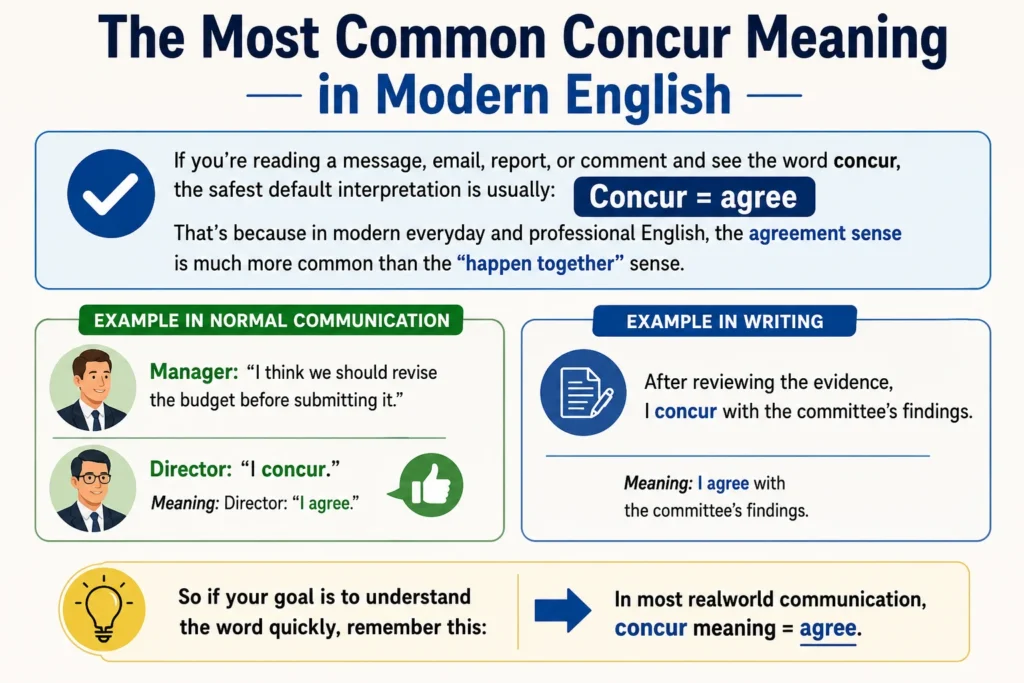
If you’re reading a message, email, report, or comment and see the word concur, the safest default interpretation is usually:
Concur = agree
That’s because in modern everyday and professional English, the agreement sense is much more common than the “happen together” sense.
Example in normal communication
- Manager: “I think we should revise the budget before submitting it.”
- Director: “I concur.”
Meaning:
- Director: “I agree.”
Example in writing
- After reviewing the evidence, I concur with the committee’s findings.
Meaning:
- I agree with the committee’s findings.
So if your goal is to understand the word quickly, remember this:
In most realworld communication, concur meaning = agree.
Why the Word “Concur” Sounds More Formal Than “Agree”
The word agree is common, casual, and flexible. You can use it almost anywhere:
- in speech
- in texts
- in emails
- in essays
- in meetings
Concur, on the other hand, sounds more formal, polished, professional, or authoritative.
That’s why you often see it in:
- business emails
- legal documents
- academic writing
- reports
- meeting minutes
- official statements
- policy discussions
- workplace approvals
Compare the tone
Casual
- I agree with you.
Formal / professional
- I concur with your assessment.
Both mean the same thing in many contexts, but the tone is different.
Why people choose “concur”
People use concur when they want to sound:
- professional
- precise
- formal
- diplomatic
- analytical
- authoritative
It can also make a response shorter and more efficient in work communication:
- I concur with the recommendation.
- I concur with the proposed timeline.
- I concur with legal’s review.
Concur Meaning in Simple English
If you want the simplest possible explanation:
Concur means:
- I agree
- I think the same
- I support that opinion
- I reach the same conclusion
- I have the same view
In some formal cases, it can also mean:
- to happen at the same time
- to occur together
- to combine in causing something
Context and Usage of Concur
The exact meaning of concur depends on the sentence around it. Context matters.
Concur as “agree”
This is the most common use.
Sentence patterns
You’ll often see it in these forms:
- concur with + person / opinion / statement
- concur that + clause
- concur in + opinion / judgment / view (more formal or older style)
Examples
- I concur with your recommendation.
- We concur that more testing is needed.
- The reviewers concurred in their assessment.
What the speaker is doing
When someone says I concur, they may be doing one or more of the following:
- agreeing with a suggestion
- endorsing a conclusion
- supporting a decision
- confirming a shared viewpoint
- formally aligning with another person’s judgment
Concur as “happen at the same time”
This use is less common in casual speech, but common enough in writing.
Sentence patterns
- X concurred with Y
- Events concurred
- Factors concurred to produce an effect
Examples
- The conference concurred with the product launch.
- Economic pressure and supply issues concurred to raise prices.
- Several events concurred during that period.
In these cases, the meaning is closer to:
- coincide
- occur together
- combine
- overlap in timing or effect
How to Tell Which Meaning Is Intended
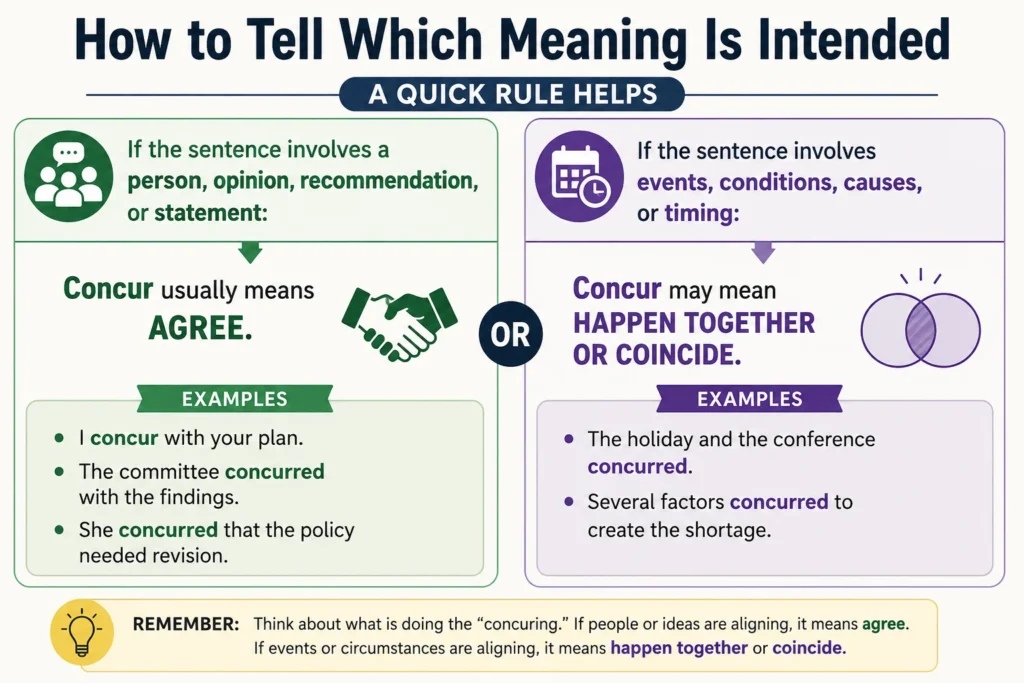
A quick rule helps:
If the sentence involves a person, opinion, recommendation, or statement:
Concur usually means agree.
Examples:
- I concur with your plan.
- The committee concurred with the findings.
- She concurred that the policy needed revision.
If the sentence involves events, conditions, causes, or timing:
Concur may mean happen together or coincide.
Examples:
- The holiday and the conference concurred.
- Several factors concurred to create the shortage.
RealLife Examples of Concur Meaning
Here are practical examples from different situations.
Workplace example
Email:
“After reviewing the revised budget, I concur with Finance’s recommendation to postpone the expansion until Q4.”
Meaning:
- The speaker agrees with Finance’s recommendation.
Academic example
Research note:
“The reviewers concur that the methodology is sound but suggest expanding the sample size.”
Meaning:
- The reviewers agree that the methodology is sound.
Legal or policy example
Statement:
“The department concurs with the legal interpretation provided in the memorandum.”
Meaning:
- The department agrees with the legal interpretation.
Historical or analytical example
Article:
“Political unrest and economic instability concurred to accelerate the collapse of the regime.”
Meaning:
- These factors combined together and happened in a way that helped cause the collapse.
Everyday example
Friend 1: “This restaurant is overpriced for the quality.”
Friend 2: “I concur.”
Meaning:
- I agree.
Concur in Everyday Conversation vs Formal Writing
The word is grammatically correct in both everyday conversation and formal writing, but it feels more natural in some settings than others.
Everyday conversation
People can say:
- I concur
- I concur with that
- I concur with your point
But in casual speech, many people would naturally say:
- I agree
- Same
- True
- Exactly
- That’s fair
- I’m with you on that
So if a friend says I concur, it may sound:
- witty
- a little formal on purpose
- intellectual
- humorous in a dry way
- theatrical or playful depending on tone
Formal writing
In professional and academic writing, concur fits much more naturally.
Examples:
- I concur with the recommendation outlined in the report.
- The committee concurs that further review is necessary.
- The panel concurred in its final decision.
Is “I Concur” Rude, Polite, or Neutral?
Usually, I concur is neutral to polite. It’s not rude. But it can feel a bit stiff depending on the setting.
It may sound:
- professional in a meeting
- polished in an email
- formal in a classroom or debate
- funny or dramatic in a casual group chat
Tone depends on context
In a work email
“I concur with your recommendation” sounds normal and professional.
In a casual text about pizza toppings
“I concur” might sound playful, sarcastic, or intentionally formal.
So the word itself isn’t rude. The effect depends on:
- relationship between speakers
- platform
- topic
- tone of the conversation
RealLife Conversation Examples
Below are realistic examples showing how concur meaning changes slightly by context while keeping the core idea of agreement.
Conversation Example 1: Office meeting
Scenario
A team is discussing a product launch date.
Maya: “I don’t think we should launch until customer support is trained.”
Daniel: “I concur. If support isn’t ready, the rollout will create avoidable issues.”
Maya: “Exactly. We need one more week.”
Meaning
Here I concur means:
- I agree with you
- I support that position
- I’ve reached the same conclusion
Conversation Example 2: College class discussion
Scenario
Students are discussing a novel in literature class.
Student A: “The author is clearly criticizing social class rather than individual characters.”
Student B: “I concur, especially in the final chapter where status becomes more important than morality.”
Meaning
The speaker is saying:
- I agree with your interpretation
Conversation Example 3: Group project chat
Scenario
Students are deciding how to divide work.
Sara: “We should finish the slides first, then write speaker notes.”
Ali: “I concur. It’ll be easier to build notes after the visuals are done.”
Meaning
- I agree with that plan
Conversation Example 4: Casual friends chat
Scenario
Friends are talking about a TV show.
Friend 1: “Season 2 was way better than Season 1.”
Friend 2: “I concur. The writing got much stronger.”
Meaning
- I agree
Tone note
Here I concur sounds a little more formal than necessary, so it can come off as playful or smartsounding rather than purely serious.
Conversation Example 5: Workplace email thread
Scenario
A manager proposes a revision.
Manager: “I recommend we move the vendor review to next Tuesday so Procurement can join.”
Director: “I concur with this change. Please update the calendar and notify the team.”
Meaning
- I agree with this recommendation and support moving forward
PlatformSpecific Meaning and Usage
The word concur doesn’t change meaning dramatically across platforms, but the tone and likelihood of use do change. It appears much more often in email, work chat, documents, and professional platforms than in highly casual social apps.
Email is one of the most common places to see concur.
How it appears
- I concur with your recommendation.
- We concur that this is the best approach.
- I concur with Legal’s assessment.
- Management concurs with the revised proposal.
Why it works in email
Email often favors concise, professional language. Concur lets someone show agreement without sounding too casual.
Example
“After reviewing the vendor comparison, I concur with your recommendation to proceed with Option B.”
Meaning:
- I agree with your recommendation
Slack or Microsoft Teams
In workplace chat apps, concur still appears, though less often than agree.
Typical use
- “I concur with that approach.”
- “Concur — let’s hold the release until QA signs off.”
Tone
It can sound:
- efficient
- slightly formal
- leadershipstyle
- a little stiff depending on team culture
In a casual startup chat, someone may prefer:
- Agreed
- Makes sense
- +1
- I’m aligned
- That works
But in a more corporate setting, concur fits naturally.
On LinkedIn, concur appears in comments and thoughtleadership posts, especially in professional discussions.
Example
“I concur with your point about upskilling. Companies that invest in employee learning are more resilient long term.”
Here it signals:
- agreement
- professionalism
- thoughtful engagement
Academic writing and university settings
Students, professors, and researchers may use concur in:
- essays
- peer reviews
- seminar discussion
- research commentary
- feedback notes
Example
“The reviewers concur that the argument is persuasive, though the conclusion could be strengthened.”
Meaning:
- the reviewers agree
Legal, medical, and policy writing
These fields often use concur because they value precision and formal tone.
Examples
- The attending physician concurred with the diagnosis.
- The appellate judge concurred with the majority opinion.
- The agency concurs with the revised policy interpretation.
In these settings, concur can sound more natural than agree because the writing style is already formal.
Texting, Snapchat, WhatsApp, or casual DMs
This is where concur becomes less common.
People in casual messaging are more likely to say:
- I agree
- same
- fr
- facts
- true
- exactly
- 100%
If someone uses I concur in a casual chat, it may be because they’re:
- joking
- intentionally sounding formal
- mirroring a professional tone
- trying to be dramatic in a funny way
- just naturally speaking that way
Casual example
Friend: “That movie was way too long.”
You: “I concur.”
Meaning:
- I agree
Tone note
In texting, it may feel slightly theatrical or dryhumorcoded, but the meaning is still straightforward.
Alternative Meanings of Concur
To fully understand concur meaning, it helps to separate the word into its possible meanings rather than assuming it always means exactly the same thing.
Meaning 1: Agreement
This is the primary meaning.
Use it when:
- sharing the same opinion
- supporting a recommendation
- agreeing with a judgment
- confirming a conclusion
Examples
- I concur with your proposal.
- The board concurred with the decision.
- We concur that additional review is needed.
Meaning 2: Coincide in time
This appears in more formal writing.
Use it when:
- two events happen at the same time
- one event overlaps with another
Examples
- The conference concurred with spring break.
- The two announcements concurred unexpectedly.
Meaning 3: Combine to produce a result
This is more analytical and formal.
Use it when:
- multiple causes work together
- several conditions combine
- different factors contribute to one outcome
Examples
- Poor planning and bad weather concurred to delay the project.
- Economic and political pressures concurred in the crisis.
Concur vs Agree
This is one of the most important comparisons because in many cases they overlap.
Similarity
Both can mean:
- share the same opinion
- support the same idea
- accept the same conclusion
Example
- I agree with your recommendation.
- I concur with your recommendation.
The meaning is nearly the same.
Difference
Agree
- more common
- more natural in everyday speech
- works in casual, neutral, and formal contexts
Concur
- more formal
- more common in professional, legal, academic, and official language
- may sound elevated or deliberate
Best rule
Use agree for everyday communication. Use concur when you want a more formal or polished tone.
Concur vs Consent
These words are not the same.
Concur
Means:
- to agree with an opinion, conclusion, or statement
Consent
Means:
- to give permission
- to allow something
- to agree to an action affecting you
Compare
- I concur with your analysis. → I agree with your analysis.
- I consent to the procedure. → I give permission for the procedure.
So concur is about agreement in thought or judgment, while consent is often about permission or authorization.
Concur vs Approve
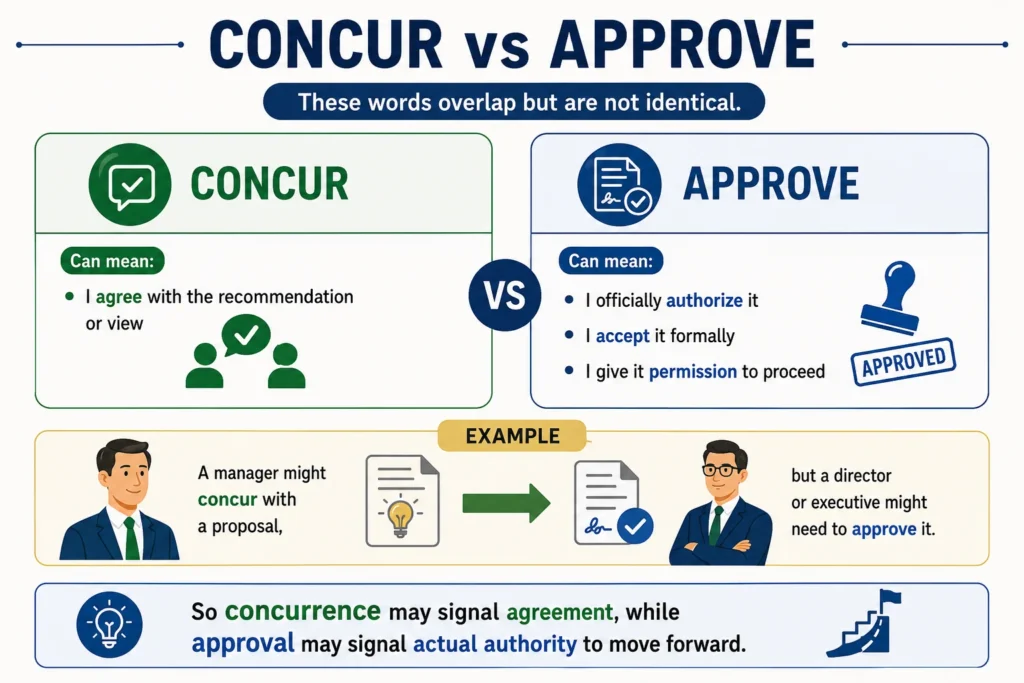
These words overlap but are not identical.
Concur
Can mean:
- I agree with the recommendation or view
Approve
Can mean:
- I officially authorize it
- I accept it formally
- I give it permission to proceed
Example
A manager might concur with a proposal, but a director or executive might need to approve it.
So concurrence may signal agreement, while approval may signal actual authority to move forward.
Concur vs Coincide
This comparison matters because of the second meaning of concur.
Coincide
Means:
- happen at the same time
- occur together
- match or overlap
Concur
Can also mean that in formal writing, but not as commonly in speech.
Example
- The event coincided with the holiday.
- The event concurred with the holiday.
Both are possible, but coincided sounds more natural in modern everyday English.
Related Terms and NLP Variations
If you’re searching for concur meaning, you may also be looking for related words or similar expressions. Here are the most useful semantic variations.
Synonyms of concur when it means “agree”
Depending on tone and context, concur may be replaced by:
- agree
- be in agreement
- share the same opinion
- be of the same mind
- support
- endorse
- align with
- accept
- assent (formal)
- approve (sometimes, depending on context)
- second (in some discussions)
- back
- go along with (casual)
Example replacements
- I concur with your recommendation
→ I agree with your recommendation - The committee concurred
→ The committee agreed - I concur with that view
→ I share that view
Synonyms of concur when it means “happen together”
- coincide
- occur together
- overlap
- happen simultaneously
- align in time
- cooccur
- combine (depending on sentence)
Related phrases people search for
People often look up concur through questions like:
- What does concur mean?
- Does concur mean agree?
- What is the meaning of I concur?
- Concur meaning in English
- Concur meaning in email
- Concur meaning in chat
- Concur meaning in law
- Concur meaning in a sentence
- Is concur formal?
- Concur synonym
How to Use Concur Correctly in a Sentence
Here are the most natural patterns.
Pattern 1: Concur with + noun
Use this when agreeing with a person, opinion, assessment, or recommendation.
Examples
- I concur with your recommendation.
- We concur with the findings.
- She concurred with the manager’s decision.
- The department concurs with the report.
Pattern 2: Concur that + clause
Use this when agreeing that something is true or necessary.
Examples
- I concur that the plan needs revision.
- The reviewers concur that the evidence is strong.
- We concur that the deadline should be extended.
Pattern 3: Concur in + noun
This is more formal and a little less common in modern speech, but still valid.
Examples
- The judges concurred in the decision.
- The members concurred in the recommendation.
Pattern 4: Events or factors concur
Use this when referring to things happening together or combining.
Examples
- Several factors concurred to produce the delay.
- The celebrations concurred with the school break.
How to Respond When Someone Says “I Concur”
If someone says I concur, they’re showing agreement. Your response depends on the situation.
In a workplace setting
You can respond by moving the discussion forward.
Good replies
- Great, I’ll proceed with that plan.
- Thanks, I’ll update the team.
- Glad we’re aligned.
- Perfect — I’ll finalize the draft.
- Understood. I’ll move ahead based on that.
In a discussion or debate
You can acknowledge the agreement and build on it.
Good replies
- Exactly — that’s the key issue.
- That’s how I see it too.
- Right, and that’s why the timeline matters.
- Agreed, which is why we should adjust the strategy now.
In a casual conversation
You can just keep chatting naturally.
Examples
- Right? That’s what I was saying.
- Exactly.
- Same here.
- Yep, totally.
Misinterpretations of Concur
Because concur is formal, people sometimes misunderstand it. Here are the most common mistakes.
Mistake 1: Thinking concur means “approve” in every case
Not always.
If your boss says, “I concur with your recommendation,” that usually means they agree. But whether that also counts as formal approval depends on the workplace and the decision process.
Better interpretation
- Concur = agree
- Approve = authorize or officially sign off
Sometimes the same person can do both, but the words are not identical.
Mistake 2: Thinking concur is only used in law or academia
No. It’s common there, but it also appears in:
- business emails
- meetings
- workplace chats
- formal social comments
- professional online discussions
Mistake 3: Thinking it’s always oldfashioned
It can sound traditional or formal, but it’s still used in modern English, especially in professional writing.
Mistake 4: Assuming it always means “happen at the same time”
That’s only one meaning, and it’s not the one most people intend in everyday communication.
If a person says I concur, they almost certainly mean I agree.
Mistake 5: Using it in ultracasual situations where it sounds awkward
It’s not wrong, but it may sound stiff.
For example, texting:
- “I concur that these fries slap.”
That sentence is understandable, but it mixes a formal verb with very casual slang. That can sound funny or intentionally dramatic.
When Not to Use Concur
Even though concur is a useful word, it’s not always the best choice.
Don’t use it when you want plain, simple language
If your audience is broad or casual, agree is usually easier.
Instead of:
- I concur with your suggestion.
You could say:
- I agree with your suggestion.
Don’t use it if you want warm, conversational tone
Concur can feel detached or formal. If you’re writing a friendly message, agree may sound more natural.
Example
Instead of:
- I concur with your concerns.
You might write:
- I understand and agree with your concerns.
That feels more human and empathetic.
Don’t use it if permission is the real issue
If you’re talking about authorization, approve, authorize, or consent may be more accurate.
Example
- The director approved the budget.
- The patient consented to treatment.
Using concur there may be too vague.
Usage Tips for Concur
If you want to use the word naturally, these tips help.
Tip 1: Use it in professional writing when you want concise agreement
Examples:
- I concur with the recommendation.
- We concur that further review is necessary.
- I concur with the revised timeline.
Tip 2: Use “concur with” for the safest modern structure
This is the easiest and most natural pattern.
Best examples
- I concur with your assessment.
- We concur with the proposal.
- She concurred with the findings.
Tip 3: Use “agree” if you’re unsure about tone
If you don’t know whether concur will sound too formal, choose agree.
Tip 4: Be careful with the “events happen together” meaning
It’s valid, but if clarity matters, coincide is often easier for readers.
Instead of
- The launch concurred with the annual conference.
You could say:
- The launch coincided with the annual conference.
Tip 5: Don’t overuse it
Because it’s a formal word, repeating it too often can make writing sound stiff.
Examples of Concur in Different Contexts
Below are more examples so you can see how flexible the word is.
In business communication
- I concur with the recommendation to delay the rollout.
- Finance concurs that the revised estimate is reasonable.
- The leadership team concurred on the final budget allocation.
In education
- The professors concur that the thesis needs stronger evidence in chapter three.
- I concur with your interpretation of the poem’s final image.
In legal or judicial language
- The judge concurred with the majority opinion.
- Counsel concurs with the proposed interpretation of the clause.
In healthcare
- The second specialist concurred with the diagnosis.
- Both physicians concur that surgery is unnecessary at this stage.
In everyday conversation
- I concur — that restaurant is overrated.
- I concur with your ranking of the albums.
- Yeah, I concur. We should leave early.
In analytical writing
- A series of economic pressures concurred to weaken consumer demand.
- Weather disruption and supply constraints concurred to slow distribution.
FAQs
What does concur mean in simple words?
In simple words, concur usually means to agree. If someone says “I concur,” they mean “I agree with you.” In more formal writing, it can also mean to happen at the same time.
Does concur always mean agree?
No, but that is the most common meaning. Concur can also mean to coincide or to happen together, especially in formal writing. Still, in emails, discussions, and meetings, it usually means agree.
What does “I concur” mean in a message?
I concur means I agree with what you said. In a work message, it often shows support for a recommendation, plan, or opinion.
Is concur a formal word?
Yes, concur is generally more formal than agree. It is common in business, academic, legal, and official writing. It can still be used in casual speech, but it may sound a little polished or playful there.
What is the difference between concur and agree?
They often mean the same thing, but agree is more common in everyday English. Concur is more formal and often appears in professional or academic settings.
Can concur mean happen at the same time?
Yes. In formal English, concur can mean to happen together, to coincide, or to occur at the same time. Example: “The conference concurred with the holiday weekend.”
How do you use concur in a sentence?
Here are a few examples:
- I concur with your recommendation.
- We concur that the budget should be revised.
- The specialists concurred with the diagnosis.
- Several factors concurred to create the delay.
Is “I concur with you” correct?
Yes, it’s grammatically correct, but I concur with your point, I concur with your view, or I concur often sounds more natural than I concur with you. Still, it is understandable and acceptable.
Is concur used in legal writing?
Yes. Concur is common in legal, judicial, and policy language. For example, a judge may concur with an opinion, or an agency may concur with an interpretation.
What is a synonym for concur?
The best synonym depends on context. For the agreement meaning, common synonyms include:
- agree
- support
- endorse
- be in agreement
- share the same view
For the timing meaning, synonyms include:
- coincide
- overlap
- occur together
Conclusion
The easiest way to remember concur meaning is this:
Concur usually means “to agree.”
If someone says “I concur,” they’re almost always saying:
- I agree
- I share that opinion
- I support that conclusion
That’s the meaning you’ll see most often in:
- emails
- meetings
- reports
- academic writing
- workplace chats
- legal or policy documents
There is also a second meaning of concur:
- to happen at the same time
- to coincide
- to combine in producing a result
But unless the sentence is clearly talking about events, causes, timing, or overlapping conditions, the word usually points back to agreement.
The practical takeaway
If you’re reading or writing modern English, here’s the safest interpretation guide:
- Person + opinion + concur → agree
- Team + recommendation + concur → agree/support
- Events + factors + concur → coincide/combine
A final simple memory trick
Think of concur like this:
- In conversation: “I agree.”
- In professional writing: “I formally agree.”
- In analytical writing: “These things happened together or worked together.”
Once you understand those three layers, the word becomes much easier to recognize and use correctly.

Justin Powell is a writer at GramBrix.com who focuses on grammar, clarity and effective communication, helping readers strengthen their language skills.