Last Updated on July 31, 2026
Keen usually means eager, enthusiastic, strongly interested, or highly aware of something. In everyday English, someone who is keen is excited, motivated, or deeply interested. Depending on context, keen can also describe sharp senses, strong emotion, or intense perception.
If you’ve seen the word keen in a text, social media caption, comment, movie subtitle, or everyday conversation, you might be wondering about the keen meaning. The short answer is that keen usually refers to strong interest, eagerness, enthusiasm, or sharp awareness. However, the full meaning of keen depends on the context in which it is used.
In modern English, keen meaning in English commonly includes being excited to do something, having a strong interest in a subject, or possessing sharp senses and observation skills. For example, someone may be keen to learn a new skill, keen on sports, or known for having a keen eye for detail.
Many people search for what is the meaning of keen because the word appears in a variety of situations. In everyday conversation, keen often means enthusiastic, interested, or willing.
For example:
- “I’m keen to join the project.” (I am eager to join.)
- “She is keen on photography.” (She has a strong interest in photography.)
- “He has a keen sense of observation.” (He notices details easily.)
A common phrase is keen interest meaning, which refers to a strong curiosity, enthusiasm, or desire to learn more about something. If someone shows a keen interest in a topic, they are highly engaged and attentive.
Similarly, keen about meaning refers to being enthusiastic or excited about a person, activity, idea, or subject. For example, “She is keen about environmental conservation” means she is very interested in and supportive of it.
You may also encounter expressions such as very keen meaning, which simply emphasizes a stronger level of enthusiasm, eagerness, or interest.
In professional settings, some people search for keen to details meaning. While this phrase is commonly used, the more natural English expression is usually keen attention to detail or a keen eye for detail, meaning someone notices small details accurately and carefully.
Another search variation is meaning keen or keen or keen meaning, both of which typically refer to understanding the word’s general definition and usage.
According to major English dictionaries, keen can function as an adjective describing enthusiasm, interest, intensity, or sharpness. It is widely used in everyday speech, academic writing, business communication, and online conversations.
This guide breaks down keen meaning in plain US English, with examples, texting use, platform-based usage, reply ideas, common misunderstandings, and related phrases. By the end, you’ll know exactly what keen means, when to use it, when not to use it, and how to understand it in real conversations both online and offline.
Quick Answer Box
| Element | Meaning |
| Word | Keen |
| Core meaning | Eager, enthusiastic, strongly interested, or highly aware |
| Common tone | Positive, interested, motivated, attentive |
| Used for | Interest, excitement, willingness, strong preference, sharp senses |
| Example | “I’m keen to try that new restaurant.” |
| In texting/chat | Usually means “I’m interested,” “I’m down,” or “I’m excited” |
| In everyday speech | Can mean eager, intense, or very interested in something |
| On platforms | Used in texts, captions, bios, comments, dating chats, and casual conversation |
| Possible emotional tone | Friendly, curious, excited, intentional, engaged |
| Not always slang | It’s a standard English word, but it can sound casual depending on how it’s used |
What Does Keen Mean?
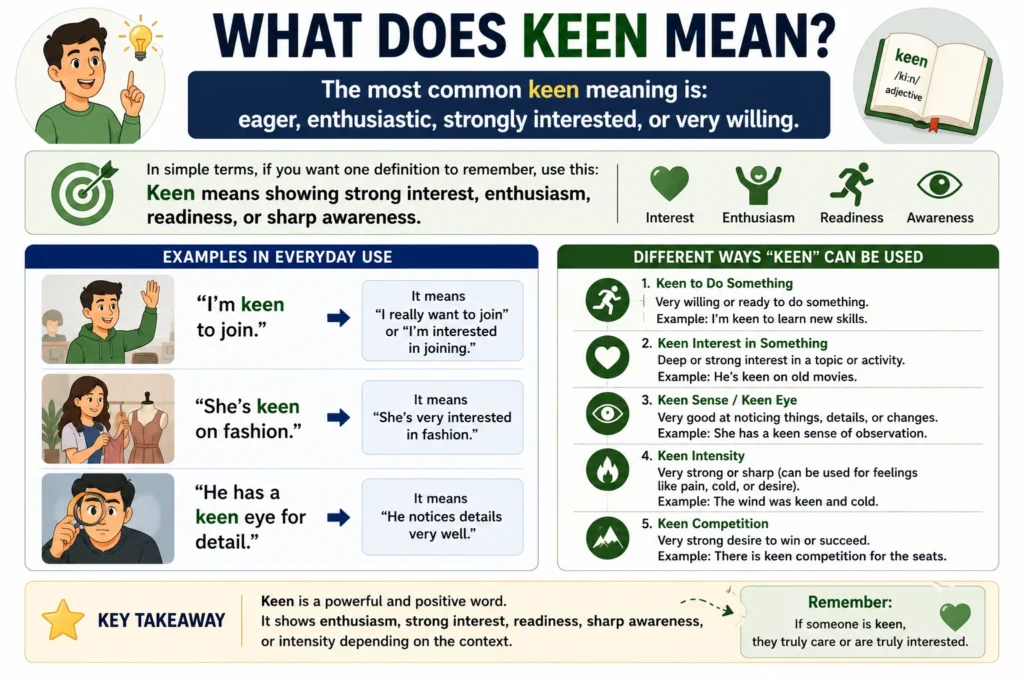
The most common keen meaning is:
Keen = eager, enthusiastic, strongly interested, or very willing
So if someone says:
- “I’m keen to join.”
It means “I really want to join” or “I’m interested in joining.” - “She’s keen on fashion.”
It means “She’s very interested in fashion.” - “He has a keen eye for detail.”
It means “He notices details very well.”
That’s why keen is such a flexible word. It can describe motivation, interest, curiosity, sharp perception, and sometimes even intensity of feeling.
In simple terms, if you want one definition to remember, use this:
Keen means showing strong interest, enthusiasm, readiness, or sharp awareness.
Full Definition of Keen
The word keen has several connected meanings. They all revolve around the idea of something being strong, sharp, active, or intense.
Keen as Eager or Willing
This is the meaning most people are looking for.
If someone is keen to do something, they are eager, excited, willing, or motivated to do it.
Examples
- “I’m keen to start the project.”
- “We’re keen to hear your ideas.”
- “She wasn’t keen to leave early.”
- “Are you keen to come with us?”
In these examples, keen means:
- interested
- ready
- enthusiastic
- up for it
- motivated
Keen as Strongly Interested in Something
If someone is keen on something, it means they really like it or care about it a lot.
Examples
- “He’s keen on basketball.”
- “She’s always been keen on art.”
- “My brother is keen on learning Japanese.”
- “I’m not too keen on spicy food.”
This structure is very common:
- keen on + noun
- keen on + activity
- keen on + person/idea
Examples:
- keen on music
- keen on hiking
- keen on the plan
- not keen on that idea
Keen as Sharp or Highly Perceptive
Keen can also mean sharp, strong, or highly developed, especially when talking about the senses, judgment, or observation.
Examples
- “Dogs have a keen sense of smell.”
- “She has a keen eye for design.”
- “He has a keen understanding of the market.”
- “The detective had keen instincts.”
Here, keen means:
- sharp
- precise
- observant
- perceptive
- strong in ability
Keen as Intense or Strong Emotion
Sometimes keen can describe a feeling that is very strong, such as keen interest, keen disappointment, or keen desire. This usage is more formal than texting language, but it still appears in articles, books, and polished writing.
Examples
- “There was keen competition between the teams.”
- “She felt keen disappointment.”
- “He showed a keen interest in science.”
In these cases, keen means:
- intense
- strong
- deeply felt
Context and Usage of Keen
To understand keen meaning properly, you need to look at the structure around it. The word changes slightly depending on what comes after it.
Keen to + Verb
This means eager or willing to do something.
Examples
- “I’m keen to learn.”
- “They’re keen to move forward.”
- “We’re keen to collaborate.”
- “She’s keen to meet everyone.”
Translation in simple US English
- I want to do it
- I’m excited to do it
- I’m open to it
- I’m interested in doing it
Keen on + Noun or Activity
This means very interested in, fond of, or really into something.
Examples
- “He’s keen on football.”
- “I’m keen on trying new coffee spots.”
- “She’s not keen on horror movies.”
- “They’re keen on the idea.”
Translation in simple US English
- really likes
- is into
- is interested in
- supports or prefers
Not Keen On
This is a very common phrase and it means not interested, not enthusiastic, or not comfortable with the idea.
Examples
- “I’m not keen on that plan.”
- “She’s not keen on public speaking.”
- “He wasn’t keen on moving.”
- “They’re not keen on changing the schedule.”
This doesn’t always mean a hard no. Sometimes it means:
- unsure
- hesitant
- not excited about it
- mildly opposed
That makes it useful in both casual and professional English.
Keen for Something
In some contexts, especially outside the US, keen for can mean wanting something or looking forward to it.
Examples
- “I’m keen for a vacation.”
- “We’re keen for some good news.”
In US English, this is a little less common than keen on or keen to, but you may still see it in global English content, captions, interviews, and online discussions.
Real Life Examples of Keen Meaning
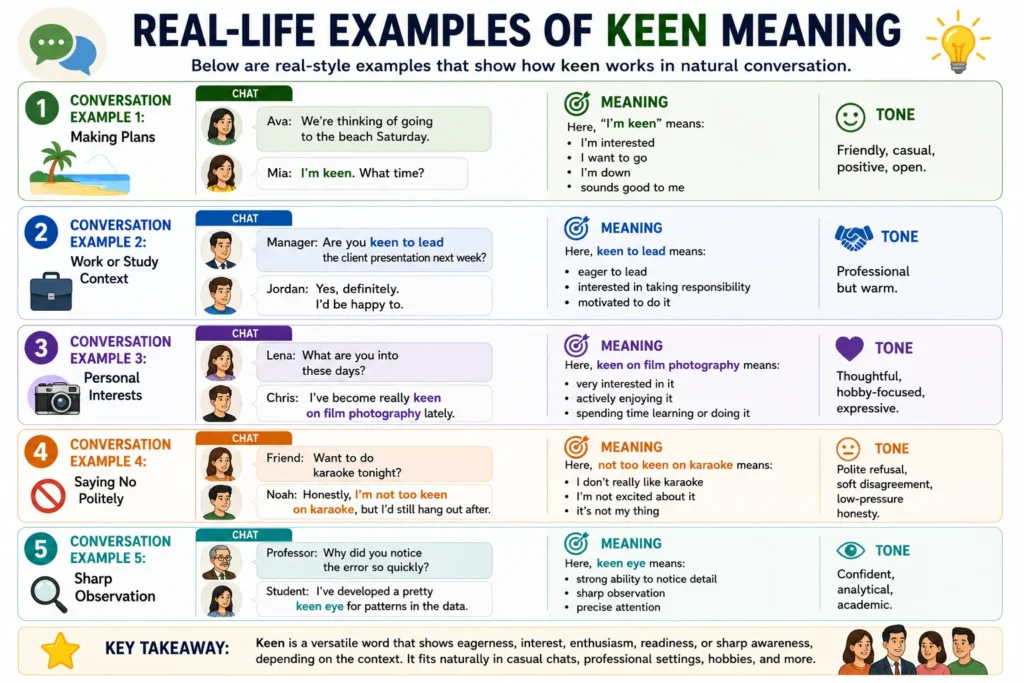
Below are realstyle examples that show how keen works in natural conversation. These examples matter because a dictionary definition alone doesn’t always show tone.
Conversation Example 1: Making Plans
Chat
Ava: We’re thinking of going to the beach Saturday.
Mia: I’m keen. What time?
Meaning
Here, “I’m keen” means:
- I’m interested
- I want to go
- I’m down
- sounds good to me
Tone
Friendly, casual, positive, open.
Conversation Example 2: Work or Study Context
Chat
Manager: Are you keen to lead the client presentation next week?
Jordan: Yes, definitely. I’d be happy to.
Meaning
Here, keen to lead means:
- eager to lead
- interested in taking responsibility
- motivated to do it
Tone
Professional but warm.
Conversation Example 3: Personal Interests
Chat
Lena: What are you into these days?
Chris: I’ve become really keen on film photography lately.
Meaning
Keen on film photography means:
- very interested in it
- actively enjoying it
- spending time learning or doing it
Tone
Thoughtful, hobbyfocused, expressive.
Conversation Example 4: Saying No Politely
Chat
Friend: Want to do karaoke tonight?
Noah: Honestly, I’m not too keen on karaoke, but I’d still hang out after.
Meaning
Not too keen on karaoke means:
- I don’t really like karaoke
- I’m not excited about it
- it’s not my thing
Tone
Polite refusal, soft disagreement, lowpressure honesty.
Conversation Example 5: Sharp Observation
Chat
Professor: Why did you notice the error so quickly?
Student: I’ve developed a pretty keen eye for patterns in the data.
Meaning
Keen eye means:
- strong ability to notice detail
- sharp observation
- precise attention
Tone
Confident, analytical, academic.
PlatformSpecific Meaning of Keen
The meaning of keen doesn’t completely change across platforms, but the tone and style can shift depending on where you see it. On some apps it feels polished and intentional; on others it sounds casual and quick.
Keen in Text Messages
In texting, keen usually means:
- I’m interested
- I’m down
- I’d like to
- sounds good
- I’m into it
Examples
- “Dinner at 8?”
“Keen.” - “Want to check out that new coffee place?”
“Yeah I’m keen.” - “You keen to hop on a call later?”
“Sure, I’m keen.”
Tone in texts
- casual
- positive
- cooperative
- sometimes slightly more polished than “yeah sure”
In texting, keen often gives off a calm but interested vibe. It’s not overly dramatic. It says yes without sounding too intense.
Keen on WhatsApp
On WhatsApp, keen often appears in group planning, family chats, work chats, and friend conversations.
Common WhatsApp uses
- “Anyone keen for chai later?”
- “I’m keen to try that place.”
- “Not keen on that timing tbh.”
- “Who’s keen for a weekend trip?”
What it signals on WhatsApp
- openness to plans
- genuine interest
- group participation
- soft agreement
Because WhatsApp conversations are often practical and social at the same time, keen works well when someone wants to sound engaged without overexplaining.
Keen on Snapchat
On Snapchat, keen is less about dictionarystyle definition and more about short conversational energy.
Example uses
- “You keen for tonight?”
- “Lowkey keen for summer fr.”
- “Not keen on this weather 😭”
- “I’m keen to see you.”
Tone on Snapchat
- casual
- playful
- fast
- sometimes flirty
On Snapchat, keen can show anticipation, romantic interest, or excitement about a plan. It’s usually short and natural rather than formal.
Keen on TikTok
On TikTok, you may see keen in captions, comments, minivlogs, and “day in my life” style posts.
Examples
- “So keen for this trip.”
- “I’m actually so keen to try this.”
- “Not keen on the new update ngl.”
- “Anyone else weirdly keen on organizing their room at 2am?”
TikTok tone
- expressive
- trendaware
- conversational
- mildly dramatic in a funny way
On TikTok, keen often blends standard English with internet tone. It can sound excited without being too loud. It’s especially common in captions that show anticipation.
Keen on Instagram
On Instagram, keen is often used in captions, comments, story replies, or travel/food/lifestyle posts.
Examples
- “Very keen to come back here.”
- “Always keen for golden hour.”
- “Not keen on winter but the outfits kinda save it.”
- “So keen for launch day.”
Tone on Instagram
- aesthetic but casual
- polished but personal
- expressive without sounding chaotic
Instagram captions often use keen to show excitement, appreciation, or emotional investment in a trip, outfit, event, or creative project.
Keen on X or TwitterStyle Posts
On fastmoving textheavy platforms, keen often shows up in opinion posts or reactions.
Examples
- “Not keen on the app redesign.”
- “Keen to see how this season plays out.”
- “I’m keen for more brands to do this.”
- “Not especially keen on that take.”
Tone
- opinionated but not aggressive
- thoughtful
- concise
- sometimes understated
Using keen in this context can make a statement feel slightly more measured than saying “I hate this” or “I’m obsessed.”
Keen in Dating Apps and Romantic Chat
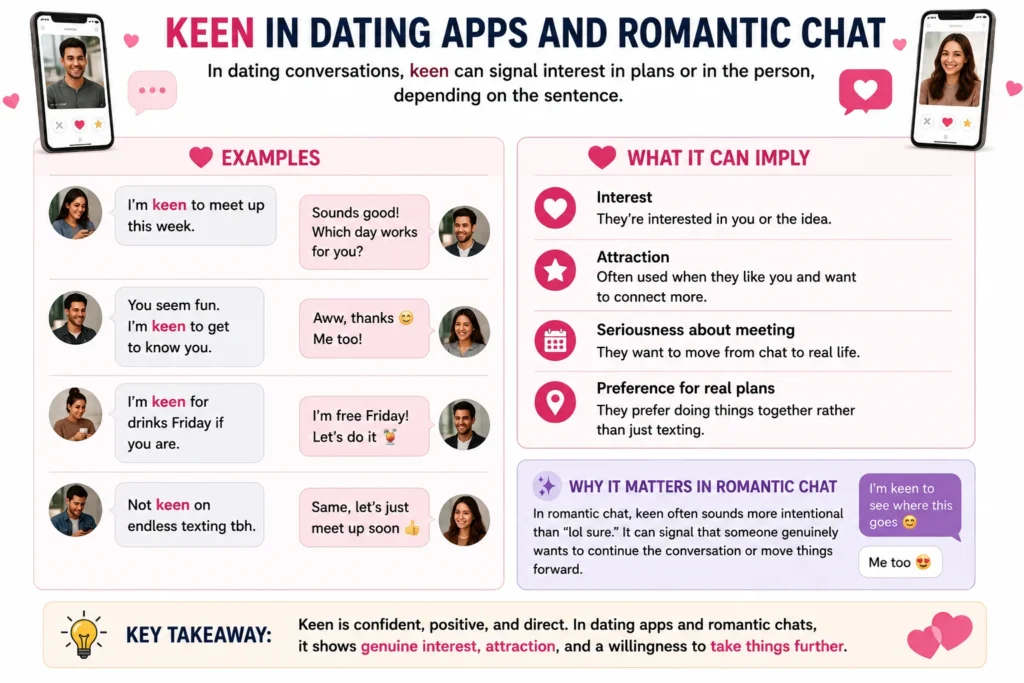
In dating conversations, keen can signal interest in plans or in the person, depending on the sentence.
Examples
- “I’m keen to meet up this week.”
- “You seem fun. I’m keen to get to know you.”
- “I’m keen for drinks Friday if you are.”
- “Not keen on endless texting tbh.”
What it can imply
- interest
- attraction
- seriousness about meeting
- a preference for real plans
In romantic chat, keen often sounds more intentional than “lol sure.” It can signal that someone genuinely wants to continue the conversation or move things forward.
Alternative Meanings of Keen
Even though keen most commonly means eager or interested, it does have other meanings that matter in writing and conversation.
Keen as Sharp
This meaning shows up in phrases like:
- keen eye
- keen sense of smell
- keen hearing
- keen intellect
Example
“She has a keen eye for vintage design.”
This means she notices design details very well.
Keen as Intense
This meaning is more common in formal writing.
Examples
- keen interest
- keen competition
- keen awareness
- keen disappointment
Example sentence
“The company has a keen interest in sustainable packaging.”
That means the interest is strong and serious.
Keen as Emotionally Deep or Strongly Felt
This is a more literary or formal layer of the word.
Example
“He felt a keen sense of loss.”
This doesn’t mean eager. It means deeply felt, sharp, or painfully strong.
That’s why context matters. If someone says, “I’m keen to go,” the meaning is enthusiastic. If a novel says, “She felt keen sorrow,” the meaning is emotional intensity.
Related Terms and NLP Variations
If you’re researching keen meaning for SEO, language understanding, or content writing, it helps to map the semantic neighborhood around the word. Here are the most common related meanings and phraselevel alternatives.
Synonyms of Keen When It Means “Eager”
- eager
- enthusiastic
- interested
- excited
- motivated
- ready
- willing
- game
- up for it
- down
Example swaps
- “I’m keen to go” → “I’m eager to go”
- “She’s keen to help” → “She’s happy to help”
- “They’re keen to start” → “They’re ready to start”
Synonyms of Keen When It Means “Interested In”
- into
- fond of
- passionate about
- drawn to
- invested in
- enthusiastic about
- engaged with
Example swaps
- “He’s keen on cooking” → “He’s really into cooking”
- “She’s keen on the idea” → “She likes the idea”
Synonyms of Keen When It Means “Sharp”
- perceptive
- observant
- sharp
- alert
- precise
- insightful
- discerning
Example swaps
- “a keen eye” → “a sharp eye”
- “keen hearing” → “excellent hearing”
Common Phrase Variations
Keen to
Used for action:
- keen to help
- keen to learn
- keen to join
- keen to try
Keen on
Used for interest or preference:
- keen on music
- keen on the plan
- keen on sports
- not keen on spicy food
Keen for
Used for wanting something:
- keen for coffee
- keen for a break
- keen for some sunshine
Keen eye / keen sense
Used for perception:
- keen eye for detail
- keen sense of humor
- keen awareness of trends
Keen vs Similar Words
Understanding keen meaning gets easier when you compare it to words people often confuse with it.
Keen vs Eager
These are very close, but keen can sound a little more natural in casual conversation depending on region and tone.
- Eager = strongly wanting to do something
- Keen = eager, interested, willing, or enthusiastic
Example
- “I’m eager to start” sounds slightly formal or energetic.
- “I’m keen to start” sounds interested and positive, often a bit more conversational.
Keen vs Interested
Interested is more neutral.
Keen usually adds extra enthusiasm or emotional energy.
Compare
- “I’m interested in photography.”
= I like it / it has my attention. - “I’m keen on photography.”
= I really like it / I’m actively into it.
Keen vs Excited
Excited is stronger and more emotional.
Keen can be calmer and more understated.
Compare
- “I’m excited for the concert.”
= high energy, emotional anticipation - “I’m keen for the concert.”
= definitely looking forward to it, interested, ready
Keen vs Down
In texting, down and keen can overlap.
Compare
- “I’m down” = I agree / I’m in
- “I’m keen” = I’m in and interested / I’m eager / sounds good
Keen can feel slightly more intentional or enthusiastic than down.
How to Respond When Someone Says “I’m Keen”
If someone says “I’m keen”, they’re usually showing interest, so your reply can move the conversation forward naturally.
If They’re Keen About a Plan
You can reply with:
- “Perfect, I’ll send the details.”
- “Love that. Let’s do it.”
- “Great, I’ll book it.”
- “Awesome, what time works for you?”
- “Nice, I’m glad you’re in.”
If They Say They’re Keen to Learn or Help
You can reply with:
- “That’s great to hear.”
- “I’d love to have your input.”
- “Perfect, I’ll send over the next steps.”
- “Thanks, I appreciate it.”
- “Amazing, let’s get started.”
If They Say They’re Not Keen
When someone says “I’m not keen” or “not too keen on that,” they usually mean they’re uncomfortable, uninterested, or not convinced.
Good responses
- “No worries, we can do something else.”
- “Fair enough—what would you prefer?”
- “Totally fine, just wanted to check.”
- “Got it. Want to suggest another option?”
- “No pressure at all.”
This keeps the conversation easy and respectful.
Misinterpretations of Keen
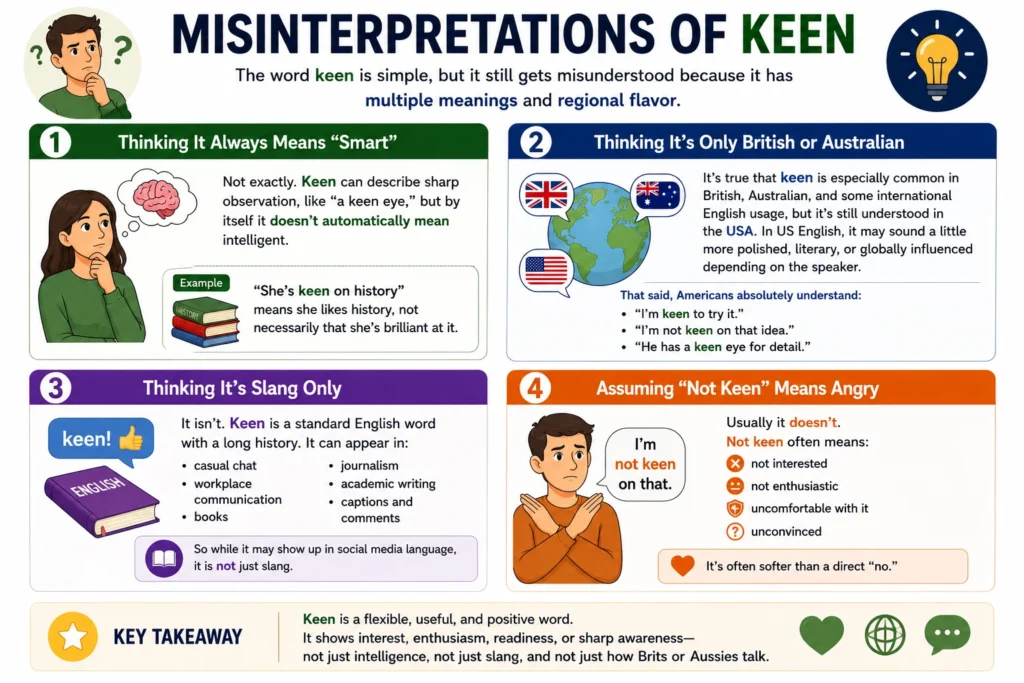
The word keen is simple, but it still gets misunderstood because it has multiple meanings and regional flavor.
Misinterpretation 1: Thinking It Always Means “Smart”
Not exactly. Keen can describe sharp observation, like “a keen eye,” but by itself it doesn’t automatically mean intelligent.
Example
- “She’s keen on history”
means she likes history, not necessarily that she’s brilliant at it.
Misinterpretation 2: Thinking It’s Only British or Australian
It’s true that keen is especially common in British, Australian, and some international English usage, but it’s still understood in the USA. In US English, it may sound a little more polished, literary, or globally influenced depending on the speaker.
That said, Americans absolutely understand:
- “I’m keen to try it.”
- “I’m not keen on that idea.”
- “He has a keen eye for detail.”
Misinterpretation 3: Thinking It’s Slang Only
It isn’t. Keen is a standard English word with a long history. It can appear in:
- casual chat
- workplace communication
- books
- journalism
- academic writing
- captions and comments
So while it may show up in social media language, it is not just slang.
Misinterpretation 4: Assuming “Not Keen” Means Angry
Usually it doesn’t.
Not keen often means:
- not interested
- not enthusiastic
- uncomfortable with it
- unconvinced
It’s often softer than a direct “no.”
When Not to Use Keen
Even though keen is useful, there are situations where it may not be the best word choice.
When Your Audience Might Find It Unnatural
If you’re writing for a very casual US audience, “keen” can sometimes sound slightly less common than:
- excited
- into
- interested
- down
- up for it
For example, a teen in the US might be more likely to text:
- “I’m down”
- “I’m so excited”
- “I’m into that”
than:
- “I’m keen”
That doesn’t make keen wrong. It just changes the vibe.
When You Need Maximum Clarity
If you’re writing a highly practical message and don’t want any ambiguity, more direct phrases can be better.
Instead of:
“I’m keen on moving ahead.”
You could say:
- “I’d like to move ahead.”
- “I’m interested in proceeding.”
- “I’m ready to move forward.”
When Tone Matters in Formal US Business Writing
In US business communication, keen can sound slightly international or polished. It’s still correct, but depending on the company tone, phrases like these may be more common:
- interested in
- excited to
- eager to
- happy to
- glad to
Example:
- “We are keen to partner with you” is correct.
- “We’re excited to partner with you” may sound more natural in some US marketing or startup contexts.
Usage Tips for Keen
If you want to use keen naturally, these rules help.
Use “keen to” for actions
Good examples
- I’m keen to learn more.
- She’s keen to apply.
- We’re keen to visit.
- He’s keen to improve.
Use “keen on” for interests and opinions
Good examples
- I’m keen on jazz.
- She’s not keen on crowds.
- He’s keen on the proposal.
- They’re keen on hiking.
Use “keen eye” or “keen sense” for perception
Good examples
- She has a keen eye for color.
- Dogs have a keen sense of smell.
- He has a keen awareness of risk.
Use “not keen” as a soft no
Good examples
- I’m not keen on that restaurant.
- She wasn’t keen to discuss it.
- We’re not keen on changing the plan last minute.
This sounds less harsh than:
- I hate that
- absolutely not
- no way
Five More Natural Conversation Examples
To make keen meaning even clearer, here are five more realistic examples across different situations.
Conversation Example 6: Friends Planning a Trip
Chat
Riya: We found cheap flights for September. You keen?
Tara: Yes please. I’ve been needing a trip so bad.
Meaning
You keen? = Are you interested? Are you in?
Conversation Example 7: Workplace Collaboration
Chat
Sam: We’re building a new content series. Are you keen to write the first draft?
Alex: Definitely. I’ve got a few ideas already.
Meaning
keen to write = interested and motivated to do it
Conversation Example 8: Food Preference
Chat
Eli: I ordered the spicy ramen. Want to try it?
Mason: I’m not keen on super spicy food, but I’ll taste a little.
Meaning
not keen on = not a big fan of
Conversation Example 9: Dating App Vibe
Chat
Nina: You seem fun. Keen for drinks this weekend?
Leo: Yeah, I’d be keen. Saturday works for me.
Meaning
keen for drinks = interested in meeting up
Conversation Example 10: Hobby and Identity
Chat
Host: How did you get into running?
Guest: My sister was really keen on marathons, and I picked it up from her.
Meaning
keen on marathons = very interested in marathons
Emotional and Social Meaning of Keen
Words don’t just carry dictionary meanings—they also carry social signals. That’s part of why keen is useful.
When someone says “I’m keen”, they often communicate more than simple agreement. They may also be signaling:
- I’m genuinely interested
- I’m emotionally engaged
- I’m open and cooperative
- I’m making an effort
- I’m not just saying yes to be polite
That’s why keen can feel warmer than a flat “sure.”
Compare the vibe
- “Sure.”
Neutral, maybe casual, maybe lowenergy. - “I’m keen.”
Positive, engaged, interested. - “Absolutely, I’d love to.”
More enthusiastic and expressive. - “I’m down.”
Casual, relaxed, social.
So keen sits in a useful middle zone: interested, positive, but not overthetop.
Keen in Professional Writing and Resumes
The word keen also appears in professional English, especially in bios, cover letters, and personal summaries.
Examples
- “A keen interest in digital marketing”
- “Keen to develop leadership skills”
- “A keen eye for visual detail”
- “Keen understanding of customer behavior”
This usage is fine, but it can become repetitive if overused. In resumes or LinkedInstyle writing, you may want to vary it with:
- strong interest in
- highly motivated to
- experienced in
- attentive to
- passionate about
- detailoriented with
Keen Meaning in Simple OneLine Translations
Here are quick translations of keen based on context.
| Sentence | Meaning |
| “I’m keen to go.” | I want to go / I’m excited to go |
| “She’s keen on music.” | She really likes music |
| “He has a keen eye.” | He notices details well |
| “I’m not keen on that.” | I don’t really like that / I’m not into it |
| “They’re keen to help.” | They’re eager to help |
| “She has keen hearing.” | Her hearing is sharp |
| “There’s keen interest in the launch.” | People are strongly interested in it |
FAQs
What does keen mean in texting?
In texting, keen usually means interested, eager, or down for it. If someone texts “I’m keen,” they usually mean they want to do it, they like the idea, or they’re excited about the plan.
Does keen mean excited?
Sometimes, yes. Keen can overlap with excited, but it usually sounds a bit calmer and more understated. It often means interested, willing, and looking forward to something, rather than super highenergy excitement.
What does “keen on” mean?
Keen on means very interested in, fond of, or really into something. For example, “She’s keen on painting” means she really likes painting or has a strong interest in it.
What does “not keen” mean?
Not keen means not interested, not enthusiastic, not comfortable with, or not a fan of something. It’s often a softer and more polite way to disagree or say no.
Is keen a slang word?
No. Keen is a standard English word, not just slang. However, it can appear in casual chat, texting, social media captions, and internet conversation, so it may feel informal depending on how it’s used.
Is keen common in the USA?
Yes, Americans understand keen, although it may feel slightly less everyday than words like excited, interested, or down in some casual US conversations. It’s still natural and correct in American English.
What does “I’m keen” mean from a guy or girl in chat?
Usually it means I’m interested, I want to, I’m into the idea, or I’d like to do that. In dating or flirting, it can also suggest genuine interest in meeting, talking more, or continuing the connection.
What does “keen eye” mean?
A keen eye means a strong ability to notice detail. Someone with a keen eye is observant, perceptive, and good at spotting things others may miss.
Can keen be negative?
Yes, but usually only in certain structures. For example, “not keen on it” is negative because it means the person doesn’t like the idea. Also, in formal writing, keen pain, keen sorrow, or keen disappointment can describe intense negative emotion.
What is another word for keen?
It depends on context. Common alternatives include:
- eager
- enthusiastic
- interested
- excited
- willing
- into
- sharp
- perceptive
- observant
Is “keen to” grammatically correct?
Yes, absolutely. Keen to + verb is a correct and common structure. Examples:
- keen to help
- keen to join
- keen to learn
- keen to meet
Is “keen on” grammatically correct?
Yes. Keen on + noun/idea/activity is also correct. Examples:
- keen on music
- keen on the idea
- keen on hiking
- not keen on drama
What does keen mean on social media?
On social media, keen usually means interested, excited, into it, or looking forward to something. It can appear in captions, comments, replies, or DMs and often carries a positive, engaged tone.
Can keen mean smart?
Not directly. Keen can describe sharp perception or understanding, such as “a keen observer” or “a keen mind,” but it doesn’t simply mean “smart” in every context.
Is keen formal or informal?
It can work in both. Keen is flexible. It appears in:
- casual chat
- social captions
- interviews
- articles
- business writing
- books
The tone depends on the sentence around it.
Conclusion
The core keen meaning is simple once you see it in context: keen usually means eager, interested, enthusiastic, willing, or sharply aware. In everyday conversation, if someone says “I’m keen”, they usually mean “I’m interested” or “I’m up for it.” If they say “I’m keen on it,” they mean they like it or care about it. And if they say “I’m not keen,” they’re usually expressing hesitation or disinterest in a softer, more polite way.
What makes keen useful is its flexibility. It works in texting, social media, workplace conversation, casual plans, dating chats, and more formal writing. It can describe enthusiasm, preference, perception, or intensity depending on the phrase. That’s why context matters so much with this word.
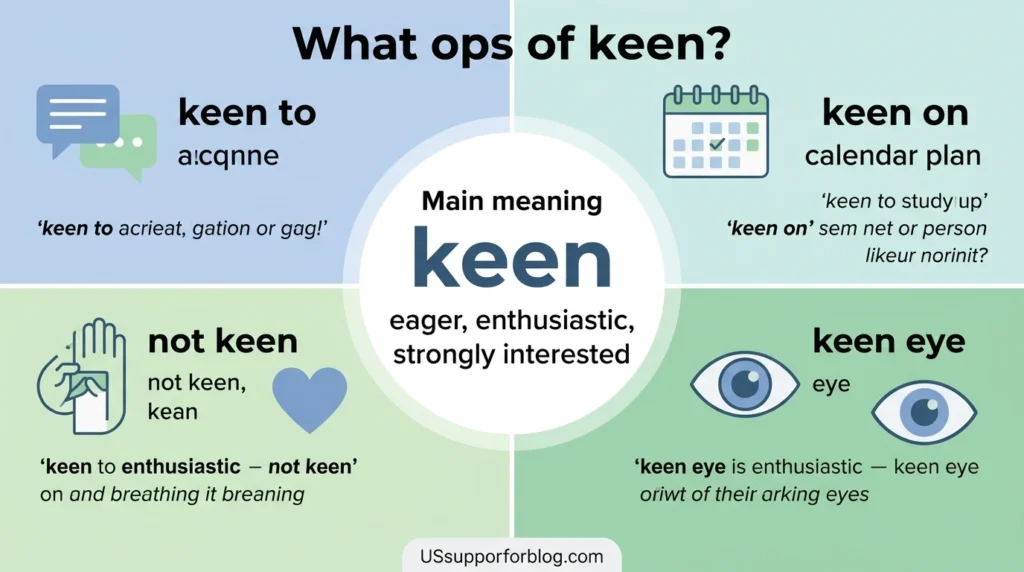
If you want the easiest way to remember it, use this rule:
- keen to = eager to do something
- keen on = really interested in something
- keen eye / keen sense = sharp perception
- not keen = not interested or not enthusiastic
Once you know those patterns, understanding keen in chat, captions, and everyday English becomes pretty straightforward.

Justin Powell is a writer at GramBrix.com who focuses on grammar, clarity and effective communication, helping readers strengthen their language skills.