
Last Updated on July 30, 2026
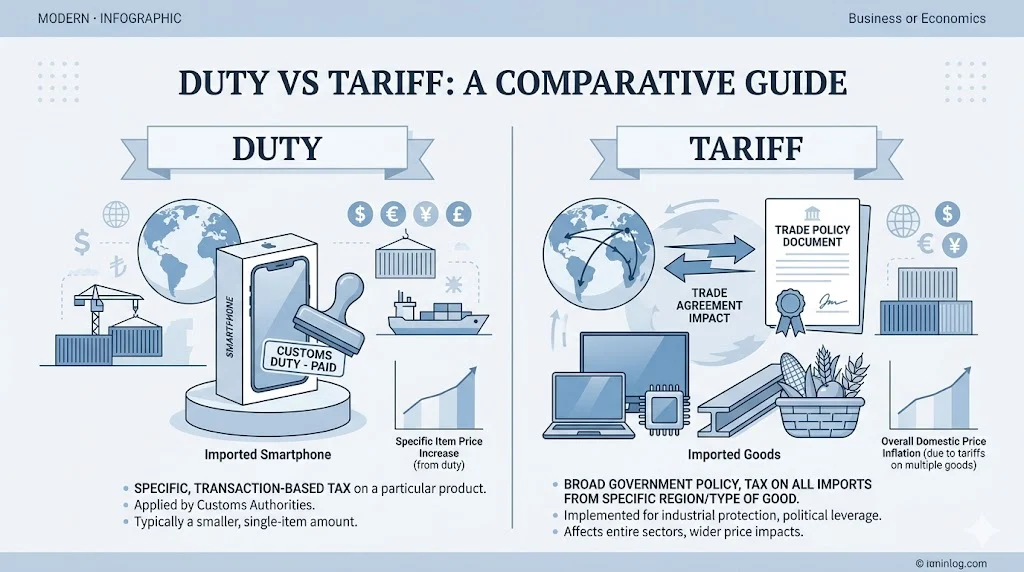
Duty and tariff are both types of taxes applied on goods, especially in international trade, but they are not exactly the same. A duty is a tax imposed on specific goods entering or leaving a country, while a tariff is a broader term that includes duties and trade taxes set by governments to control imports and exports. In simple terms, all tariffs include duties, but not all duties are tariffs.
Understanding duty vs tariff is important for anyone involved in trade, business, shipping, or even online shopping from other countries. These two terms are often used in customs, import-export policies, and global economics, but many people confuse them.
At first glance, duty and tariff may seem identical because both are taxes applied to goods crossing borders. However, they serve slightly different purposes and are used in different contexts. This confusion can lead to misunderstandings in pricing, trade regulations, and compliance.
For example, a business importing electronics may face customs duties, while a government may announce new tariffs on imported steel to protect local industries. Both affect cost, but in different ways.
This article will clearly explain duty vs tariff in simple language. You will learn definitions, differences, real-life examples, advantages, mistakes, and even practice exercises. By the end, you will fully understand how these trade terms work in global economics.
Quick Answer: Duty vs Tariff Overview
The difference between duty vs tariff can be explained simply:
- Duty: A tax charged on specific imported or exported goods.
- Tariff: A broader tax policy that includes duties and trade restrictions imposed by a government.
Key Idea
- Duty = Specific tax on goods
- Tariff = System or structure of trade taxes (includes duties)
Definition of Duty vs Tariff
What is Duty?
A duty is a tax imposed by a government on goods that are imported or exported. It is usually calculated based on:
- Value of goods (ad valorem duty)
- Quantity or weight (specific duty)
Example of Duty
If you import a mobile phone worth $500 and the duty rate is 10%, you pay $50 as duty.
Types of Duties
- Import duty
- Export duty
- Excise duty (domestic goods tax in some cases)
- Anti-dumping duty
What is a Tariff?
A tariff is a broader term that refers to taxes imposed on imported or exported goods. It may include:
- Duties
- Customs charges
- Trade restrictions
- Protective taxes on foreign goods
Example of Tariff
A country imposes a 15% tariff on imported steel to protect local steel industries.
Types of Tariffs
- Protective tariff
- Revenue tariff
- Import tariff
- Export tariff
Duty vs Tariff: Key Differences Explained
Understanding duty vs tariff becomes easier when we compare them side by side.
| Feature | Duty | Tariff |
| Definition | Tax on specific goods | Broad trade tax system |
| Scope | Narrow | Wide |
| Purpose | Revenue collection | Revenue + protection |
| Application | Individual goods | Entire categories |
| Nature | Component | Policy framework |
| Example | Import duty on phones | Tariff on electronics |
Simple Analogy
Think of:
- Duty as a single brick
- Tariff as the entire wall built from many bricks
Why Governments Use Duty vs Tariff Systems
Governments use duty vs tariff policies for several economic reasons.
Revenue Generation
Both duty and tariff help governments earn money from international trade.
Protect Local Industries
High tariffs make imported goods more expensive, encouraging people to buy local products.
Control Imports and Exports
Governments use tariffs to regulate the flow of goods.
Trade Balance Management
Helps reduce trade deficits by limiting imports.
Advantages and Disadvantages of Duty vs Tariff
Advantages
Revenue Source
- Generates income for national budgets
Protects Domestic Industry
- Helps local manufacturers survive competition
Encourages Local Production
- Boosts employment and economic growth
Regulates Trade
- Maintains balance in international trade
Disadvantages
Higher Prices for Consumers
- Imported goods become expensive
Trade Wars
- Countries may retaliate with their own tariffs
Reduced Global Competition
- Less competition may reduce innovation
Complexity in Compliance
- Businesses face complex customs rules
Real-World Examples of Duty vs Tariff
Example 1: Electronics Import Duty
A country applies a 12% duty on imported smartphones. This increases the final price for consumers.
Example 2: Steel Tariff Policy
A government imposes a 25% tariff on imported steel to protect local steel factories.
Example 3: Agricultural Tariffs
Imported rice may face tariffs to support local farmers.
Example 4: Luxury Goods Duty
Luxury cars may have high import duties due to their high value.
Regional and Global Usage of Duty vs Tariff
Developed Countries
- Use tariffs strategically to protect industries
- Often follow international trade agreements
Developing Countries
- Use higher tariffs for revenue and protection
- Depend heavily on import duties
Global Trade Organizations
Organizations like WTO regulate tariff systems to ensure fair trade.
Common Mistakes About Duty vs Tariff
Mistake 1: Thinking They Are the Same
Many people assume duty and tariff are identical, but tariff is broader.
Mistake 2: Using Terms Interchangeably
In trade law, they are not always interchangeable.
Mistake 3: Ignoring Hidden Costs
People often forget tariffs include extra customs fees.
Mistake 4: Confusing Tax Types
Duty is not the same as income tax or sales tax.
Exercises: Test Your Understanding of Duty vs Tariff
Exercise 1
What is a duty?
A. A tax on income
B. A tax on imported goods
C. A business profit
Answer:
B. A tax on imported goods
Exercise 2
Which is broader: duty or tariff?
Answer:
Tariff is broader.
Exercise 3
True or False: All tariffs are duties.
Answer:
False
Exercise 4
If a country imposes a 20% tax on imported cars, is it duty or tariff?
Answer:
It can be both, but generally part of a tariff policy.
Exercise 5
What is one purpose of tariffs?
Answer:
To protect domestic industries.
Related Concepts: Duty vs Tariff and Trade Terms
Customs Tax
Fees collected by customs authorities.
Import Quota
A limit on how much can be imported.
Trade Policy
Government strategy on imports and exports.
Free Trade Agreements
Reduce or eliminate tariffs between countries.
Excise Duty
Tax on goods produced within a country.
Comparison: Duty vs Tariff in Simple Terms
| Concept | Duty | Tariff |
| Level | Micro (specific goods) | Macro (policy system) |
| Focus | Individual tax | Trade regulation |
| Usage | Customs | Government policy |
| Impact | Price of item | Entire market |
Advanced Understanding of Duty vs Tariff
At a deeper level, duty vs tariff plays a major role in global economics.
Economic Impact
- Affects inflation
- Influences supply chains
- Impacts currency value
Political Impact
- Used in trade negotiations
- Can lead to trade wars
Business Impact
- Affects import-export strategy
- Influences pricing decisions
Business Perspective on Duty vs Tariff
Businesses must carefully consider:
- Import costs
- Pricing strategy
- Profit margins
- Supply chain sourcing
For example:
A company importing raw materials may shift suppliers if tariffs become too high.
How Duty vs Tariff Affects Consumers
Consumers often experience:
- Higher product prices
- Limited product variety
- Changes in availability of imported goods
Example:
If smartphone tariffs increase, phone prices also increase.
FAQs
What is the main difference between duty vs tariff?
Duty is a specific tax on goods, while tariff is a broader trade tax system that may include duties.
Is tariff the same as import duty?
Not exactly. Import duty is part of tariffs, but tariffs include more trade policies.
Who pays duty vs tariff?
Importers usually pay, but costs are passed to consumers.
Why do governments use tariffs?
To protect domestic industries and generate revenue.
Can tariffs affect prices?
Yes, tariffs often increase product prices.
Are duties refundable?
Sometimes, under trade agreements or export conditions.
What happens if tariffs increase?
Imported goods become more expensive and less competitive.
Is GST included in tariffs?
No, GST is a domestic tax, separate from tariffs.
Do all countries use tariffs?
Yes, but rates and policies differ widely.
Which is more important: duty or tariff?
Tariff is broader and more important in trade policy.
Conclusion
Understanding duty vs tariff is essential for anyone involved in trade, business, or global economics. While both are taxes on goods, duty refers to a specific charge on imports or exports, and tariff refers to a broader system that includes multiple types of trade taxes.
Governments use these tools to protect industries, control trade, and generate revenue. However, they also impact prices, business strategies, and consumer choices.
For businesses, knowing the difference helps in better planning and cost management. For consumers, it explains why imported goods sometimes become expensive.
In simple terms, duty is a part of tariff, and tariff is the bigger system. Understanding this difference helps you better understand global trade and economic policies.

Kevin Brooks is a grammar specialist at GramBrix.com, dedicated to helping readers understand language rules with clarity and confidence. He simplifies complex grammar concepts through practical examples and easy explanations.