Last Updated on July 7, 2026
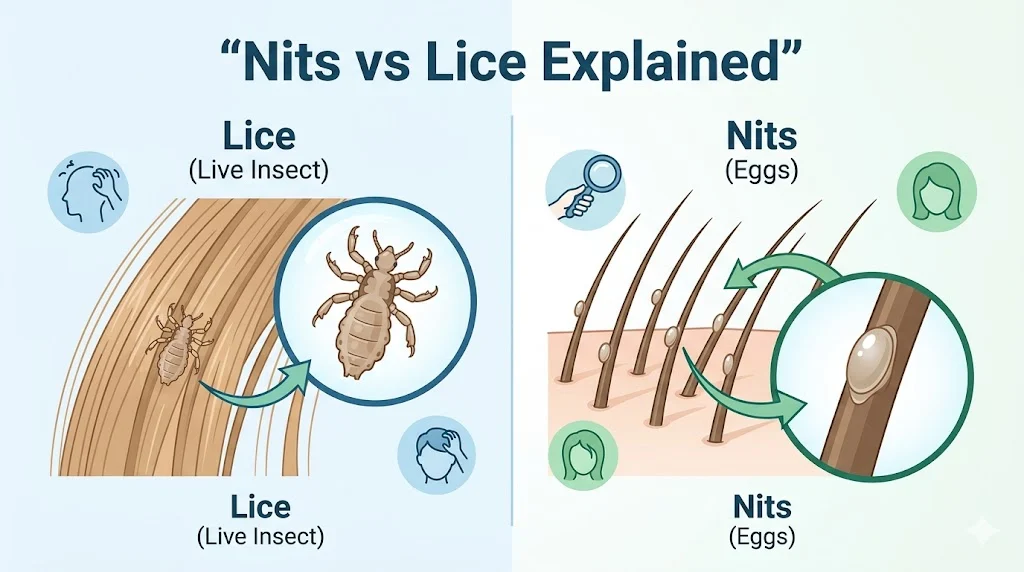
Nits are the eggs of lice, while lice are the live insects that feed on the human scalp and cause infestation. Nits are usually small, oval, and attached firmly to hair strands, whereas lice move quickly and are harder to spot. Understanding the difference between nits vs lice is essential for correct diagnosis and effective treatment.
Nits vs lice is a common topic searched by parents, teachers, and even adults dealing with scalp itching and irritation. Many people confuse nits with lice because both are related to the same problem: head lice infestation. However, they are not the same thing. Nits are the eggs, while lice are the living parasites.
This confusion often leads to wrong treatment. Some people treat only lice and ignore nits, which causes the infestation to return. Others mistake dandruff or dirt for nits, leading to unnecessary worry.
Understanding nits vs lice is important for quick recovery and preventing spread, especially in schools and crowded environments. Head lice spread easily through close contact, sharing combs, hats, or bedding. Once you know how to identify both correctly, treatment becomes faster and more effective.
In this article, we will explore nits vs lice in detail, including definitions, differences, symptoms, treatments, prevention, real-life examples, and common mistakes. The goal is to make everything simple, clear, and practical so anyone can understand and manage the issue confidently.
Quick Answer Overview
Nits vs lice can be explained simply:
- Lice are live insects that crawl on the scalp and feed on blood.
- Nits are lice eggs attached to hair shafts.
- Lice move and cause itching.
- Nits do not move but stick firmly to hair.
- Removing both is necessary to fully eliminate infestation.
Understanding this basic difference helps ensure correct treatment and prevents reinfestation.
Definition of Nits vs Lice
What Are Lice?
Lice are tiny parasitic insects that live on the human scalp. They survive by feeding on small amounts of blood from the scalp. Adult lice are about the size of a sesame seed and move quickly through hair.
There are three main types of lice:
- Head lice (most common)
- Body lice
- Pubic lice
In the context of nits vs lice, we mainly refer to head lice.
What Are Nits?
Nits are the eggs laid by adult female lice. They are attached to the hair shaft near the scalp using a sticky substance. Nits are oval-shaped and usually yellow, white, or brown.
Key facts about nits:
- They do not move
- They hatch in about 7–10 days
- They remain attached to hair even after hatching
Nits vs Lice: Key Differences
Understanding nits vs lice becomes easier when compared side by side.
Comparison Table
| Feature | Lice | Nits |
| Type | Live insect | Egg |
| Movement | Moves quickly | Does not move |
| Color | Grayish or brown | White, yellow, or brown |
| Location | Scalp and hair | Attached to hair shaft |
| Size | Sesame seed size | Very small oval dots |
| Visibility | Hard but visible | Often mistaken for dandruff |
| Treatment target | Must be killed | Must be removed or combed out |
This table clearly shows why both must be treated together in nits vs lice management.
Life Cycle in Nits vs Lice
Understanding the life cycle helps explain why infestations return if not fully treated.
Stage 1: Nit (Egg)
- Laid near scalp
- Strongly attached to hair
- Hatches in 7–10 days
Stage 2: Nymph (Young Louse)
- Hatches from nit
- Starts feeding on blood
- Grows rapidly
Stage 3: Adult Louse
- Fully grown insect
- Can lay up to 6–10 eggs daily
- Lives around 30 days on scalp
In nits vs lice management, breaking this cycle is essential. If even a few nits remain, lice can return.
How to Identify Nits vs Lice
Identifying Lice
- Look for movement in hair
- Use fine-tooth comb on wet hair
- Check behind ears and neck area
Identifying Nits
- Small white or yellow dots on hair strands
- Firmly stuck, do not flick off easily
- Located close to scalp
Simple Test
If it moves → lice
If it stays fixed → nit
This is the simplest way to understand nits vs lice in real life.
Causes and Spread of Nits vs Lice
How Lice Spread
Lice do not fly or jump. They spread through:
- Head-to-head contact
- Sharing combs or brushes
- Wearing shared hats or scarves
- Sleeping on shared bedding
Why Children Are More Affected
- Close physical contact in schools
- Sharing personal items
- Less awareness of hygiene practices
Myth
Poor hygiene does NOT cause lice. Anyone can get them.
Symptoms of Nits vs Lice
Symptoms of Lice
- Itching on scalp
- Feeling of movement in hair
- Red bumps on neck or scalp
- Trouble sleeping due to irritation
Symptoms of Nits
- White or yellow specks in hair
- Visible clusters near scalp
- No direct itching from nits themselves
Important Note
Itching is caused by lice bites, not nits.
Advantages and Disadvantages of Understanding Nits vs Lice
Advantages
Understanding nits vs lice helps in:
- Early detection of infestation
- Correct treatment application
- Preventing reinfestation
- Reducing unnecessary panic
- Saving time and money
Disadvantages of Misunderstanding
- Wrong treatment choices
- Repeated infestation cycles
- Misidentifying dandruff as nits
- Delayed recovery
Correct identification is essential for effective control.
Real-World Examples of Nits vs Lice
Example 1: School Outbreak
A child brings lice from school. Within days, siblings also develop itching. Parents initially treat only lice, but nits remain, causing recurrence.
Example 2: Misdiagnosis
A woman thinks dandruff is nits vs lice infestation. She uses harsh treatments unnecessarily, damaging her scalp.
Example 3: Successful Treatment
A family uses fine combing daily and removes both lice and nits, breaking the life cycle completely.
These examples show why proper understanding matters.
Regional and Global Understanding of Nits vs Lice
Head lice are found worldwide.
Developed Countries
- Schools often conduct regular lice checks
- Awareness campaigns are common
- Specialized lice treatment products are widely available
Developing Countries
- Limited awareness of nits vs lice difference
- Home remedies are more common
- Misconceptions are widespread
Cultural Beliefs
In some regions, lice are wrongly linked to poor hygiene or superstition, though medically they are unrelated.
Common Mistakes in Nits vs Lice Treatment
Mistake 1: Treating Only Lice
People kill live lice but ignore eggs.
Mistake 2: Confusing Dandruff with Nits
Dandruff flakes easily, nits do not.
Mistake 3: One-Time Treatment
Lice require repeated treatment cycles.
Mistake 4: Not Cleaning Environment
Combs, pillows, and bedding may still carry lice.
Mistake 5: Ignoring Family Members
Everyone in close contact should be checked.
Treatment of Nits vs Lice
Step 1: Medicated Shampoos
- Use anti-lice shampoos
- Follow instructions carefully
- Repeat after 7–10 days
Step 2: Wet Combing
- Use fine-tooth lice comb
- Comb hair in sections
- Remove both lice and nits manually
Step 3: Manual Removal
- Use fingernails or comb to remove nits
- Focus near scalp area
Step 4: Cleaning Environment
- Wash bedding in hot water
- Clean combs and brushes
- Vacuum furniture if needed
Step 5: Repeat Treatment
Since nits hatch later, repetition is key in nits vs lice control.
Prevention of Nits vs Lice
Personal Hygiene Tips
- Do not share combs or hats
- Tie long hair
- Regular scalp checks
School Prevention
- Educate children about lice
- Encourage reporting symptoms early
Home Prevention
- Wash bedding regularly
- Maintain routine hair checks
- Avoid head-to-head contact during play
Exercises with Answers
Exercise 1
What is the main difference between nits and lice?
Answer: Lice are live insects, nits are eggs.
Exercise 2
Do nits move on hair?
Answer: No, nits do not move.
Exercise 3
Where are nits usually found?
Answer: Attached near the scalp on hair strands.
Exercise 4
What causes itching in nits vs lice?
Answer: Lice bites cause itching, not nits.
Exercise 5
Can lice spread through hats?
Answer: Yes, shared hats can spread lice.
FAQs
What is the main difference between nits vs lice?
Lice are live insects, while nits are eggs attached to hair strands.
Do nits turn into lice?
Yes, nits hatch into nymphs and then become adult lice.
Can nits survive without lice?
No, nits need to hatch into lice to continue the cycle.
How long do nits take to hatch?
Usually 7 to 10 days depending on conditions.
Are nits visible to the naked eye?
Yes, but they are very small and often confused with dandruff.
Can lice go away without treatment?
Rarely. Most infestations need proper treatment.
Is itching caused by nits or lice?
Itching is caused by lice feeding on the scalp.
How do I remove both nits vs lice effectively?
Use medicated shampoo combined with wet combing.
Can lice live on pillows?
Yes, but only for a short time without a human host.
Why do lice keep coming back?
Because nits were not fully removed or treated.
Conclusion
Understanding nits vs lice is essential for effective treatment and prevention of head lice infestations. Lice are live insects that cause itching and spread quickly, while nits are their eggs attached to hair shafts. Many treatment failures happen because people ignore nits or confuse them with dandruff.
The key to success is a complete approach: treating live lice, removing nits, cleaning the environment, and repeating treatment when necessary. Awareness, patience and consistency are important for full recovery.
If you or your child experiences symptoms, early detection of nits vs lice can prevent spreading and reduce discomfort. With proper care and knowledge, head lice can be managed quickly and effectively without stress.

Justin Powell is a writer at GramBrix.com who focuses on grammar, clarity and effective communication, helping readers strengthen their language skills.