Last Updated on July 17, 2026
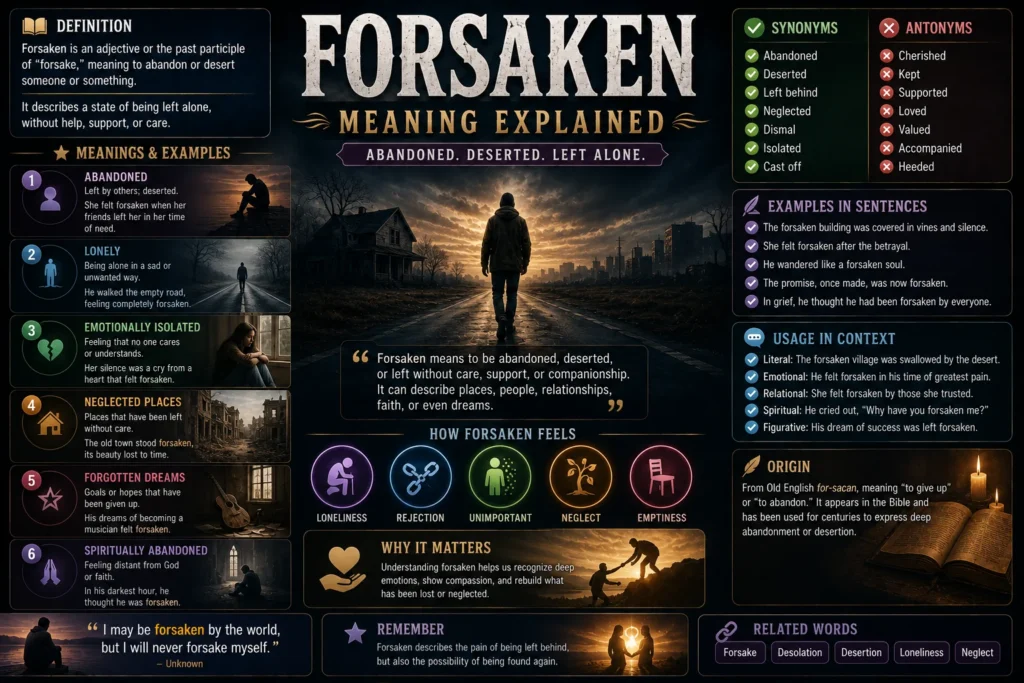
Forsaken means abandoned, deserted, rejected, or left alone by someone or something that once offered support, care, or connection. People commonly use the word to describe emotional isolation, neglect, loneliness, spiritual separation, or situations where a person feels completely left behind.
The word forsaken carries strong emotional weight. Unlike simple words such as “left” or “abandoned,” forsaken often describes a deeper feeling of being deserted, forgotten, or rejected. As a result, it appears frequently in literature, religious texts, movies, songs, and everyday conversations when people want to express profound loneliness or loss.
You may have heard statements such as:
- “She felt completely forsaken after her friends moved away.”
- “The old building stood forsaken for decades.”
- “He believed everyone had forsaken him.”
- “The town looked forsaken and empty.”
Although the word sounds dramatic, people still use it today in both formal and emotional contexts. Therefore, understanding the true forsaken meaning requires exploring its definition, emotional implications, modern usage, and common misunderstandings.
In this guide, you’ll discover what forsaken means, where it comes from, how people use it online and offline, and how to recognize its meaning across different situations.
Quick Answer Box
| Element | Explanation |
|---|---|
| Meaning | Abandoned, deserted, rejected, or left alone |
| Context | Emotional, social, religious, literary, and personal |
| Usage | Formal, emotional, descriptive |
| Platforms | Social media, books, movies, conversations, music |
| Example | “He felt forsaken after everyone ignored him.” |
| Tone | Serious, emotional, dramatic, reflective |
What Does Forsaken Mean?
At its core, forsaken means abandoned or deserted.
When someone feels forsaken, they believe others have left them behind, ignored them, or withdrawn support. Similarly, a place can be described as forsaken when it appears empty, neglected, or forgotten.
For example:
“The child felt forsaken after being separated from her family.”
In this sentence, forsaken refers to emotional abandonment.
Another example:
“The forsaken village sat quietly in the mountains.”
Here, the word describes a deserted location.
Therefore, the common theme behind forsaken is the absence of support, companionship, care, or attention.
Full Definition of Forsaken
The meaning of forsaken changes slightly depending on the context.
Forsaken as Abandoned
This is the most common meaning.
A person, place, or thing becomes forsaken when someone leaves it behind.
Example:
“The dog was forsaken by its owner.”
The owner abandoned the dog.
Forsaken as Emotionally Rejected
Sometimes forsaken describes emotional neglect.
Example:
“She felt forsaken when her friends stopped calling.”
The feeling involves loneliness and rejection.
Forsaken as Spiritually Abandoned
Religious texts often use forsaken to describe separation from divine support.
Example:
“He feared he had been forsaken.”
This meaning appears frequently in biblical passages.
Forsaken as Neglected
Places, buildings, and objects can also be forsaken.
Example:
“The forsaken house slowly fell apart.”
The house was ignored and neglected.
Forsaken as Forgotten
People sometimes use the term when something no longer receives attention.
Example:
“The project became a forsaken idea.”
Nobody continued working on it.
The Origin and History of Forsaken
The word comes from the Old English verb forsacan, which meant “to reject,” “renounce,” or “abandon.”
Over time, the term evolved into the modern word forsake, while forsaken became its past participle form.
Historically, writers used the word extensively in:
- Religious texts
- Poetry
- Literature
- Historical writings
- Dramatic storytelling
Because of these origins, the word still carries a formal and emotional tone today.
Moreover, many people recognize the word through famous biblical passages, which strengthened its association with abandonment and spiritual struggle.
Context and Usage of Forsaken
The context determines exactly how the word functions.
Personal Context
People often use forsaken to describe emotional experiences.
Examples include:
- Feeling ignored
- Experiencing loneliness
- Losing support
- Being left behind
Example:
“After the breakup, she felt forsaken.”
Family Context
The term can describe family abandonment.
Example:
“He felt forsaken when his relatives stopped speaking to him.”
Social Context
People sometimes feel forsaken by communities or friends.
Example:
“The student felt forsaken during a difficult transition.”
Religious Context
Many religious discussions use forsaken to describe spiritual distance.
Example:
“She wondered whether she had been forsaken by God.”
Physical Context
Locations can appear forsaken when they seem empty and neglected.
Example:
“The forsaken road stretched for miles.”
Emotional Meaning of Forsaken
One reason people continue using the word is its emotional intensity.
Unlike simple alternatives, forsaken often suggests:
- Deep loneliness
- Isolation
- Rejection
- Heartbreak
- Neglect
- Hopelessness
Consequently, writers and speakers choose the word when ordinary language feels insufficient.
For example:
“I was alone.”
This statement is clear.
However:
“I felt forsaken.”
This statement conveys stronger emotion and vulnerability.
Therefore, the emotional meaning often matters more than the literal definition.
Real-Life Examples of Forsaken
Understanding real situations helps clarify the meaning.
Example 1: Friendship Breakdown
A person loses contact with longtime friends.
Messages go unanswered.
Invitations stop arriving.
Eventually, they feel forsaken.
Example 2: Family Separation
A family member moves away and cuts communication.
The remaining relatives may feel forsaken.
Example 3: Workplace Experience
An employee receives no support during a crisis.
Management ignores concerns.
The employee feels forsaken.
Example 4: Community Neglect
A neighborhood receives little investment for years.
Residents may describe the area as forsaken.
Example 5: Emotional Struggle
Someone faces a personal challenge without support.
As a result, they may feel abandoned and forsaken.
Conversation Examples
Conversation Example 1
Sarah: Why does he seem so upset?
Emma: He feels forsaken by his friends.
Sarah: Did something happen?
Emma: They stopped including him.
Conversation Example 2
Alex: Have you visited that old town?
Jake: Yes. It looks completely forsaken.
Alex: Nobody lives there anymore?
Jake: Almost nobody.
Conversation Example 3
Liam: How was your first year after moving?
Sophia: Honestly, I felt forsaken.
Liam: That must have been difficult.
Sophia: It was, but things improved.
Conversation Example 4
Chris: Why is the building empty?
Taylor: The owners left years ago.
Chris: So it’s basically forsaken?
Taylor: Exactly.
Conversation Example 5
Ryan: Why does the poem sound so sad?
Grace: The writer feels forsaken and alone.
Ryan: That explains the tone.
Platform-Specific Meaning of Forsaken
Different platforms use the word in slightly different ways.
Forsaken on Social Media
On platforms such as X, Facebook, and Instagram, people often use forsaken to express emotional struggles.
Examples:
- Feeling excluded
- Relationship issues
- Friendship problems
- Personal hardships
Example:
“I felt completely forsaken during that chapter of my life.”
Forsaken on TikTok
TikTok creators frequently use the term in storytelling videos.
Common themes include:
- Childhood experiences
- Personal growth journeys
- Mental health discussions
- Relationship recovery stories
Example:
“At my lowest point, I felt forsaken.”
Forsaken in Online Gaming
Gamers sometimes use forsaken metaphorically.
Examples:
- Abandoned maps
- Deserted locations
- Forgotten characters
- Neglected game modes
Example:
“That area feels forsaken.”
Forsaken in Literature Communities
Book readers often discuss forsaken characters.
Examples include:
- Exiled heroes
- Lonely protagonists
- Rejected individuals
Forsaken in Music Discussions
Songs frequently use the word to express heartbreak and emotional pain.
Therefore, music audiences often associate the term with sadness and loss.
Biblical and Religious Meaning of Forsaken
The word holds special significance in religious traditions.
Many people first encounter it in biblical passages.
One of the most recognized examples appears in discussions of spiritual suffering and separation.
In religious contexts, forsaken often means:
- Feeling distant from God
- Experiencing spiritual struggle
- Facing hardship without visible guidance
- Enduring periods of testing
However, many religious interpretations emphasize that feeling forsaken does not necessarily mean actual abandonment.
Therefore, spiritual teachings often distinguish between perception and reality.
Alternative Meanings of Forsaken
Although abandonment remains the primary meaning, the word can carry several related interpretations.
Deserted
A location may be forsaken if nobody uses or visits it.
Example:
“The forsaken warehouse stood empty.”
Forgotten
People sometimes describe neglected ideas as forsaken.
Example:
“The proposal became a forsaken project.”
Rejected
Someone may feel forsaken when others reject them.
Example:
“He felt forsaken by society.”
Neglected
The word can also suggest a lack of care.
Example:
“The garden became forsaken.”
Forsaken vs Similar Words
Many words share similar meanings. However, important differences exist.
Forsaken vs Abandoned
Abandoned focuses on being left behind.
Forsaken adds emotional depth and often implies suffering.
Forsaken vs Rejected
Rejected emphasizes refusal.
Forsaken emphasizes loss and separation.
Forsaken vs Neglected
Neglected refers to insufficient care.
Forsaken suggests more complete abandonment.
Forsaken vs Lonely
Lonely describes a feeling.
Forsaken often describes both a feeling and a cause.
Forsaken vs Deserted
Deserted usually refers to places.
Forsaken can describe people, places, emotions, and ideas.
Related Terms and NLP Variations
Search engines and AI systems commonly associate forsaken with related concepts.
Important semantic variations include:
- Abandoned
- Deserted
- Rejected
- Ignored
- Forgotten
- Isolated
- Neglected
- Lonely
- Unwanted
- Left behind
- Disconnected
- Alienated
- Despair
- Solitude
- Emotional abandonment
- Social exclusion
- Spiritual isolation
- Forgotten place
- Empty landscape
- Unloved
These semantic relationships help AI systems understand the broader meaning ecosystem surrounding the word.
Common Phrases Using Forsaken
Several popular expressions include the word.
God-Forsaken
A common phrase describing a remote, unpleasant, or isolated place.
Example:
“We ended up in a god-forsaken town.”
Feeling Forsaken
Used to describe emotional abandonment.
Example:
“She felt forsaken after the loss.”
Forsaken by Friends
Describes social rejection.
Example:
“He believed he had been forsaken by his friends.”
Forsaken Land
Refers to neglected or deserted territory.
Example:
“The explorers crossed forsaken land.”
Forsaken Dreams
Describes abandoned goals.
Example:
“She revisited her forsaken dreams.”
How to Respond When Someone Uses Forsaken
Your response should match the context.
If Someone Feels Emotionally Forsaken
Response:
“I’m sorry you’re feeling that way.”
If They Describe Isolation
Response:
“That sounds incredibly difficult.”
If They Discuss Rejection
Response:
“You deserve support and understanding.”
If They Refer to a Place
Response:
“It sounds deserted and forgotten.”
If They Speak About Spiritual Struggles
Response:
“Many people go through periods of doubt and reflection.”
Misinterpretations of Forsaken
People sometimes misunderstand the word.
Misinterpretation 1: It Always Means Permanent Abandonment
Not necessarily.
Someone may feel forsaken temporarily.
Misinterpretation 2: It Is Only Religious
Although religion uses the term frequently, modern English applies it broadly.
Misinterpretation 3: It Always Refers to People
Places, communities, ideas, and objects can also be forsaken.
Misinterpretation 4: It Means Complete Hopelessness
Many people recover after feeling forsaken.
Therefore, the word describes a condition, not necessarily a permanent outcome.
Misinterpretation 5: It Is Outdated
Although somewhat formal, people still use the word regularly in literature, media, and conversation.
Edge Cases and Special Uses
Some situations require extra interpretation.
Creative Writing
Authors often use forsaken to create emotional intensity.
Example:
“The forsaken warrior wandered alone.”
Horror Stories
Writers frequently describe eerie locations as forsaken.
Example:
“A forsaken mansion stood on the hill.”
Poetry
Poets use the term to express grief and longing.
Music Lyrics
Songwriters often connect forsaken with heartbreak and emotional pain.
Motivational Stories
Interestingly, many transformation stories begin with someone feeling forsaken before finding purpose and support.
When NOT to Use Forsaken
Although the word is powerful, it doesn’t fit every situation.
Avoid using it when discussing:
- Minor disagreements
- Everyday inconveniences
- Routine scheduling issues
- Small social misunderstandings
For example:
Instead of:
“I felt forsaken because my friend replied late.”
Use:
“I felt ignored.”
Therefore, reserve forsaken for situations involving significant emotional or physical abandonment.
Usage Tips for Using Forsaken Correctly
Use It for Strong Emotional Situations
The word carries substantial emotional impact.
Consider the Tone
Forsaken sounds more formal and dramatic than abandoned.
Match the Context
Ensure the situation involves meaningful separation or neglect.
Avoid Overuse
Because the word is powerful, excessive use weakens its effect.
Understand the Emotional Layer
Most uses imply sadness, loneliness, or rejection.
Therefore, keep that emotional dimension in mind.
FAQs About Forsaken Meaning
What does forsaken mean in simple words?
Forsaken means abandoned, deserted, forgotten, or left alone without support or care.
Is forsaken the same as abandoned?
They are similar. However, forsaken usually carries stronger emotional meaning.
What does feeling forsaken mean?
It means feeling rejected, isolated, ignored, or abandoned by others.
Is forsaken a negative word?
Yes. In most contexts, it expresses sadness, neglect, or loss.
What does a forsaken place mean?
A forsaken place is deserted, neglected, empty, or forgotten.
Is forsaken commonly used today?
Yes. People still use it in literature, media, religious discussions, and emotional conversations.
What is the biblical meaning of forsaken?
In biblical contexts, it often refers to feelings of abandonment, spiritual struggle, or separation.
Can objects be forsaken?
Yes. Buildings, towns, projects, and locations can all be described as forsaken.
What are synonyms for forsaken?
Common synonyms include abandoned, deserted, neglected, rejected, forgotten, and isolated.
Is forsaken stronger than lonely?
Yes. Lonely describes a feeling, while forsaken often suggests a deeper sense of abandonment and rejection.
Conclusion
The forsaken meaning goes far beyond simply being left alone. The word describes abandonment, rejection, neglect, emotional isolation, and profound loneliness. Because of its emotional depth, people use it in literature, religion, music, storytelling, and personal conversations.
Whether someone feels forsaken by friends, describes a forsaken town, or discusses spiritual struggles, the core meaning remains consistent: a loss of support, connection, care, or belonging.
Therefore, when you encounter the word forsaken, think of more than physical abandonment. Think of the emotional experience of being left behind, forgotten, or disconnected. That deeper layer is what gives the word its enduring power and significance in modern English.

Kevin Brooks is a grammar specialist at GramBrix.com, dedicated to helping readers understand language rules with clarity and confidence. He simplifies complex grammar concepts through practical examples and easy explanations.