Last Updated on July 17, 2026
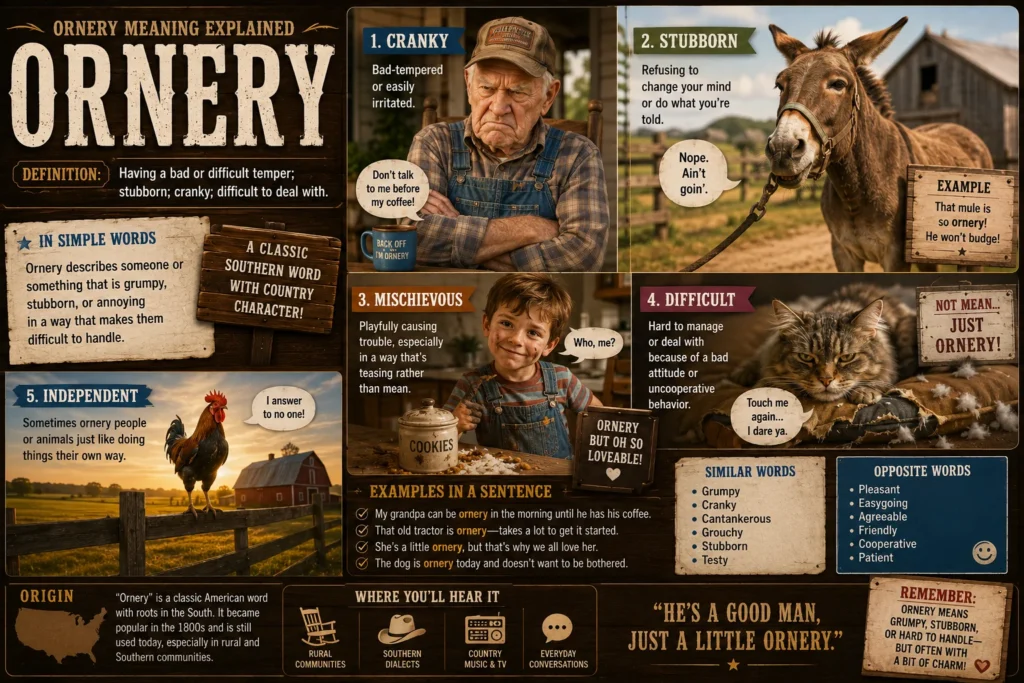
Ornery means bad-tempered, stubborn, cranky, difficult to deal with, or easily irritated. People often use the word to describe someone who argues, resists cooperation, or behaves grumpily. In some regions of the United States, ornery can also describe someone who is mischievous rather than truly mean.
Have you ever heard someone say, “That old man is ornery,” or “My dog gets ornery when strangers visit”? If so, you may have wondered what the word actually means.
The term ornery is a uniquely American expression that has survived for generations. Although many people associate it with grumpy grandparents, stubborn mules, or difficult personalities, the word carries several shades of meaning depending on context.
In some situations, ornery describes a person who is irritable and argumentative. In others, it refers to someone who is playful, mischievous, or stubbornly independent. Therefore, understanding the context is essential.
This comprehensive guide explains the complete ornery meaning, its origin, emotional implications, real-life examples, regional differences, modern usage, related terms, common misunderstandings, and much more.
Quick Answer Box
| Category | Meaning |
|---|---|
| Word Type | Adjective |
| Primary Meaning | Bad-tempered, cranky, stubborn |
| Common Usage | Describing difficult or grumpy behavior |
| Emotional Tone | Usually negative but sometimes playful |
| Formality | Informal to moderately formal |
| Common Subjects | People, children, animals |
| Example | “The ornery customer argued with everyone.” |
| Synonyms | Grumpy, cranky, cantankerous, difficult |
| Opposite | Pleasant, agreeable, cooperative |
What Does It Mean?
At its core, ornery means:
Bad-tempered, stubborn, difficult, argumentative, or easily annoyed.
The word often describes someone who resists cooperation and displays a grouchy attitude.
For example:
“The ornery neighbor complained about every little thing.”
In this example, the neighbor behaves in a difficult and unpleasant manner.
However, depending on region and tone, ornery can sometimes suggest playful stubbornness rather than genuine hostility.
For example:
“That little boy is ornery today.”
Here, the speaker may mean the child is mischievous rather than mean.
Full Definition
The dictionary definition of ornery generally includes:
- Bad-tempered
- Irritable
- Difficult to deal with
- Stubborn
- Uncooperative
- Cantankerous
- Mischievous
Therefore, ornery describes behavior that creates frustration for others.
The word usually refers to someone who:
- Complains frequently
- Refuses cooperation
- Challenges authority
- Acts stubbornly
- Displays irritability
- Enjoys causing minor trouble
Although ornery often carries a negative meaning, many Americans use it affectionately when referring to family members, pets, or children.
Context & Usage
Understanding context helps clarify the exact meaning of ornery.
Describing a Grumpy Person
The most common use involves describing someone who is consistently cranky.
Example:
“He’s been ornery all morning because he didn’t sleep well.”
Here, ornery means irritable and difficult.
Describing Stubborn Behavior
Sometimes the word emphasizes resistance.
Example:
“She’s too ornery to admit she was wrong.”
The focus is stubbornness rather than anger.
Describing Mischievous Children
In some families, ornery describes playful troublemaking.
Example:
“Those ornery kids hid my keys again.”
The children are causing harmless trouble.
Describing Animals
Many people use ornery when discussing animals.
Example:
“That horse gets ornery around strangers.”
The animal becomes difficult or aggressive.
Describing Elderly People
Americans often use ornery when talking about older relatives.
Example:
“Grandpa gets ornery when people touch his tools.”
The word sounds less harsh than calling him mean.
Real-Life Examples
Conversation Example 1
Person A: “Why did the meeting take so long?”
Person B: “One ornery customer argued with every suggestion.”
Meaning: The customer was difficult and argumentative.
Conversation Example 2
Parent: “How was your son today?”
Teacher: “A little ornery, but nothing serious.”
Meaning: Slightly mischievous or difficult.
Conversation Example 3
Friend: “What’s wrong with your dog?”
Owner: “He gets ornery during thunderstorms.”
Meaning: Irritable or difficult.
Conversation Example 4
Coworker: “How’s your grandfather doing?”
Friend: “Still ornery as ever.”
Meaning: Still stubborn and grumpy.
Conversation Example 5
Neighbor: “Why won’t the mule move?”
Farmer: “Because he’s ornery today.”
Meaning: Stubborn and uncooperative.
Platform-Specific Meaning
Although ornery is not internet slang, people still use it across digital platforms.
On WhatsApp, people often use ornery to describe someone’s mood.
Example:
“Dad’s feeling ornery today, so don’t bring up politics.”
Facebook users frequently use ornery in family discussions.
Example:
“My ornery cat knocked over another plant.”
The tone is often humorous.
Instagram captions sometimes use ornery playfully.
Example:
“My ornery little puppy refuses to sit still.”
TikTok
TikTok creators commonly use ornery when discussing:
- Pets
- Grandparents
- Rural life
- Southern culture
Example:
“POV: Your ornery goat escaped again.”
X (Twitter)
Users often describe public figures, sports coaches, or celebrities as ornery when they appear argumentative.
Reddit discussions frequently use ornery to describe difficult personalities, especially in storytelling communities.
The Origin of Ornery
The history of ornery is surprisingly interesting.
Derived from “Ordinary”
The word originally evolved from the term “ordinary.”
Over time, pronunciation changes in rural American English transformed ordinary into ornery.
Early American Usage
By the 1800s, Americans began using ornery to mean:
- Inferior
- Common
- Poor quality
Eventually, the meaning shifted toward describing difficult behavior.
Southern and Rural Influence
The word became especially common in:
- Southern states
- Midwest communities
- Rural America
Therefore, many people associate ornery with traditional American speech.
Modern Meaning
Today, the original connection to ordinary has largely disappeared.
Instead, most people recognize ornery as a word describing a stubborn or bad-tempered person.
Emotional Meaning
Words often carry emotional undertones beyond dictionary definitions.
Mildly Negative
Ornery usually suggests annoyance rather than serious hostility.
For example:
“He’s ornery.”
This sounds less severe than:
“He’s cruel.”
Sometimes Affectionate
Many families use the term with affection.
Example:
“That ornery old grandfather still tells the best stories.”
The speaker clearly likes the person.
Suggests Independence
In some situations, ornery implies strong-willed independence.
Example:
“She’s too ornery to follow the crowd.”
The word almost becomes complimentary.
Humor and Charm
Many people find ornery behavior amusing when it is harmless.
Therefore, context determines whether the word feels insulting or endearing.
Alternative Meanings
Although the core definition remains similar, usage varies.
Stubborn
Some speakers primarily mean stubborn.
Example:
“He’s too ornery to change his mind.”
Grumpy
Others use it to mean cranky.
Example:
“She’s ornery before her morning coffee.”
Mischievous
Parents often use it this way.
Example:
“Those ornery twins hid the remote again.”
Difficult
Some people use ornery broadly for anyone who creates challenges.
Example:
“The ornery customer demanded five managers.”
Related Terms and NLP Variations
Many words share semantic connections with ornery.
Synonyms
- Grumpy
- Cranky
- Irritable
- Cantankerous
- Difficult
- Argumentative
- Stubborn
- Contrary
- Grouchy
- Cross
Near Synonyms
- Feisty
- Mischievous
- Rebellious
- Strong-willed
- Defiant
Opposites
- Pleasant
- Friendly
- Agreeable
- Cooperative
- Easygoing
- Cheerful
- Accommodating
Contextual Alternatives
Depending on the situation, people may choose:
- Testy
- Surly
- Moody
- Obstinate
- Temperamental
How to Respond or Reply
When someone describes another person as ornery, your response depends on context.
If Referring to a Grumpy Person
Person A: “He’s been ornery all week.”
Person B: “Hopefully he feels better soon.”
If Referring to a Child
Person A: “My son is feeling ornery today.”
Person B: “Sounds like he’s full of energy.”
If Referring to a Pet
Person A: “The cat is ornery.”
Person B: “Maybe she wants attention.”
If Referring to Yourself
Person A: “I’m feeling ornery today.”
Person B: “Need some coffee?”
These responses acknowledge the mood without escalating tension.
Misinterpretations
Several misconceptions surround the word ornery.
Ornery Does Not Always Mean Mean
Many people assume ornery equals cruelty.
However, the word usually describes irritability rather than malicious behavior.
Ornery Is Not Always Angry
A person can be ornery without being furious.
Often, they simply feel stubborn or grouchy.
Ornery Can Be Affectionate
Family members frequently use the word lovingly.
Therefore, tone matters significantly.
Ornery Does Not Mean Dangerous
Someone who is ornery may be annoying, but not necessarily threatening.
When NOT to Use It
Certain situations require caution.
Formal Legal Writing
Avoid ornery in contracts, legal documents, or official records.
Clinical Psychology Discussions
Use precise psychological terminology instead.
Professional Evaluations
Formal performance reviews should use more objective language.
International Audiences
Many non-American English speakers may not recognize the term.
Therefore, consider alternatives such as:
- Difficult
- Irritable
- Stubborn
Serious Conflicts
When discussing serious abuse or harmful behavior, ornery may minimize the issue.
Usage Tips
Consider Regional Differences
In Southern America, ornery often sounds familiar and natural.
Elsewhere, it may sound old-fashioned.
Match the Tone
Use ornery when the situation calls for mild criticism or playful teasing.
Avoid Overuse
Although colorful, the word loses impact if used repeatedly.
Think About Intent
The same word can sound affectionate or insulting.
Therefore, your tone matters.
Use Specific Context
Adding context helps readers understand exactly what kind of ornery behavior occurred.
Ornery vs Similar Words
| Word | Meaning | Intensity |
|---|---|---|
| Ornery | Difficult, grumpy, stubborn | Moderate |
| Grumpy | Irritable | Mild |
| Cranky | Easily annoyed | Mild |
| Cantankerous | Habitually argumentative | Strong |
| Stubborn | Unwilling to change | Moderate |
| Surly | Rude and unfriendly | Strong |
| Mischievous | Playfully troublesome | Mild |
| Obstinate | Extremely stubborn | Strong |
Cultural Significance in America
The word ornery occupies a unique place in American English.
Rural Communities
Farmers often use ornery when describing:
- Mules
- Horses
- Cattle
- Dogs
Southern Speech
Many Southerners consider ornery part of everyday vocabulary.
Family Storytelling
Grandparents frequently appear in stories as lovable but ornery characters.
Television and Movies
American films often use ornery to create colorful, memorable personalities.
Examples include:
- Stubborn ranchers
- Gruff sheriffs
- Difficult coaches
- Independent grandparents
Therefore, the word remains deeply rooted in American culture.
Edge Cases and Special Situations
The Ornery Pet
A dog that refuses commands may be ornery.
However, it might simply be scared or uncomfortable.
The Ornery Employee
An employee who challenges every idea may earn this label.
However, they may also be raising valid concerns.
The Ornery Teenager
Parents often describe teenagers as ornery during periods of independence.
The Ornery Customer
Retail workers frequently use the term for difficult customers.
The Ornery Friend
Sometimes friends become ornery when stressed or overwhelmed.
Therefore, the behavior may be temporary rather than permanent.
Famous Examples of Ornery Personalities
Although people rarely describe themselves as ornery, society often labels certain personality types this way.
Examples include:
- The stubborn coach
- The argumentative neighbor
- The gruff grandfather
- The rebellious ranch owner
- The difficult but lovable mentor
These characters appear repeatedly in American literature, television, and film.
FAQs
What does ornery mean exactly?
Ornery means bad-tempered, stubborn, difficult, cranky, or mischievous depending on context.
Is ornery an insult?
Sometimes. However, many people use it affectionately.
What is the difference between ornery and grumpy?
Grumpy mainly means irritable. Ornery often includes stubbornness and difficulty.
Is ornery a Southern word?
It is widely used throughout America, but it is especially common in the South and Midwest.
Can animals be ornery?
Yes. People frequently describe stubborn horses, dogs, cats, and mules as ornery.
Is ornery always negative?
No. In many cases, it carries a playful or affectionate tone.
What is an ornery child?
An ornery child may act mischievous, stubborn, or difficult.
What is an ornery old man?
Typically, it refers to an elderly man who is grumpy, stubborn, or argumentative.
What are synonyms for ornery?
Common synonyms include cranky, grumpy, cantankerous, stubborn, difficult, and irritable.
Why do Americans use the word ornery?
The term has deep roots in American English and remains popular because it describes a specific blend of stubbornness, irritation, and personality.
Conclusion
The ornery meaning goes beyond simply being bad-tempered. While the word often describes someone who is cranky, stubborn, argumentative, or difficult, it can also carry affectionate and humorous undertones. Therefore, context plays a major role in determining how listeners interpret it.
In American English, ornery remains a colorful and expressive word. People use it to describe grumpy grandparents, stubborn animals, mischievous children, difficult customers, and strong-willed personalities. Moreover, the word often softens criticism by adding a touch of humor or familiarity.
Whether you encounter the term in conversation, literature, social media, or everyday life, understanding its nuances will help you recognize exactly what the speaker intends. In most cases, an ornery person may be challenging, but they are often memorable, independent, and uniquely human.

Kevin Brooks is a grammar specialist at GramBrix.com, dedicated to helping readers understand language rules with clarity and confidence. He simplifies complex grammar concepts through practical examples and easy explanations.