
Last Updated on July 17, 2026
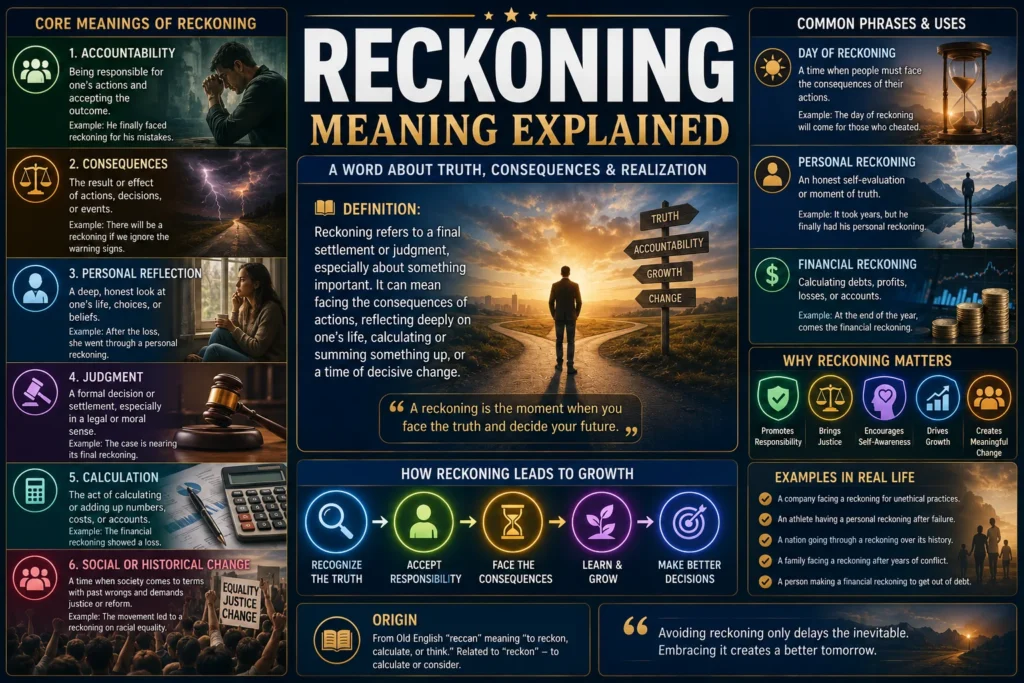
Reckoning means a moment of judgment, accountability, truth, or consequences. People use the word when someone must face the results of their actions, decisions, or past behavior. It can refer to personal growth, social change, financial calculations, spiritual judgment, or a significant turning point in life.
The term reckoning is one of those powerful English words that carries both practical and emotional meaning. Depending on the situation, it can refer to a simple calculation, a moment of truth, a period of accountability, or even a major life-changing event.
You may have seen phrases such as:
- “The day of reckoning has arrived.”
- “He faced a personal reckoning.”
- “The company experienced a financial reckoning.”
- “Society is going through a reckoning.”
Although the word sounds dramatic, people use it in many different contexts. Therefore, understanding the true reckoning meaning requires looking at its definitions, history, emotional significance, and modern usage.
In this guide, you’ll learn exactly what reckoning means, how people use it in conversations, where it appears online, and how to recognize its different meanings in real-life situations.
Quick Answer Box
| Element | Explanation |
|---|---|
| Meaning | A moment of judgment, accountability, calculation, or facing consequences |
| Context | Personal, social, financial, historical, religious, and cultural |
| Usage | Formal and semi-formal communication |
| Platforms | News, social media, books, movies, discussions, workplaces |
| Example | “After years of mistakes, he finally faced a reckoning.” |
| Tone | Serious, reflective, dramatic, or analytical |
What Does Reckoning Mean?
The word reckoning generally refers to a time when someone must confront reality, accept responsibility, or deal with the consequences of previous actions.
In simple terms, a reckoning happens when the truth can no longer be ignored.
For example:
“The company faced a reckoning after years of poor management.”
In this sentence, reckoning means the company had to deal with the results of its decisions.
Similarly:
“She experienced a personal reckoning after realizing how her choices affected others.”
Here, reckoning refers to self-reflection and accountability.
The word often suggests that an important realization, judgment, or consequence is finally taking place.
Full Definition of Reckoning
The meaning of reckoning changes slightly depending on context.
Reckoning as Accountability
This is the most common modern meaning.
A reckoning can be a moment when a person, organization, or society must answer for past actions.
Example:
“The political scandal led to a national reckoning.”
The nation began examining issues that had previously gone unaddressed.
Reckoning as Consequences
Sometimes reckoning means facing the outcome of choices.
Example:
“Ignoring the warning signs eventually brought a reckoning.”
The consequences finally arrived.
Reckoning as Self-Reflection
A reckoning may involve personal awareness and growth.
Example:
“His career setback triggered a reckoning about his priorities.”
The experience forced him to evaluate his life.
Reckoning as Calculation
Historically, reckoning referred to counting or calculating.
Example:
“By my reckoning, we should arrive by noon.”
Here, reckoning means estimation or calculation.
Reckoning as Judgment
In religious and literary contexts, reckoning often means divine or moral judgment.
Example:
“The final reckoning awaits all people.”
This usage appears frequently in religious texts and dramatic storytelling.
The Origin and History of Reckoning
The word comes from the Old English term gerecenian, which meant to explain, count, calculate, or account for something.
Over time, the meaning evolved.
Initially, people used reckoning mainly for:
- Counting numbers
- Keeping records
- Settling accounts
- Making calculations
However, the idea of “giving an account” gradually expanded into the concept of accountability.
As a result, modern English uses reckoning to describe moments when people must explain, justify, or face the results of their actions.
Therefore, today’s emotional meaning developed naturally from its historical roots.
Context and Usage of Reckoning
The context determines the exact meaning of reckoning.
Personal Context
People often experience personal reckonings when they confront uncomfortable truths.
Examples include:
- Relationship problems
- Career decisions
- Financial mistakes
- Personal growth journeys
Example:
“Turning forty brought a reckoning about what truly mattered.”
Social Context
Societies can undergo reckonings when addressing longstanding issues.
Example:
“The country experienced a reckoning about racial inequality.”
In this case, reckoning refers to collective reflection and change.
Business Context
Companies face reckonings when poor decisions create consequences.
Example:
“The financial reckoning came after years of overspending.”
Historical Context
Historians often describe major turning points as reckonings.
Example:
“The war created a reckoning for political leaders.”
Religious Context
Many religions discuss a final reckoning involving judgment and accountability.
Example:
“Believers prepare for a final reckoning.”
Real-Life Examples of Reckoning
Understanding examples makes the meaning much clearer.
Example 1: Career Reckoning
A professional ignores workplace problems for years.
Eventually, performance declines.
Management intervenes.
This moment becomes a reckoning because consequences arrive.
Example 2: Financial Reckoning
Someone accumulates debt while avoiding budgeting.
Eventually, bills become impossible to ignore.
The person must confront reality.
That situation represents a financial reckoning.
Example 3: Relationship Reckoning
A friend repeatedly breaks trust.
Eventually, the relationship reaches a breaking point.
An honest conversation occurs.
That discussion becomes a reckoning.
Example 4: Social Reckoning
A society recognizes a long-standing injustice.
Citizens demand accountability.
Institutions respond.
This process becomes a social reckoning.
Example 5: Personal Reckoning
An individual realizes they have ignored their health for years.
A medical scare forces change.
The realization creates a personal reckoning.
Conversation Examples
Conversation Example 1
Sarah: Why did he quit his job?
Mark: He had a reckoning about how unhappy he was.
Sarah: So he decided to change careers?
Mark: Exactly.
Conversation Example 2
Alex: The company is laying people off.
Jordan: Sounds like a financial reckoning.
Alex: Years of bad decisions finally caught up with them.
Conversation Example 3
Emma: Have you spoken to your brother?
Liam: Yes. We had a reckoning about our relationship.
Emma: Was it difficult?
Liam: Very, but it helped.
Conversation Example 4
Chris: Why is everyone talking about accountability?
Taylor: Society is going through a reckoning about that issue.
Chris: That makes sense.
Conversation Example 5
Jake: What caused the major changes?
Ryan: Leadership faced a reckoning after the investigation.
Jake: So they had to answer for their actions?
Ryan: Exactly.
Platform-Specific Meaning of Reckoning
Different platforms often use reckoning in slightly different ways.
Reckoning on Social Media
On platforms such as X, Instagram, and Threads, reckoning often means public accountability.
Examples include:
- Celebrity controversies
- Public apologies
- Social justice discussions
- Corporate accountability
Example:
“This scandal sparked a reckoning across the industry.”
Reckoning on TikTok
TikTok creators frequently use reckoning in storytelling videos.
Examples:
- Personal transformation stories
- Mental health journeys
- Family experiences
- Career lessons
Example:
“My 30th birthday triggered a reckoning.”
Reckoning in News Media
Journalists often use reckoning for major social or political developments.
Examples:
- Economic crises
- Cultural shifts
- Institutional reform
- Government accountability
Example:
“The election prompted a national reckoning.”
Reckoning in Business Discussions
Business leaders use the term when discussing consequences and strategic changes.
Example:
“The market downturn forced a reckoning.”
Reckoning in Entertainment
Movies, books, and television often portray reckoning as a dramatic turning point.
Examples include:
- Hero confrontations
- Family revelations
- Moral decisions
- Final battles
Therefore, entertainment frequently amplifies the emotional impact of the word.
Emotional Meaning of Reckoning
One reason the word remains powerful is its emotional depth.
A reckoning often involves:
- Truth
- Accountability
- Reflection
- Consequences
- Change
- Growth
Consequently, people use the term during meaningful life transitions.
Unlike ordinary words such as “problem” or “issue,” reckoning suggests a deeper confrontation with reality.
For many people, a reckoning becomes the beginning of transformation.
Alternative Meanings of Reckoning
Although accountability remains the dominant meaning, reckoning has several alternative uses.
Estimation
Example:
“By my reckoning, the project will take three months.”
Meaning:
According to my calculation or estimate.
Counting
Historically, reckoning meant counting or computing values.
Example:
“The merchant completed his reckoning.”
Settlement of Accounts
Older English sometimes used reckoning for paying debts or settling accounts.
Example:
“The final reckoning came at the end of the month.”
Moral Judgment
Religious and literary works frequently use reckoning for judgment.
Example:
“The villain met his reckoning.”
Reckoning vs Similar Words
Many people confuse reckoning with related terms.
Reckoning vs Judgment
Judgment focuses on evaluation.
Reckoning focuses on confronting consequences.
Reckoning vs Accountability
Accountability is responsibility.
Reckoning is the moment that responsibility becomes unavoidable.
Reckoning vs Consequences
Consequences are outcomes.
Reckoning is facing those outcomes.
Reckoning vs Realization
Realization means understanding something.
Reckoning often includes action, consequences, and change.
Related Terms and NLP Variations
Search engines and AI systems frequently associate reckoning with related concepts.
Common variations include:
- Accountability
- Judgment
- Consequences
- Reality check
- Turning point
- Wake-up call
- Self-reflection
- Self-awareness
- Moral responsibility
- Financial assessment
- Day of reckoning
- Personal transformation
- Social accountability
- Cultural shift
- Facing the truth
- Coming to terms
- Moment of truth
- Critical realization
These related terms help explain why reckoning appears across many topics.
Common Phrases Using Reckoning
Several popular expressions include the word reckoning.
Day of Reckoning
A time when consequences finally arrive.
Example:
“The day of reckoning has come.”
Personal Reckoning
An internal confrontation with reality.
Example:
“She experienced a personal reckoning.”
National Reckoning
A country examining significant issues.
Example:
“The event sparked a national reckoning.”
Financial Reckoning
Facing economic consequences.
Example:
“A financial reckoning followed years of overspending.”
Cultural Reckoning
A society reevaluating beliefs and behaviors.
Example:
“The movement created a cultural reckoning.”
How to Respond When Someone Uses Reckoning
Your response depends on the context.
If It Refers to Personal Growth
Response:
“That sounds like an important realization.”
If It Refers to Accountability
Response:
“It seems people are finally addressing the issue.”
If It Refers to Consequences
Response:
“Actions often catch up eventually.”
If It Refers to Self-Reflection
Response:
“Moments like that can lead to meaningful change.”
If It Refers to Social Change
Response:
“Hopefully the discussion leads to progress.”
Misinterpretations of Reckoning
People sometimes misunderstand the word.
Misinterpretation 1: It Always Means Punishment
Not necessarily.
A reckoning may involve growth, understanding, or learning.
Misinterpretation 2: It Is Always Negative
Many reckonings lead to positive outcomes.
For example, personal improvement often begins with honest reflection.
Misinterpretation 3: It Is Only Religious
Although religion uses the term, modern English applies it broadly.
Misinterpretation 4: It Means Immediate Disaster
A reckoning can unfold gradually over months or years.
Misinterpretation 5: It Only Applies to Individuals
Groups, businesses, institutions, and entire societies can experience reckonings.
When Not to Use Reckoning
Although the word is useful, some situations call for simpler language.
Avoid using reckoning when:
- Discussing routine events
- Referring to minor mistakes
- Describing casual disagreements
- Explaining ordinary calculations in modern conversation
For example:
Instead of:
“We had a reckoning about lunch plans.”
Use:
“We discussed lunch plans.”
Therefore, reserve reckoning for situations involving significance, accountability, or major reflection.
Usage Tips for Using Reckoning Correctly
Use It for Meaningful Situations
The word carries weight.
Choose it when discussing important matters.
Consider the Emotional Tone
Reckoning often sounds serious.
Therefore, ensure the tone fits the conversation.
Match the Context
The meaning changes slightly depending on whether the topic is personal, social, financial, or historical.
Avoid Overusing It
Using reckoning too frequently can reduce its impact.
Focus on Accountability or Truth
Most modern uses involve confronting reality.
Keep that idea in mind.
FAQs About Reckoning Meaning
What does reckoning mean in simple words?
Reckoning means facing the truth, accepting responsibility, dealing with consequences, or experiencing a moment of realization.
Is reckoning a positive or negative word?
It can be either. Sometimes it involves difficult consequences. However, it can also lead to growth and positive change.
What is a personal reckoning?
A personal reckoning occurs when someone honestly evaluates their actions, beliefs, choices, or life direction.
What does “day of reckoning” mean?
It means a time when consequences finally arrive and accountability becomes unavoidable.
Does reckoning mean judgment?
Sometimes. However, reckoning usually focuses on confronting consequences rather than simply being judged.
Can a company face a reckoning?
Yes. Businesses often face reckonings after poor decisions, scandals, or financial problems.
Why do journalists use the word reckoning?
News organizations use it to describe major moments of accountability, reform, reflection, or social change.
What does “by my reckoning” mean?
It means “according to my calculation” or “based on my estimate.”
Is reckoning a formal word?
Yes. It is generally more formal than words like problem, issue, or realization.
Can reckoning refer to positive change?
Absolutely. Many reckonings lead to learning, growth, healing, and improved decision-making.
Conclusion
The reckoning meaning extends far beyond a simple dictionary definition. While the word originally referred to counting and calculation, modern English uses it to describe moments of accountability, truth, reflection, judgment, and consequences.
Whether someone experiences a personal reckoning, a company faces financial realities, or a society confronts long-standing issues, the core idea remains the same: a reckoning occurs when reality demands attention and action.
Therefore, whenever you encounter the word reckoning, think of it as a significant moment of truth. It marks a point where people, organizations, or communities must face facts, accept responsibility, and move forward with greater awareness.Image SEO Assets

Justin Powell is a writer at GramBrix.com who focuses on grammar, clarity and effective communication, helping readers strengthen their language skills.