Last Updated on July 15, 2026
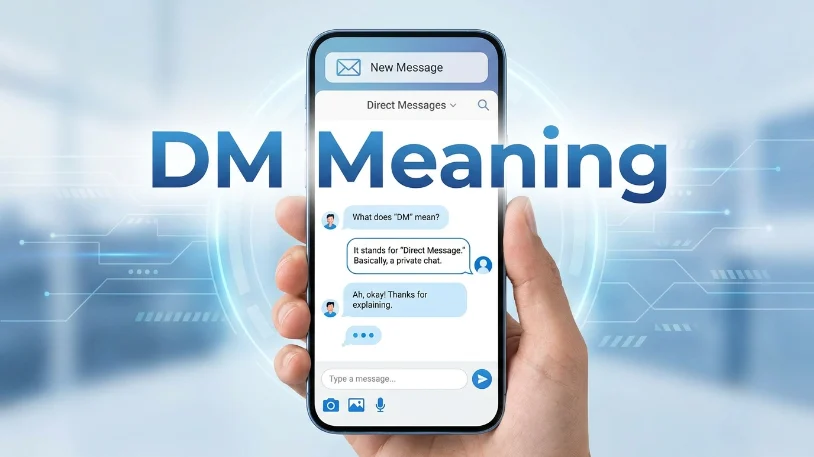
DM stands for Direct Message. It refers to a private conversation between two or more users on social media platforms, messaging apps, or online communities. Instead of posting publicly, you send a DM directly to someone’s inbox. The phrase is commonly used on Instagram, X (formerly Twitter), Facebook, TikTok, LinkedIn, Discord, and many other platforms.
If you’ve ever seen someone comment “DM me”, “Check your DMs”, or “I’ll send you a DM,” you’re not alone. The abbreviation DM has become one of the most commonly used internet terms, appearing everywhere from social media comments to professional networking conversations.
Whether you’re chatting with friends, contacting a business, networking on LinkedIn, or buying something through Facebook Marketplace, knowing the DM meaning helps you communicate confidently online.
In this guide, you’ll learn exactly what DM means, where it came from, how people use it across different platforms, examples in real conversations, common mistakes to avoid, professional alternatives, and even its lesser-known meanings.
What Does DM Mean?
Definition
DM means Direct Message, which is a private message sent directly to another person’s account instead of posting publicly.
Unlike comments that everyone can see, DMs are visible only to the participants in the conversation.
Simple Example
Public Comment:
Nice artwork!
Private DM:
Hi! I love your artwork. Do you take custom orders?
The second message is a Direct Message (DM).
Origin of DM
How Did “DM” Start?
The abbreviation DM became popular during the early growth of social media.
Platforms like:
- Twitter (now X)
- Tumblr
introduced private messaging systems that were separate from public posts.
Users quickly shortened Direct Message to DM because it was faster to type.
Soon phrases like:
- DM me
- Send me a DM
- Check your DMs
became part of everyday internet language.
Today, the abbreviation is understood almost universally by internet users.
Why Is DM So Popular?
Several reasons explain why people prefer using DMs.
Privacy
Sensitive conversations stay private.
Convenience
Sharing:
- phone numbers
- addresses
- payment details
- business inquiries
is much safer through DMs than public comments.
Business Communication
Brands regularly ask customers to continue conversations through DMs.
Example:
Sorry you’re experiencing this. Please DM us your order number.
Personal Conversations
Friends often switch from public comments to DMs for longer chats.
Where Is DM Used?
Instagram popularized the phrase:
DM me.
People use Instagram DMs for:
- chatting
- sharing reels
- sending photos
- business inquiries
- collaborations
Facebook Messenger serves as the platform’s direct messaging system.
Users commonly say:
I’ll DM you the address.
X (Formerly Twitter)
Although X officially calls them Messages, people still commonly say DMs.
Example:
DM me your email.
TikTok
TikTok users often continue conversations privately through DMs.
Creators may say:
Send me a DM if you’re interested.
Professionals use DMs for:
- networking
- job opportunities
- business partnerships
- recruitment
Discord
Discord uses direct messaging between users outside public servers.
Users privately message each other through DMs or chat.
How People Use DM in Everyday Conversations
Asking Someone to Message You
Example:
DM me if you need help.
Tone:
Friendly
Continuing a Private Conversation
Example:
Let’s talk in DMs.
Tone:
Neutral
Sharing Personal Information
Example:
I’ll DM you my phone number.
Tone:
Private
Business Inquiry
Example:
Please DM us your order ID.
Tone:
Professional
Customer Support
Example:
Check your DMs—we’ve sent the solution.
Tone:
Helpful
Example Table: DM in Different Situations
| Situation | Example | Tone |
|---|---|---|
| Friend | DM me later 😊 | Friendly |
| Business | Please DM us your account number. | Professional |
| Marketplace | I’ll DM you the location. | Neutral |
| Customer Support | Check your DMs for assistance. | Helpful |
| Networking | I’ll send you a DM on LinkedIn. | Professional |
| Dating App | Mind if I DM you? | Respectful |
Common Phrases That Include DM
DM Me
Means:
Send me a private message.
Example:
DM me for details.
Slide Into My DMs
A playful expression meaning:
Start a private conversation, often romantically.
Example:
He finally slid into my DMs.
Usually casual or humorous.
Check Your DMs
Means:
I’ve already sent you a private message.
Example:
Check your DMs—I sent the files.
Open DMs
Means someone accepts messages from anyone.
Example:
My DMs are open for questions.
Close Your DMs
Refers to restricting who can message you.
Example:
I closed my DMs because of spam.
Tone of DM in Different Situations
Friendly 😊
DM me anytime!
Shows openness.
Professional 💼
Please DM us your order number.
Used by businesses.
Romantic ❤️
Can I DM you sometime?
Often used while getting to know someone.
Casual 😄
I’ll DM you the meme.
Used among friends.
Serious ⚠️
Please DM us immediately regarding your account.
Used for urgent support.
Examples of DM in Real Conversations
Example 1
Person A:
Where did you buy those shoes?
Person B:
I’ll DM you the link.
Example 2
Creator:
DM me if you want the template.
Follower:
Sending one now!
Example 3
Company:
Sorry about that.
Please DM your order number.
Example 4
Friend:
Check your DMs 😂
Example 5
LinkedIn Recruiter:
Hi! I just sent you a DM regarding an opportunity.
DM vs PM vs IM
| Term | Full Form | Meaning | Common Use |
|---|---|---|---|
| DM | Direct Message | Private message on social media | Most common today |
| PM | Private Message | Private conversation | Older forums, Facebook |
| IM | Instant Message | Real-time chat | Messaging apps |
Which One Is Most Popular?
Today, DM is the most widely recognized abbreviation across social media.
DM vs Text Message
| DM | Text Message |
|---|---|
| Requires social media account | Requires phone number |
| Sent inside an app | Sent via SMS |
| Often includes media | Usually SMS or MMS |
| Platform-based | Mobile network |
When Should You Use DMs?
Good Situations
- Sharing private information
- Asking business questions
- Sending documents
- Following up after comments
- Networking professionally
- Customer support
Avoid Using DMs When
- Someone clearly doesn’t accept private messages.
- You’re sending spam.
- You’re repeatedly messaging someone who isn’t responding.
- The conversation should stay public for transparency.
DM Etiquette
Always Be Respectful
Start politely.
Example:
Hi! Hope you’re doing well.
Avoid Spam
Don’t send repeated messages.
Introduce Yourself
Especially in professional conversations.
Respect Privacy
Don’t share screenshots of DMs without permission.
Keep Messages Clear
Short messages often receive faster replies.
Common Mistakes People Make
Assuming Everyone Accepts DMs
Some users disable direct messaging.
Sending Large Messages Immediately
Start with a greeting first.
Using DMs for Public Questions
Sometimes public comments help others too.
Expecting Instant Replies
People may respond hours or days later.
Professional Alternatives to “DM Me”
Instead of saying:
DM me.
You can say:
- Please send me a private message.
- Feel free to contact me directly.
- Reach out privately.
- Send me a message anytime.
- Contact me through direct messaging.
- Message me privately if you have questions.
- I’d be happy to continue this conversation privately.
- Please reach out directly.
Other Meanings of DM
Although Direct Message is the most common meaning today, DM can represent different terms depending on context.
| DM Meaning | Field |
|---|---|
| Direct Message | Social Media |
| Dungeon Master | Dungeons & Dragons |
| Digital Marketing | Business |
| Diabetes Mellitus | Medicine |
| Decision Maker | Business |
| Data Mining | Technology |
| District Manager | Retail |
| Direct Mail | Marketing |
Always use the surrounding context to understand which meaning is intended.
Why Businesses Ask Customers to DM Them
Businesses often move conversations into DMs because they may need personal information such as:
- Order numbers
- Shipping addresses
- Phone numbers
- Account details
This helps protect customer privacy while resolving issues more efficiently.
Is DM the Same on Every Platform?
Yes, the basic meaning remains the same.
Whether you’re using:
- TikTok
- X
- Discord
a DM always refers to a private message sent directly to another user.
The interface may differ, but the purpose remains identical.
Frequently Asked Questions
What does DM stand for?
DM stands for Direct Message, a private message sent between users on an online platform.
What does “DM me” mean?
It means send me a private message instead of replying publicly.
Is a DM private?
Yes. Only the people included in the conversation can normally view the messages, although platform administrators may still have access under certain circumstances.
Is DM the same as texting?
No. A DM is sent through an online platform, while a text message uses your mobile phone number and SMS or MMS.
What is the difference between DM and PM?
Both refer to private messaging. DM is more common on modern social media, while PM was widely used on older forums and messaging platforms.
Can businesses send DMs?
Yes. Many businesses use DMs for customer support, sales inquiries, and follow-up conversations.
What does “slide into my DMs” mean?
It means starting a private conversation, often in a friendly or romantic way, though it can also simply mean reaching out privately.
Can everyone send me DMs?
Not necessarily. Most platforms allow you to control who can message you through privacy settings.
Conclusion
The DM meaning is simple but incredibly important in today’s digital communication. A Direct Message allows people to communicate privately across social media platforms without sharing information publicly.
Whether you’re chatting with friends, contacting customer support, networking professionally, or making a purchase online, DMs make conversations more secure, personal, and convenient.
Understanding how and when to use DMs, along with proper etiquette and privacy practices, helps you communicate confidently in any online setting. As social media continues to evolve, the humble DM remains one of the most essential tools for private digital communication.

Kevin Brooks is a grammar specialist at GramBrix.com, dedicated to helping readers understand language rules with clarity and confidence. He simplifies complex grammar concepts through practical examples and easy explanations.