
Last Updated on June 16, 2026
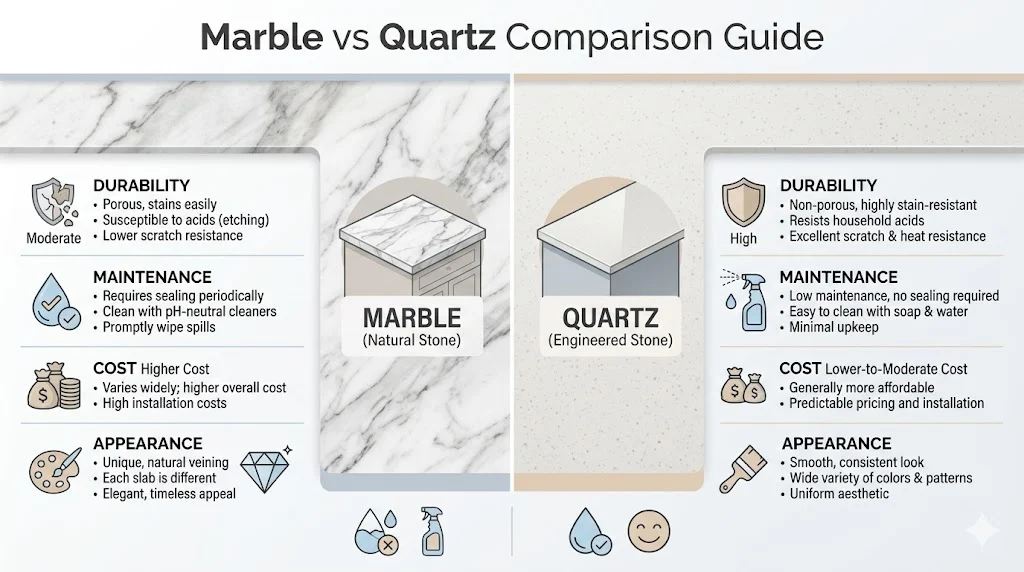
Marble vs quartz is a common comparison in kitchen and bathroom design. Marble is a natural stone known for its luxury look but requires high maintenance and is prone to staining. Quartz is an engineered stone that is more durable, low-maintenance, and resistant to stains, making it ideal for busy modern homes.
Choosing between marble vs quartz is one of the most important decisions in home design. Both materials are widely used for countertops, flooring, and wall finishes, but they are very different in performance, price, and maintenance. Many homeowners get confused because both look elegant and premium at first glance.
Marble is natural and timeless, often linked with luxury interiors and classical architecture. Quartz, on the other hand, is manufactured using natural quartz crystals and resins, designed to be stronger and easier to maintain.
The problem is simple. People want beauty, but they also want durability. They want a surface that looks expensive but does not require constant care. This is where the marble vs quartz debate becomes important.
In this guide, you will learn everything about marble vs quartz in simple language. We will explore their differences, pros and cons, real-world uses, and common mistakes. You will also see practical examples, comparison tables, and exercises to help you understand which one is best for your home or project.
Quick Answer / Overview: Marble vs Quartz
When comparing marble vs quartz, the main difference lies in their origin and maintenance needs.
- Marble is a natural stone formed over millions of years. It is beautiful but soft and porous.
- Quartz is engineered stone made from crushed quartz mixed with resins. It is strong and non-porous.
Simple Summary
- Choose marble for luxury, natural beauty, and traditional designs.
- Choose quartz for durability, low maintenance, and modern living.
What is Marble?
Marble is a natural metamorphic rock formed when limestone is exposed to heat and pressure over time. It is mined from quarries and cut into slabs.
Key features of marble:
- Natural veining patterns
- Soft and porous surface
- Sensitive to acids and stains
- High-end, luxury appearance
Marble has been used in ancient buildings, sculptures, and palaces for centuries. It is often associated with elegance and classic beauty.
What is Quartz?
Quartz used in countertops is an engineered stone. It contains around 90 to 95 percent crushed natural quartz mixed with resin and pigments.
Key features of quartz:
- Non-porous surface
- Highly durable
- Stain and scratch resistant
- Consistent patterns and colors
Unlike marble, quartz is manufactured in controlled environments, which makes it more uniform and predictable.
Marble vs Quartz in Simple Terms
Think of marble as a “natural painting” created by Earth, while quartz is a “designed product” created in a factory for strength and consistency.
Advantages and Disadvantages of Marble vs Quartz
Advantages of Marble
- Natural beauty and unique veining
- Luxurious and high-end appearance
- Cool surface, ideal for baking areas
- Increases property value in premium homes
Disadvantages of Marble
- Easily stains from coffee, wine, and oils
- Scratches and etches easily
- Requires sealing and regular maintenance
- Expensive installation and care
Advantages of Quartz
- Very low maintenance
- Highly resistant to stains
- Strong and durable surface
- Wide variety of colors and patterns
- No sealing required
Disadvantages of Quartz
- Less heat resistant than marble
- Not fully natural (engineered material)
- Can look slightly uniform or artificial
- Expensive in high-end designs
Comparison Table: Marble vs Quartz
| Feature | Marble | Quartz |
| Origin | Natural stone | Engineered stone |
| Durability | Medium | High |
| Maintenance | High | Low |
| Stain resistance | Low | High |
| Heat resistance | High | Medium |
| Appearance | Natural luxury | Modern consistency |
| Cost | High | Medium to high |
Real-World Examples of Marble vs Quartz
Marble in Real Homes
Marble is commonly used in:
- Luxury hotel lobbies
- Classical villas
- Bathroom walls and floors
- Decorative kitchen islands
Example: A high-end villa may use white Carrara marble for flooring to create a classic European look.
Quartz in Real Homes
Quartz is commonly used in:
- Modern kitchens
- Apartment countertops
- Office pantries
- Commercial spaces
Example: A busy family kitchen uses quartz countertops because they resist stains from daily cooking and are easy to clean.
Practical Scenario
If you cook frequently, quartz is more practical. If your kitchen is more for display and light use, marble may be preferred.
Regional and Global Usage of Marble vs Quartz
Marble Usage Around the World
Marble is popular in:
- Italy (Carrara marble)
- Greece (Parthenon architecture)
- Middle East luxury villas
- South Asia high-end homes
It is often used in religious buildings, monuments, and luxury architecture.
Quartz Usage Around the World
Quartz is widely used in:
- United States modern homes
- Europe contemporary apartments
- Australia kitchen renovations
- Urban Asian housing projects
Quartz has become more popular globally due to modern lifestyle needs.
Trend Comparison
- Marble is timeless but traditional
- Quartz is modern and fast-growing
Common Mistakes in Choosing Marble vs Quartz
Mistake 1: Choosing Marble for Heavy Use Kitchens
Many people choose marble for kitchens without understanding its sensitivity. It can stain easily.
Correction:
Use quartz for busy kitchens instead.
Mistake 2: Ignoring Maintenance Requirements
People often underestimate marble maintenance.
Correction:
Marble requires sealing and careful cleaning.
Mistake 3: Assuming Quartz is Indestructible
Quartz is strong but not heat-proof.
Correction:
Avoid placing hot pans directly on quartz.
Mistake 4: Choosing Based Only on Appearance
Both materials look beautiful but behave differently.
Correction:
Always consider lifestyle and usage first.
Mistake 5: Not Considering Long-Term Cost
Marble may need polishing and repair over time.
Correction:
Quartz often has lower long-term maintenance cost.
Exercises with Answers: Marble vs Quartz
Exercise 1
Which material is better for a busy kitchen?
A. Marble
B. Quartz
Answer: Quartz
Because it is stain-resistant and low maintenance.
Exercise 2
Which material is natural?
A. Quartz
B. Marble
Answer: Marble
It is formed naturally over millions of years.
Exercise 3
Which material requires sealing?
A. Quartz
B. Marble
Answer: Marble
Because it is porous.
Exercise 4
Which material is engineered?
A. Marble
B. Quartz
Answer: Quartz
Exercise 5
True or False: Quartz is more resistant to stains than marble.
Answer: True
Related Concepts or Comparisons
Marble vs Granite
Granite is harder and more durable than marble but less uniform than quartz.
Quartz vs Solid Surface
Solid surfaces are softer than quartz but easier to repair.
Natural Stone vs Engineered Stone
- Natural stone: marble, granite
- Engineered stone: quartz
Countertop Material Selection
When choosing materials, consider:
- Budget
- Maintenance
- Design style
- Usage level
FAQs
What is the main difference between marble vs quartz?
Marble is natural stone, while quartz is engineered. Quartz is more durable and easier to maintain.
Is marble better than quartz for kitchens?
Quartz is generally better for kitchens due to stain resistance and durability.
Does quartz look like marble?
Yes, many quartz designs are made to mimic marble appearance.
Which is more expensive, marble or quartz?
Both can be expensive, but high-quality marble is usually more costly.
Does marble scratch easily?
Yes, marble is softer and can scratch more easily than quartz.
Is quartz heat resistant?
Quartz is moderately heat resistant but can be damaged by high temperatures.
Which is easier to clean, marble or quartz?
Quartz is easier to clean because it is non-porous.
Can marble increase home value?
Yes, marble can increase luxury appeal and property value in premium homes.
Which lasts longer, marble or quartz?
Quartz usually lasts longer due to higher durability and resistance.
Is quartz completely natural?
No, quartz is engineered using natural quartz and resins.
Conclusion
The marble vs quartz debate comes down to lifestyle, budget, and design preference. Marble offers unmatched natural beauty and luxury appeal, making it ideal for elegant and classic interiors. However, it requires careful maintenance and is not suitable for heavy-use areas.
Quartz, on the other hand, is designed for modern living. It is durable, stain-resistant, and low-maintenance, making it perfect for kitchens, bathrooms, and busy households.
If you want timeless luxury and are ready for upkeep, marble is a great choice. If you want convenience, strength, and practicality, quartz is the better option.
Before making a decision, always consider how you use your space daily. The right choice is not just about looks, but about long-term comfort and usability.

Kevin Brooks is a grammar specialist at GramBrix.com, dedicated to helping readers understand language rules with clarity and confidence. He simplifies complex grammar concepts through practical examples and easy explanations.