Last Updated on July 15, 2026
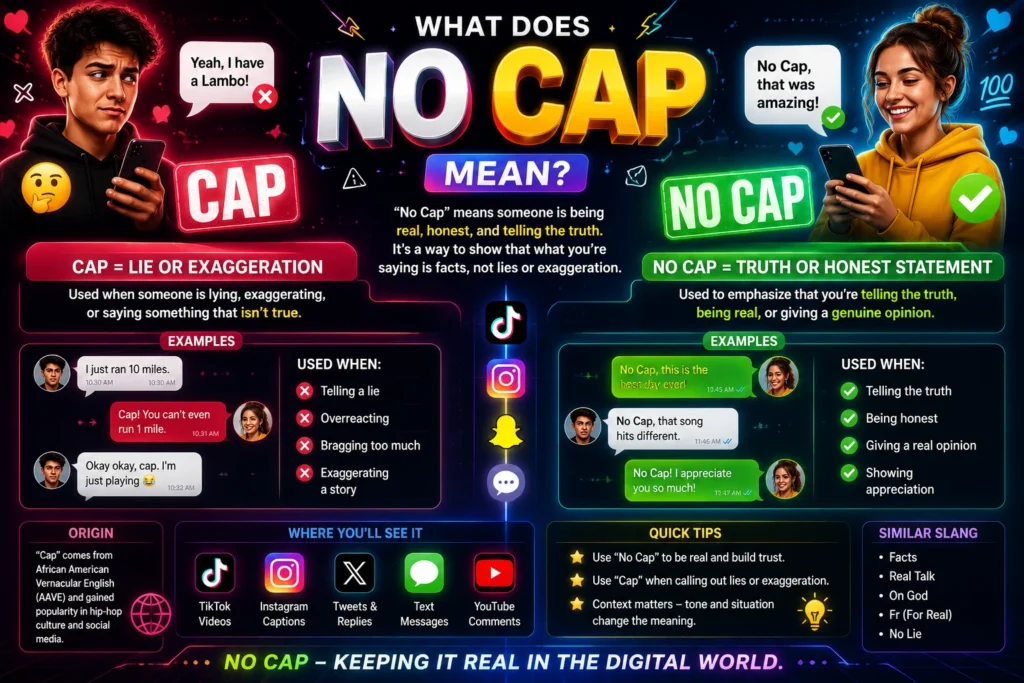
No cap is a popular slang phrase that means “no lie,” “for real,” or “I’m telling the truth.” People use it to emphasize honesty, sincerity, or certainty. The phrase appears frequently on TikTok, Instagram, Snapchat, X, text messages, and everyday conversations.
If you’ve spent any time on TikTok, Instagram, Snapchat, YouTube comments, or group chats, you’ve probably seen someone say “no cap.” The phrase has become one of the most recognizable pieces of modern internet slang.
However, many people still search for “no cap meaning” because the expression can seem confusing at first. Does it refer to a hat? Is it an acronym? Is it a joke?
The answer is much simpler.
No cap means someone is being truthful, serious, or completely honest. It often works as a way to emphasize that a statement is genuine and not exaggerated.
In this guide, you’ll learn exactly what no cap means, where it came from, how Gen Z uses it, when to use it, when not to use it, common misunderstandings, platform-specific meanings, real-life examples, and much more.
Quick Answer Box
| Element | Explanation |
|---|---|
| Meaning | No lie; telling the truth |
| Context | Slang and casual conversation |
| Usage | Emphasizes honesty or seriousness |
| Popular Platforms | TikTok, Snapchat, Instagram, X, Discord |
| Example | “That was the best burger I’ve ever had, no cap.” |
| Tone | Casual, confident, expressive |
| Opposite | Cap (lie, exaggeration) |
| Audience | Primarily Gen Z and younger Millennials |
What Does It Mean?
The phrase no cap means:
- I’m telling the truth.
- I’m not exaggerating.
- I’m serious.
- What I said is genuine.
- This is completely honest.
When someone adds “no cap” to a statement, they want listeners to know they are being sincere.
For example:
“That movie changed my life, no cap.”
The speaker wants others to know they genuinely believe what they said.
Similarly:
“No cap, that’s the hardest test I’ve ever taken.”
This means:
“Honestly, that’s the hardest test I’ve ever taken.”
Therefore, no cap functions as a truth marker in modern slang.
Full Definition
The modern slang term no cap comes from the word cap, which means a lie, exaggeration, or false statement.
As a result:
- Cap = Lie
- No Cap = No Lie
The phrase often appears:
- At the beginning of a sentence
- At the end of a sentence
- As a standalone response
Examples:
Beginning
“No cap, that concert was amazing.”
Middle
“This is, no cap, the best pizza in town.”
End
“That was crazy, no cap.”
Because of its flexibility, the phrase works naturally in many conversations.
Context & Usage
Understanding context helps you use no cap correctly.
Honest Opinions
People often use no cap when sharing strong opinions.
Example:
“This is the best phone I’ve ever owned, no cap.”
The speaker emphasizes sincerity.
Personal Experiences
People frequently use it when discussing experiences.
Example:
“No cap, I walked ten miles today.”
The phrase reinforces credibility.
Compliments
Many compliments include no cap.
Example:
“Your presentation was incredible, no cap.”
This suggests genuine praise.
Surprise or Shock
People sometimes use no cap when describing something unbelievable.
Example:
“No cap, I saw a celebrity at the grocery store.”
The speaker wants others to believe them.
Emotional Statements
The phrase can also strengthen emotional expressions.
Example:
“No cap, that song made me cry.”
This communicates authenticity.
Real-Life Examples
Conversation Example 1: Friends Talking
Alex: How was the new restaurant?
Jordan: No cap, it was amazing.
Alex: Better than the old place?
Jordan: Way better.
Conversation Example 2: School Discussion
Student 1: Was the exam difficult?
Student 2: No cap, it was brutal.
Student 1: Really?
Student 2: Hardest test this semester.
Conversation Example 3: Gaming Chat
Player 1: Is that new game worth buying?
Player 2: No cap, I’ve played it every day this week.
Player 1: That good?
Player 2: Absolutely.
Conversation Example 4: Social Media Comment
User A: Is this show actually worth watching?
User B: No cap, it’s one of the best series this year.
Conversation Example 5: Family Conversation
Sibling: Did you really finish the entire project?
You: No cap, I stayed up all night working on it.
Platform-Specific Meaning
The core meaning remains the same across platforms. However, usage styles differ.
TikTok
On TikTok, no cap often appears:
- In captions
- Video overlays
- Comments
- Reactions
Examples:
“Best food spot in NYC, no cap.”
“No cap, this life hack works.”
TikTok users often combine it with humor and exaggeration.
Snapchat
On Snapchat, users typically employ no cap in private messages.
Examples:
“No cap, that party was wild.”
“You’re the funniest person I know, no cap.”
The phrase usually signals sincerity.
Instagram users add no cap to:
- Reels
- Stories
- Comments
- Captions
Examples:
“Best vacation ever, no cap.”
“This outfit is fire, no cap.”
X (Twitter)
On X, no cap often appears in short reactions.
Examples:
“No cap, this team looks unstoppable.”
“Best album of the year. No cap.”
Discord
Gaming and community servers use no cap regularly.
Examples:
“No cap, that boss fight was impossible.”
“You’re carrying the team, no cap.”
Text Messages
Many people use no cap during casual texting.
Example:
“No cap, I miss hanging out with everyone.”
The phrase adds emotional authenticity.
Alternative Meanings
While no cap almost always means “no lie,” there are situations where people misunderstand it.
Literal Meaning
Outside slang, cap literally means:
- A hat
- A lid
- A covering
However, when people search for no cap meaning, they almost always refer to slang.
Regional Differences
Different regions may use the phrase with slightly different intensity.
Some people use it casually.
Others use it only for statements they strongly believe.
Internet Culture Meaning
Online communities sometimes use no cap humorously.
Example:
“No cap, my dog has better fashion sense than me.”
The statement may contain exaggeration while still expressing a genuine opinion.
Related Terms / NLP Variations
Understanding related slang improves comprehension.
Cap
Means:
- Lie
- False statement
- Exaggeration
Example:
“You’re capping.”
Translation:
“You’re lying.”
Stop the Cap
Means:
Stop lying.
Example:
“Stop the cap. We know that didn’t happen.”
For Real
Very similar to no cap.
Example:
“For real, that’s amazing.”
Honestly
A standard English equivalent.
Example:
“Honestly, that was impressive.”
Truthfully
Another close synonym.
Example:
“Truthfully, I wasn’t expecting that.”
Fr
Short for:
For real.
Example:
“That’s the best burger ever fr.”
Lowkey
Means:
Somewhat secretly or quietly.
Example:
“Lowkey, I agree with you.”
Ngl
Means:
Not gonna lie.
Example:
“Ngl, that’s pretty impressive.”
Deadass
Common in some regions.
Means:
Completely serious.
Example:
“I’m deadass.”
Facts
Used to show agreement.
Example:
“Facts. No cap.”
How to Respond / Reply
If someone says no cap, several responses fit naturally.
Agreeing
You can say:
Facts.
For real.
I agree.
That’s true.
Showing Surprise
You might respond:
Seriously?
No way.
Really?
Are you sure?
Asking for Details
Examples:
What happened?
Tell me more.
How did that happen?
Casual Responses
Examples:
I believe it.
That’s wild.
That’s crazy.
Makes sense.
Misinterpretations
Many people misunderstand no cap when they first hear it.
Thinking It Refers to Hats
This is the most common mistake.
In slang, cap rarely refers to headwear.
Instead, it refers to honesty.
Assuming It’s an Acronym
No cap is not an acronym.
It is a phrase built around slang terminology.
Thinking It Means Confidence
Some people assume no cap means confidence.
Although confident people may use it, the phrase specifically relates to truthfulness.
Believing It Is Offensive
No cap is generally not offensive.
However, context still matters.
When NOT to Use It
Although no cap is popular, it doesn’t fit every situation.
Professional Emails
Avoid:
“No cap, the project looks great.”
Use:
“I genuinely believe the project looks great.”
Academic Writing
Avoid slang in formal assignments.
Instead, choose standard language.
Business Meetings
Professional settings require more formal wording.
For example:
Instead of:
“No cap, sales are improving.”
Use:
“Sales have improved significantly.”
Legal or Official Documents
Formal communication should remain professional and precise.
Therefore, avoid internet slang entirely.
Usage Tips
Know Your Audience
First, consider who you’re talking to.
Friends may understand no cap immediately.
Older audiences may not.
Use It Naturally
Don’t force the phrase into every sentence.
Overuse can sound unnatural.
Match the Tone
No cap works best in:
- Casual chats
- Social media
- Gaming communities
- Informal conversations
Understand the Opposite
Remember:
- Cap = lie
- No cap = truth
This distinction helps you interpret conversations accurately.
Learn Related Slang
Understanding connected phrases improves fluency in online culture.
Examples include:
- Fr
- Ngl
- Lowkey
- Facts
- Deadass
FAQs
What does no cap mean in slang?
No cap means “no lie,” “for real,” or “I’m telling the truth.”
What does cap mean by itself?
Cap means a lie, exaggeration, or false statement.
Is no cap a Gen Z phrase?
Yes. Gen Z popularized it, although many Millennials also use it.
Is no cap rude?
No. The phrase is usually harmless and casual.
Can adults use no cap?
Yes. Anyone can use it if the context is appropriate.
What is the opposite of no cap?
The opposite is cap, which means a lie or exaggeration.
Is no cap used on TikTok?
Yes. TikTok users frequently include it in captions, comments, and videos.
What does no cap mean in texting?
In texting, it means the sender is being honest or serious.
Is no cap an acronym?
No. It is a slang phrase rather than an acronym.
Can I use no cap in professional settings?
Generally, no. Formal communication usually requires standard English.
Why No Cap Became So Popular
Internet slang spreads quickly when it fills a communication need.
No cap became popular because it provides a short and memorable way to signal honesty.
Moreover, social media rewards concise language.
Instead of writing:
“I’m completely serious and not exaggerating.”
People can simply write:
“No cap.”
The phrase also sounds conversational. Therefore, creators, influencers, gamers, and everyday users adopted it rapidly.
As TikTok, Instagram, Snapchat, and Discord communities grew, no cap became part of mainstream internet vocabulary.
Today, many people recognize the phrase even if they don’t actively use it.
No Cap vs Similar Expressions
| Expression | Meaning | Formality |
|---|---|---|
| No Cap | No lie | Casual |
| For Real | Genuine | Casual |
| Honestly | Truthfully | Neutral |
| NGL | Not gonna lie | Casual |
| Deadass | Completely serious | Casual |
| Truthfully | Honest statement | Formal |
| Seriously | Genuine emphasis | Neutral |
Although these expressions overlap, no cap remains one of the most recognizable modern slang phrases.
Edge Cases and Special Situations
Sarcastic Use
Sometimes users employ no cap sarcastically.
Example:
“This traffic is so fun, no cap.”
The speaker actually means the opposite.
Memes
Memes often exaggerate situations.
However, users still add no cap for comedic effect.
Influencer Content
Creators frequently use the phrase to appear authentic.
Example:
“No cap, this product surprised me.”
Sports Discussions
Fans use no cap to emphasize opinions.
Example:
“No cap, he’s the best player in the league.”
Music Communities
Hip-hop and rap culture significantly contributed to the phrase’s popularity.
Therefore, music discussions often include no cap naturally.
Conclusion
No cap means “no lie,” “for real,” or “I’m telling the truth.” It serves as a simple way to emphasize honesty, sincerity, and confidence in casual conversation.
The phrase appears across TikTok, Snapchat, Instagram, Discord, text messages, gaming communities, and everyday speech. Moreover, it has become one of the defining slang expressions of modern internet culture.
Understanding no cap helps you navigate online conversations more effectively. It also helps you recognize when someone wants to stress that they genuinely mean what they’re saying.
So the next time someone says, “That was the best concert ever, no cap,” you’ll know exactly what they mean: they’re being completely honest. No cap.

Kevin Brooks is a grammar specialist at GramBrix.com, dedicated to helping readers understand language rules with clarity and confidence. He simplifies complex grammar concepts through practical examples and easy explanations.