Last Updated on July 14, 2026
Azizam is a Persian word that usually means “my dear,” “my beloved,” “darling,” or “dear one.” It’s a warm, affectionate term used for romantic partners, family, close friends, and sometimes in polite everyday conversation. In English, the closest meaning depends on tone and context.
If you’ve seen azizam in a text, heard it in a song, spotted it in a caption, or had someone call you azizam, you’re probably wondering what it actually means and whether it’s romantic, friendly, or cultural. The short answer is that azizam is a Persian term of affection. It’s commonly used to mean my dear, darling, sweetheart, or beloved, but the exact feeling behind it changes based on who says it, how they say it, and the relationship between the people involved.
That’s why this word can feel a little tricky. In one situation, azizam sounds deeply romantic. In another, it’s just a warm, loving way to say dear to a child, sibling, parent, or friend. It can even appear in casual conversation as a gentle, caring form of address. So if you want the real azizam meaning rather than a flat one-line translation, context matters a lot.
In this guide, you’ll get a complete breakdown of azizam meaning in English, where the word comes from, how Persian speakers use it in real life, what it means in texting and social media, whether it’s flirtatious, how to reply when someone calls you azizam, and the situations where you probably shouldn’t use it. You’ll also see realistic examples, platform-specific usage, alternative meanings people assume by mistake, and the subtle emotional tone behind the word.
Quick Answer Box
| Element | Meaning |
|---|---|
| Word | Azizam |
| Language of origin | Persian (Farsi) |
| Basic English meaning | My dear, darling, beloved, sweetheart |
| Literal sense | Something like “my dear one” or “my beloved” |
| Tone | Warm, affectionate, caring, loving |
| Can it be romantic? | Yes, often—but not always |
| Can it be platonic/family-based? | Yes, very commonly |
| Used in texting? | Yes, especially in affectionate or emotionally warm messages |
| Common contexts | Romance, family affection, friendship, comforting someone, endearment in conversation |
| Example | “How are you, azizam?” = “How are you, my dear?” |
What Does Azizam Mean?
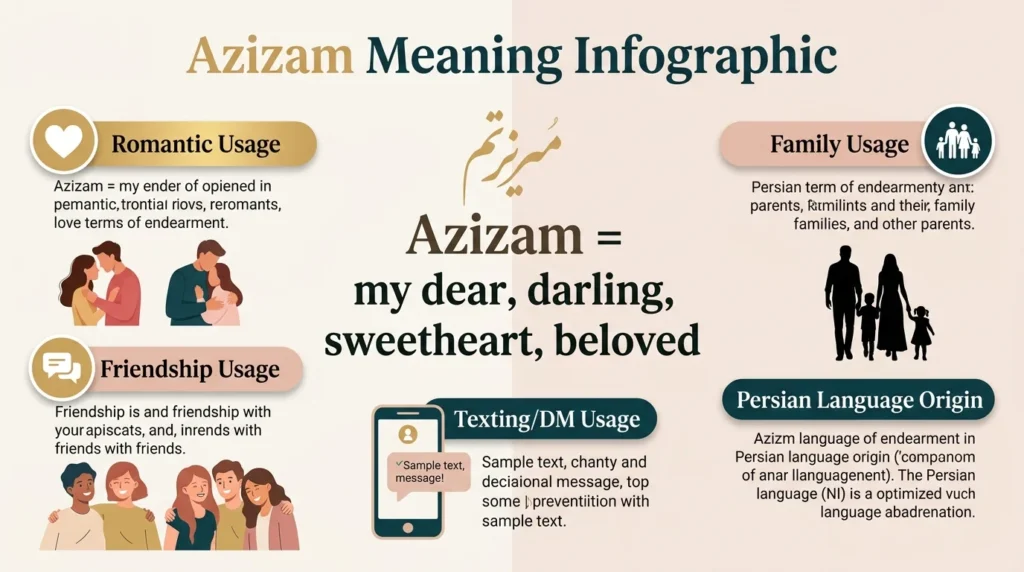
Azizam means “my dear,” “darling,” “sweetheart,” “beloved,” or “dear one” in Persian. It’s an affectionate word used to address someone warmly. In most cases, it signals love, tenderness, closeness, or emotional warmth.
If you want the simplest possible translation, this is the one to remember:
Azizam = my dear / darling
That said, the word is more flexible than a direct dictionary translation. Depending on the relationship and tone, azizam can feel:
- romantic
- nurturing
- gentle
- comforting
- playful
- deeply loving
- respectful but warm
So when someone says azizam, they’re usually not just labeling you with a word. They’re signaling closeness and affection.
The shortest practical translation
If you’re reading a text message and need a quick interpretation, here’s the fastest guide:
- From a romantic partner: probably “my love,” “darling,” or “baby”
- From a parent or older relative: likely “my dear” or “sweetheart”
- From a close friend: usually “dear” or “love” in a warm, affectionate way
- From a Persian speaker in a caring tone: a soft term of endearment, not necessarily flirtation
Full Definition of Azizam
To really understand azizam meaning, it helps to break the word into its emotional and cultural function rather than just forcing one English equivalent.
Azizam as a term of endearment
At its core, azizam is a term of endearment. That means it belongs in the same broad family as words like:
- darling
- sweetheart
- dear
- my love
- honey
- beloved
But unlike some English pet names that feel overly romantic or cheesy depending on context, azizam has a wider emotional range. It can be used in a very intimate way, but it can also be used naturally in family speech and affectionate everyday interaction.
What does the word suggest emotionally?
When someone says azizam, the emotional message is often something like:
- “You matter to me.”
- “I care about you.”
- “I’m speaking to you with tenderness.”
- “You’re close to my heart.”
- “I want my tone to feel soft and affectionate.”
That’s why a plain translation like “dear” can be technically correct but emotionally incomplete. In many situations, azizam carries more warmth than the English word dear normally does in everyday American English.
Common English translations of azizam
There isn’t one perfect English translation because the best option changes with context. These are the most accurate equivalents depending on the situation:
- My dear
- Darling
- Sweetheart
- Beloved
- My love
- Dear one
- Honey or sweetie in some casual relationship contexts
Here’s how they map emotionally:
| Persian Word | Common English Equivalent | Typical Tone |
|---|---|---|
| Azizam | My dear | Warm, caring, gentle |
| Azizam | Darling | Romantic or affectionate |
| Azizam | Sweetheart | Loving, soft, personal |
| Azizam | My love | Romantic and emotionally intimate |
| Azizam | Dear one | Poetic, emotional, tender |
| Azizam | Beloved | Deep affection, sometimes dramatic or literary |
Where Does Azizam Come From?
Azizam comes from Persian (Farsi), one of the major languages spoken in Iran and by Persian-speaking communities around the world. The word is built from aziz, which broadly carries the sense of dear, beloved, cherished, precious, or loved.
The -am ending in Persian can function like “my” in this context, so azizam is commonly understood as “my dear” or “my beloved.”
Why the word feels richer than a direct translation
Words of affection often carry cultural weight that doesn’t translate perfectly. In Persian, affectionate language can be especially expressive, poetic, and emotionally layered. A word like azizam isn’t only about naming a relationship. It often creates a tone of warmth, softness, and closeness in the conversation itself.
That’s one reason people may hear azizam in:
- family conversations
- love songs
- films and TV
- texts between couples
- social media captions
- comforting speech
- voice notes between friends or relatives
It’s not just a label. It’s also a tone-setter.
Context and Usage: How Azizam Is Actually Used
The meaning of azizam depends heavily on who is saying it, who they’re saying it to, and what kind of relationship they have. That’s the part most quick definitions miss.
Romantic Usage
In a romantic relationship, azizam often means something close to:
- my love
- darling
- sweetheart
- baby
- beloved
It can be used in texts, voice notes, calls, or in person. In this context, it usually signals affection and emotional intimacy.
Examples:
- “Good morning, azizam.”
- “I miss you, azizam.”
- “Come home safe, azizam.”
- “You looked beautiful tonight, azizam.”
In English, the vibe here is similar to babe, love, or darling, but with a slightly softer and more heartfelt feel.
When it feels especially romantic
It leans more romantic when it appears with:
- flirty emojis
- heart emojis
- compliments
- longing or missing someone
- affectionate check-ins
- couple-style captions
- intimate voice tone
For example:
“Sleep well, azizam ❤️”
This reads as clearly affectionate and likely romantic if sent by a partner or someone you’re dating.
Family Usage
This is one of the most important things to know about azizam meaning: it is not only romantic.
Parents, grandparents, aunts, uncles, siblings, and relatives may use azizam very naturally with children or loved ones. In that setting, it means something more like:
- sweetheart
- dear
- my dear
- precious one
Examples:
- “Come eat, azizam.”
- “How was school, azizam?”
- “Don’t worry, azizam, everything will be okay.”
- “I’m proud of you, azizam.”
In these cases, the word is nurturing rather than flirty. It can sound deeply loving, but not romantic at all.
Why people sometimes misunderstand this
If you only encounter azizam in songs, couple captions, or romantic scenes, you might assume it always means “my love.” But in Persian-speaking families, affectionate words are often used much more broadly than some English pet names.
That’s why context matters. Azizam from your Persian grandmother and azizam from someone flirting with you are not emotionally identical, even though the word is the same.
Friendship Usage
Among close friends, azizam can work like a warm and affectionate “dear,” “love,” or “sweetie” depending on personality and culture. It may be used:
- to comfort a friend
- to soften a conversation
- to express closeness
- to be playful and caring
- to show emotional support
Examples:
- “Azizam, don’t stress so much.”
- “I’m here for you, azizam.”
- “You did your best, azizam.”
- “Text me when you get home, azizam.”
In English, this can feel a bit like how some people use love, hun, or sweetie with friends, though the exact vibe depends on region and culture.
Polite or Softened Everyday Usage
Sometimes azizam is used less as a dramatic pet name and more as a softener in speech. It can make a sentence sound kinder, gentler, or more affectionate.
Examples:
- “No, azizam, that’s not what I meant.”
- “Wait a second, azizam.”
- “It’s okay, azizam.”
- “Listen, azizam, you need to rest.”
In this type of usage, the word may not be announcing deep romance at all. Instead, it adds warmth to the interaction.
Real-Life Examples of Azizam in Conversation
Below are realistic examples showing how azizam changes meaning based on context.
Conversation Example 1: Romantic Text
Person A: I got home safely.
Person B: Good. I was worried about you, azizam ❤️
Meaning: Here azizam means something like my love, darling, or baby. The heart emoji and caring tone make it clearly romantic.
Conversation Example 2: Parent to Child
Mom: Did you eat lunch at school?
Child: Yes.
Mom: Good job, azizam.
Meaning: Here it means sweetheart or my dear. It’s affectionate and nurturing, not romantic.
Conversation Example 3: Comforting a Friend
Friend 1: I completely messed up my interview.
Friend 2: Azizam, one bad interview doesn’t define you. You’ll be okay.
Meaning: In this case, azizam means something like dear or sweetie in a caring, supportive way.
Conversation Example 4: Partner Check-In
Text: Did you take your medicine, azizam?
Meaning: This sounds loving, gentle, and intimate. In English, it could feel like babe, love, or sweetheart, depending on the couple’s dynamic.
Conversation Example 5: Family Reassurance
Grandmother: Don’t cry, azizam. Come sit with me.
Meaning: Here it’s a soothing family term of affection—very close to my dear or sweet child in emotional tone.
Platform-Specific Meaning of Azizam
Online, the meaning of azizam usually stays close to its original Persian sense, but the tone can shift depending on the platform. A word used in a private text doesn’t hit the same way in a TikTok caption or Instagram comment.
Azizam on WhatsApp
On WhatsApp, azizam often appears in direct, personal, relationship-based conversation. This is one of the most common places to see it used naturally in affectionate messages.
Common WhatsApp uses
- good morning/good night texts
- checking in on someone
- comforting a partner or relative
- voice-note intimacy
- family group chat affection
Examples:
- “Morning, azizam. Did you sleep okay?”
- “Call me when you can, azizam.”
- “Happy birthday, azizam!”
- “Don’t forget your appointment, azizam.”
Typical tone on WhatsApp
Because WhatsApp is often used for close personal communication, azizam there usually feels:
- intimate
- caring
- personal
- emotionally warm
If it comes from someone you’re dating, it can absolutely read as romantic. If it comes from family, it reads as loving and familiar.
Azizam on Instagram
On Instagram, azizam often shows up in:
- captions for a partner
- comments under a friend’s photo
- family posts
- nostalgic or emotional captions
- Persian cultural content
Examples of Instagram-style usage
- “Miss you, azizam.”
- “Happy birthday to my azizam.”
- “My forever azizam.”
- “Looking gorgeous, azizam 😍”
- “Come back soon azizam.”
What it means on Instagram
Instagram adds performance and aesthetics to language, so azizam can sometimes feel more poetic or stylized there. In captions, it often carries a polished, emotionally expressive tone. It may signal romance, but it can also simply be affectionate and sentimental.
If someone comments “azizam” under your photo, the tone depends on who they are:
- partner = likely romantic
- parent/relative = loving family affection
- close friend = warm and playful
- stranger = unusual unless they’re using it culturally or flirtatiously
Azizam on TikTok
On TikTok, people may use azizam in captions, edits, sound trends, comments, or videos with Persian music and romantic themes.
How it shows up on TikTok
- in romantic edits
- in bilingual content
- in cultural explanation videos
- in lyrics or song references
- in “what pet names mean in my language” style posts
Examples:
- “When he calls me azizam 😭❤️”
- “POV: your Persian mom says ‘azizam’ after yelling at you.”
- “Azizam energy only.”
- “This song calling someone azizam has me unwell.”
TikTok tone
TikTok tends to exaggerate emotional nuance, so azizam may be framed as:
- ultra-romantic
- soft and comforting
- culturally cute
- poetic
- “main character” affectionate language
That doesn’t change the meaning of the word, but it can amplify how people perceive it.
Azizam in Text Messages
In plain texting, azizam is usually shorthand for affection. It’s often inserted where an English speaker might use:
- babe
- love
- dear
- sweetheart
- honey
Common text examples
- “I’m outside, azizam.”
- “Eat something, azizam.”
- “I miss you, azizam.”
- “Don’t be sad, azizam.”
- “Wake up, azizam.”
Tone clues in texting
To understand the meaning, look at the surrounding message:
- “I miss you azizam ❤️” → romantic
- “How was your exam, azizam?” → could be family or partner
- “Azizam, relax. It’s not a big deal.” → caring and soothing
- “Thanks azizam 😘” → probably affectionate and personal
- “Happy birthday azizam” → could be romantic, family-based, or close friendship depending on sender
Azizam in Music and Pop Culture
If you encountered azizam in a song, poem, movie, or dramatic clip, it may sound especially intense because Persian and Middle Eastern love language in media can be very expressive. In artistic contexts, azizam often leans toward:
- beloved
- my love
- darling
- dearest
- cherished one
Songs and poetry can make it sound more dramatic than it would in everyday family conversation. So if you heard it in a romantic lyric, that doesn’t mean it always carries the same level of intensity in normal speech.
Is Azizam Romantic?
Sometimes yes, but not always. That’s the cleanest answer.
When azizam is romantic
It’s usually romantic when:
- a partner says it to you
- a crush uses it while flirting
- it appears with affectionate compliments
- it’s paired with heart emojis, kissing emojis, or longing language
- it’s used in a clearly intimate relationship context
Examples:
- “I can’t wait to see you, azizam.”
- “You’re so beautiful, azizam.”
- “Sleep well, azizam ❤️”
- “Miss your voice, azizam.”
When azizam is not romantic
It’s often non-romantic when:
- a parent says it to a child
- an aunt or grandparent says it to a relative
- a friend says it while comforting you
- it’s used as a warm, culturally normal term of affection
- it’s meant to soften speech rather than flirt
Examples:
- “Azizam, wear a jacket.”
- “How was work, azizam?”
- “Don’t worry, azizam.”
- “Eat before you leave, azizam.”
So yes, azizam can be romantic, but you should not automatically read it as a confession of love.
Alternative Meanings and Translation Nuances
One reason people search azizam meaning is because different websites translate it differently. You may see:
- my dear
- darling
- sweetheart
- beloved
- honey
- dear one
- my love
None of these are fully wrong, but some fit better in certain contexts than others.
Best translation by context
If a romantic partner says azizam
Best translations:
- my love
- darling
- sweetheart
- baby
If a parent or grandparent says azizam
Best translations:
- sweetheart
- my dear
- dear one
If a friend says azizam
Best translations:
- dear
- sweetie
- love
If it’s in poetry or music
Best translations:
- beloved
- my love
- dearest
Related Terms and Semantic Variations
If you’re learning affectionate Persian vocabulary or trying to understand related language online, azizam sits in a larger group of loving and emotionally warm expressions. These aren’t always exact synonyms, but they’re semantically connected because they all signal affection, closeness, or emotional attachment.
English words closest to azizam
These are the most useful English parallels:
- dear
- my dear
- darling
- sweetheart
- beloved
- honey
- love
- babe
- dear one
Each one overlaps with azizam, but none is perfect in every context.
Emotional shades around azizam
You can think of azizam as sitting at the intersection of these emotional meanings:
- affection
- tenderness
- fondness
- emotional warmth
- care
- endearment
- closeness
- love
- comfort
- softness
This matters for SEO and for actual understanding, because people often search not just “what does azizam mean” but also things like:
- is azizam flirty?
- does azizam mean I love you?
- what does azizam mean from a guy?
- what does azizam mean from a girl?
- is azizam romantic or friendly?
- can you call a friend azizam?
All of those questions are really about tone, not just dictionary translation.
What Azizam Does Not Mean
Because internet searches often flatten words into oversimplified definitions, it helps to clear up a few things azizam does not automatically mean.
It does not always mean “I’m in love with you”
Calling someone azizam does not automatically mean a marriage proposal is loading. It can be romantic, yes, but it can also be familial, friendly, or simply caring.
It does not always mean “babe”
Sometimes babe is a decent English equivalent, but azizam can sound softer and more emotionally sincere than babe, especially in family use.
It is not just a slang term
Azizam is not internet slang in the same way as something like LOL, rizz, or FR. It’s a real Persian word with cultural and emotional depth. It may appear online, but it didn’t originate as platform slang.
It’s not only for women
Men, women, children, relatives, friends, and partners can all be called azizam depending on the relationship and speaker.
How to Respond When Someone Calls You Azizam
If someone calls you azizam, your reply should match the relationship and tone. You don’t need to overthink it, but it helps to read the emotional vibe of the message.
If it’s romantic
If a partner or someone you’re dating says:
“Goodnight, azizam.”
You could reply with:
- “Goodnight, azizam ❤️”
- “Sleep well, my love.”
- “Goodnight, babe.”
- “Aww, goodnight 😘”
- “You too, azizam.”
If you want to mirror the affection, repeating the word back is a natural option.
If it’s from family
If your mom, aunt, or grandparent says:
“How are you, azizam?”
You can simply reply:
- “I’m good, thank you.”
- “I’m okay, how are you?”
- “I’m fine, love you.”
- “Good, thanks ❤️”
You don’t have to translate it back or make a big deal out of it. Treat it like a loving form of address.
If it’s from a friend
If a friend says:
“Azizam, don’t stress.”
A natural reply might be:
- “Thanks, I needed that.”
- “You’re the best.”
- “I’m trying not to 😭”
- “Love you for that.”
- “Thanks azizam.”
Five Expanded Conversation Scenarios
To make the meaning clearer, here are five longer, realistic scenarios that show how azizam works in everyday communication.
Scenario 1: Romantic Good Morning Text
Chat
A: Morning, azizam. Did you sleep okay?
B: Barely 😭 I was up way too late.
A: Then nap later, azizam. And please eat breakfast this time.
B: Yes boss 😌
A: I’m serious.
B: I know, I know. Miss you.
A: Miss you too ❤️
Meaning breakdown
Here azizam works like babe, my love, or sweetheart. The word softens concern and makes the message feel intimate rather than controlling.
Scenario 2: Mother Comforting Her Child
Chat
Child: I failed my math test.
Mom: Azizam, it’s okay. One test doesn’t define you.
Child: I studied so hard.
Mom: I know you did, azizam. We’ll go over it together tonight.
Meaning breakdown
This is a classic nurturing use. The best English sense here is sweetheart or my dear. It signals comfort and reassurance.
Scenario 3: Friend Helping After a Breakup
Chat
Friend 1: I feel so foolish for missing him.
Friend 2: Azizam, missing someone doesn’t make you foolish.
Friend 1: It just feels embarrassing.
Friend 2: No. It means you cared. Be gentle with yourself.
Meaning breakdown
In this setting, azizam acts like a soft emotional cushion. It’s not romantic. It’s affectionate, supportive friendship language.
Scenario 4: Flirty Message From a Crush
Chat
Crush: You looked really good tonight, azizam 😉
You: Oh? Is that so?
Crush: Very so. I’m still thinking about you.
Meaning breakdown
Now the word clearly leans flirtatious. The wink emoji and compliment shift azizam toward darling or beautiful one in tone, even if the literal translation stays the same.
Scenario 5: Grandparent Energy
Chat
Grandma: Did you take a sweater, azizam?
You: It’s literally 75 degrees.
Grandma: I asked a question.
You: Fine, I’ll take one 😂
Grandma: Good. Call me later.
Meaning breakdown
This is pure family affection with a side of loving overprotection. The word means my dear in the warmest possible way.
When Azizam Can Be Misinterpreted
Because azizam sits between romance, family affection, and warm friendship, it’s easy to misunderstand if you don’t know the speaker’s background or communication style.
Misinterpretation 1: Assuming it’s always flirting
This is probably the most common mistake. If a Persian speaker calls you azizam, that doesn’t automatically mean they’re trying to date you. It may just be their natural affectionate speech pattern.
How to read it more accurately
Ask yourself:
- What’s our relationship?
- Do they use affectionate language with everyone?
- Is the rest of the message flirty?
- Are there romantic signals beyond the word itself?
Misinterpretation 2: Assuming it’s casual slang with no emotional weight
The opposite mistake is treating azizam like a random filler word. It usually does carry warmth. Even when it isn’t romantic, it often signals care, tenderness, or emotional closeness.
Misinterpretation 3: Translating it too literally
If you translate azizam as only “dear”, you might miss the warmth. If you translate it as only “my love”, you might accidentally over-romanticize it. The best translation is the one that fits the relationship.
When Not to Use Azizam
If you’re not a Persian speaker and you’re thinking about using azizam yourself, there’s nothing inherently wrong with it, but context matters.
Don’t use it with random strangers unless you understand the tone
Because it’s affectionate, using azizam with someone you don’t know can feel too personal, awkward, or performative.
Don’t use it sarcastically unless you know the person well
A sarcastic “okay azizam” could land badly, especially if the word has emotional or cultural value for the other person.
Don’t assume it’s a universal replacement for “babe”
It can be romantic, but it’s broader and culturally specific. If you’re borrowing it only because it sounds aesthetic without understanding how it works, there’s a decent chance you’ll use it in a weird context.
Don’t use it to fake intimacy
If you barely know someone and suddenly call them azizam, it may come off as forced flirting or cultural cosplay rather than genuine affection.
Usage Tips: How to Understand Azizam Correctly Every Time
If you want the fastest way to decode azizam in the wild, use this checklist.
Look at the relationship
This is the biggest clue.
- partner → probably romantic
- parent/grandparent → family affection
- close friend → comforting affection
- acquaintance → depends on cultural style and tone
Look at the rest of the sentence
Words around azizam tell you a lot.
- “I miss you, azizam” → romantic
- “Eat something, azizam” → caring/family/partner
- “Don’t cry, azizam” → comforting
- “You looked amazing tonight, azizam” → likely flirty
Look at emojis and punctuation
These can push the tone one way or another.
- ❤️ 😘 🥹 → romantic or deeply affectionate
- 😊 🌸 → soft and caring
- 😂 → playful, friendly, or family-style
Look at how often the person uses endearments
Some people use affectionate language naturally with lots of people. Others only use it for partners. That changes the meaning a lot.
Azizam Meaning Compared to Similar Terms
People often understand a word better when it’s compared to nearby terms. Here’s how azizam differs from some common English endearments.
| Term | Similar to Azizam? | Key Difference |
|---|---|---|
| Dear | Yes | Dear can sound formal in English; azizam often feels warmer and more intimate |
| Darling | Yes | Darling often sounds romantic in English; azizam can also be family-based |
| Sweetheart | Yes | Sweetheart is a strong match in family and caring contexts |
| Babe | Sometimes | Babe feels more modern/romantic; azizam can be softer and more culturally broad |
| Honey | Sometimes | Honey overlaps in affectionate tone but doesn’t always capture the same emotional nuance |
| Beloved | Sometimes | Beloved is more literary and intense; azizam can be much more everyday |
Does Azizam Mean “My Love”?
Sometimes, yes. If a partner or crush says azizam, translating it as my love can be completely accurate. But it’s not the only possible meaning. In family or friendship contexts, my dear or sweetheart is often more natural.
A good rule of thumb:
- Romantic context → my love / darling
- Family context → my dear / sweetheart
- Friendship context → dear / sweetie / love
Does Azizam Mean “I Love You”?
No, not literally.
Azizam is a term of endearment, not a full sentence declaration like “I love you.” It can absolutely imply affection and closeness, but it does not directly translate to I love you.
Think of it this way:
- Azizam = affectionate way to address someone
- I love you = explicit statement of love
A partner saying “goodnight, azizam” may absolutely love you, but the word itself does not literally mean I love you.
Can You Call a Friend Azizam?
Yes, especially in Persian-speaking or culturally affectionate contexts. Whether it sounds natural depends on your relationship and the communication style of the people involved.
It works best when:
- you’re close
- affection is already normal in the friendship
- you’re comforting them
- you both understand the cultural tone of the word
It may feel less natural if:
- the friendship is new
- the other person could mistake it for flirting
- you’re using it because it sounds trendy rather than because it fits the relationship
Can a Guy Call a Girl Azizam? Can a Girl Call a Guy Azizam?
Yes to both. Azizam is not restricted to one gender pairing. A man can call a woman azizam, a woman can call a man azizam, and family members can use it across generations as well.
Again, the key isn’t gender. It’s relationship + tone + context.
FAQs
What does azizam mean in English?
It usually means my dear, darling, sweetheart, beloved, or my love depending on context.
Is azizam a romantic word?
It can be romantic, but it isn’t always. It’s also commonly used for family members and close friends.
What language is azizam from?
It comes from Persian (Farsi).
Does azizam mean “I love you”?
No. It’s a term of endearment, not a literal statement meaning I love you.
Can azizam be used for friends?
Yes. Close friends may use it in a warm, affectionate, or comforting way.
What does it mean if a guy calls me azizam?
It could mean my dear, darling, or sweetheart, but whether it’s romantic depends on your relationship and the rest of the conversation.
What does it mean if a girl says azizam?
Usually the same thing: a warm term of affection such as dear, sweetheart, or my love, depending on context.
Is azizam formal or informal?
It’s generally affectionate and personal, not formal. It’s more about emotional warmth than formal politeness.
Can azizam be used in texting?
Absolutely. It’s very common in texts, DMs, WhatsApp chats, and affectionate online messages.
Is azizam only used between couples?
No. It’s also used by parents, grandparents, relatives, and sometimes close friends.
Common Search Variations Around Azizam Meaning
People often search for the word in slightly different ways. If you landed here through one of these searches, the meaning is generally the same, but the answer depends on context.
“Azizam meaning in text”
In text messages, azizam usually means dear, sweetheart, darling, or my love depending on who sent it.
“Azizam meaning from a guy”
If a guy says azizam, it may be romantic, flirty, or simply affectionate. Look at your relationship and the rest of the message.
“Azizam meaning from a girl”
Same idea: it can be romantic or just caring and warm. The word itself doesn’t tell the whole story without context.
“Azizam meaning in Persian”
In Persian, it’s a term of endearment meaning my dear, beloved, or darling.
“Azizam meaning in love”
In a romantic context, it often means my love, darling, or sweetheart.
Emotional Meaning of Azizam
Beyond dictionary definitions, azizam often carries a specific emotional texture. It doesn’t just identify the person; it changes the mood of the sentence. It can make speech feel:
- softer
- safer
- more loving
- more intimate
- more protective
- more emotionally open
Compare these two lines:
- “Are you okay?”
- “Are you okay, azizam?”
The second one feels more caring, more personal, and more emotionally present. That’s part of why the word sticks with people and why so many search for its meaning after hearing it once.
If Someone Calls You Azizam, Should You Read Into It?
Sometimes yes, but not immediately.
If the person is:
- a romantic partner → yes, it’s affectionate and likely meaningful
- a crush using flirty language → yes, it may be a sign of interest
- a Persian friend with a naturally affectionate style → maybe not romantic at all
- an older relative or family member → probably just love and care
The safest approach is not to treat the word as a standalone confession. Treat it as a clue, then read the bigger context.
Conclusion
The full azizam meaning is my dear, darling, sweetheart, beloved, or my love, but the real meaning depends on the relationship, tone, and context. It’s a Persian term of affection used to express warmth, tenderness, closeness, and care. Sometimes it’s romantic. Sometimes it’s family-based. Sometimes it’s just a gentle, loving way to speak to someone you care about.
If you saw azizam in a text, DM, caption, or conversation, don’t rush to translate it in the most dramatic way possible. Instead, ask: Who said it? What’s our relationship? What else was in the message? That will tell you whether azizam means darling, sweetheart, my dear, or something closer to my love.
The good news is that the word almost always carries a positive tone. Whether it comes from a partner, a friend, a parent, or a grandparent, azizam is usually a sign of affection, warmth, and emotional closeness. In other words, if someone calls you azizam, the vibe is almost always kind.

Kevin Brooks is a grammar specialist at GramBrix.com, dedicated to helping readers understand language rules with clarity and confidence. He simplifies complex grammar concepts through practical examples and easy explanations.