
Last Updated on July 16, 2026
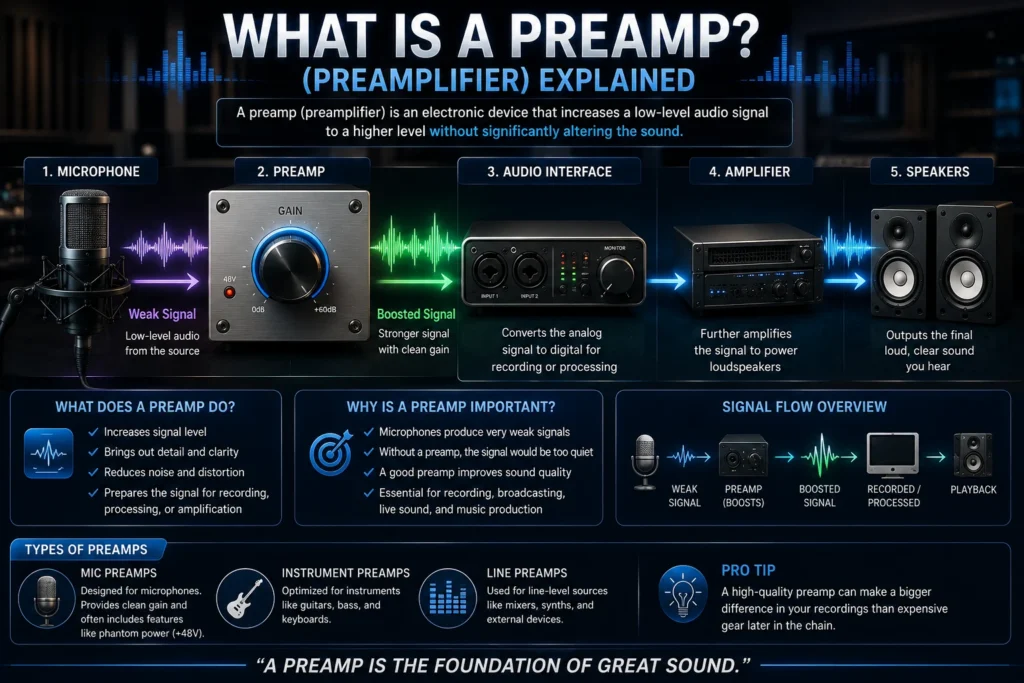
A preamp (preamplifier) is an electronic device that boosts a weak audio signal before sending it to a power amplifier, mixer, recording interface, speaker system, or other audio equipment. It improves signal strength and helps deliver clearer, cleaner sound.
If you have explored audio equipment, music production, microphones, home theaters, or recording studios, you have probably encountered the term preamp. Many beginners see the word on mixers, audio interfaces, amplifiers, and receivers but remain unsure about its purpose.
Understanding the preamp meaning is important because preamps play a critical role in almost every professional and consumer audio setup. Whether you record podcasts, sing into a microphone, play guitar, stream online, or build a home theater, a preamp helps ensure that audio signals reach usable levels before further processing.
In this guide, you will learn exactly what a preamp is, how it works, where it is used, why it matters, common examples, platform-specific discussions, related audio terms, and answers to the most frequently asked questions.
Quick Answer Box
| Element | Explanation |
|---|---|
| Meaning | A device that amplifies weak audio signals |
| Context | Audio engineering, music production, broadcasting |
| Usage | Recording, streaming, live sound, home audio |
| Platforms | YouTube, podcasting, recording software, audio forums |
| Example | A microphone signal passes through a preamp before recording |
| Tone | Technical but commonly used in everyday audio discussions |
What Does It Mean?
The preamp meaning refers to a preamplifier, an electronic component that increases the strength of a low-level audio signal before additional processing occurs.
Many audio sources produce signals that are too weak to be used directly. For example, microphones generate very small electrical signals. Consequently, these signals need amplification before mixers, speakers, or recording devices can handle them effectively.
A preamp performs this initial amplification stage.
Think of a preamp as the first helper in an audio chain. It takes a quiet signal and raises it to a usable level while preserving clarity and quality.
Common audio sources that often require preamps include:
- Microphones
- Turntables
- Musical instruments
- Audio playback devices
- Broadcast equipment
- Recording systems
Without a proper preamp, audio may sound extremely quiet, weak, or noisy.
Full Definition
A preamplifier (preamp) is an electronic circuit or standalone device designed to increase the voltage of low-level signals before those signals enter a power amplifier or another audio-processing stage.
The term combines two words:
- Pre = before
- Amplifier = device that increases signal strength
Therefore, a preamp literally means an amplifier that operates before the main amplification stage.
In professional audio systems, the signal path often looks like this:
Microphone → Preamp → Audio Interface/Mixer → Power Amplifier → Speakers
The preamp strengthens the signal so downstream equipment can process it correctly.
Why Audio Signals Need a Preamp
Different audio sources produce different signal levels.
For example:
| Audio Source | Signal Strength |
|---|---|
| Microphone | Very low |
| Electric guitar pickup | Low |
| Turntable cartridge | Very low |
| CD player | Higher |
| Smartphone output | Moderate |
Because microphones and turntables produce weak signals, they generally need a preamp before they can function effectively within an audio system.
What a Preamp Does
A preamp typically performs several functions:
- Amplifies weak signals
- Reduces unwanted noise
- Improves audio clarity
- Matches signal levels
- Provides gain control
- Supports recording equipment
As a result, audio becomes stronger and more usable.
Context & Usage
People use the term “preamp” in several audio-related contexts.
Recording Studios
Recording engineers frequently discuss microphone preamps.
Example:
“The vocal sounds better through that preamp.”
In this context, the speaker refers to a device that boosts and shapes the microphone signal.
Home Audio Systems
Audiophiles often use dedicated preamps.
Example:
“I added a tube preamp to improve the warmth of my system.”
Podcasting
Podcasters use microphone preamps to improve recording quality.
Example:
“My microphone needs more gain, so I bought a preamp.”
Broadcasting
Radio stations and broadcast facilities rely heavily on preamps.
Example:
“The broadcast chain includes several preamps.”
Music Production
Musicians often discuss preamps when recording instruments.
Example:
“That guitar preamp gives the tone more character.”
Real-Life Examples
The easiest way to understand the preamp meaning is through practical examples.
Conversation Example 1
Person A: Why is my microphone so quiet?
Person B: Your microphone probably needs a preamp to boost the signal.
Conversation Example 2
Person A: What does this audio interface do?
Person B: It contains built-in preamps for recording microphones.
Conversation Example 3
Person A: Why does this recording sound cleaner?
Person B: The engineer used a high-quality preamp.
Conversation Example 4
Person A: Do I need a preamp for my turntable?
Person B: Yes, many turntables require a phono preamp.
Conversation Example 5
Person A: What’s the first device in the recording chain?
Person B: Usually the microphone preamp.
Platform-Specific Meaning
Although the definition remains the same, people discuss preamps differently across platforms.
YouTube
Audio creators frequently review:
- Tube preamps
- Microphone preamps
- Budget preamps
- Studio preamps
Typical comment:
“This preamp adds warmth to the vocal.”
Audio communities often compare preamps.
Common discussion topics include:
- Gain levels
- Noise performance
- Audio coloration
- Value for money
Typical comment:
“That preamp has a cleaner sound than mine.”
Podcasting Communities
Podcasters focus on:
- Voice clarity
- Noise reduction
- Gain enhancement
Example:
“A preamp helped my microphone reach proper recording levels.”
Music Production Forums
Producers discuss:
- Analog preamps
- Digital preamps
- Tube saturation
- Recording chains
Example:
“The preamp adds character before mixing.”
Home Theater Communities
Users often discuss AV receivers and integrated amplifiers.
Example:
“The receiver includes a built-in preamp section.”
Alternative Meanings
Although “preamp” almost always refers to a preamplifier, the specific meaning varies slightly depending on the equipment involved.
Microphone Preamp
Boosts microphone signals.
Phono Preamp
Amplifies turntable signals and applies RIAA equalization.
Guitar Preamp
Shapes and amplifies guitar signals.
Tube Preamp
Uses vacuum tubes to add warmth and tonal coloration.
Solid-State Preamp
Uses transistors and electronic circuits for clean amplification.
Digital Preamp
Provides digital control and signal management.
Despite these differences, the core purpose remains signal amplification.
Related Terms / NLP Variations
People often search for related phrases when researching preamps.
Common Synonyms
- Preamplifier
- Audio preamp
- Mic preamp
- Signal booster
- Audio amplifier stage
Related Audio Terms
- Gain
- Amplifier
- Mixer
- Audio interface
- Equalizer
- Compressor
- Audio chain
- Phantom power
- Signal path
- Sound engineering
Similar Searches
Users frequently search:
- What is a preamp?
- What does preamp do?
- Why do I need a preamp?
- Preamp vs amplifier
- Microphone preamp meaning
- Audio preamp explained
- Best preamp for recording
- What is preamp gain?
These related phrases help explain the broader audio ecosystem.
How to Respond or Reply
When someone mentions a preamp, your response depends on the conversation.
If Someone Asks What a Preamp Is
You can say:
“A preamp boosts weak audio signals before further amplification.”
If Someone Says They Need More Volume
You might reply:
“You may need a preamp if your signal level is too low.”
If Someone Mentions Recording Equipment
You can respond:
“Most audio interfaces include microphone preamps.”
If Someone Discusses Turntables
You might say:
“Many record players need a phono preamp.”
If Someone Talks About Sound Quality
You can answer:
“A quality preamp can improve signal clarity and reduce noise.”
Misinterpretations
Many beginners misunderstand the role of a preamp.
Mistake 1: Thinking It Is a Speaker
A preamp does not produce sound directly.
Instead, it prepares the signal for other equipment.
Mistake 2: Confusing It With a Power Amplifier
A power amplifier drives speakers.
A preamp strengthens the signal before that stage.
Mistake 3: Assuming Every Device Needs One
Some devices already contain built-in preamps.
Therefore, an external preamp may not be necessary.
Mistake 4: Believing It Automatically Improves Sound
A preamp improves signal levels. However, overall audio quality also depends on microphones, speakers, room acoustics, and recording techniques.
Mistake 5: Thinking More Gain Is Always Better
Too much gain can introduce distortion and unwanted noise.
When NOT to Use It
There are situations where a separate preamp may not be needed.
Built-In Audio Interfaces
Many interfaces include excellent preamps already.
Active Speakers
Some active speaker systems contain integrated amplification stages.
Strong Line-Level Sources
CD players and many modern devices output line-level signals.
Therefore, they often do not need additional preamplification.
Minimalist Audio Systems
Some setups work perfectly with integrated components.
Adding unnecessary equipment may complicate the signal chain.
Usage Tips
Understanding how to use a preamp correctly can improve audio quality significantly.
Match the Right Preamp
Choose a preamp designed for your source.
For example:
- Microphones need mic preamps.
- Turntables need phono preamps.
- Guitars may need instrument preamps.
Set Gain Carefully
Begin with moderate gain settings.
Then increase gradually.
Avoid Clipping
Excessive gain causes distortion.
Therefore, monitor signal levels carefully.
Use Quality Cables
Good cables help maintain signal integrity.
Understand Signal Flow
Always know where the preamp sits in the audio chain.
This understanding helps troubleshoot problems faster.
Consider Noise Levels
A clean preamp minimizes hiss and interference.
Consequently, recordings sound more professional.
Preamp vs Amplifier
Many people compare preamps and amplifiers.
| Feature | Preamp | Amplifier |
|---|---|---|
| Purpose | Boost weak signals | Drive speakers |
| Signal Stage | Early stage | Final stage |
| Power Output | Low | High |
| Main Function | Signal preparation | Speaker power |
| Typical Use | Recording and processing | Audio playback |
A simple way to remember the difference is:
The preamp prepares the signal. The amplifier powers the speakers.
Edge Cases and Special Situations
Some situations create confusion regarding preamps.
USB Microphones
Most USB microphones contain internal preamps.
Therefore, users often do not need an external device.
Audio Interfaces
Many interfaces already include multiple preamps.
Consequently, beginners can start recording immediately.
Wireless Systems
Wireless microphone receivers may contain gain stages that reduce the need for separate preamps.
Streaming Setups
Streamers sometimes add dedicated preamps to improve vocal clarity.
Mobile Recording
Portable recorders frequently include built-in preamps for convenience.
Why Preamps Matter in Professional Audio
Professionals pay close attention to preamps because they influence the earliest stage of sound capture.
A poor signal at the beginning can affect the entire recording chain.
Therefore, studios often invest in quality preamps.
Benefits include:
- Better clarity
- Lower noise
- Improved dynamic range
- Stronger signals
- Enhanced recording flexibility
Consequently, preamps remain a foundational component of professional audio production.
FAQs
What does preamp mean?
A preamp, or preamplifier, boosts weak audio signals before they reach amplifiers, mixers, recording devices, or speakers.
What is a preamp used for?
A preamp strengthens low-level signals from microphones, turntables, guitars, and other audio sources.
Do I need a preamp for a microphone?
Many microphones require a preamp because they produce weak signals.
What is the difference between a preamp and an amplifier?
A preamp prepares the signal, while an amplifier provides enough power to drive speakers.
Is a preamp necessary for recording?
Most recording systems use a preamp somewhere in the signal chain.
What is a phono preamp?
A phono preamp boosts turntable signals and applies special equalization.
Can a preamp improve sound quality?
A quality preamp can improve signal clarity, reduce noise, and provide cleaner recordings.
Do audio interfaces have preamps?
Yes. Most modern audio interfaces include built-in microphone preamps.
What is preamp gain?
Gain controls how much the preamp increases the incoming signal level.
Can too much preamp gain cause problems?
Yes. Excessive gain can introduce distortion, clipping, and unwanted noise.
Conclusion
The preamp meaning centers on a simple but essential concept: boosting weak audio signals before additional processing or amplification occurs. Whether you record music, produce podcasts, stream online, operate a home theater, or work in broadcasting, preamps help ensure audio signals reach usable levels with clarity and consistency.
Moreover, understanding preamps makes it easier to build better audio systems and troubleshoot sound problems. While different types of preamps exist including microphone, phono, guitar, tube, and solid-state models—they all share the same fundamental purpose preparing low-level signals for the next stage of the audio chain.
Once you understand how a preamp works, the entire world of audio equipment becomes much easier to navigate.

Victoria Lane is a grammar-focused writer at GramBrix.com, passionate about helping readers master the rules of language. She provides clear explanations and practical examples that make writing more accurate, polished and confident.