Last Updated on August 16, 2026
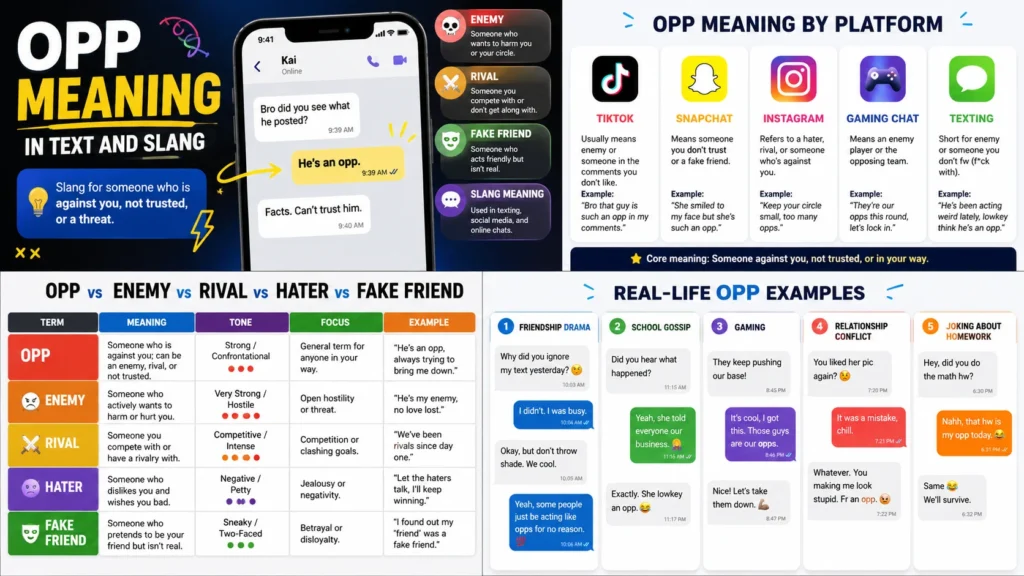
“Opp” usually means an opponent, enemy, rival, or someone you’re against. In texting, social media, and slang, it often refers to a person from a rival group, someone causing problems, or someone seen as fake or disloyal. The exact meaning depends on the conversation, platform, and tone.
Ever received a text saying “OPP” and wondered what it means? You’re not alone. The OPP meaning can change depending on the conversation. In texting, social media, music, and everyday slang, OPP is most commonly used to mean “opponent” or “opposition.” It can describe someone viewed as a rival, enemy, or person working against you. However, the term can have other meanings in different contexts. You may also see people ask “what does OPP mean?”, “what does opp mean in texting?”, or “what does OPP mean in slang?” Understanding the context is important because the same abbreviation can carry different meanings. In this guide, we’ll break down the OPP definition, its slang usage, examples, and how people use it online in 2026.
Quick Answer Box
| Topic | Answer |
| Word | Opp |
| Main meaning | Opponent, enemy, rival, or someone against you |
| Common use | Slang in texting, social media, rap culture, and casual chat |
| Tone | Usually negative, suspicious, dismissive, or confrontational |
| Can it mean fake friend? | Yes, sometimes it refers to someone acting against you behind the scenes |
| Common platforms | TikTok, Snapchat, Instagram, X, YouTube comments, group chats |
| Example | “Don’t trust him, he’s an opp.” |
| Simple translation | “He’s not on our side” or “He’s against us.” |
What Does Opp Mean?
The most common opp meaning is:
An opp is a person who is against you, your group, your goals, or your side.
It comes from the word opposition or opponent, but in slang it usually feels more personal than just “competitor.” It often implies tension, distrust, conflict, rivalry, or bad intentions.
The simplest definition
If someone says:
- “He’s an opp”
- “She moves like an opp”
- “We don’t talk to opps”
- “That’s opp behavior”
they usually mean:
- that person is not loyal
- that person is acting like an enemy
- that person is against them
- that person is working for the other side
- that person is suspicious, fake, or untrustworthy
Short definition in plain English
Opp = opponent, enemy, rival, hater, or someone acting against you.
That’s the core meaning. Everything else branches out from there.
Full Definition of Opp
To fully understand opp meaning, it helps to separate the literal meaning from the slang meaning.
Literal meaning of opp
In its most basic form, opp is short for:
- opponent
- opposition
In standard English, an opponent is someone you compete against or someone on the other side of a conflict, debate, or game.
For example:
- In sports, the opposing team is your opponent.
- In politics, a rival candidate is an opponent.
- In gaming, the other player can be your opponent.
Slang meaning of opp
In internet slang and street slang, opp usually goes beyond normal competition. It often means:
- a person who is against you personally
- a rival group member
- a fake friend
- someone who wants information about you for the wrong reasons
- a person pretending to be cool with you while working against you
- someone you don’t trust
- a hater or enemy
This is why opp often sounds heavier than just saying “rival.” It can carry social tension, neighborhood politics, friendship drama, or group loyalty issues.
Expanded definition by context
Here’s how opp changes slightly depending on the situation:
| Context | Meaning of “opp” |
| Texting / group chat | Someone causing drama, fake, disloyal, or against the group |
| Social media slang | Hater, enemy, rival, fake supporter, or someone moving weird |
| Rap / drill / street slang | A rival, enemy, or opposing person/group |
| School / college drama | Someone talking behind your back or siding against you |
| Gaming | The other team or opponent, sometimes jokingly |
| Sports banter | Rival player or rival team |
| Workplace / business jokes | Someone trying to block your progress or office rival |
Context and Usage of Opp
The meaning of opp depends heavily on context. The same word can be used seriously, jokingly, sarcastically, or casually.
The three most common ways people use “opp”
1. A real rival or enemy
This is the strongest version of the word. It means someone who is actively against you.
Examples:
- “He’s not my friend, he’s an opp.”
- “They’ve been opps for years.”
- “Don’t tell them anything, they’re with the opps.”
This version suggests conflict, distrust, and separation between “us” and “them.”
2. A fake friend or disloyal person
Sometimes opp doesn’t mean a formal enemy. It means someone close to you who acts in ways that hurt you.
Examples:
- “She smiled in my face then exposed my business. Total opp.”
- “If your friend keeps switching sides, that’s opp behavior.”
- “He acts cool but always reports back to the people who hate me. He’s an opp.”
In this sense, “opp” is tied to betrayal and fake loyalty.
3. A joke for anyone who gets in your way
On social media, people also use opp in a lighter, funny way.
Examples:
- “My alarm clock is my biggest opp.”
- “This homework is an opp.”
- “The WiFi acting like an opp again.”
- “Monday morning is my opp fr.”
This is not literal enemy language. It’s just playful exaggeration.
Where Did the Word Opp Come From?
The term opp comes from opposition or opponent, but its modern slang popularity grew through hiphop, drill music, urban slang, social media culture, and texting culture.
Over time, the word moved from a more serious “enemy” meaning into broader online usage. Now you’ll see it in:
- rap lyrics
- TikTok captions
- Snapchat stories
- Instagram comments
- YouTube reaction videos
- meme pages
- gaming streams
- friend group chats
As slang spreads online, words like opp often become more flexible. A term that once referred to a serious rival can become a funny way to describe anything annoying or anyone acting weird.
Opp Meaning in Text Messages
In texting, opp usually means one of four things:
- Someone against you
- Someone being fake or disloyal
- Someone from the “other side” of a conflict
- Someone you don’t trust
Common texting examples
- “Don’t invite him. He’s an opp.”
Meaning: He’s not on our side or he causes problems. - “She talks to everyone I don’t like. She’s lowkey an opp.”
Meaning: She acts in ways that suggest disloyalty. - “He’s moving like an opp.”
Meaning: His behavior feels suspicious, fake, or unfriendly. - “We found out who the opp was.”
Meaning: We figured out who was leaking information or acting against us.
Tone in texting
The tone of “opp” in text can be:
- serious
- accusatory
- protective
- joking
- sarcastic
- dramatic
You have to read the conversation around it. A text saying “bro my math teacher is an opp” is obviously a joke. A text saying “don’t tell him where we’re going, he’s an opp” sounds more serious.
Opp Meaning in Slang
As slang, opp is broader than dictionary English. It’s less about formal opposition and more about social alignment.
In slang, “opp” often means:
- not one of us
- can’t be trusted
- sides with our enemies
- watches us too closely
- wants us to fail
- acts friendly but isn’t
- competes with us in a hostile way
“Opp” is often about loyalty
One reason the word is so popular is that it quickly labels someone’s position in a social situation. Instead of explaining all the details, someone can just say:
- “He’s an opp.”
- “That’s opp behavior.”
- “She hangs with opps.”
That instantly signals distance, distrust, and disapproval.
RealLife Examples of Opp Meaning
Below are realistic scenarios showing how people use opp in actual conversation.
RealLife Examples
Conversation Example 1: Friend group drama
A: Why didn’t you tell Mia about the party?
B: Because she told Kayla everything last time.
A: So?
B: So she’s an opp. I’m not repeating that mistake.
Meaning: B sees Mia as untrustworthy and working against the group.
Conversation Example 2: Social media joke
A: My phone died at 2% before I could submit the assignment.
B: Your charger is an opp.
A: No cap.
Meaning: “Opp” is being used playfully to describe something that caused a problem.
Conversation Example 3: Relationship tension
A: Why are you still talking to your ex after all that?
B: I’m not.
A: Then why did they post your screenshots? That’s opp behavior.
Meaning: The ex is being framed as someone hostile or disloyal.
Conversation Example 4: School gossip
A: I thought he was cool with us.
B: He’s cool with everyone until there’s drama. Then he runs back with information.
A: So basically an opp?
B: Exactly.
Meaning: Someone who leaks information and switches sides is being labeled an opp.
Conversation Example 5: Gaming chat
A: Bro the other squad camped our spawn the whole match.
B: Certified opp activity.
A: They were sweating hard.
Meaning: “Opp” is used jokingly for the opposing team.
PlatformSpecific Meaning of Opp
One reason people search for opp meaning is that the word feels different depending on where they saw it. A rap lyric doesn’t use it the same way a TikTok caption does.
PlatformSpecific Meaning
Opp meaning on TikTok
On TikTok, opp is often used in three ways:
- As slang for an enemy or rival
- As a joke for anything inconvenient
- In trendbased captions or storytimes about fake people
Examples:
- “When your own friend starts acting like an opp”
- “My professor is my biggest opp this semester”
- “POV: you accidentally liked an opp’s old post”
On TikTok, the tone is often dramatic, ironic, or exaggerated. People use “opp” for entertainment and relatability, not just serious conflict.
Opp meaning on Snapchat
On Snapchat, opp often appears in:
- private chats
- story captions
- screenshots of drama
- friendgroup discussions
Examples:
- “Don’t add him to the group, he’s an opp.”
- “Why is she snapping all my opps?”
- “I saw your story with the opps.”
Here, the word can imply:
- someone from the wrong side
- someone your friends don’t trust
- someone involved in gossip or conflict
- a person you shouldn’t be close to
Opp meaning on Instagram
On Instagram, “opp” commonly appears in:
- captions
- comments
- meme pages
- relationship reels
- story posts
Examples:
- “Posting like the opps don’t watch too”
- “You can’t call me your friend and chill with my opps”
- “My sleep schedule is really an opp”
Instagram usage often blends real conflict with internet humor.
Opp meaning on X or Twitterstyle posts
On X, “opp” is usually quick, sarcastic, and punchy.
Examples:
- “This app is my opp today.”
- “Anybody defending him is an opp too.”
- “Your own team can become opps when money gets involved.”
Because posts are short, “opp” works well as a compressed social label.
Opp meaning in YouTube comments
In YouTube comments, “opp” can mean:
- a rival in a story
- someone in a reaction clip who’s clearly against the creator
- a joke about someone failing
- a villainlike figure in internet drama
Example:
- “The way his own friend exposed him… that’s an opp, not a friend.”
Opp meaning in gaming communities
In gaming, “opp” can be literal or playful.
Examples:
- “The opp team had no mercy.”
- “That sniper is my opp for life.”
- “Bro stole my loot, instant opp.”
In gaming spaces, it often just means enemy player or person making the game harder.
Opp Meaning in Rap, Drill, and Music Culture
A lot of people first hear the word opp in rap lyrics, especially in drill, trap, and streetinfluenced music. In that context, the word is often much more serious than casual social media slang.
In music culture, “opp” often means:
- a rival person or group
- an enemy
- someone from the other side of a conflict
- someone who should not be trusted
- a threat or active opponent
Because rap slang spreads fast online, many listeners pick up the term from music and start using it in everyday conversation. But the internet often softens the meaning. A word that sounds intense in a song might become a joke in a group chat.
Important nuance
Not every use of “opp” carries the same seriousness as music slang. In many everyday conversations, it’s just a dramatic way of saying:
- “They’re against me”
- “They’re not on my side”
- “They act weird”
- “They’re a problem”
So if you see the word online, don’t assume the most extreme interpretation. Context matters.
Alternative Meanings of Opp
Although slang is the most searched meaning, opp can have other meanings depending on the context.
Alternative Meanings
Opp = opponent
This is the cleanest nonslang version.
Example:
- “The opp scored in the final minute.”
Here, opp just means opponent in sports or competition.
Opp = opposition
In some contexts, “opp” can refer to the opposing side rather than one specific person.
Example:
- “We studied the opp before the debate.”
That means they studied the opposition.
Opp = obstacle or problem, jokingly
In casual online speech, people use opp for anything making life harder.
Examples:
- “My schedule is my biggest opp.”
- “This printer is an opp.”
- “Traffic is an opp.”
- “My bank account is my opp right now.”
This meaning is humorous and exaggerated.
Opp in business or work jokes
Sometimes people jokingly call a competitor, strict manager, or blocker an opp.
Examples:
- “The hiring system is an opp.”
- “Every time I get ahead, a meeting appears like an opp.”
- “That coworker is lowkey an opp.”
This doesn’t usually mean literal enemy behavior. It’s more about frustration or distrust.
Related Terms and NLP Variations
If you’re researching opp meaning, it helps to understand related words people use in the same conversations.
Related Terms / NLP Variations
1. Enemy
This is the closest strong synonym.
- “He’s an opp.”
- “He’s an enemy.”
But enemy sounds more formal and direct. Opp feels more slangheavy and socially coded.
2. Rival
A rival competes against you, but not every rival is an opp.
Opp usually adds more negativity, distrust, or hostility.
3. Hater
A hater is someone who dislikes you, criticizes you, or wants to see you fail.
A hater can be called an opp, especially online.
4. Snake
“Snake” means a sneaky, disloyal, backstabbing person.
If someone betrays you, people might say they’re both a snake and an opp.
5. Fake friend
This is one of the most common modern interpretations of “opp.”
A fake friend can “move like an opp.”
6. Ops / opps
You may see opp and opps.
Opps is simply the plural form, meaning multiple enemies or rivals.
Examples:
- “He’s an opp.”
- “They’re opps.”
- “Stop hanging around opps.”
7. Opp behavior / moving like an opp
These phrases matter because people often don’t say “you are an opp” directly. Instead, they comment on behavior.
Examples:
- “That’s opp behavior.”
- “Why are you moving like an opp?”
- “He’s acting like an opp.”
This suggests the person is doing something suspicious, disloyal, or hostile.
Emotional Meaning Behind the Word Opp
One hidden part of opp meaning is the emotional layer. People don’t always use this word just to describe conflict. They use it to express how they feel about someone’s behavior.
Emotional Meaning
When someone calls a person an opp, they may be signaling:
- betrayal – “I trusted you and you moved against me.”
- suspicion – “You’re acting weird and I don’t trust your motives.”
- distance – “You’re not one of us.”
- anger – “You’re helping the people who hurt me.”
- frustration – “You keep making things harder.”
- social boundarysetting – “Stay away from that person.”
That’s why “opp” can be emotionally loaded. It’s often less about a dictionary definition and more about loyalty, trust, and group identity.
How to Respond When Someone Says “He’s an Opp”
If someone uses the word opp in a conversation, your response depends on whether they’re being serious, playful, or dramatic.
How to Respond / Reply
If they mean “enemy” or “rival”
You can respond by clarifying the situation:
- “What happened?”
- “Why do you think he’s an opp?”
- “Is he actually against you or just being messy?”
- “So you don’t trust him anymore?”
If they mean “fake friend”
A thoughtful reply might be:
- “That sounds shady.”
- “If they’re leaking your business, I’d keep distance.”
- “Yeah, that’s not friend behavior.”
- “If they keep switching sides, I get why you’d call them an opp.”
If they’re joking
You can play along:
- “Not the charger being an opp.”
- “Monday really is the biggest opp.”
- “Your sleep schedule has been plotting against you.”
- “That WiFi has opp energy.”
If you don’t know what they mean
Ask directly:
- “Do you mean enemy, fake friend, or just annoying?”
- “Like a real opp or just joking?”
- “What kind of opp are we talking about?”
That helps avoid misunderstandings.
How to Use Opp Correctly in Your Own Sentences
If you want to use the word naturally, it helps to know the common sentence patterns.
Usage Tips
Common sentence structures
1. “He/She is an opp.”
- “He’s an opp, don’t tell him anything.”
- “She became an opp the moment she shared private screenshots.”
2. “They’re opps.”
- “We don’t hang around opps.”
- “Those two groups have been opps forever.”
3. “That’s opp behavior.”
- “Liking my post and then talking behind my back is opp behavior.”
- “Taking my notes and not crediting me is opp behavior.”
4. “Moving like an opp”
- “Why are you moving like an opp?”
- “He acts friendly but moves like an opp.”
5. “My biggest opp is…”
- “My biggest opp is procrastination.”
- “My biggest opp is my 7 a.m. alarm.”
- “This semester is my biggest opp.”
Best times to use it
“Opp” works best in:
- casual conversation
- texting
- meme captions
- friend group chat
- social media posts
- slangheavy writing
It usually does not fit formal writing, workplace emails, academic papers, or professional communication unless you’re intentionally quoting slang.
When Not to Use Opp
Because the word has a confrontational edge, it’s not appropriate in every setting.
When NOT to Use It
1. In professional communication
Avoid using “opp” in:
- emails to coworkers
- school assignments
- client communication
- business presentations
- official complaints
Instead of:
- “My coworker is an opp.”
Say:
- “My coworker has been uncooperative.”
- “There appears to be a conflict.”
- “I’m concerned about repeated undermining.”
2. When you only mean normal competition
If someone is just a competitor in a harmless sense, “opp” may sound too hostile.
For example, in a friendly soccer game, calling the other team “opps” might be fine jokingly, but in a neutral article or school setting, opponents is clearer.
3. When you’re not sure about the tone
Some people use “opp” casually, while others hear it as intense. If you’re talking to someone outside slangheavy internet culture, they may misunderstand your meaning.
4. Around serious conflict if you don’t know the background
Because “opp” has roots in serious rivalry contexts, it’s smart to be careful using it around people who may take it more literally than you intend.
Common Misinterpretations of Opp
A lot of confusion around opp meaning comes from people assuming it always means the same thing. It doesn’t.
Misinterpretations
Misinterpretation 1: Opp always means criminal or dangerous enemy
Not true. Sometimes it does refer to a serious rival, but often it just means:
- fake friend
- hater
- rival
- annoying person
- obstacle
- joke enemy
Misinterpretation 2: Opp always means the same thing on every platform
Also false. TikTok usage can be way more playful than a rap lyric or a tense group chat.
Misinterpretation 3: If someone calls you an opp, they literally hate you
Not always. Sometimes they’re joking. Sometimes they mean you’re being annoying. Sometimes they mean you took the other side in a disagreement.
Misinterpretation 4: Opp only applies to people
No. Online, people regularly call things “opps” too:
- alarm clocks
- school deadlines
- WiFi
- traffic
- printers
- bad sleep schedules
Misinterpretation 5: Opp is always singular
You’ll see both:
- opp = one person
- opps = multiple people
Opp vs Enemy vs Rival vs Hater
Because these words overlap, it helps to compare them directly.
| Term | Main meaning | Tone | When people use it |
| Opp | Someone against you; rival, enemy, fake friend, or hater | Slang, social, often dramatic | Texting, social media, rap slang, casual chat |
| Enemy | A person openly hostile to you | Strong, direct | Serious conflict |
| Rival | A competitor or opposing person/group | Neutral to competitive | Sports, school, business, debates |
| Hater | Someone who criticizes or resents you | Casual, online | Social media, gossip, popularity dynamics |
| Snake | Disloyal, sneaky person | Negative, personal | Betrayal situations |
| Fake friend | Someone pretending to be your friend while acting against you | Personal, emotional | Friendship and relationship drama |
Quick rule of thumb
- Use opp when the issue is about being against you or acting against your side
- Use snake when the issue is betrayal
- Use hater when the issue is negativity or jealousy
- Use rival when the issue is competition
- Use enemy when the hostility is direct and serious
Realistic Scenarios Where Opp Makes Sense
To make the meaning even clearer, here are common situations where someone might use the word naturally.
Scenario 1: A friend leaks private messages
You trusted someone with personal information, and they shared it with others. Someone might say:
- “That’s not your friend, that’s an opp.”
Scenario 2: Someone hangs out with people who constantly attack you
Even if they act friendly to your face, their loyalty looks questionable.
- “If she keeps siding with people who hate you, she’s moving like an opp.”
Scenario 3: A rival team beats you badly
In a joking sports or gaming context:
- “Those opps were locked in today.”
Scenario 4: Your life is going wrong in a funny way
Your laptop crashes, your alarm doesn’t go off, and you miss class.
- “Technology is my opp this week.”
Scenario 5: Someone acts supportive in public but undermines you privately
That’s classic “opp behavior” in slangheavy conversation.
Five More Natural Conversation Examples
To make this article practical, here are five more dialogue examples using different tones.
Example 6: Work joke
A: The printer jammed right before my meeting.
B: That printer has been your opp since day one.
A: Literally.
Meaning: playful use for something causing repeated problems.
Example 7: Dating drama
A: Why did he tell your ex where you were?
B: Exactly why I said he’s an opp.
A: Yeah, that’s weird.
Meaning: someone acting against your interests.
Example 8: Group project betrayal
A: She submitted the slides without adding our names.
B: That’s opp behavior.
A: I knew she was shady.
Meaning: disloyal, selfish, undermining behavior.
Example 9: Sports
A: We play our biggest opps on Friday.
B: Good. I’ve been waiting for that match.
Meaning: rival team or opponent.
Example 10: Family joke
A: Who ate my leftovers?
B: Your brother.
A: He’s an opp.
B: Fair.
Meaning: light, joking use.
How Opp Is Used in Different Social Situations
In friendships
“Opp” often signals:
- broken trust
- gossip
- fake support
- switching sides
- sharing secrets
- cloutchasing off someone else’s drama
In relationships
Someone may be called an opp if they:
- expose private messages
- stir conflict
- sabotage a relationship
- support an ex who caused harm
- act friendly while creating chaos
In school or college
“Opp” might describe:
- someone who spreads rumors
- a classmate who sabotages group work
- a rival clique
- someone feeding information to people you don’t trust
In sports and gaming
It often means:
- opponent team
- enemy player
- rival squad
- the person repeatedly beating you
In online humor
It can describe:
- your alarm clock
- Monday
- finals week
- bad internet
- a broken charger
- your own procrastination
That flexibility is a big reason the term stays popular.
Search Intent Behind “Opp Meaning”
People searching opp meaning usually have one of several goals, even if they only type two words into Google.
Primary search intent
The main intent is definition and interpretation:
- What does opp mean?
- Is it slang?
- Is it an insult?
- What does it mean in text or on TikTok?
Secondary search intent
Many users also want:
- examples of how it’s used
- platformspecific meaning
- whether it’s serious or playful
- what to say back
- whether “opp” means enemy or fake friend
Hidden intent
There’s often a hidden emotional or social question behind the search:
- “Did someone insult me?”
- “Are they calling me fake?”
- “Is this serious beef or just internet slang?”
- “Should I be worried about how this word was used?”
That’s why context matters so much with this term.
FAQs
1. What does opp mean in slang?
In slang, opp usually means an enemy, rival, hater, fake friend, or someone acting against you. It can be serious or playful depending on the context.
2. What does opp mean in a text message?
In texting, opp often means someone you don’t trust, someone causing drama, or someone who is on the other side of a conflict.
3. Does opp mean enemy?
Yes, sometimes. But it can also mean rival, fake friend, hater, or just someone acting against your interests.
4. What does “he’s an opp” mean?
It usually means he’s not on our side, he can’t be trusted, or he acts like an enemy or rival.
5. What does “opp behavior” mean?
Opp behavior means someone is acting suspicious, disloyal, fake, hostile, or against your interests.
6. What does “moving like an opp” mean?
It means a person is acting like an enemy, fake friend, or untrustworthy person, even if they haven’t openly said they’re against you.
7. What does opp mean on TikTok?
On TikTok, opp can mean an enemy or fake friend, but it’s also used jokingly for anything annoying, inconvenient, or working against you.
8. Can opp be used as a joke?
Yes. People often joke by calling school, traffic, alarms, deadlines, or bad WiFi their “biggest opp.”
9. Is opp singular or plural?
- Opp = singular
- Opps = plural
Example:
- “He’s an opp.”
- “They’re opps.”
10. Is opp a bad word?
It’s not profanity, but it can definitely sound negative. Calling someone an opp usually suggests distrust, conflict, or disapproval.
Conclusion
So, what is the real opp meaning?
In simple terms, an opp is someone or something against you. In slang, it usually refers to an enemy, rival, fake friend, hater, or suspicious person who doesn’t seem loyal. In lighter internet use, it can also describe anything that keeps making your life harder—like deadlines, alarms, WiFi, or a chaotic semester.
The key to understanding the word is context.
If you see opp in a rap lyric, it may carry a serious “rival or enemy” meaning. If you see it in a TikTok caption, it might just mean “annoying problem.” If you see someone say “he’s an opp” in a group chat, it often points to distrust, betrayal, or someone acting against the group.
That’s why the safest way to interpret opp is this:
- serious context = enemy, rival, hostile person, fake friend
- casual context = hater, disloyal person, annoying obstacle
- joking context = anything causing problems
Once you know that, the word gets a lot easier to read in texts, memes, comments, and conversations. And if someone says a person is “moving like an opp,” now you know exactly what they mean: that person is acting like they’re not on your side.
Discover More Article
- Obsequious Meaning | Definition, Examples, Usage, and Context
- ASL Meaning Slang | What It Means in Text, Chat, and Social Media

Kevin Brooks is a grammar specialist at GramBrix.com, dedicated to helping readers understand language rules with clarity and confidence. He simplifies complex grammar concepts through practical examples and easy explanations.