
Last Updated on July 11, 2026
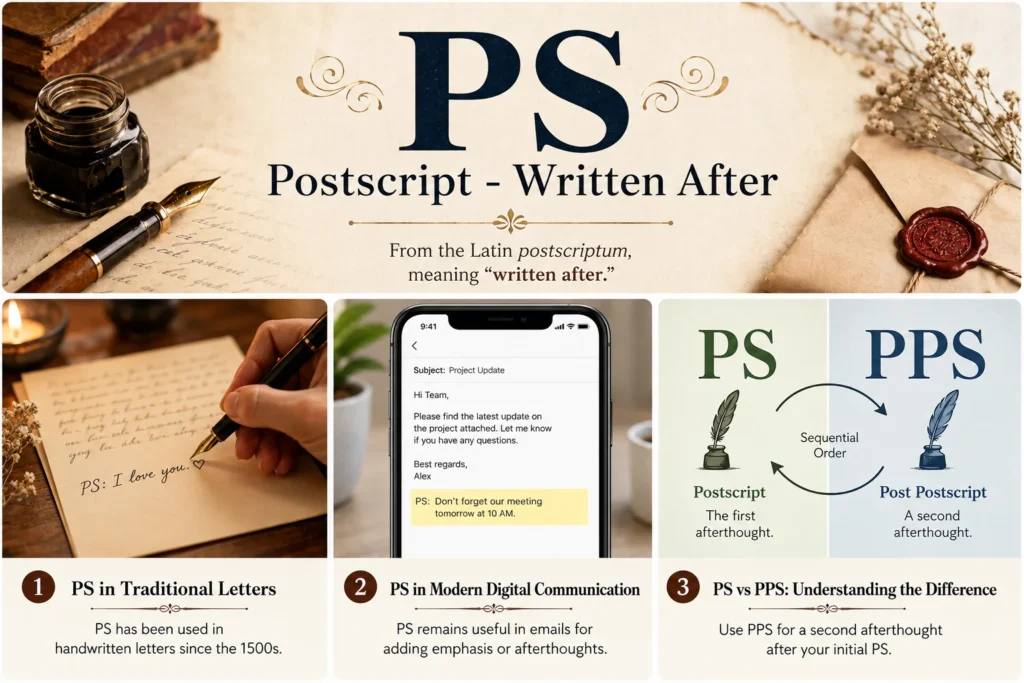
PS stands for “postscript,” which comes from the Latin word postscriptum meaning “written after.” You use PS to add extra information, an afterthought, or a forgotten detail at the end of a message after your signature. The abbreviation has been in use since the 1500s and remains common today in letters, emails, text messages, and social media posts.
Have you ever reached the end of a letter or email and suddenly remembered something else you wanted to say? Perhaps you have scrolled to the bottom of a message and noticed a PS with an extra thought or a playful comment. This small but powerful abbreviation has stood the test of time, surviving from handwritten letters to modern digital communication.
This guide explains everything you need to know about the PS meaning. You will learn its origin, correct usage, formatting rules, and real-life examples for different platforms. Therefore, whether you are writing a formal business email or sending a casual text, you will use PS with confidence.
Quick Answer Box
| Aspect | Details |
|---|---|
| Meaning | Postscript (from Latin postscriptum, “written after”) |
| Context | Additional thought or information added after the main message ends |
| Usage | Letters, emails, text messages, social media, marketing materials |
| Platforms | Email, texting, social media, handwritten letters, direct mail |
| Example | “Thanks for your time. PS: I attached the report you requested.” |
| Tone | Can be formal, casual, playful, or persuasive depending on context |
What Does PS Mean?
Literal Definition
PS stands for “postscript.” This word comes directly from the Latin term postscriptum, which translates to “written after” . The prefix “post” means “after,” while “scriptum” means “written.” Therefore, a postscript is literally something written after the main text has ended.
In practical terms, a PS is an additional thought, comment, or piece of information that you add at the end of a message . You typically write it after you have signed your name or concluded the main body of your communication.
Historical Context
The PS meaning has remained consistent for centuries. The word “postscript” first appeared in English during the early 1500s, and the abbreviation PS became widely used within a hundred years .
Before computers and word processors, rewriting a letter was extremely time-consuming. If you forgot to include something important, you could not simply scroll back up and edit. Consequently, people used PS to add forgotten details without rewriting the entire letter . This practical solution became a social convention that has persisted into the digital age.
Full Definition
Understanding the full PS meaning requires knowing how the abbreviation functions in different contexts.
Formal Definition
The Cambridge Dictionary defines PS as an abbreviation for “postscript,” used at the end of a letter or email to introduce additional information . Similarly, the Oxford Dictionary describes it as a note added after the signature at the end of a letter or document.
Practical Definition
In everyday usage, PS serves several practical purposes:
- Afterthoughts: When you remember something after finishing your message
- Emphasis: To draw attention to a particular point
- Personal touches: Adding a more casual or intimate note
- Call to action: In marketing, to encourage a specific response
- Reminders: To highlight information the reader should not miss
Purpose
The primary purpose of PS is to include information that you either forgot or deliberately saved for the end. Since it stands out visually, a PS often catches the reader’s attention more effectively than information buried in the main text . Marketers use this effect intentionally, placing important offers or calls to action in a PS.
Context and Usage
Formal Communication (Letters and Business Emails)
In formal correspondence, you use PS to add a final note after your signature. For example, a business letter might include a PS reminding the recipient of a deadline or acknowledging an enclosed document.
When using PS in formal writing, keep your postscript concise and relevant. Long, rambling PS sections can undermine the professionalism of your message. Moreover, be aware that some recipients may not read past your signature, so do not place critical information exclusively in the PS .
Casual Communication (Texts and Personal Emails)
In casual settings, the PS meaning becomes more flexible. You might use PS to add a funny comment, a playful jab, or a personal anecdote that you forgot to mention earlier.
For example, a friend might text: “I had such a great time tonight! PS: Your outfit was on point.” This use of PS adds a warm, personal touch to the conversation.
Social Media
On social media, PS often serves to add a final thought or a call to action. For instance, an influencer might post: “Check out my new video! PS: Hit the notification bell so you do not miss any updates.”
The abbreviation functions similarly to its use in other contexts, though it tends to be more informal on these platforms.
Marketing and Sales
In direct mail and email marketing, PS has become a strategic tool. Studies show that many people read the PS of a letter before the main content. Consequently, marketers often place their strongest offer, testimonial, or call to action in the postscript . This practice leverages the PS meaning to drive conversions.
Real-Life Examples
Conversation Example 1: Professional Email
Sender: “Dear Mr. Johnson, I hope this email finds you well. Please find the quarterly report attached for your review. Do not hesitate to reach out if you have any questions. Best regards, Sarah Thompson. PS: The deadline for feedback is Friday, so please let me know your thoughts by then.”
Conversation Example 2: Text Message Between Friends
Person A: “I am so excited for this weekend! We are going to have a blast.”
Person B: “Me too! I cannot wait to see everyone.”
Person A: “PS: Do not forget to bring your swimsuit. I heard the hotel has an amazing pool.”
Conversation Example 3: Personal Letter
Writer: “Dear Grandma, Thank you so much for the birthday card and the lovely note you included. It truly made my day. I am so grateful to have you in my life. All my love, Eliza. PS: I made your famous cookie recipe last week, and everyone loved them!”
Conversation Example 4: Social Media Post
Creator: “I am beyond excited to announce that my new collection drops next Thursday! I have been working on this for months, and I cannot wait for you to see it. PS: Followers get early access, so make sure you are following me!”
Conversation Example 5: Dating App
User: “I am really enjoying this conversation. You seem like such a fun person. PS: I think your taste in music is incredibly cool. That band you mentioned is one of my favorites.”
Platform-Specific Meaning
In email, PS serves both practical and stylistic purposes. Although you can easily edit an email before sending, many people still use PS. The abbreviation adds a personal touch and can emphasize important points. However, since you can rewrite emails without extra effort, the PS meaning has shifted from necessity to style .
Many email signatures and marketing emails include a PS to provide a final call to action or testimonial. For instance: “PS: Early bird pricing ends tomorrow. Do not miss out!”
Text Messaging
Text messaging uses PS similarly to email, though it tends to be more casual. People often use PS to add afterthoughts, reminders, or playful comments. Since texts are naturally short, a PS might be a single sentence or even a few words.
Social Media
Social media platforms use PS to add final thoughts, calls to action, or clarifications. For example, a tweet might end with “PS: Share this with someone who needs to hear it.” Similarly, an Instagram caption might include “PS: Link in bio.”
Direct Mail Marketing
In direct mail, the PS meaning carries significant weight. Marketers intentionally craft PS sections to stand out and drive action. This strategy works because many people scan a letter and read the PS before the main body. Therefore, a well-written PS can increase response rates significantly.
Alternative Meanings
Although “postscript” is the primary PS meaning, the abbreviation has several alternative interpretations.
Public School
In the United States, some school systems use PS to stand for “Public School.” For example, PS 166 in Manhattan indicates a specific public school . This usage is common in New York City and other urban areas.
PlayStation
Among gamers, PS often refers to the PlayStation video game console series. For instance, someone might say, “I just bought a new PS5,” meaning a PlayStation 5. This is one of the most common alternative PS meanings.
Photoshop
In digital design, PS frequently abbreviates Adobe Photoshop. Designers might say, “I will edit this in PS,” indicating Photoshop.
Slang Uses
In internet slang, PS occasionally takes on additional meanings depending on context. Urban Dictionary records several niche uses, including:
- A Hokkien slang term meaning “oops” or “sorry
- An abbreviation for “pimp slap” in certain online communities
- A reference to “party slut” in specific social contexts
However, these uses are far less common than the standard PS meaning of postscript.
Related Terms and NLP Variations
PPS (Post-Postscript)
When you need to add a second afterthought, you can use PPS. This stands for “post-postscript” and literally means “after the postscript” . You use it just like PS, but for your second additional thought.
For example: “PS: I attached the document. PPS: I also included the revised budget.”
Note that PPS is the correct form, not PSS. PSS would mean “postscript script,” which does not make grammatical sense . If you need even more additions, you can continue with PPPS, PPPPS, and so on.
Synonyms
Several English expressions convey similar meaning to PS:
- Afterthought: A thought that comes later
- Addendum: A supplementary note added to a document
- Supplementary note: Additional information
- By the way: A common phrase for adding extra information in speech and casual writing
Semantic Relationships
The PS meaning connects to broader concepts of written communication, including:
- Signatures: PS appears after your signature line
- Main body: PS exists separately from the main text
- Emphasis: PS often highlights important information
- Punctuation: How you format PS affects its readability
How to Respond to PS
In Professional Contexts
When someone includes a PS in a professional email, respond to it as you would any other part of the message. Address the information directly in your reply. For instance:
Original: “Looking forward to the meeting. PS: Please bring the project files.” Response: “I will bring the project files to the meeting. Thank you for the reminder.”
In Personal Communication
In personal messages, you can respond to a PS casually. You might answer the question, acknowledge the comment, or simply continue the conversation. For example:
Original: “I had so much fun today. PS: Let us do it again soon.” Response: “I agree! When are you free next week?”
In Social Media
Social media PS comments often do not require a direct response. However, if the PS asks a question or includes a call to action, you should respond accordingly. For example, if an influencer posts “PS: Let me know what you think,” you can reply in the comments.
Misinterpretations and Common Mistakes
Mistake 1: Confusing PS with Other Abbreviations
Some people confuse PS with “P.S.” versus “PS.” Both are correct, but style guides differ on punctuation. The Chicago Manual of Style recommends “PS” without periods, while the Cambridge Dictionary prefers “P.S.” for American English . The key is to stay consistent throughout your message.
Mistake 2: Using PS Incorrectly in Emails
Since emails are easy to edit, some people argue that PS is no longer necessary. However, PS still serves stylistic and emphasis purposes. Do not overuse it, but do not avoid it entirely either. Use PS when you want to add a final thought or draw attention to something important.
Mistake 3: Placing PS Before the Signature
Always place PS after your signature. The postscript is, by definition, written after the main text has ended. Placing it before your signature confuses the structure of your message.
Mistake 4: Making PS Too Long
A PS should be brief. If your postscript is multiple paragraphs long, it defeats the purpose of being an afterthought. Keep it concise and focused on one or two points.
Mistake 5: Using PSS Instead of PPS
Do not use PSS. The correct form for a second postscript is PPS (post-postscript). PSS is grammatically incorrect and will confuse your reader .
When NOT to Use PS
In Very Short Messages
For extremely short messages, such as a one-sentence text, PS is usually unnecessary. If your entire message is already brief, adding a PS creates redundancy.
When the Information Is Critical
Do not place critical information exclusively in a PS. Some recipients might not read past your signature . If the information is essential, include it in the main body of your message.
In Formal Reports
PS is generally inappropriate in formal documents like research papers, technical reports, or legal documents. These formats require structured sections and do not accommodate informal afterthoughts.
When Overusing It
If you use PS in every message, it loses its impact. Reserve PS for occasions when you genuinely have an afterthought or want to emphasize something important.
Usage Tips
Tip 1: Keep It Concise
A PS should be brief and to the point. A single sentence or two is usually sufficient. Longer postscripts can become distracting.
Tip 2: Use It Strategically
Use PS to emphasize important points or add a personal touch. In marketing, use PS to include a call to action or a testimonial . In personal correspondence, use it to add a warm or humorous note.
Tip 3: Be Consistent with Punctuation
Choose either “PS” or “P.S.” and use it consistently throughout your writing. Both are acceptable, but consistency is crucial for professionalism.
Tip 4: Capitalize PS
Always capitalize the abbreviation. Whether you use periods or not, “PS” should always be in uppercase letters .
Tip 5: Place It Correctly
PS always appears at the end of your message, after your signature . If you are using an email signature block, place the PS above or below it, depending on your preference.
FAQs
1. What does PS stand for?
PS stands for “postscript,” which comes from the Latin word postscriptum meaning “written after” .
2. Is it PS or P.S.?
Both are correct. The Chicago Manual of Style recommends “PS,” while the Cambridge Dictionary recommends “P.S.” for American English. Choose one and stay consistent .
3. What is PS in a letter?
In a letter, PS is a note added after the signature. It includes extra information, an afterthought, or something the writer forgot to mention in the main body .
4. What does PS mean in text?
In text messaging, PS has the same meaning as in letters: an afterthought or additional note at the end of a message. It often adds a personal or playful touch .
5. Can I use PS in a professional email?
Yes, PS is acceptable in professional emails, especially when you want to add a final thought, a reminder, or emphasize something important .
6. What is the origin of PS?
PS comes from the Latin word postscriptum, which means “written after.” The abbreviation first appeared in English around the 1500s .
7. What is PPS meaning?
PPS stands for “post-postscript,” meaning after the postscript. It is used to add a second afterthought after the first PS .
8. Is PS still relevant today?
Yes, PS remains relevant in modern communication. It adds emphasis, personal touch, and serves as a strategic tool in marketing .
9. What are other meanings of PS?
Alternative meanings include “Public School,” “PlayStation,” and “Photoshop.” The meaning depends on context .
10. How do I format PS in a letter?
Place PS after your signature. You can write it as “PS” or “P.S.” and always capitalize it. Keep the content concise and relevant .
Conclusion
The PS meaning has remained remarkably consistent for centuries. From its Latin origins as postscriptum to its modern use in emails and texts, PS continues to serve as a valuable tool for adding afterthoughts and emphasizing important points. The abbreviation’s longevity demonstrates its utility and adaptability.
When you use PS, remember to keep it concise, place it after your signature, and be consistent with punctuation. Whether you are writing a formal letter, a business email, or a casual text, PS can add that extra touch that makes your message more effective.

Victoria Lane is a grammar-focused writer at GramBrix.com, passionate about helping readers master the rules of language. She provides clear explanations and practical examples that make writing more accurate, polished and confident.