
Last Updated on July 11, 2026
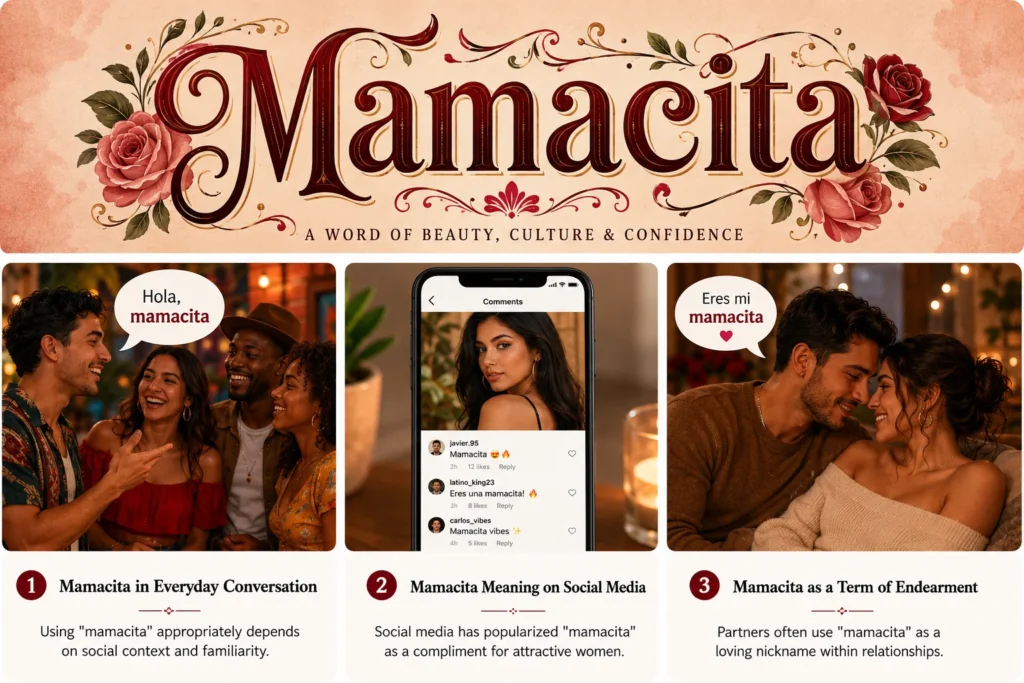
Mamacita is a Spanish term of endearment that literally translates to “little mama.” In modern usage, it commonly refers to an attractive or beautiful woman. The word combines “mama” (mother) with the suffix “-cita” (little), creating a term that can express affection, admiration, or flirtation depending on the context and tone .
You have probably heard someone use the word “mamacita” in a song, a movie, or a casual conversation. Perhaps you have wondered what it really means and whether it is appropriate to use. This Spanish term has traveled far beyond its original cultural boundaries, appearing in everything from hip-hop lyrics to everyday slang. However, its meaning can shift dramatically based on who says it, how they say it, and the situation they are in.
This guide explains everything you need to know about the mamacita meaning. You will learn its literal translation, cultural significance, proper usage, and important context to avoid misunderstandings. Therefore, whether you are learning Spanish, enjoying Latin music, or simply curious about the term, this comprehensive breakdown will help you understand it fully.
Quick Answer Box
| Aspect | Details |
|---|---|
| Literal Meaning | “Little mama” or “little mother” |
| Common Usage | Term of endearment for an attractive woman |
| Context | Can be affectionate, flirtatious, or objectifying depending on tone |
| Origin | Spanish, combining “mama” (mother) with “-cita” (diminutive suffix) |
| Platforms | Music, movies, social media, casual conversation |
| Example | “Did you see her? She is a total mamacita!” |
| Tone | Ranges from sweet and affectionate to sleazy or disrespectful |
What Does Mamacita Mean?
Literal Translation
The word “mamacita” breaks down into two parts. Mama” means “mother,” and “-cita” is a diminutive suffix that means “little” or “dear.” Consequently, the literal translation is “little mama” or “dear mother . However, the phrase functions very differently from its literal meaning in everyday conversation.
Common Modern Usage
In contemporary slang, mamacita typically refers to an attractive woman. The term often carries a flirtatious or admiring tone. Moreover, it frequently describes a woman of Hispanic or Latina background, though people apply it to any attractive woman in casual settings .
For instance, someone might say, “I met this beautiful mamacita at the party last night.” This usage clearly indicates physical attraction, whereas the literal translation of “little mother” does not capture the intended meaning.
Cultural Context
The term has deep roots in Spanish-speaking cultures. In some contexts, family members may use it as a term of endearment without any romantic connotation. However, in other situations, strangers or acquaintances might use it as a flirtatious compliment. The cultural background of the speaker and listener significantly influences how they perceive the word.
Full Definition
The mamacita meaning encompasses several layers of definition, from literal translation to cultural connotations. Understanding these layers helps you use the term appropriately.
Dictionary Definitions
Major slang dictionaries define “mamacita” primarily as a term for an attractive woman. For example, the Rap Dictionary defines it as “Little Mama; A beautiful woman. Typically a pretty Spanish woman” . Similarly, Green’s Dictionary of Slang records its usage as “an attractive young woman” in American English .
Slang and Colloquial Meaning
In casual speech, people use mamacita as a compliment. The term conveys appreciation for a woman’s physical appearance. Additionally, it expresses admiration, similar to calling someone “baby,” “honey,” or “beautiful” in English .
Endearment vs. Objectification
Notably, the tone of voice makes a significant difference in how people perceive the term. When someone uses it with genuine affection, it can sound sweet and complimentary. However, when someone uses it in a sleazy manner, it can come across as disrespectful or objectifying . This dual nature makes context crucial.
Context and Usage
Understanding when and how to use “mamacita” is essential to avoid cultural missteps.
Flirtatious Usage
Most commonly, men use “mamacita” as a flirtatious nickname for women they find attractive. For example, a man might say to a woman, “Hey there, mamacita!” in a social setting. In this context, the term acts as a playful compliment. However, women should be aware that some may perceive it as catcalling.
Term of Endearment
In close relationships, “mamacita” can function as a term of endearment. A boyfriend might call his girlfriend “mamacita” affectionately. Similarly, a husband might use it for his wife. In these contexts, the term conveys love and admiration rather than objectification.
Cultural and Linguistic Context
In Spanish-speaking households, “mamacita” sometimes refers to a mother or older female relative. Young children might call their mother “mamacita” as a term of affection. This usage is entirely non-romantic and displays familiarity.
Nevertheless, among strangers, the term carries a very different weight. A stranger using “mamacita” toward someone they do not know often comes across as forward or disrespectful.
Media and Entertainment
The term appears frequently in music, movies, and television. For instance, a popular TV show might feature a character calling someone “mamacita” flirtatiously. Moreover, many songs across Latin and hip-hop genres include the term. The music often portrays it as a compliment, which helps spread its usage in popular culture .
Real-Life Examples
Conversation Example 1: Romantic Interest
Man: “You look absolutely stunning tonight, mamacita.”
Woman: “Thank you, that is very sweet of you to say.”
Man: “I mean it. You are the most beautiful woman in this room.”
Conversation Example 2: Casual Compliment
Friend A: “Who is that woman across the room?”
Friend B: “I do not know, but she is a total mamacita.”
Friend A: “I agree. She is gorgeous.”
Conversation Example 3: Affectionate Partner
Partner A: “How was your day, mamacita?”
Partner B: “It was exhausting, but seeing you makes it better.”
Partner A: “I am glad I can help you relax.”
Conversation Example 4: Family Context
Grandchild: “Mamacita, can you tell me that story again?”
Grandmother: “Of course, my love. I will tell it again just for you.”
Grandchild: “Thank you, Mamacita. You are the best.”
Conversation Example 5: Playful Friends
Friend A: “You think you are such a mamacita today, huh?”
Friend B: “I know I am. Why do you think I dressed up?”
Friend A: “Okay, I see you. You look great.”
Platform-Specific Meaning
Instagram and Social Media
On Instagram, people use the hashtag #mamacita to describe attractive women. Similarly, users employ it as a comment on photos. Consequently, the term has become closely associated with beauty standards and admiration on visual platforms. Influencers and models often receive this comment from followers.
Music and Hip-Hop Culture
In hip-hop music, “mamacita” appears frequently in lyrics. For example, Quavo uses it in the song “Cross the Country”: “Caught him two weeks later in the club, with his mamacita” . Similarly, Offset raps, “I got a foreign mamacita and I been known to beat it” . These lyrics reinforce the term’s association with attractive women.
Dating Apps
On dating apps, users sometimes describe themselves or others as “mamacita.” This usage signals confidence and attractiveness. However, using the term in a dating profile can be polarizing since some women find it flattering while others find it off-putting.
Text Messaging
In text messages, “mamacita” often appears as a flirtatious nickname. People send messages like “Good morning, mamacita” to their romantic partners. Meanwhile, in group chats, friends might joke about someone being a “mamacita” after seeing a good photo.
Alternative Meanings and Interpretations
Literal Translation
As previously mentioned, the literal translation is “little mama” or “dear mother.” In some Spanish-speaking families, this remains the primary meaning. Children call their mothers “mamacita” as an affectionate nickname .
Term of Endearment
In relationships, “mamacita” functions as a term of endearment similar to “baby” or “honey.” Its usage depends heavily on the relationship between speakers. A partner might use it daily, whereas a stranger might avoid it entirely.
Objectifying Connotation
In certain contexts, “mamacita” carries an objectifying connotation. When a stranger uses it as a catcall, it reduces the woman to her physical appearance. Consequently, many women perceive this usage as disrespectful. Therefore, it is important to consider how the term might be received.
Sassy or Playful Tone
Sometimes, friends use “mamacita” ironically or playfully. For instance, two female friends might call each other “mamacita” as a joke. In this context, the term loses its romantic meaning entirely and functions as a playful compliment.
Related Terms and NLP Variations
Synonyms
Several English and Spanish words share similar meanings to “mamacita”:
- Senorita – A respectful Spanish term for an unmarried woman
- Shawty – Slang for an attractive woman
- Shorty – Similar to shawty, referring to an attractive woman
- Babe – A common English term of endearment
- Boo – Slang for a romantic partner
- Dime piece – Slang for a highly attractive person
Variations and Misspellings
Common misspellings include “mamaceta” . However, the correct spelling is “mamacita.” Additionally, some people mistakenly write “mamasita,” which is a variation but less commonly used .
Semantic Relationships
The term connects to broader concepts of attraction, affection, and cultural identity. It bridges Spanish and English slang, making it a unique linguistic crossover. Furthermore, it belongs to a category of terms that use familial words (like “mama” or “papa”) to express affection toward romantic partners.
How to Respond to Mamacita
Accepting the Compliment
If someone calls you “mamacita” and you appreciate the compliment, respond politely. You could say:
- “Thank you, that is sweet of you.”
- “I appreciate the compliment.”
- “That is very kind of you to say.”
Addressing Discomfort
If the term makes you uncomfortable, you have every right to express that. Politely but firmly correct them:
- “I prefer you not call me that.”
- “Please just use my name.”
- “That makes me uncomfortable. Can you stop?”
Setting Boundaries
In some cases, you might need to set firm boundaries. For instance:
- “I do not appreciate being called that.”
- “We are not close enough for that kind of nickname.”
- “Please do not speak to me that way.”
Matching the Playful Tone
If you are with friends and they use it playfully, you can lean into the joke. For example:
- “I know I am. What is your point?”
- “I am a mamacita every day. Glad you noticed.”
- “Took you long enough to realize.”
Misinterpretations and Cultural Sensitivity
Mistake 1: Assuming It Is Always Flattering
One common mistake is assuming “mamacita” is always a compliment. While many people use it positively, others find it objectifying. Therefore, you should consider context and relationship before using it.
Mistake 2: Using It with Strangers
Using “mamacita” with strangers often backfires. Since you do not know their preferences, it can come across as disrespectful. Consequently, it is safer to avoid using it with people you do not know well.
Mistake 3: Ignoring Cultural Context
The term carries different weight in different cultures. In some Spanish-speaking communities, it is entirely acceptable among family members. In others, it is strictly romantic. Therefore, understanding cultural norms matters when using the term.
Mistake 4: Using It in Professional Settings
“Mamacita” is almost never appropriate in professional settings. Using it at work can create a hostile environment and may lead to accusations of sexual harassment. Always stick to professional language in workplace contexts.
When NOT to Use Mamacita
In Professional or Formal Settings
Avoid “mamacita” in the workplace, formal events, or any professional setting. The term is inherently casual and personal. Consequently, using it professionally is inappropriate and potentially offensive.
With People You Do Not Know Well
Until you understand how someone feels about the term, it is best to avoid it. Using “mamacita” with acquaintances or strangers can make them uncomfortable. In addition, it may create awkwardness in the relationship.
When the Recipient Shows Discomfort
If someone indicates they do not like being called “mamacita,” stop immediately. Continuing to use it after they express discomfort demonstrates disrespect. Therefore, pay attention to their reaction and adjust accordingly.
In Sensitive or Serious Conversations
The term is casual and often playful. Consequently, it does not belong in serious discussions. Using it during sensitive conversations can undermine the gravity of the situation.
Usage Tips for the Term
Tip 1: Know Your Audience
Before using “mamacita,” consider who you are speaking to. Is it your partner or a stranger? Are they comfortable with informal terms of endearment? Understanding your audience prevents misunderstandings.
Tip 2: Pay Attention to Tone
Your tone of voice significantly influences how someone receives the term. A warm, affectionate tone conveys admiration, while a sleazy tone conveys disrespect . Therefore, be mindful of how you say it.
Tip 3: Gauge the Relationship
Only use “mamacita” with people you have a close relationship with. Partners, close friends, and family members are generally safe audiences. However, acquaintances and strangers are not.
Tip 4: Respect Boundaries
If someone asks you to stop using the term, respect their wishes immediately. Their comfort matters more than your intended compliment. Consequently, do not push the issue if they express discomfort.
FAQs
1. What is the literal translation of mamacita?
The literal translation is “little mama” or “dear mother.” The word combines “mama” (mother) with the diminutive suffix “-cita” .
2. Is mamacita a compliment?
It can be a compliment, but it depends on the context. When someone uses it affectionately, it conveys admiration. However, in other contexts, it can come across as disrespectful or objectifying .
3. Is it offensive to call someone mamacita?
It depends entirely on context and relationship. Partners and close friends may appreciate it, while strangers or colleagues may find it offensive. Therefore, it is best to use it carefully .
4. Do people use mamacita in Spanish-speaking countries?
Yes, but the usage varies. In some families, children call their mothers “mamacita” affectionately. In other contexts, men use it as a flirtatious term for attractive women. The meaning depends heavily on the situation.
5. What is the difference between mamacita and mamasita?
“Mamacita” is the correct Spanish spelling. “Mamasita” is a variation but less common. Both refer to an attractive woman or a term of endearment .
6. Can women use mamacita?
Absolutely. Women can use it to refer to other women as a playful compliment. Women also use it between friends to joke around or show affection.
7. Is mamacita used in hip-hop music?
Yes, the term appears frequently in hip-hop lyrics. Artists like Quavo and Offset have used it in their songs to refer to attractive women .
8. What is a synonym for mamacita?
Synonyms include “senorita,” “shawty,” “shorty,” “babe,” “boo,” and “dime piece” .
9. Can I use mamacita with my girlfriend?
Yes, many couples use “mamacita” as a term of endearment. However, you should ensure your girlfriend is comfortable with it first. Some women appreciate the nickname while others dislike it.
10. Is mamacita appropriate in professional settings?
No, you should avoid “mamacita” in professional or formal settings. The term is too casual and personal for workplace contexts.
Conclusion
The mamacita meaning is multi-layered and culturally rich. Originally translating to “little mama,” the term now functions as a compliment, a term of endearment, and sometimes a flirtatious nickname. However, understanding its cultural context is crucial because the term can be positive or negative depending on usage.
If you use “mamacita” with a close partner, it can strengthen your connection. Yet, using it with strangers or in professional settings can cause offense. Therefore, always consider your relationship, the listener’s comfort, and the overall situation before using the term. When used appropriately, “mamacita” can be a sweet and affectionate expression. When used carelessly, however, it can create misunderstandings.

Justin Powell is a writer at GramBrix.com who focuses on grammar, clarity and effective communication, helping readers strengthen their language skills.