Last Updated on July 10, 2026
| Term | Meaning |
|---|---|
| Sentient | Able to perceive, feel, experience sensations, or be aware of surroundings |
| Part of Speech | Adjective |
| Common Contexts | Philosophy, biology, psychology, AI discussions, science fiction |
| Example | “Many animals are considered sentient because they can feel pain and emotions.” |
| Tone | Academic, scientific, philosophical |
| Related Concepts | Consciousness, awareness, perception, cognition |
The word sentient has become increasingly common in discussions about animals, artificial intelligence, consciousness, ethics, and science fiction. You may have heard people ask questions like:
- “Are animals sentient?”
- “Could AI become sentient?”
- What does sentient actually mean?”
- “Is sentient the same as conscious?”
Although the term is widely used, many people misunderstand its meaning. Some assume sentient simply means intelligent, while others use it interchangeably with consciousness or self-awareness.
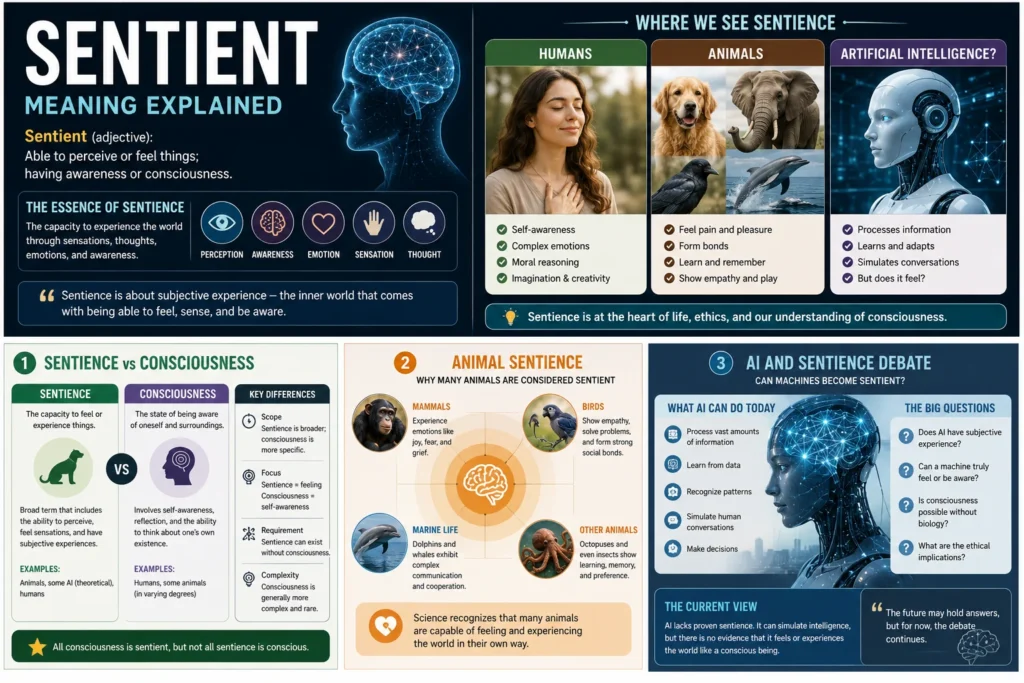
In reality, the sentient meaning is more specific. At its core, a sentient being is capable of sensing, feeling, or experiencing the world around it. This ability to have subjective experiences makes sentience an important concept in science, ethics, philosophy, psychology, and technology.
This comprehensive guide explains the meaning of sentient, its origins, examples, real-life usage, platform-specific interpretations, connections to artificial intelligence, common misunderstandings, related terms, FAQs, and much more.
Quick Answer Box
| Category | Explanation |
|---|---|
| Meaning | Able to feel, perceive, or experience sensations |
| Type | Adjective |
| Common Usage | Animals, humans, AI discussions, philosophy |
| Example | “Dogs are sentient animals capable of feeling emotions.” |
| Tone | Educational, scientific, philosophical |
| Related Concepts | Consciousness, awareness, perception |
| Opposite | Insentient, unconscious, unfeeling |
| Pronunciation | SEN-shee-ent |
What Does It Mean?
The simplest definition of sentient is:
Having the ability to perceive, feel, or experience sensations.
A sentient being can experience things such as:
- Pain
- Pleasure
- Fear
- Comfort
- Hunger
- Emotions
- Physical sensations
The key idea is that something is not merely reacting mechanically—it is actually experiencing sensations in some way.
For example:
“Humans are sentient beings because they can feel emotions and physical sensations.”
Similarly:
“Most scientists agree that many animals are sentient.”
In everyday language, sentient often refers to the ability to experience the world subjectively.
Full Definition
The formal definition of sentient is:
Capable of sensing, perceiving, or feeling things.
The word describes beings that have experiences rather than merely existing as objects.
Pronunciation
Sentient
Pronounced:
SEN-shee-ent
Syllable Breakdown
Sen-ti-ent
Word Origin
The word comes from the Latin term sentiens, which means:
Feeling or perceiving.
The root is related to sensation and perception.
Over time, the word evolved into the modern English term used in science, philosophy, and everyday discussions.
Context and Usage
The meaning of sentient can vary slightly depending on the field in which it is used.
Everyday Usage
In casual conversation, sentient generally means capable of feeling or experiencing life.
Example:
“Pets are sentient creatures that deserve proper care.”
Scientific Usage
Scientists use the term when discussing an organism’s ability to experience sensations.
Example:
“Evidence suggests many species are sentient.”
Philosophical Usage
Philosophers often debate:
- What qualifies as sentient?
- Whether consciousness requires sentience
- Whether sentience creates moral rights
Example:
“Sentience plays a central role in ethical philosophy.”
Technology Usage
In discussions about artificial intelligence, people often ask:
“Can AI become sentient?”
This question has become increasingly common in modern technology debates.
Real-Life Examples
Understanding examples makes the concept much easier to grasp.
Example 1: Human Experience
A person feels happiness after receiving good news.
This emotional experience demonstrates sentience.
Example 2: Animal Welfare
A dog feels pain after an injury.
Because it experiences suffering, the dog is considered sentient.
Example 3: Fear Response
A deer reacts to danger and appears to experience fear.
Many researchers consider such experiences evidence of sentience.
Example 4: Medical Ethics
Healthcare professionals consider pain and suffering when treating patients because humans are sentient beings.
Example 5: Artificial Intelligence Debate
People debate whether future AI systems could ever genuinely experience feelings rather than simply process information.
This discussion centers on the idea of sentience.
Real-Life Conversation Examples
Conversation Example 1
Alex: Why do animal welfare laws exist?
Jordan: Because animals are sentient and can suffer.
Conversation Example 2
Emma: What does sentient mean?
Ryan: It means being able to feel or experience things.
Conversation Example 3
Student: Are fish sentient?
Teacher: Many scientists believe they can experience pain and sensations.
Conversation Example 4
Friend 1: Could robots become sentient?
Friend 2: That’s one of the biggest debates in AI.
Conversation Example 5
Parent: Why should we treat animals kindly?
Child: Because they’re sentient and can feel pain.
Platform-Specific Meaning
The term sentient appears across many online platforms and communities.
On Reddit, discussions about sentience often involve:
- Animal ethics
- Artificial intelligence
- Consciousness
- Philosophy
Users frequently debate whether future machines could become sentient.
YouTube
Educational videos commonly explain:
- Sentience vs consciousness
- Animal cognition
- AI development
Comment sections often contain discussions about the limits of machine awareness.
TikTok
On TikTok, the word is frequently used in:
- Science content
- Philosophy videos
- AI discussions
- Science fiction content
Sometimes the term is used humorously.
Example:
“My coffee machine is becoming sentient.”
In this case, the speaker is joking.
Social Media
People often use sentient figuratively.
Example:
“My phone seems sentient today.”
This usually implies the device appears unusually intelligent.
Gaming Communities
In gaming, sentient often describes:
- Intelligent alien species
- Advanced robots
- Self-aware characters
Example:
“The game features sentient machines.”
Alternative Meanings
While sentient generally refers to the ability to feel or perceive, the word may be interpreted differently depending on context.
Biological Meaning
Refers to living beings capable of sensation.
Example:
“Mammals are sentient organisms.”
Philosophical Meaning
Focuses on subjective experiences.
Example:
“Sentience is central to moral consideration.”
Science Fiction Meaning
Often refers to intelligent self-aware beings.
Example:
“The spaceship was controlled by a sentient AI.”
Popular Culture Meaning
Many people mistakenly use sentient as a synonym for intelligent.
However, the two concepts are not identical.
Sentience vs Consciousness
One of the most common questions involves the difference between sentience and consciousness.
Sentience
Refers to:
- Feeling
- Sensing
- Experiencing
Consciousness
Typically refers to:
- Awareness
- Self-awareness
- Understanding one’s existence
Comparison Table
| Sentience | Consciousness |
|---|---|
| Ability to feel | Awareness of self or surroundings |
| Includes sensations | Includes higher awareness |
| May exist without full self-awareness | Often broader than sentience |
| Focuses on experience | Focuses on awareness |
Many experts view sentience as one component of consciousness.
Sentience and Artificial Intelligence
One reason searches for sentient meaning have increased is the rise of AI discussions.
Can AI Be Sentient?
Currently, there is no evidence that modern AI systems are sentient.
AI can:
- Process information
- Generate responses
- Recognize patterns
However, there is no verified evidence that AI experiences:
- Pain
- Joy
- Fear
- Conscious feelings
Why People Ask This Question
Advanced AI can sometimes appear human-like.
As a result, users may wonder whether AI genuinely experiences emotions.
Science Fiction Influence
Movies, books, and television often portray sentient robots and machines.
Examples include:
- Self-aware computers
- Intelligent androids
- Conscious robots
These fictional portrayals influence public understanding of sentience.
Related Terms and NLP Variations
People searching for sentient meaning often search related concepts.
Synonyms
Depending on context:
- Aware
- Perceptive
- Feeling
- Conscious
- Responsive
- Sensitive
Related Terms
- Consciousness
- Awareness
- Cognition
- Perception
- Intelligence
- Emotion
- Experience
- Self-awareness
Antonyms
- Insentient
- Unaware
- Unconscious
- Inanimate
- Unfeeling
Related Search Queries
- What is sentience?
- Sentient definition
- Sentient vs conscious
- Are animals sentient?
- Can AI become sentient?
- What does sentient mean in philosophy?
Emotional and Ethical Meaning
Sentience has significant ethical implications.
Why Sentience Matters
Many ethical systems argue that beings capable of suffering deserve moral consideration.
Animal Rights
Arguments for animal welfare often depend on sentience.
Reasoning:
If an animal can feel pain, that pain matters morally.
Human Rights
Human rights frameworks often assume humans are sentient beings capable of suffering and flourishing.
Technology Ethics
Future discussions about AI ethics may depend on whether artificial systems ever become sentient.
How to Respond or Reply When Someone Uses Sentient
You may encounter the word in conversations, articles, or online discussions.
If Someone Asks What It Means
You can reply:
“Sentient means able to feel, perceive, or experience sensations.”
If Discussing Animals
Example:
“Many animals are considered sentient because they can experience pain and emotions.”
If Discussing AI
Example:
“Current AI is advanced, but there is no evidence it is sentient.”
If Clarifying a Misunderstanding
Example:
“Sentient doesn’t necessarily mean highly intelligent—it means capable of experiencing sensations.”
Misinterpretations
Many people misunderstand the word sentient.
Mistake 1: Sentient Means Smart
Incorrect.
Intelligence and sentience are different concepts.
A being may be intelligent without being proven sentient.
Mistake 2: Sentient Means Human
Incorrect.
Many animals are widely considered sentient.
Mistake 3: Sentient Means Conscious
Not always.
The concepts overlap but are not identical.
Mistake 4: Every AI Is Sentient
Current AI systems are not considered sentient by scientific consensus.
Mistake 5: Sentience Requires Language
A being can be sentient without speaking a language.
Many animals likely experience sensations despite lacking human language.
When NOT to Use It
The word sentient is often misapplied.
Inanimate Objects
Most everyday objects are not sentient.
Examples:
- Rocks
- Chairs
- Tables
Simple Machines
Basic machines are not sentient.
Example:
A calculator processes numbers but does not experience feelings.
Automatic Systems
Automated behavior does not automatically indicate sentience.
Fictional Exaggeration
Sometimes people use sentient humorously.
Example:
“My printer hates me.”
This is figurative rather than literal.
Usage Tips
Use It for Experiencing Beings
Sentient generally applies to entities capable of sensation.
Avoid Using It as a Synonym for Smart
Intelligence and sentience are separate ideas.
Consider Context
Scientific, philosophical, and casual uses may differ slightly.
Distinguish Between AI and Sentience
Advanced behavior does not necessarily indicate subjective experience.
Remember the Core Idea
The central concept is:
The ability to feel or experience.
Sentience in Popular Culture
Popular culture has helped make the term widely known.
Science Fiction Movies
Many films feature:
- Sentient robots
- Sentient computers
- Sentient aliens
Television Series
Stories often explore what happens when machines become self-aware.
Video Games
Many games include sentient characters that raise ethical questions.
Literature
Authors frequently use sentience to examine:
- Humanity
- Identity
- Morality
- Consciousness
Edge Cases and Ongoing Debates
Some questions about sentience remain unresolved.
Are Insects Sentient?
Scientists continue studying whether insects experience subjective sensations.
Are Fish Sentient?
Many researchers believe fish can feel pain and possess some degree of sentience.
Could Future AI Become Sentient?
This remains an open philosophical and scientific question.
Could Alien Life Be Sentient?
If intelligent extraterrestrial life exists, it may also possess sentience.
How Do We Measure Sentience?
Researchers use behavioral, neurological, and cognitive evidence, but no universal test exists.
FAQs
What is the simple meaning of sentient?
Sentient means able to feel, perceive, or experience sensations.
Is sentient the same as conscious?
Not exactly. Sentience focuses on feeling and experience, while consciousness often includes broader awareness.
Are humans sentient?
Yes. Humans are widely recognized as sentient beings.
Are animals sentient?
Most scientists agree that many animals are sentient and capable of experiencing pain and emotions.
Can artificial intelligence be sentient?
There is currently no evidence that modern AI systems are sentient.
What is an example of sentience?
Feeling pain after an injury is an example of sentience.
What is the opposite of sentient?
Common opposites include insentient, unconscious, and inanimate.
Does sentient mean intelligent?
No. Intelligence and sentience are related but distinct concepts.
Why is sentience important?
It influences discussions about ethics, animal welfare, consciousness, and technology.
How do you use sentient in a sentence?
Example: “Scientists continue studying which animals are sentient.”
Conclusion
The sentient meaning centers on one fundamental idea: the ability to feel, perceive, or experience sensations. A sentient being is not merely reacting to the world mechanically—it is experiencing the world in some subjective way.
The concept plays a major role in biology, psychology, ethics, philosophy, animal welfare, artificial intelligence, and science fiction. While humans are clearly sentient, ongoing debates continue regarding animals, insects, future AI systems, and other forms of potential consciousness.
Understanding sentience helps clarify discussions about morality, rights, suffering, awareness, and intelligence. Whether you encounter the term in academic research, technology debates, literature, media, or everyday conversation, remembering that sentience is fundamentally about the capacity to feel and experience will help you use and understand the word accurately.

Kevin Brooks is a grammar specialist at GramBrix.com, dedicated to helping readers understand language rules with clarity and confidence. He simplifies complex grammar concepts through practical examples and easy explanations.