Last Updated on July 8, 2026
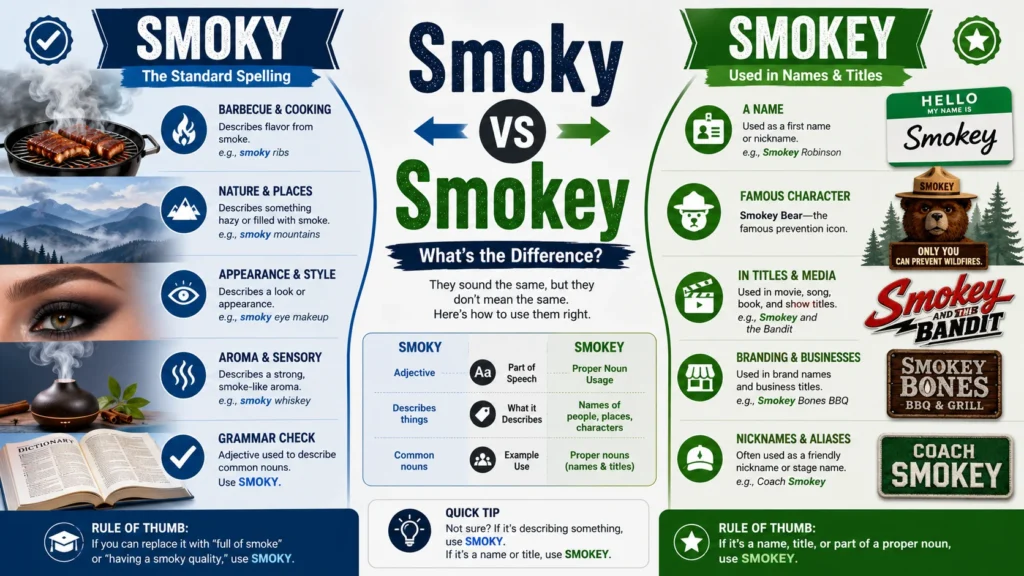
Smoky and smokey are both English words, but smoky is the standard and most widely accepted spelling for describing something filled with smoke or having a smoke-like flavor, smell, or appearance. Smokey is less common and is often used in proper names, nicknames, and specific brands, such as Smokey Bear.
Many English words have more than one spelling. Some variations come from regional differences, while others result from historical usage. One pair that often causes confusion is smoky or smokey.
If you have ever written about barbecue, campfires, whiskey, foggy landscapes, or even eye makeup, you may have wondered which spelling is correct. Should you describe a flavor as smoky or smokey? Is a room filled with smoke smoky or smokey?
The confusion exists because both spellings appear in books, websites, advertisements, and everyday writing. However, they are not used equally. One spelling is considered the standard form in modern English, while the other appears mainly in specific contexts.
Understanding the difference can improve your writing, help you avoid mistakes, and make your communication look more professional. Whether you are a student, blogger, business writer, marketer, or English learner, knowing when to use smoky and when smokey might be acceptable is valuable.
This guide explains everything you need to know about smoky or smokey, including definitions, examples, regional usage, common errors, exercises, and frequently asked questions.
Quick Answer
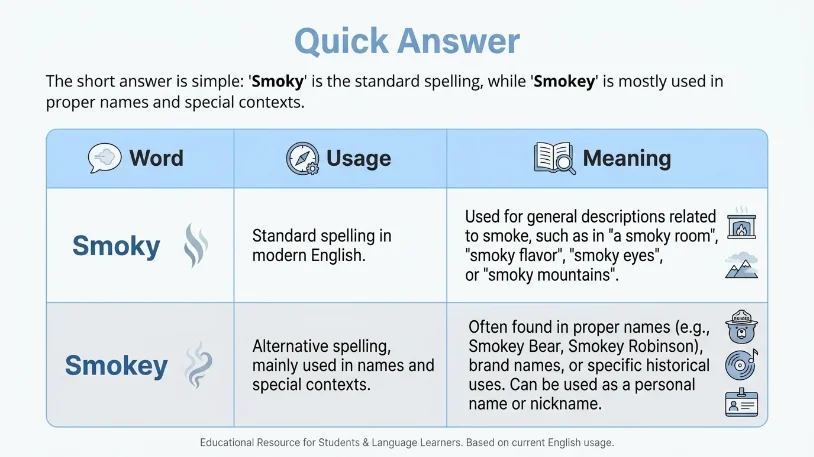
The short answer is simple:
| Word | Usage |
|---|---|
| Smoky | Standard spelling in modern English |
| Smokey | Alternative spelling, mainly used in names and special contexts |
Examples
Correct:
- The barbecue had a smoky flavor.
- The cabin looked smoky after the fire.
- The room became smoky from the fireplace.
Less common:
- Smokey Bear teaches fire prevention.
- Smokey and the Bandit is a movie title.
For almost all everyday writing, smoky is the preferred spelling.
What Does Smoky Mean?
Smoky is an adjective.
It describes something that:
- Contains smoke
- Produces smoke
- Looks like smoke
- Smells like smoke
- Tastes like smoke
Basic Definition
Smoky means having the qualities, appearance, smell, or flavor of smoke.
Examples
- The kitchen became smoky while cooking.
- The mountains appeared smoky in the distance.
- The cheese has a rich smoky taste.
- Her makeup created a smoky eye effect.
Synonyms
- Hazy
- Misty
- Foggy
- Smoldering
- Fume filled
- Charred flavored
In modern dictionaries, smoky is generally listed as the primary spelling.
What Does Smokey Mean?
Smokey is an alternative spelling of smoky.
Historically, both forms appeared in English writing. Over time, smoky became the dominant spelling.
Today, smokey often appears in:
- Proper names
- Nicknames
- Brand names
- Titles
Examples
- Smokey Bear
- Smokey Robinson
- Smokey and the Bandit
Outside these specific uses, most editors recommend using smoky.
Smoky vs Smokey Comparison Table
| Feature | Smoky | Smokey |
|---|---|---|
| Standard English spelling | Yes | No |
| Dictionary preference | Primary | Secondary |
| Common in professional writing | Yes | Rare |
| Used in food descriptions | Yes | Rare |
| Used in academic writing | Yes | Rare |
| Appears in proper names | Sometimes | Often |
| Recommended for SEO content | Yes | Usually no |
Winner for General Writing
Smoky is the safer and more professional choice.
Why Is There Confusion Between Smoky and Smokey?
The confusion comes from English spelling patterns.
Many adjectives ending in “y” sometimes gain an extra “e” in related forms.
For example:
- Shine → Shiny
- Stone → Stoney (historical)
- Smoke → Smoky
Some writers naturally assume that smoke should become smokey.
Historically, both spellings appeared in English literature. Over time, dictionaries and style guides standardized smoky.
As a result, modern English favors smoky.
Historical Development of Smoky and Smokey
Language evolves over time.
In older English texts, spellings were less standardized. Writers often used variations based on personal preference.
During the nineteenth and early twentieth centuries:
- Smoky appeared frequently.
- Smokey also appeared occasionally.
As dictionaries became more influential, smoky gained preference.
Today:
- Newspapers use smoky.
- Academic publications use smoky.
- Professional writers use smoky.
- Businesses usually use smoky when describing flavors and aromas.
This gradual shift explains why both spellings still exist.
Real World Examples of Smoky
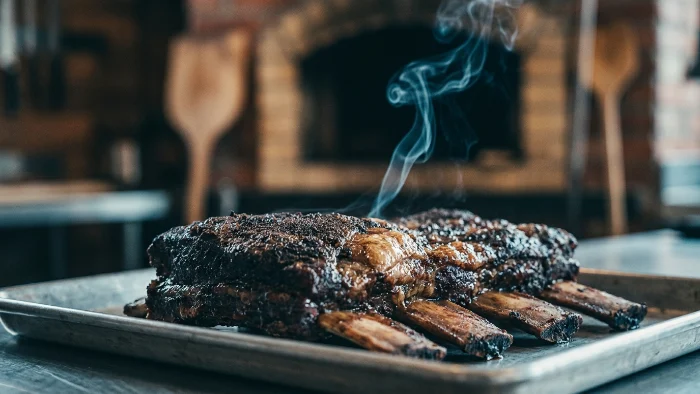
The word smoky appears in many industries.
Food and Cooking
Food writers frequently use smoky.
Examples:
- Smoky barbecue sauce
- Smoky grilled chicken
- Smoky cheddar cheese
- Smoky salsa
Sentence examples:
- The ribs had a deep smoky flavor.
- The peppers added a smoky taste to the dish.
Beverage Industry
Many beverages use the term.
Examples:
- Smoky whiskey
- Smoky Scotch
- Smoky tea
Sentence:
- The tea delivers a smooth and smoky finish.
Beauty and Fashion
One of the most famous beauty terms is the smoky eye.
Examples:
- Smoky eye makeup
- Smoky gray eyeshadow
- Smoky eyeliner look
Sentence:
- She wore a dramatic smoky eye for the event.
Nature and Weather
Examples:
- Smoky skies
- Smoky mountains
- Smoky atmosphere
Sentence:
- Wildfires created smoky conditions across the region.
Real World Examples of Smokey
While less common, smokey appears in several famous names.
Smokey Bear
A well-known fire prevention mascot.
Example:
- Smokey Bear teaches people to prevent forest fires.
Smokey Robinson
A legendary singer and songwriter.
Example:
- Smokey Robinson influenced generations of musicians.
Smokey and the Bandit
A famous movie title.
Example:
- Smokey and the Bandit remains a classic comedy film.
Nicknames
People may use Smokey as a nickname.
Example:
- His friends called him Smokey because of his campfire stories.
Advantages and Disadvantages of Using Smoky
Advantages
Widely Accepted
Most readers recognize it immediately.
Preferred by Dictionaries
Major dictionaries list it as the standard spelling.
Better for Professional Writing
Editors generally expect this version.
Stronger SEO Performance
Most search traffic uses “smoky.”
Disadvantages
May Look Unfamiliar to Some
People who often see names like Smokey Bear may assume smokey is correct.
Historical Variants Exist
Older texts can create confusion.
Advantages and Disadvantages of Using Smokey
Advantages
Useful for Names
Works correctly in titles and proper nouns.
Historical Recognition
Has historical usage in English.
Distinctive Branding
Some brands choose it for style.
Disadvantages
Not Standard
Most style guides prefer smoky.
Can Appear Incorrect
Many readers view it as a misspelling.
Less Common in Professional Writing
Editors often change it to smoky.
Regional and Global Usage
The difference is not primarily regional.
Unlike words such as:
- Color and colour
- Center and centre
- Defense and defence
The choice between smoky and smokey is mostly a matter of standard versus alternative spelling.
American English
Strong preference for smoky.
Examples:
- Smoky flavor
- Smoky room
- Smoky sky
British English
Also prefers smoky.
Examples:
- Smoky atmosphere
- Smoky aroma
- Smoky landscape
Australian English
Generally uses smoky.
Canadian English
Also favors smoky.
Therefore, smoky is the global standard.
Common Mistakes When Using Smoky or Smokey
Mistake: Using Smokey for Flavor Descriptions
Incorrect:
- The sauce has a smokey flavor.
Preferred:
- The sauce has a smoky flavor.
Mistake: Using Smokey in Academic Writing
Incorrect:
- The wildfire created smokey conditions.
Preferred:
- The wildfire created smoky conditions.
Mistake: Changing Proper Names
Incorrect:
- Smoky Bear
Correct:
- Smokey Bear
Always preserve official names.
Mistake: Assuming Both Are Equally Common
While both exist, smoky is far more common in standard writing.
Smoky in Popular Expressions
Many common expressions use smoky.
Smoky Flavor
A taste similar to wood smoke.
Smoky Aroma
A smell that resembles smoke.
Smoky Eye
A makeup style using blended dark colors.
Smoky Mountains
A descriptive phrase referring to hazy mountain views.
Smoky Atmosphere
Air filled with smoke or haze.
Related Concepts and Comparisons
Understanding related words can make usage easier.
| Word | Meaning |
|---|---|
| Smoke | Gas from burning materials |
| Smoky | Having smoke-like qualities |
| Smoldering | Burning slowly |
| Hazy | Slightly unclear atmosphere |
| Misty | Filled with light mist |
| Foggy | Covered by fog |
| Ashy | Covered with ash |
| Charred | Burned and blackened |
Example Comparison
- The room was smoky because of the fireplace.
- The road was foggy because of weather.
- The wood looked charred after burning.
Exercises With Answers
Choose the Correct Word
Question 1
The steak had a rich _____ flavor.
A. Smoky
B. Smokey
Answer: Smoky
Question 2
_____ Bear is a famous fire prevention mascot.
A. Smoky
B. Smokey
Answer: Smokey
Question 3
The cabin became _____ after the chimney malfunctioned.
A. Smoky
B. Smokey
Answer: Smoky
Question 4
We enjoyed a _____ barbecue sauce.
A. Smoky
B. Smokey
Answer: Smoky
Question 5
_____ Robinson is a famous musician.
A. Smoky
B. Smokey
Answer: Smokey
Practice Sentences
Correct the sentence.
Sentence 1
The restaurant serves smokey ribs.
Correct Version:
The restaurant serves smoky ribs.
Sentence 2
The wildfire caused smokey skies.
Correct Version:
The wildfire caused smoky skies.
Sentence 3
Smoky Bear teaches fire safety.
Correct Version:
Smokey Bear teaches fire safety.
When Should You Use Smoky?
Use smoky when describing:
- Taste
- Smell
- Appearance
- Atmosphere
- Weather
- Fire conditions
- Food
- Makeup
Examples:
- Smoky flavor
- Smoky scent
- Smoky air
- Smoky eye makeup
- Smoky landscape
This covers nearly all everyday writing situations.
When Should You Use Smokey?
Use smokey when:
- Referring to official names
- Writing titles
- Mentioning brands
- Using a person’s nickname
Examples:
- Smokey Bear
- Smokey Robinson
- Smokey and the Bandit
Outside these situations, use smoky.
FAQs
Is smoky or smokey correct?
Both exist, but smoky is the standard spelling for most writing.
Which spelling is more common, smoky or smokey?
Smoky is much more common in books, articles, websites, and professional writing.
Do dictionaries prefer smoky or smokey?
Most dictionaries list smoky as the primary spelling.
Can I write smokey flavor?
You can, but smoky flavor is the preferred and standard form.
Why is Smokey Bear spelled with an e?
It is part of the official name and should never be changed.
Is smokey considered wrong?
Not always. It is acceptable in names and some historical contexts, but less common in standard writing.
Is smoky used in American English?
Yes. American English strongly prefers smoky for general descriptions.
Is smoky used in British English?
Yes. British English also favors smoky over smokey.
How do chefs usually write smoky or smokey?
Professional chefs and food writers typically use smoky when describing flavor and aroma.
Should SEO articles use smoky or smokey?
Most SEO content should use smoky because it is the dominant spelling searched and recognized by readers.
Conclusion
The debate over smoky or smokey is easier to resolve than many English spelling questions. While both spellings have existed historically, smoky has become the standard form in modern English. It is the preferred spelling in dictionaries, professional writing, journalism, academic work, food descriptions, beauty content, and everyday communication.
Use smoky whenever you are describing flavor, smell, appearance, atmosphere, weather, or anything related to smoke. Examples include smoky barbecue, smoky skies, smoky aroma, and smoky eye makeup. This is the spelling most readers expect and understand.
Use smokey mainly when referring to official names, brands, titles, or nicknames such as Smokey Bear or Smokey Robinson. In these cases, the spelling is part of the name and should remain unchanged.
For writers, students, marketers, and business professionals, the safest recommendation is simple: choose smoky for general writing and reserve smokey for proper nouns. Doing so will make your writing clearer, more professional, and more consistent with modern English standards.

Kevin Brooks is a grammar specialist at GramBrix.com, dedicated to helping readers understand language rules with clarity and confidence. He simplifies complex grammar concepts through practical examples and easy explanations.