Last Updated on July 5, 2026
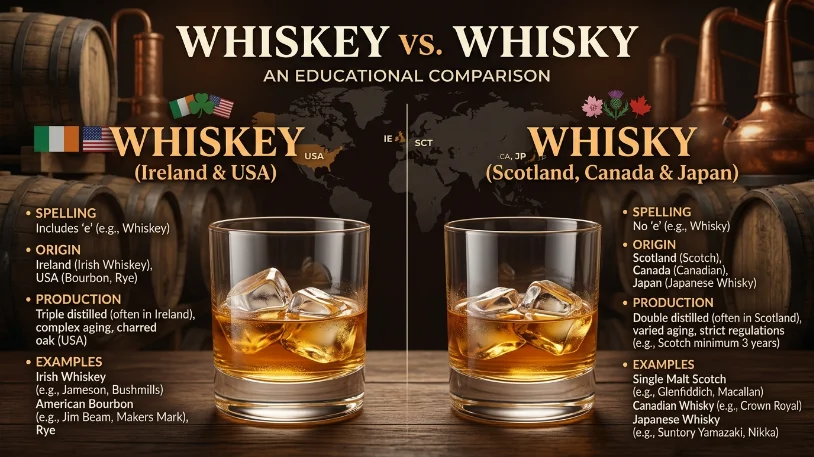
The difference between whiskey and whisky comes down mainly to geography and tradition. “Whiskey” is the preferred spelling in Ireland and the United States, while “whisky” is commonly used in Scotland, Canada, and Japan. Both refer to distilled grain spirits, but production methods, flavor profiles, and regional regulations can vary significantly.
If you’ve ever stood in a liquor store or browsed a drinks menu, you’ve probably noticed two different spellings: whiskey and whisky.
At first glance, it looks like a simple spelling variation. Many people assume they mean exactly the same thing. While they refer to the same type of alcoholic spirit, the spelling often reveals where the drink was produced and sometimes even hints at its style and flavor.
The debate around whiskey or whisky has existed for generations. Distillers, historians, and enthusiasts often have strong opinions on which spelling should be used. Understanding the difference can help you read labels correctly, choose the right bottle, and appreciate the traditions behind one of the world’s most famous spirits.
In this guide, we’ll explore the history, differences, similarities, production methods, and common misconceptions surrounding whiskey and whisky.
Quick Answer: Whiskey or Whisky?
The simplest answer is:
| Spelling | Common Regions |
| Whiskey | Ireland, United States |
| Whisky | Scotland, Canada, Japan |
Neither spelling is wrong.
The correct spelling usually depends on the country where the spirit is made.
For example:
- Irish whiskey uses an “e”
- American whiskey uses an “e”
- Scotch whisky does not use an “e”
- Japanese whisky does not use an “e”
Think of it as a regional preference rather than a quality difference.
What Is Whiskey or Whisky?
Understanding the Spirit
Whiskey or whisky is a distilled alcoholic beverage made from fermented grain mash.
The grains may include:
- Barley
- Corn
- Rye
- Wheat
After fermentation and distillation, the spirit is aged in wooden barrels, often oak casks, which contribute much of its flavor, color, and aroma.
Why Two Different Spellings Exist
The spelling difference originated centuries ago.
Irish distillers began using “whiskey” to distinguish their products from Scottish whisky. When Irish immigrants moved to America, they brought the spelling with them.
As a result:
- Ireland adopted whiskey
- America adopted whiskey
- Scotland retained whisky
- Canada and Japan followed the Scottish convention
The History Behind Whiskey and Whisky
Origins in Scotland
Many historians believe whisky production began in Scotland during the Middle Ages.
Early distillers produced spirits using malted barley and traditional copper pot stills.
The Irish Influence
Ireland later became famous for producing smoother spirits through triple distillation methods.
Irish producers wanted their products to stand apart from Scottish competitors, leading to the addition of the letter “e.”
Expansion Around the World
As whisky-making spread globally, different countries adopted different traditions.
Today, each major producing region has its own regulations and identity.
Key Differences Between Whiskey and Whisky
Spelling Difference
The most obvious difference is the spelling.
| Region | Preferred Spelling |
| Ireland | Whiskey |
| USA | Whiskey |
| Scotland | Whisky |
| Canada | Whisky |
| Japan | Whisky |
Production Methods
Production techniques often vary by region.
Irish whiskey is commonly triple distilled, producing a lighter character.
Scotch whisky is often distilled twice and may have a smokier profile.
Flavor Profiles
General flavor differences include:
| Type | Common Flavors |
| Irish Whiskey | Smooth, light, fruity |
| Scotch Whisky | Smoky, earthy, rich |
| American Whiskey | Sweet, vanilla, caramel |
| Japanese Whisky | Balanced, delicate |
Ingredients
Different countries impose different rules regarding grain selection and aging.
These regulations contribute significantly to each spirit’s character.
Advantages and Disadvantages of Each Style
Advantages of Whiskey
Smooth and Approachable
Many Irish and American whiskeys are beginner-friendly.
Wide Variety
Consumers can choose from bourbon, rye whiskey, Tennessee whiskey, and more.
Easy Availability
Popular brands are available worldwide.
Disadvantages of Whiskey
Flavor Differences Can Be Confusing
New drinkers may struggle to distinguish between styles.
Premium Bottles Can Be Expensive
Rare releases often command high prices.
Advantages of Whisky
Strong Regional Identity
Scotch and Japanese whisky have distinct traditions.
Complex Flavor Profiles
Many enthusiasts appreciate the depth and character.
Global Prestige
Premium whisky enjoys strong recognition worldwide.
Disadvantages of Whisky
Acquired Taste
Smoky expressions may not appeal to beginners.
Higher Entry Price
Quality single malts can be costly.
Real World Examples
Irish Whiskey Example
Jameson is one of the world’s most recognized Irish whiskeys.
Its smooth character makes it popular among new drinkers.
American Whiskey Example
Bourbon is a uniquely American whiskey style.
It is known for notes of caramel, vanilla, and oak.
Scotch Whisky Example
Scotch whisky often delivers flavors ranging from honey and fruit to smoke and peat.
Japanese Whisky Example
Japanese distillers have become famous for producing refined and balanced whiskies.
Regional and Global Usage
Scotland
Scotland exclusively uses the spelling whisky.
Scotch remains one of the country’s most important exports.
Ireland
Ireland consistently uses whiskey.
Irish producers continue to emphasize smoothness and tradition.
United States
American whiskey includes:
- Bourbon
- Rye
- Tennessee whiskey
Each follows specific legal standards.
Canada
Canadian whisky often features lighter flavor profiles and blends.
Japan
Japanese whisky has gained worldwide respect for craftsmanship and precision.
Common Mistakes People Make
Assuming One Is Better Than the Other
Neither spelling indicates higher quality.
Quality depends on production methods, aging, ingredients, and craftsmanship.
Using the Wrong Spelling
Many people mistakenly write Scotch whiskey.
The correct term is Scotch whisky.
Believing They Taste the Same
Different regions produce dramatically different flavor experiences.
Judging Based Only on Price
Expensive bottles are not always better suited to personal taste.
Related Comparisons
Whiskey vs Bourbon
Bourbon is a type of whiskey.
All bourbon is whiskey, but not all whiskey is bourbon.
Whisky vs Scotch
Scotch is whisky produced in Scotland according to strict regulations.
Whiskey vs Rye
Rye whiskey uses a higher percentage of rye grain, creating a spicier flavor profile.
Whiskey vs Brandy
Whiskey comes from grains.
Brandy comes from fruit.
Exercises With Answers
Exercise 1
Which countries commonly use the spelling “whiskey”?
Answer: Ireland and the United States.
Exercise 2
Which countries commonly use the spelling “whisky”?
Answer: Scotland, Canada, and Japan.
Exercise 3
Is bourbon a whisky or whiskey?
Answer: Bourbon is a type of American whiskey.
Exercise 4
Does spelling determine quality?
Answer: No. Quality depends on production and aging.
Exercise 5
Which style is often known for smoky flavors?
Answer: Scotch whisky.
Frequently Asked Questions
Is whiskey or whisky correct?
Both are correct. The proper spelling depends on the country of origin.
Why do Scotland and Ireland use different spellings?
Historical branding and cultural traditions led Ireland to adopt “whiskey” while Scotland kept “whisky.”
Is Scotch whisky the same as whiskey?
Scotch whisky is a type of whisky produced specifically in Scotland.
Which came first, whiskey or whisky?
The spelling “whisky” appeared earlier, while “whiskey” emerged later in Ireland.
Why does American whiskey have an e?
American producers inherited the Irish spelling tradition.
Does whiskey taste different from whisky?
The spelling alone does not affect taste, but regional production methods often create noticeable differences.
Is bourbon whiskey or whisky?
Bourbon is classified as whiskey because it is produced in the United States.
Why is Japanese whisky spelled without an e?
Japanese distillers historically followed Scottish whisky traditions.
Which is smoother, whiskey or whisky?
Many people find Irish whiskey smoother, but smoothness varies between brands.
Can I use whiskey and whisky interchangeably?
In casual conversation, yes. However, using the correct regional spelling is considered more accurate.
Conclusion
The whiskey or whisky debate is less about right and wrong and more about history, geography, and tradition. Both spellings refer to the same family of distilled grain spirits, but the choice of spelling usually reveals where the product was made.
Ireland and the United States favor “whiskey,” while Scotland, Canada, and Japan prefer “whisky.” Beyond spelling, each region has developed its own production techniques, flavor profiles, and cultural identity.
For beginners, the best approach is not to focus on the spelling but on the style. Explore Irish whiskey if you prefer smooth and approachable flavors. Try Scotch whisky if you enjoy complexity and smoky notes. American whiskey offers sweetness and richness, while Japanese whisky often delivers balance and elegance.
Ultimately, understanding the difference helps you read labels with confidence and appreciate the traditions behind one of the world’s most celebrated spirits.

Kevin Brooks is a grammar specialist at GramBrix.com, dedicated to helping readers understand language rules with clarity and confidence. He simplifies complex grammar concepts through practical examples and easy explanations.