Last Updated on June 15, 2026
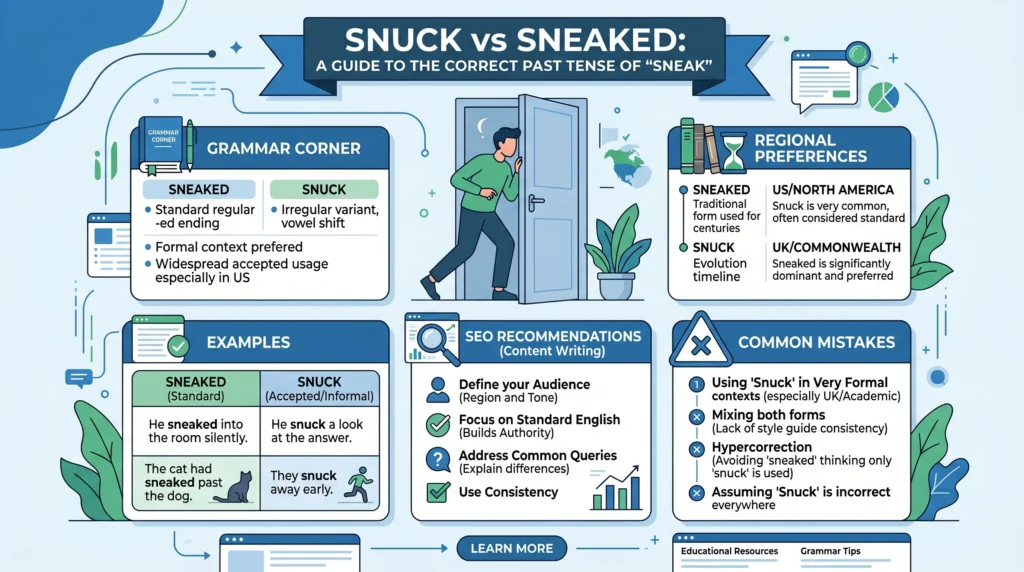
Snuck and sneaked are both correct past tense forms of the verb sneak. However, snuck is more common in American English, while sneaked is often preferred in formal writing and remains widely used in British English. In modern usage, both spellings are accepted, but snuck has become increasingly popular in everyday conversation and online content.
The debate over snuck or sneaked has existed for decades among writers, teachers, editors, and English learners.
Unlike many grammar questions where one answer is clearly wrong, this is a case where both forms are accepted by major dictionaries and style guides.
Consider these examples:
- He snuck out of the house at midnight.
- He sneaked out of the house at midnight.
Both sentences are grammatically correct.
The confusion comes from the fact that sneaked is the original past tense form, while snuck developed later through common spoken usage.
Today, both words are widely recognized. However, regional preferences and writing styles often influence which version people choose.
This guide explains:
- Definitions
- Historical background
- Grammar rules
- Regional differences
- Examples
- Common mistakes
- SEO recommendations
- FAQs
Quick Answer
| Word | Correct? | Common Usage |
|---|---|---|
| Snuck | Yes | Informal and American English |
| Sneaked | Yes | Traditional and Formal English |
Simple Summary
Both forms are correct. Snuck is more common in modern American speech, while sneaked is often preferred in formal or traditional writing.
What Does Sneak Mean?
Definition
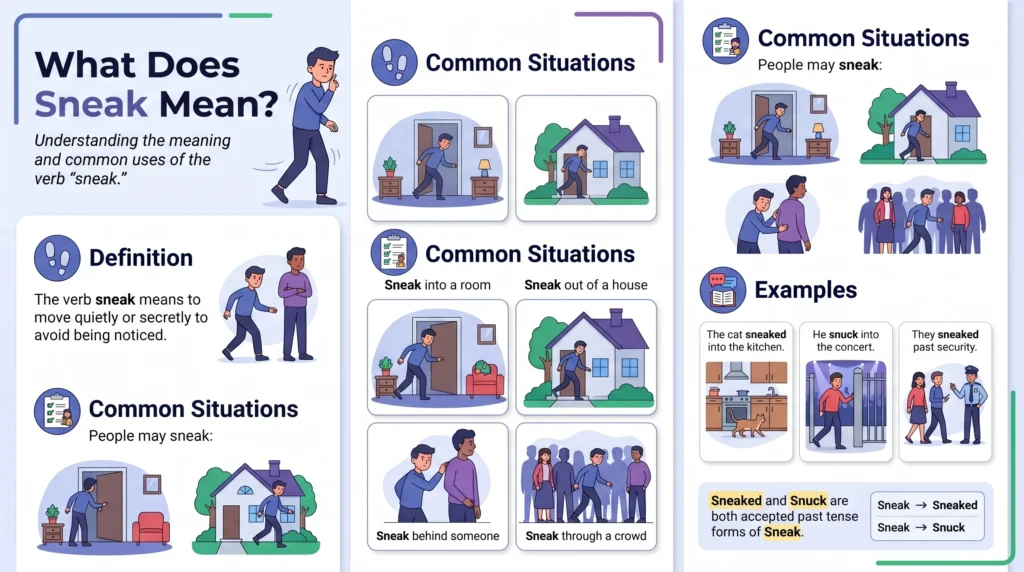
The verb sneak means to move quietly or secretly to avoid being noticed.
Common Situations
People may sneak:
- Into a room
- Out of a house
- Behind someone
- Through a crowd
Examples
- The cat sneaked into the kitchen.
- He snuck into the concert.
- They sneaked past security.
What Does Sneaked Mean?
Definition
Sneaked is the traditional past tense and past participle of sneak.
Historical Usage
Sneaked appeared first in English and was the accepted form for centuries.
Examples
- She sneaked out after dinner.
- They sneaked into the building.
Formal Writing
Many editors still prefer sneaked in highly formal documents.
What Does Snuck Mean?
Definition
Snuck is an alternative past tense form of sneak.
Modern Acceptance
Most dictionaries recognize snuck as standard English.
Examples
- He snuck into the theater.
- The dog snuck onto the couch.
Everyday Speech
Snuck is extremely common in casual conversation.
Main Difference Between Snuck or Sneaked
Meaning
Snuck
Past tense of sneak.
Sneaked
Past tense of sneak.
Grammar
Both forms are grammatically correct.
Usage Preference
Snuck
More common in American English.
Sneaked
More common in formal and traditional writing.
Comparison Table
| Feature | Snuck | Sneaked |
|---|---|---|
| Correct Grammar | Yes | Yes |
| American English | Very Common | Common |
| British English | Less Common | More Common |
| Formal Writing | Accepted | Often Preferred |
| Informal Speech | Very Common | Common |
| Meaning | Same | Same |
Why Two Past Tense Forms Exist
Language Evolution
English often develops alternative verb forms through everyday speech.
Similar Patterns
Other verbs have evolved in similar ways.
Examples:
- Dive → Dove
- Sneak → Snuck
Popular Usage
As more people used snuck, dictionaries eventually accepted it.
Modern Recognition
Today, both forms appear in major dictionaries.
Snuck in American English
Everyday Conversation
Most Americans frequently use snuck.
Television and Movies
Characters often say snuck in dialogue.
News and Media
Many publications accept snuck.
Online Content
Snuck is very common in blogs and articles.
Sneaked in British English
Traditional Preference
British English often favors sneaked.
Formal Writing
Some editors consider sneaked slightly more formal.
Academic Contexts
Sneaked may appear more often in scholarly writing.
Publishing Standards
Certain publishers still prefer sneaked.
Which Form Is More Common Today?
Spoken English
Snuck dominates casual conversation in the United States.
Written English
Both forms appear regularly.
Search Trends
Snuck often receives more search interest.
Modern Style Guides
Many style guides accept either version.
Common Examples of Snuck
Home
- The children snuck downstairs.
School
- He snuck a note to his friend.
Travel
- We snuck into the event.
Sports
- The player snuck past defenders.
Common Examples of Sneaked
Workplace
- She sneaked into the office early.
Family Life
- The dog sneaked into the bedroom.
Education
- Students sneaked extra snacks into class.
Literature
- The character sneaked through the castle.
Common Mistakes People Make
Thinking Snuck Is Incorrect
Modern dictionaries accept snuck.
Assuming Sneaked Is Outdated
Sneaked remains widely used and correct.
Mixing Writing Styles
Choose one form and remain consistent.
Following Outdated Grammar Rules
Some older grammar books rejected snuck, but modern usage accepts it.
Which Version Is Better for SEO?
Search Popularity
Snuck often attracts more searches due to everyday usage.
Reader Expectations
Many readers naturally recognize snuck.
Content Strategy
Mention both forms to capture broader search intent.
Recommendation
Use snuck as the primary keyword while explaining sneaked as an equally correct alternative.
Real World Examples
Family Stories
- The kids snuck cookies before dinner.
Crime Fiction
- The suspect sneaked through the alley.
Movie Dialogue
- He snuck into the building unnoticed.
News Reports
- Protesters sneaked past barriers.
How to Choose the Correct Form
Use Snuck If
- Writing conversational content
- Targeting American audiences
- Creating modern web content
Use Sneaked If
- Following traditional style guides
- Writing highly formal documents
- Targeting readers who prefer conventional grammar
When Unsure
Both forms are acceptable in modern English.
Related Word Comparisons
Dove or Dived
Another example of competing past tense forms.
Dreamed or Dreamt
Both accepted in English.
Learned or Learnt
Regional differences influence preference.
Snuck or Sneaked
Both forms are correct and widely recognized.
Exercises With Answers
Exercise 1
Which form is more common in American speech?
Answer: Snuck
Exercise 2
Is sneaked grammatically correct?
Answer: Yes
Exercise 3
Do snuck and sneaked have different meanings?
Answer: No
Exercise 4
Which form existed first historically?
Answer: Sneaked
Exercise 5
Can both forms be used in modern writing?
Answer: Yes
FAQs
Is it snuck or sneaked?
Both are correct past tense forms of sneak.
Which is more common in American English?
Snuck is generally more common.
Which is more formal, snuck or sneaked?
Sneaked is often considered slightly more formal.
Is snuck grammatically correct?
Yes. Major dictionaries recognize it as standard English.
Did sneaked come before snuck?
Yes. Sneaked is the older historical form.
Which form should students use?
Students should follow their teacher’s or style guide’s preference.
Do dictionaries accept both forms?
Yes. Modern dictionaries list both.
Which spelling is better for SEO in 2026?
Snuck generally receives more interest due to common usage.
Can I use snuck in professional writing?
Yes. Most modern editors accept it.
Do British writers prefer sneaked?
Generally, yes, although snuck is becoming more common globally.
Conclusion
The debate between snuck or sneaked is one of the few grammar questions where both answers are correct.
Key points include:
- Both are accepted past tense forms of sneak.
- Sneaked is the original historical form.
- Snuck is more common in modern American English.
- Sneaked often appears in formal or traditional writing.
- Neither form is grammatically wrong.
For most blogs, websites, and SEO-focused content in 2026, snuck is often the preferred choice because it reflects modern usage and matches common search behavior. However, sneaked remains perfectly acceptable and continues to appear in professional writing around the world.

Justin Powell is a writer at GramBrix.com who focuses on grammar, clarity and effective communication, helping readers strengthen their language skills.