
Last Updated on August 16, 2026
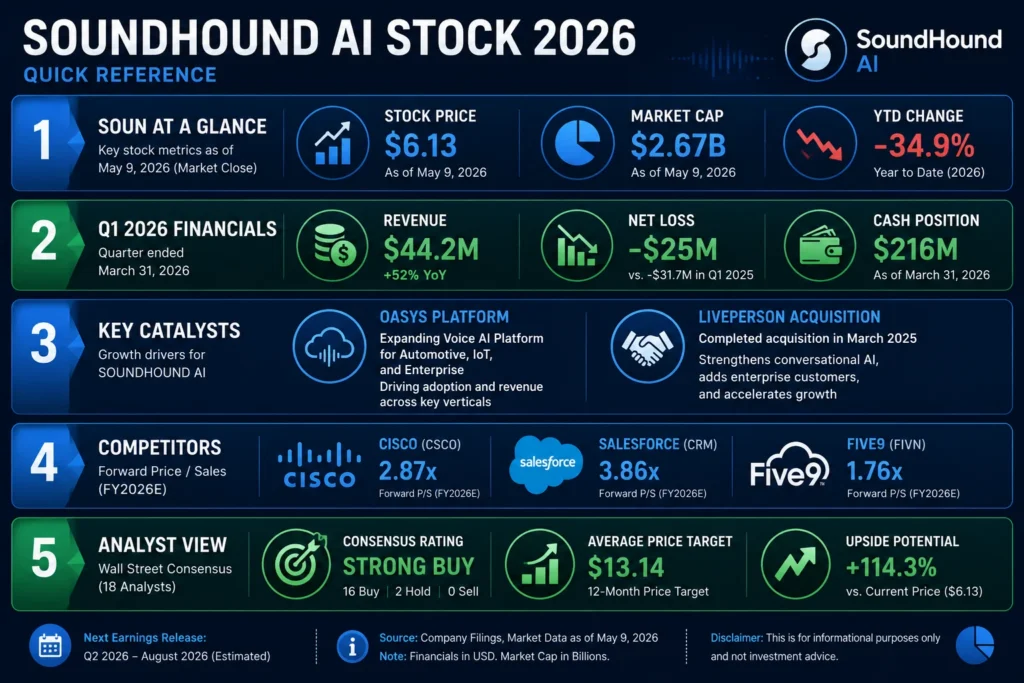
SoundHound AI (SOUN) is an enterprise voice AI company that has seen its stock drop 70% from its 52-week high of $22.17 to around $6.13. The company reported Q1 2026 revenue of $44.2 million, up 52% year-over-year, but posted a net loss of $25 million. It’s acquiring LivePerson for $43 million to expand its enterprise reach, projecting a combined 2027 revenue of $350-$400 million. However, profitability remains elusive with declining gross margins (31.1% from 36.5%) and widening operating cash burn (-$26 million). Analysts maintain a Strong Buy consensus with a $13.14 price target, but Zacks rates the stock a Sell. The company faces fierce competition from Cisco, Salesforce, Five9, and Alphabet, all of which trade at lower revenue multiples. With revenue growth projected to slow from 52% to 38% in 2026 and losses persisting through 2027, investors should weigh the company’s strong enterprise AI momentum against its uncertain path to profitability.
What Is SoundHound AI?
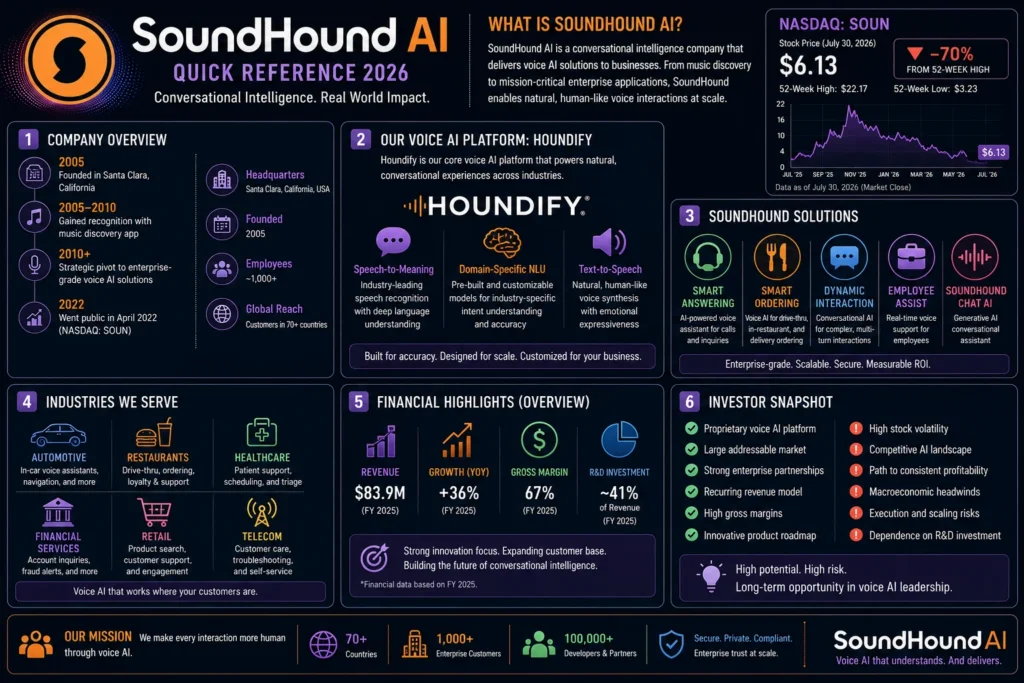
SoundHound AI (NASDAQ: SOUN) is a conversational intelligence company that provides independent voice AI solutions to businesses across automotive, restaurants, healthcare, financial services, retail, and telecommunications. Founded in 2005 and headquartered in Santa Clara, California, the company initially gained recognition with its music discovery app before pivoting to enterprise-grade voice AI solutions.
The company’s core offering is the Houndify voice AI platform, which provides customizable speech-to-meaning technology, domain-specific natural language understanding, and text-to-speech capabilities. Today, SoundHound’s broader portfolio spans Smart Answering, Smart Ordering, Dynamic Interaction, Employee Assist, and SoundHound Chat AI.
SoundHound went public in April 2022 and has since become one of the more volatile stocks in the AI sector. The stock briefly fell below $1 per share soon after its IPO before surging past $20 twice since late 2024. Today, it trades around $6.13, down approximately 70% from its 52-week high of $22.17.
SoundHound AI Stock Performance: The Numbers
Current Price and Key Metrics
As of July 31, 2026, SoundHound AI stock (SOUN) trades at approximately $6.13 per share. Here’s where things stand:
| Metric | Value |
|---|---|
| Current Price | $6.13 |
| 52-Week High | $22.17 |
| 52-Week Low | $5.65 |
| Market Cap | ~$2.67 billion |
| YTD Performance | -34.9% |
| Beta | 2.81 |
| Shares Outstanding | 435.67 million |
Stock Price History
SoundHound’s stock has been on a roller-coaster ride. It surged past $20 per share twice since late 2024, only to suffer massive pullbacks each time. The stock’s 52-week high of $22.17 came in late December 2024, and shares have been on a downward march since.
Key technical indicators:
- 50-day moving average: ~$7.06
- 200-day moving average: ~$9.60
- Short interest: 42.35% of float, 169.19 million shares
The high short interest suggests many investors are betting against the stock, reflecting skepticism about the company’s path to profitability.
Analyst Ratings and Price Targets
Despite the stock’s decline, analysts remain surprisingly bullish on SOUN.
| Metric | Value |
|---|---|
| Analyst Consensus | Strong Buy |
| Average Price Target | $13.14 |
| Potential Upside | ~114% |
Seven analysts cover the stock, with 85.7% rating it Strong Buy and 14.3% rating it Hold. However, this optimistic outlook contrasts with the stock’s Zacks Rank #4 (Sell) and poor scores across valuation metrics.
SoundHound AI Financials: Revenue Growth vs. Persistent Losses
Revenue Performance
SoundHound continues to deliver strong top-line growth. The story is straightforward: revenue is growing fast, but the company still can’t turn a profit.
2025 full-year performance:
- Revenue: $168.9 million, up 99% year-over-year
- Net loss: -$14.01 million
Q1 2026 performance:
- Revenue: $44.2 million, up 52% year-over-year
- Excluding acquisitions, core automotive and IoT AI business grew 88%
- GAAP gross margin: 31.1%, down from 36.5% a year earlier
- GAAP net loss: -$25.0 million (-$0.06 per share)
- Adjusted EBITDA loss: -$26.7 million
Profitability Concerns
Here’s where the story gets concerning. Despite revenue growth, SoundHound’s losses are widening.
| Metric | Q1 2026 | Q1 2025 |
|---|---|---|
| Revenue | $44.2M | $29.1M |
| GAAP Gross Margin | 31.1% | 36.5% |
| GAAP Net Loss | -$25.0M | +$129.9M (profit) |
| Operating Cash Flow | -$26M | -$19M |
Operating margin history:
| Date | Operating Margin |
|---|---|
| Q1 2026 | -94.57% |
| Q4 2025 | -13.61% |
| Q3 2025 | -216.78% |
| Q4 2024 | -402.35% |
| Q4 2023 | -147.83% |
The Q4 2025 operating margin improvement to -13.61% was a positive sign, but Q1 2026 reversed that progress. Management attributes the margin decline partly to nonrecurring vendor-related costs and investments in the OASYS platform.
Cash Position and Burn
SoundHound ended Q1 2026 with approximately $216 million in cash and equivalents and no debt. However, cash burn increased:
- Operating cash flow (Q1 2026): -$26 million (vs. -$19 million in Q1 2025)
- Trailing twelve-month operating cash flow: -$105.3 million
The company’s cash position is strong for now, but continued burn could eventually require additional financing if profitability takes longer than expected.
Full-Year 2026 Outlook
SoundHound reaffirmed its full-year 2026 revenue outlook of $225 million to $260 million. Analysts project:
- Revenue growth of roughly 38% in 2026
- Revenue growth of about 15.8% in 2027
- 2026 EPS: loss of $0.18 per share
- 2027 EPS: loss of $0.17 per share
The LivePerson Acquisition: Game Changer or Distraction?
What Is LivePerson?
LivePerson is a digital messaging and conversational AI company serving enterprise and mid-market customers. The acquisition, announced in May 2026, is valued at an equity value of $43 million.
Key details:
- LivePerson reported revenue of more than $243 million in 2025
- LivePerson also reported a net loss of more than $67 million
- The deal is expected to close in the second half of 2026
What SoundHound Expects
SoundHound management described the acquisition as a “transformational turnaround opportunity.” Here’s what they project:
| Metric | Projection |
|---|---|
| 2027 Revenue (combined) | $350-$400 million |
| LivePerson contribution (2027) | $100 million from long-tenured customers |
| Long-term opportunity | $500 million from existing customer base alone |
| Customer reach | 25 Fortune 100 companies, operations in 30+ countries |
Combined customer base includes:
- 12 of the top 15 global banks
- 4 of the top 5 global airlines
- 4 of the top 5 global automakers
- 10 major telecommunications providers
Integration Risks
Not everyone is convinced the acquisition makes sense. Key concerns include:
Integration risk: Successfully integrating LivePerson into SoundHound’s operations will take time and resources. If integration goes poorly, the deal could become a drag on both companies’ performance.
Financial strain: Both companies are losing money. Combining two unprofitable businesses doesn’t automatically create profitability.
Execution required: Management projects $100 million in growable revenue from LivePerson’s long-tenured customers, but this requires successful cross-selling of SoundHound’s voice AI to LivePerson’s customer base.
Until the deal closes and integration shows results, uncertainty will likely keep the stock trading sideways.
OASYS: SoundHound’s Agentic AI Platform
What Is OASYS?
OASYS (Orchestrated Agent System) is SoundHound’s new self-learning orchestrated agentic AI platform. Launched in 2026, OASYS enables businesses to automatically build, deploy, manage, and continuously improve AI agents across multiple channels.
Key features:
- Build AI agents in minutes using existing documentation and integrations
- Deploy once across phone, text, web chat, kiosks, social media, TVs, and vehicles
- Self-learning capabilities that improve over time
- Reduces implementation time from months to minutes
Why OASYS Matters
OASYS represents a strategic shift from SoundHound being a voice assistant provider to a broader enterprise conversational AI platform. This expands the addressable market significantly.
Customer examples cited by management:
- A Fortune 100 insurance customer achieved more than $10 million in quarterly labor savings
- The customer’s AI served 21+ million customers
- Maintained 96%+ routing accuracy
- Processed 1+ million financial transactions
- Generated $5+ million in savings through enhanced customer self-service
OASYS migration is “the biggest priority for the company,” though management hasn’t provided a specific timeline.
Competitive Landscape: How SoundHound Stacks Up
SoundHound faces intense competition from larger, more profitable players.
| Competitor | Ticker | Key Differentiator | Forward P/S |
|---|---|---|---|
| SoundHound | SOUN | Agentic AI architecture, outcome-based pricing | ~11.1 |
| Cisco | CSCO | Enterprise installed base, Webex AI platform | 6.96 |
| Five9 | FIVN | Cloud contact centers, AI voice bots | 1.49 |
| Salesforce | CRM | Agentforce, CRM integration | 2.92 |
| IBM | IBM | Watson Assistant, regulated industries, enterprise security | — |
| Alphabet | GOOGL | Dialogflow, Google Cloud integration | — |
How competitors performed in 2026:
- Cisco shares: +54.5% YTD
- Five9 shares: +28.8% YTD
- Salesforce shares: -35.3% YTD
- SoundHound shares: -34.9% YTD
The fact that competitors outperformed SoundHound while trading at lower revenue multiples highlights the market’s skepticism about SOUN’s valuation relative to its profitability challenges.
Should You Buy, Hold, or Sell SOUN Stock?
The Bull Case
Strong revenue growth: 52% growth in Q1 2026 with 88% organic growth excluding acquisitions. Revenue nearly doubled in 2025.
Enterprise AI momentum: SoundHound closed more than 100 enterprise deals in Q4 2025 alone across banking, insurance, healthcare, and technology.
OASYS platform: New agentic AI platform reduces implementation time and expands addressable market.
LivePerson acquisition: Could create $500 million revenue opportunity and bring 25 Fortune 100 customers.
No debt: Strong balance sheet with $216 million in cash gives the company runway to execute.
Analyst optimism: Average price target of $13.14 implies 114% upside.
The Bear Case
Persistent losses: Q1 2026 net loss of $25 million and adjusted EBITDA loss of $26.7 million. Analysts project losses through 2027.
Widening cash burn: Operating cash flow worsened to -$26 million from -$19 million a year ago.
Slowing revenue growth: Revenue growth decelerated from 99% in 2025 to 52% in Q1 2026. Analysts project further slowdown to 38% in 2026 and 18% in 2027.
High valuation: Price-to-sales ratio of 13.79 for an unprofitable company. Industry average is 11.52.
Share dilution risk: Shares outstanding up 68% since early 2024. Further dilution likely if losses continue.
Integration risk: LivePerson acquisition adds uncertainty and combines two unprofitable businesses.
Zacks Rank #4 (Sell): Institutional downgrade from Zacks Investment Research.
Frequently Asked Questions
Is SoundHound AI stock a buy right now?
Analysts rate it Strong Buy with a $13.14 price target, but Zacks rates it a Sell. The company has strong revenue growth but persistent losses and negative cash flow. Investors should weigh growth against profitability concerns.
Why is SoundHound AI stock down so much?
The stock is down 70% from its 52-week high due to widening losses, declining gross margins, negative cash flow, slowing revenue growth, and shareholder dilution concerns. The market is now rewarding profitable AI companies over growth-only stories.
What is SoundHound AI’s revenue growth?
Q1 2026 revenue grew 52% year-over-year to $44.2 million. Excluding acquisitions, organic growth was 88% in the core automotive and IoT business. The company projects full-year 2026 revenue of $225-$260 million.
Is SoundHound AI profitable?
No. SoundHound posted a Q1 2026 GAAP net loss of $25 million and adjusted EBITDA loss of $26.7 million. Analysts project losses through at least 2027.
What is the LivePerson acquisition?
SoundHound is acquiring LivePerson, a digital messaging and conversational AI company, for $43 million. The deal is expected to close in H2 2026 and could create a combined 2027 revenue of $350-$400 million.
What is OASYS?
OASYS (Orchestrated Agent System) is SoundHound’s new agentic AI platform that lets businesses build and deploy AI agents in minutes across multiple channels. It’s a key part of the company’s shift toward enterprise conversational AI.
Conclusion
SoundHound AI sits at a crossroads. The company has built a legitimate enterprise AI business with impressive revenue growth, expanding customer diversification, and a compelling product roadmap. OASYS and the LivePerson acquisition could transform the company into a major player in conversational AI.
But the financial reality is sobering. Losses are widening, margins are compressing, and the path to profitability remains unclear. The market has punished the stock for these sins, sending it down 70% from its peak. The question for investors is whether this decline represents a buying opportunity or a value trap.
Our honest recommendation: SoundHound’s long-term story is compelling, but the short-to-medium-term risks are significant. The LivePerson acquisition needs to close successfully and integration needs to go smoothly. OASYS needs to drive meaningful revenue. Margins need to improve. And profitability needs to materialize.
If you’re a high-risk investor with a long time horizon and believe in the enterprise AI thesis, SOUN at $6.13 could be an interesting speculative bet. The analyst consensus suggests significant upside, and the company’s no-debt balance sheet provides runway.
But if you’re risk-averse or need near-term returns, caution is warranted. As Zacks puts it: “Until the company delivers clearer evidence of improving margins and a path toward consistent profitability, existing investors may prefer to remain cautious, while prospective investors may find better risk-reward opportunities elsewhere in the AI software space.”

Kevin Brooks is a grammar specialist at GramBrix.com, dedicated to helping readers understand language rules with clarity and confidence. He simplifies complex grammar concepts through practical examples and easy explanations.