
Last Updated on July 5, 2026
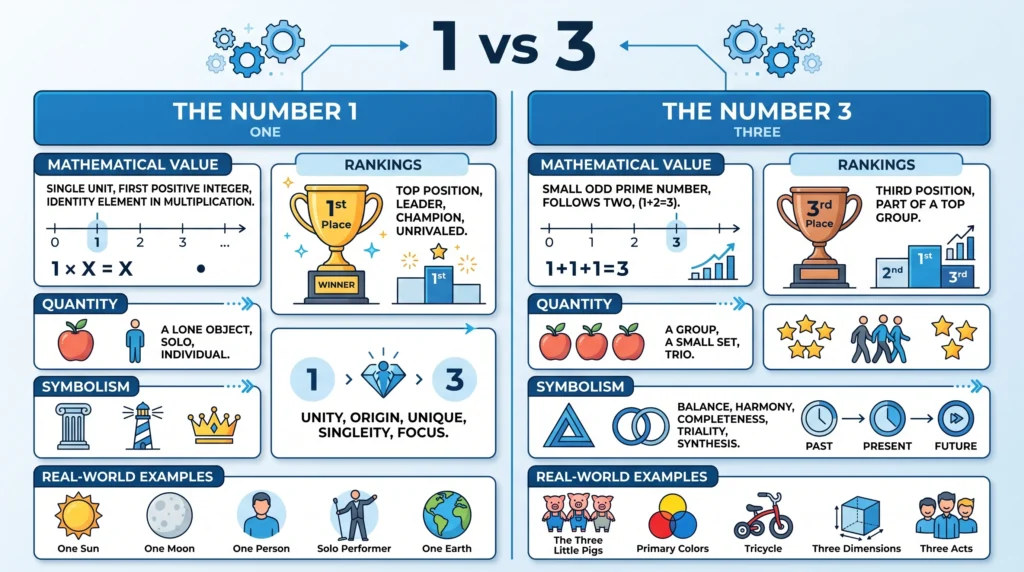
The comparison 1 or 3 can have different meanings depending on the context, including mathematics, rankings, choices, gaming, sports, surveys, and everyday decisions. Generally, 1 represents the first position, highest priority, or smallest whole number, while 3 represents the third position, a larger value, or an alternative option. The better choice depends entirely on the situation and purpose.
At first glance, comparing 1 or 3 may seem simple. They are both numbers, and everyone learns them early in life. However, the meaning of choosing between 1 and 3 can vary greatly depending on the context.
For example:
- In mathematics, 3 is greater than 1.
- In rankings, 1st place is better than 3rd place.
- In surveys, option 1 and option 3 may represent different choices.
- In sports, a team finishing 1st is usually more successful than one finishing 3rd.
Because of these differences, there is no universal answer to the question “1 or 3.”
This guide explains:
- Mathematical differences
- Real-world applications
- Common comparisons
- Advantages and disadvantages
- Ranking systems
- Frequently asked questions
Whether you’re choosing a number, comparing rankings, or trying to understand the significance of these values, this article will help clarify the differences.
Quick Answer
| Comparison | Result |
|---|---|
| Numerical Value | 3 is greater than 1 |
| Ranking Position | 1 is higher than 3 |
| Sequence Order | 1 comes before 3 |
| Quantity | 3 represents more than 1 |
Simple Summary
In mathematics, 3 is larger than 1. In rankings and competitions, 1st place is usually better than 3rd place.
What Does 1 Mean?
Basic Definition
The number 1 is the first positive whole number.
Common Symbolism
The number 1 often represents:
- Leadership
- Beginning
- First place
- Independence
- Priority
Everyday Examples
Examples include:
- 1 winner
- 1st position
- 1 goal
- 1 choice
What Does 3 Mean?
Basic Definition
The number 3 is the third positive whole number.
Common Symbolism
The number 3 often represents:
- Growth
- Balance
- Completion
- Creativity
- Expansion
Everyday Examples
Examples include:
- 3 attempts
- 3 choices
- 3 goals
- 3 team members
Main Difference Between 1 or 3
Numerical Value
1
Represents a smaller quantity.
3
Represents a larger quantity.
Ranking
1st Place
Usually represents the highest achievement.
3rd Place
Usually represents third-best performance.
Order
1
Comes first.
3
Comes after 1 and 2.
Mathematical Comparison
Greater Than and Less Than
Mathematically:
3 > 1
1 < 3
Number Line Example
On a number line:
1 appears before 3.
3 is farther from zero than 1.
Addition Example
1 + 3 = 4
Both numbers are basic building blocks of arithmetic.
Comparison Table
| Feature | 1 | 3 |
|---|---|---|
| Numerical Value | Smaller | Larger |
| Position | First | Third |
| Quantity | Less | More |
| Ranking Advantage | Higher | Lower |
| Symbolism | Leadership | Growth |
Real World Examples
Sports Competition
If a team finishes:
- 1st place = Champion
- 3rd place = Bronze medal or third ranking
In this context, 1 is generally preferred.
Product Choices
A survey may ask users to select:
- Option 1
- Option 2
- Option 3
The best choice depends on the available options.
Classroom Ranking
Students may finish:
- 1st in class
- 3rd in class
Both are impressive, but 1st ranks higher.
Advantages of Choosing 1
Simplicity
One is easy to understand and manage.
Top Ranking
In competitions, 1st place is typically the goal.
Clear Focus
A single choice often reduces complexity.
Symbol of Leadership
Many cultures associate 1 with success and achievement.
Advantages of Choosing 3
More Quantity
Three provides more than one.
More Flexibility
Three options may offer greater variety.
Balanced Structure
Many systems use groups of three for organization.
Popular Number
Three is frequently viewed as a balanced and memorable number.
Contexts Where 1 Is Better
Competition
Winning first place.
Priority Lists
The highest priority item.
Rankings
Top-rated selection.
Leadership Roles
Being number one in a group.
Contexts Where 3 Is Better
Quantity
When more items are beneficial.
Team Structure
Three people may handle more work than one.
Options and Choices
Three choices provide more flexibility.
Productivity
Multiple resources can improve efficiency.
Common Mistakes People Make
Assuming Bigger Is Always Better
Three is larger, but larger does not always mean better.
Ignoring Context
Rankings and quantities are different comparisons.
Confusing Position With Value
1st place is better than 3rd place, even though 3 is numerically larger.
Using Numbers Without Clear Meaning
Always understand what the numbers represent.
Symbolism of 1 and 3
Meaning of 1
Often associated with:
- Leadership
- Independence
- Achievement
Meaning of 3
Often associated with:
- Creativity
- Balance
- Communication
Cultural Significance
Both numbers appear frequently in:
- Literature
- Religion
- Sports
- Business
Related Number Comparisons
1 or 2
Compares first and second positions.
2 or 3
Focuses on middle rankings.
1 or 10
Compares very different values.
Exercises With Answers
Exercise 1
Which number is larger?
1 or 3
Answer: 3
Exercise 2
Which ranking is higher?
1st or 3rd
Answer: 1st
Exercise 3
Which number comes first?
1 or 3
Answer: 1
Exercise 4
Which quantity is greater?
1 item or 3 items
Answer: 3 items
Exercise 5
Which position usually wins a competition?
1st or 3rd
Answer: 1st
FAQs
Is 1 or 3 bigger?
Three is numerically larger than one.
Is 1st place better than 3rd place?
Yes. In most competitions, 1st place ranks higher.
Does 3 always mean better?
No. The answer depends on the context.
Which number comes first?
One comes before three.
What does the number 1 symbolize?
It often symbolizes leadership, achievement, and independence.
What does the number 3 symbolize?
It is often associated with growth, creativity, and balance.
Is 3 greater than 1 in math?
Yes. Three is greater than one.
Why is 1 considered important?
It represents the starting point and often the highest ranking position.
Can 3 be better than 1?
Yes, when quantity, flexibility, or multiple options are important.
How do I choose between 1 or 3?
Consider the context. Rankings favor 1, while quantity often favors 3.
Conclusion
The comparison between 1 or 3 depends entirely on what you’re measuring.
If you’re talking about:
- Mathematical value → 3 is greater than 1.
- Rankings → 1st place is better than 3rd place.
- Quantity → 3 provides more than 1.
- Leadership → 1 is often associated with being the best.
- Flexibility → 3 may offer more options.
Neither number is universally better. The correct choice depends on your goals, context, and interpretation of the numbers.
Understanding this distinction helps avoid confusion and allows you to make better decisions when comparing values, rankings, choices, and outcomes.

Victoria Lane is a grammar-focused writer at GramBrix.com, passionate about helping readers master the rules of language. She provides clear explanations and practical examples that make writing more accurate, polished and confident.