Last Updated on June 17, 2026
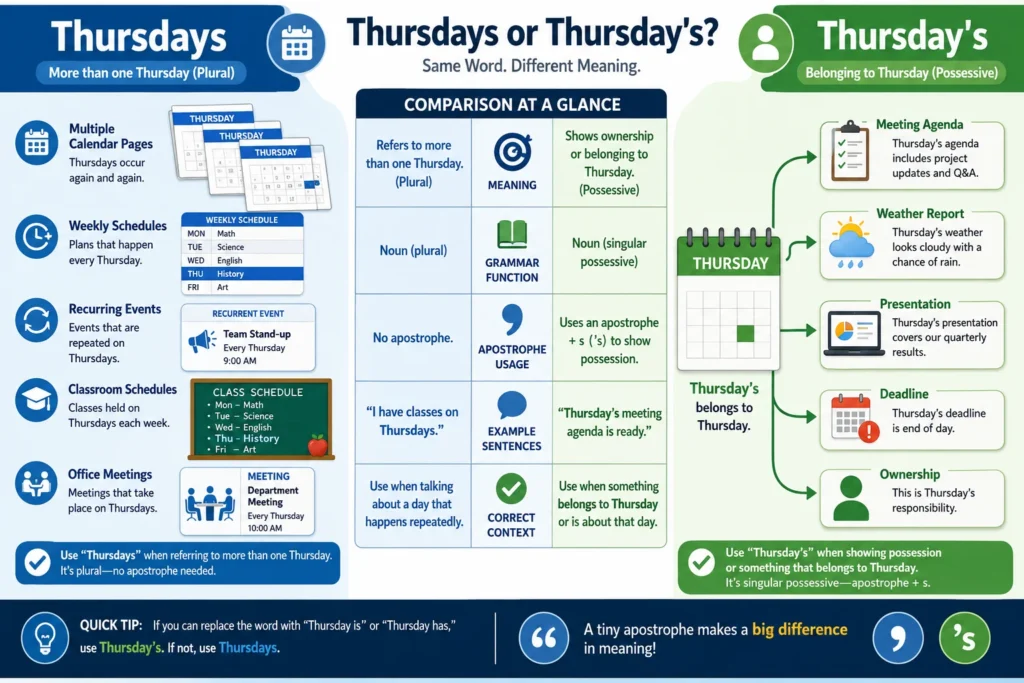
“Thursdays” is the plural form of Thursday and refers to more than one Thursday. “Thursday’s” is the possessive form and shows that something belongs to or is connected with Thursday. Understanding the difference between Thursdays or Thursday’s helps you avoid one of the most common punctuation mistakes in English writing.
Many people get confused when writing thursdays or thursday’s. At first glance, the words look almost the same. The only difference is a small apostrophe. Yet that tiny mark changes the meaning completely.
English grammar can be tricky. Apostrophes are one of the most common causes of mistakes in emails, school assignments, business reports, blog posts, and social media content. Many writers are unsure when to use a plural noun and when to use a possessive noun.
The confusion becomes even greater with days of the week. Should you write every Thursdays? Is it Thursday’s meeting or Thursdays meeting? What about on Thursdays?
This guide explains everything you need to know about thursdays or thursday’s. You will learn the meanings, grammar rules, examples, common mistakes, regional usage patterns, and practical exercises. By the end of this article, you will be able to use both forms confidently in everyday writing.
Quick Answer
The difference between thursdays or thursday’s is simple:
| Word | Meaning | Example |
|---|---|---|
| Thursdays | Plural form of Thursday | We meet on Thursdays. |
| Thursday’s | Possessive form of Thursday | Thursday’s meeting was canceled. |
Easy Rule
Use Thursdays when talking about more than one Thursday.
Use Thursday’s when something belongs to, happens on, or is associated with Thursday.
Examples
Correct:
- The gym offers discounts on Thursdays.
- Thursday’s presentation lasted two hours.
- We usually have classes on Thursdays.
- Thursday’s weather forecast predicts rain.
Incorrect:
- We meet every Thursday’s.
- The store closes on Thursday’s.
In these cases, the plural form Thursdays is needed because no ownership is being shown.
What Does “Thursdays” Mean?
Thursdays is simply the plural version of Thursday.
It refers to multiple Thursdays rather than one specific Thursday.
Examples
- We play soccer on Thursdays.
- Most meetings are scheduled on Thursdays.
- The restaurant offers special menus on Thursdays.
- I attend language classes every Thursdays afternoon.
A more grammatically polished version of the last sentence would be:
- I attend language classes every Thursday afternoon.
- I attend language classes on Thursdays.
When to Use Thursdays
Use Thursdays when discussing:
- Recurring events
- Weekly schedules
- Habits
- Multiple Thursdays over time
Example Sentences
- Sales increase on Thursdays.
- Schools often hold assemblies on Thursdays.
- We visit our grandparents on Thursdays.
- Online workshops take place on Thursdays.
Think of Thursdays as meaning “many Thursdays.”
What Does “Thursday’s” Mean?
Thursday’s is the singular possessive form of Thursday.
The apostrophe shows possession, ownership, association, or connection.
Examples
- Thursday’s meeting was productive.
- Thursday’s weather was sunny.
- Thursday’s newspaper featured a special report.
- Thursday’s game attracted many fans.
In each sentence, something is connected to a specific Thursday.
Understanding Possession
Possession does not always mean ownership.
For example:
- Thursday’s forecast
- Thursday’s schedule
- Thursday’s event
The forecast, schedule, and event do not belong to Thursday in a literal sense. Instead, they are associated with that particular day.
Simple Formula
Thursday + apostrophe + s = something related to Thursday
Examples:
- Thursday’s meeting
- Thursday’s deadline
- Thursday’s report
- Thursday’s announcement
Why People Confuse Thursdays and Thursday’s
Several factors cause confusion.
Apostrophe Misuse
Many people mistakenly believe that adding an apostrophe automatically creates a plural word.
This is incorrect.
For example:
| Incorrect Plural | Correct Plural |
|---|---|
| Apple’s | Apples |
| Car’s | Cars |
| Thursday’s | Thursdays |
Apostrophes generally do not make words plural.
Similar Pronunciation
Both words sound almost identical when spoken.
Because there is little difference in pronunciation, writers often choose the wrong spelling.
Autocorrect Issues
Word processors and phone keyboards sometimes suggest possessive forms automatically, leading to mistakes.
Lack of Grammar Practice
Many people learned apostrophe rules years ago and rarely review them.
Grammar Rules Behind Thursdays and Thursday’s
Understanding the grammar makes the distinction much easier.
Rule for Plurals
Most English nouns become plural by adding s.
Examples:
| Singular | Plural |
|---|---|
| Monday | Mondays |
| Tuesday | Tuesdays |
| Wednesday | Wednesdays |
| Thursday | Thursdays |
| Friday | Fridays |
Therefore:
- One Thursday
- Many Thursdays
Rule for Possessives
To show possession with a singular noun, add apostrophe + s.
Examples:
| Noun | Possessive |
|---|---|
| Teacher | Teacher’s |
| Student | Student’s |
| Thursday | Thursday’s |
Therefore:
- Thursday’s meeting
- Thursday’s weather
- Thursday’s agenda
Thursdays vs Thursday’s Comparison Table
| Feature | Thursdays | Thursday’s |
|---|---|---|
| Part of Speech | Plural noun | Possessive noun |
| Apostrophe | No | Yes |
| Meaning | More than one Thursday | Something connected to Thursday |
| Example | Classes are on Thursdays. | Thursday’s class was canceled. |
| Indicates Ownership | No | Yes or association |
| Common Use | Weekly schedules | Specific events |
Real World Examples of Thursdays and Thursday’s
Workplace Communication
Correct:
- Team meetings are held on Thursdays.
- Thursday’s meeting covered the new project.
School Environment
Correct:
- Students attend labs on Thursdays.
- Thursday’s science lesson focused on astronomy.
Sports
Correct:
- Practices occur on Thursdays.
- Thursday’s game ended in a draw.
News Reporting
Correct:
- Markets are closed on certain Thursdays.
- Thursday’s report highlighted economic growth.
Social Media
Correct:
- We post tips every Thursdays morning.
- Thursday’s featured post gained thousands of views.
A more natural version would be:
- We post tips on Thursdays morning.
- We post tips every Thursday morning.
Regional and Global Usage
The distinction between thursdays or thursday’s remains the same across major English-speaking countries.
American English
Examples:
- Meetings are on Thursdays.
- Thursday’s event starts at noon.
British English
Examples:
- Training sessions are held on Thursdays.
- Thursday’s match was exciting.
Canadian English
Examples:
- The course runs on Thursdays.
- Thursday’s lecture was informative.
Australian English
Examples:
- Classes take place on Thursdays.
- Thursday’s weather was warm.
The grammar rule does not change based on region.
Common Mistakes and How to Fix Them
Mistake 1
Incorrect:
- We work every Thursday’s.
Correct:
- We work every Thursday.
- We work on Thursdays.
Mistake 2
Incorrect:
- The office closes on Thursday’s.
Correct:
- The office closes on Thursdays.
Mistake 3
Incorrect:
- Thursdays meeting starts at 10 AM.
Correct:
- Thursday’s meeting starts at 10 AM.
Mistake 4
Incorrect:
- We enjoy Thursday’s because they are less busy.
Correct:
- We enjoy Thursdays because they are less busy.
Mistake 5
Incorrect:
- The team discusses reports during Thursday’s.
Correct:
- The team discusses reports during Thursdays meetings.
- The team discusses reports on Thursdays.
How to Remember the Difference
A simple memory trick can help.
Think About Ownership
Ask yourself:
Does something belong to Thursday?
If yes, use Thursday’s.
Example:
- Thursday’s presentation
The presentation is connected to Thursday.
Think About Quantity
Ask yourself:
Am I talking about multiple Thursdays?
If yes, use Thursdays.
Example:
- We meet on Thursdays.
Many Thursdays are involved.
Quick Memory Formula
- Many Thursdays = Thursdays
- Something from Thursday = Thursday’s
Related Concepts and Comparisons
The same rule applies to all days of the week.
Mondays vs Monday’s
| Correct Usage | Example |
|---|---|
| Mondays | We meet on Mondays. |
| Monday’s | Monday’s meeting was canceled. |
Tuesdays vs Tuesday’s
| Correct Usage | Example |
|---|---|
| Tuesdays | Classes are on Tuesdays. |
| Tuesday’s | Tuesday’s lecture was interesting. |
Wednesdays vs Wednesday’s
| Correct Usage | Example |
|---|---|
| Wednesdays | We train on Wednesdays. |
| Wednesday’s | Wednesday’s session lasted three hours. |
Fridays vs Friday’s
| Correct Usage | Example |
|---|---|
| Fridays | Employees work remotely on Fridays. |
| Friday’s | Friday’s presentation impressed everyone. |
Understanding one day makes all the others easy.
Advanced Grammar Notes
Singular Possessive
Most style guides accept:
- Thursday’s schedule
- Thursday’s event
Plural Possessive
Sometimes multiple Thursdays share ownership.
Example:
- The last three Thursdays’ attendance records were reviewed.
Here:
- Thursdays = plural
- Apostrophe after s = plural possessive
This form is less common but grammatically correct.
Comparison
| Form | Meaning |
|---|---|
| Thursday | One day |
| Thursdays | More than one Thursday |
| Thursday’s | Possessive singular |
| Thursdays’ | Possessive plural |
Examples in Professional Writing
Business Email
Correct:
- Please review Thursday’s agenda before the meeting.
- Training sessions occur on Thursdays.
Academic Writing
Correct:
- Seminars are conducted on Thursdays.
- Thursday’s lecture introduced key concepts.
Marketing Content
Correct:
- New offers appear on Thursdays.
- Thursday’s promotion generated strong engagement.
Journalism
Correct:
- Markets remained stable on Thursdays throughout the quarter.
- Thursday’s announcement affected stock prices.
Exercises With Answers
Exercise 1
Choose the correct form.
- We meet every (Thursdays / Thursday’s).
- (Thursdays / Thursday’s) conference was successful.
- The gym is crowded on (Thursdays / Thursday’s).
- (Thursdays / Thursday’s) forecast predicts sunshine.
- Sales increase on (Thursdays / Thursday’s).
Answers
- Thursdays
- Thursday’s
- Thursdays
- Thursday’s
- Thursdays
Exercise 2
Correct the mistakes.
- The office closes on Thursday’s.
- Thursdays meeting begins at nine.
- We exercise every Thursday’s.
- Thursdays schedule changed.
- The store is busy on Thursday’s afternoons.
Answers
- The office closes on Thursdays.
- Thursday’s meeting begins at nine.
- We exercise every Thursday.
- Thursday’s schedule changed.
- The store is busy on Thursdays afternoons.
Exercise 3
Fill in the blank.
- ______ report was submitted yesterday.
- We attend workshops on ______.
- ______ weather was unusually warm.
- Most sales happen on ______.
- ______ presentation impressed the audience.
Answers
- Thursday’s
- Thursdays
- Thursday’s
- Thursdays
- Thursday’s
Practical Writing Scenarios
Scenario 1
Sentence:
“The team gathers on _____.”
Answer:
Thursdays
Reason:
Multiple Thursdays are being discussed.
Scenario 2
Sentence:
“_____ training session was extended.”
Answer:
Thursday’s
Reason:
The training session belongs to a particular Thursday.
Scenario 3
Sentence:
“We usually publish articles on _____.”
Answer:
Thursdays
Reason:
A recurring weekly schedule.
Scenario 4
Sentence:
“_____ deadline cannot be moved.”
Answer:
Thursday’s
Reason:
A specific deadline associated with Thursday.
FAQs
What is the difference between Thursdays and Thursday’s?
Thursdays is the plural form of Thursday, while Thursday’s is the possessive form showing something related to Thursday.
When should I use Thursdays?
Use Thursdays when referring to multiple Thursdays or recurring events that happen on that day.
When should I use Thursday’s?
Use Thursday’s when something belongs to or is associated with a specific Thursday.
Is Thursdays grammatically correct?
Yes. Thursdays is the correct plural form of Thursday.
Is Thursday’s meeting correct?
Yes. Thursday’s meeting correctly shows that the meeting is connected to Thursday.
Why do people confuse Thursdays or Thursday’s?
People often misuse apostrophes and mistakenly believe they create plural nouns.
Can I write every Thursday’s?
No. Use every Thursday or on Thursdays instead.
What does Thursday’s schedule mean?
It means the schedule associated with a particular Thursday.
What is the plural possessive form of Thursday?
The plural possessive form is Thursdays’, though it is used less frequently.
Are the rules different in American and British English?
No. The grammar rules for thursdays or thursday’s are the same in American, British, Canadian, and Australian English.
How can I remember the difference quickly?
Remember this rule:
- Many Thursdays = Thursdays
- Something connected to Thursday = Thursday’s
Conclusion
Understanding the difference between thursdays or thursday’s is easier than it first appears. The key is knowing whether you are talking about multiple Thursdays or showing possession.
Use Thursdays when referring to recurring events, schedules, habits, or more than one Thursday. Examples include meetings on Thursdays, classes on Thursdays, and promotions on Thursdays.
Use Thursday’s when describing something connected to a specific Thursday. Examples include Thursday’s meeting, Thursday’s weather, Thursday’s report, and Thursday’s deadline.
A simple test can help. Ask yourself whether you mean “many Thursdays” or “something belonging to Thursday.” If you mean quantity, use Thursdays. If you mean possession or association, use Thursday’s.
Mastering this small grammar rule improves professional writing, academic work, emails, blog posts, and everyday communication. With regular practice and attention to apostrophe usage, you can avoid one of the most common English grammar mistakes and write with greater confidence and accuracy.

Kevin Brooks is a grammar specialist at GramBrix.com, dedicated to helping readers understand language rules with clarity and confidence. He simplifies complex grammar concepts through practical examples and easy explanations.