
Last Updated on July 17, 2026
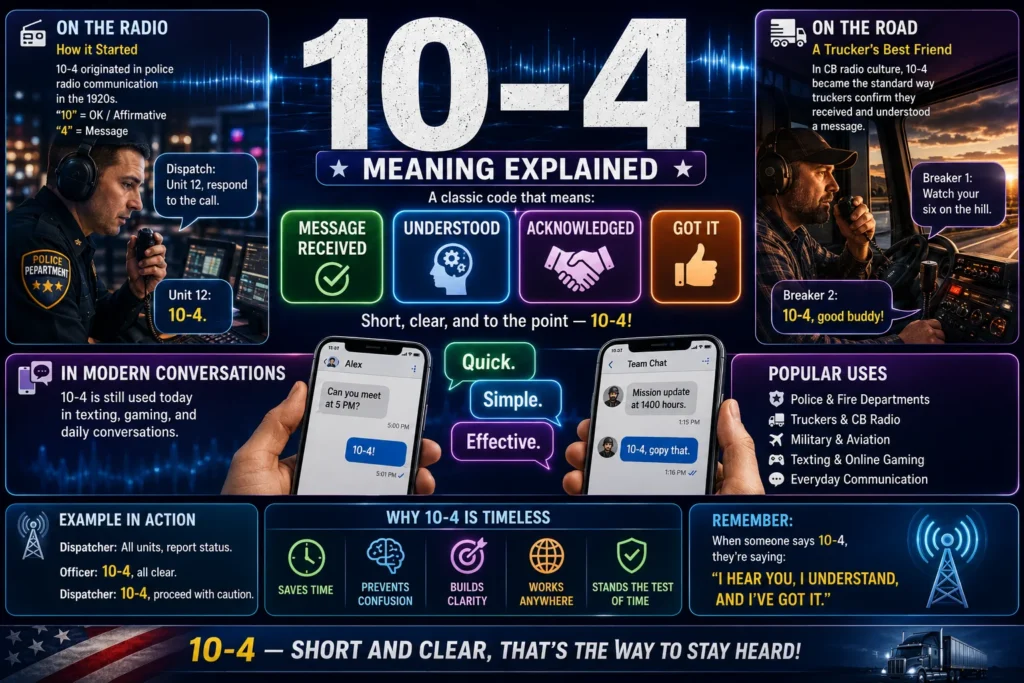
10-4 means “message received,” “understood,” or “okay.” It originated from police and CB radio communication codes. Today, people use it in conversations, texts, online chats, and workplace communication to confirm they understood a message.
If you’ve ever watched a police drama, listened to trucker radio chatter, or heard someone casually say “10-4,” you may have wondered what it actually means.
The phrase 10-4 is one of the most recognized communication codes in American culture. Although it began in professional radio communication, it has expanded into everyday speech. Today, people use it to acknowledge instructions, confirm understanding, or simply say “got it.”
However, many people know the phrase without understanding its history, proper usage, or different meanings in modern contexts.
In this guide, you’ll learn the complete 10-4 meaning, where it came from, how people use it today, examples from real conversations, platform-specific uses, related terms, common misunderstandings, and much more.
Quick Answer Box
| Category | Explanation |
|---|---|
| Meaning | Message received and understood |
| Context | Radio communication, texting, conversations |
| Usage | Acknowledging information |
| Common Platforms | Text messages, WhatsApp, Facebook, Discord, workplace chats |
| Example | “Meet me at 3 PM.” → “10-4.” |
| Tone | Casual, friendly, cooperative |
| Origin | Police and CB radio ten-codes |
What Does It Mean?
The 10-4 meaning is straightforward:
10-4 means “understood,” “message received,” or “okay.”
Someone uses it after receiving information to confirm they heard and understood the message.
For example:
Person A: “Please send the report before noon.”
Person B: “10-4.”
In this situation, Person B confirms they received and understood the instruction.
Therefore, 10-4 functions as an acknowledgment rather than a detailed response.
Full Definition
The phrase 10-4 comes from the Ten-Code communication system, which law enforcement officers, emergency responders, and radio operators developed to communicate quickly and clearly.
Within that system:
- “10” indicates the message is part of the ten-code format.
- “4” represents acknowledgment or confirmation.
As a result, 10-4 literally means acknowledgment received and understood.
Today, the phrase often serves as a substitute for:
- Got it
- Understood
- Okay
- Copy that
- Message received
- Roger
- Sounds good
Although these phrases are similar, 10-4 carries a distinctly American and radio-inspired tone.
Context & Usage
People use 10-4 in many different situations. The exact meaning stays mostly the same, but the context can influence the tone.
Confirming Instructions
One of the most common uses involves acknowledging directions.
Example:
Manager: “Please finish the inventory count tonight.”
Employee: “10-4.”
The employee confirms understanding.
Confirming Information
People also use it after receiving information.
Example:
Friend: “The movie starts at 7.”
You: “10-4.”
Casual Agreement
Sometimes it means agreement rather than strict acknowledgment.
Example:
Friend: “Let’s grab pizza after work.”
You: “10-4.”
In this context, it means “sounds good.”
Workplace Communication
Many teams use it humorously or casually.
Example:
Supervisor: “Join the meeting at 9.”
Employee: “10-4.”
Therefore, it provides a quick and professional confirmation.
Military-Inspired Conversations
Although military communication often uses different terminology, many civilians use 10-4 when they want to sound efficient or authoritative.
Real-Life Examples
Conversation Example 1
Person A: “Can you pick up milk on your way home?”
Person B: “10-4.”
Meaning: “I understand and will do it.”
Conversation Example 2
Boss: “The client meeting moved to 2 PM.”
Employee: “10-4.”
Meaning: “Message received.”
Conversation Example 3
Friend: “We’re meeting at the restaurant instead.”
You: “10-4.”
Meaning: “Got it.”
Conversation Example 4
Parent: “Be home before midnight.”
Teen: “10-4.”
Meaning: “Understood.”
Conversation Example 5
Coworker: “Send me the final draft today.”
You: “10-4.”
Meaning: “I understand and will handle it.”
Platform-Specific Meaning
Although the definition remains consistent, usage varies across platforms.
On WhatsApp, people use 10-4 as a quick acknowledgment.
Example:
“Meeting starts in 20 minutes.”
“10-4.”
This prevents unnecessary long replies.
Snapchat
On Snapchat, the phrase often appears playfully.
Example:
“Don’t forget the concert tickets.”
“10-4 😂”
The emoji makes the acknowledgment more casual.
TikTok
TikTok users sometimes reference 10-4 in videos involving:
- Truckers
- Police culture
- Military humor
- Workplace skits
Therefore, it often carries a humorous or nostalgic tone.
Instagram comments may use 10-4 to show agreement.
Example:
“See you tomorrow.”
“10-4.”
Facebook users frequently use it in community groups, local discussions, and hobby communities.
Discord
Gamers and online communities use 10-4 similarly to “copy that.”
Example:
“Defend the left side.”
“10-4.”
Text Messages
Texting remains one of the most common modern uses.
Because it is short and clear, many people prefer it over longer responses.
The History and Origin of 10-4
Understanding the history helps explain why 10-4 became so popular.
Birth of Ten-Codes
In the 1930s, radio communication often suffered from poor signal quality.
Consequently, law enforcement agencies needed standardized short messages.
The Association of Public-Safety Communications Officials developed ten-codes to simplify radio communication.
Why Numbers Were Used
Numbers transmitted more clearly than long sentences.
Therefore, operators could communicate efficiently even when signals weakened.
Rise in Law Enforcement
Police departments adopted ten-codes across the United States.
As a result, phrases like:
- 10-4
- 10-20
- 10-7
- 10-8
became familiar among officers.
CB Radio Boom
The phrase exploded in popularity during the 1970s.
Truck drivers frequently used CB radios.
Because of this trend, millions of Americans heard 10-4 regularly.
Movies, television shows, and music further increased its popularity.
Modern Usage
Today, most people recognize 10-4 even if they have never used a CB radio.
The phrase remains a cultural icon in American English.
Alternative Meanings
Although “understood” remains the primary meaning, context sometimes creates slight variations.
Okay
Some people use 10-4 as a substitute for “okay.”
Example:
“Let’s leave at six.”
“10-4.”
Sounds Good
In casual conversations, it can mean agreement.
Example:
“Dinner at 7?”
“10-4.”
I Will Do It
Sometimes acknowledgment implies action.
Example:
“Please send the invoice.”
“10-4.”
The speaker confirms both understanding and intention.
Message Received
This remains the most accurate interpretation.
Related Terms and NLP Variations
Many phrases share a similar meaning.
Roger
“Roger” means “message received.”
Example:
“Roger that.”
Copy That
This phrase confirms receipt of information.
Example:
“Copy that.”
Understood
A direct alternative.
Got It
A modern everyday version.
Message Received
Formal acknowledgment.
Affirmative
Indicates agreement or confirmation.
Loud and Clear
Means both received and understood.
Acknowledged
Often used in professional environments.
How to Respond or Reply to 10-4
When someone says 10-4, you generally do not need to clarify further.
However, you can respond naturally.
Simple Confirmation
Person A: “10-4.”
Person B: “Great.”
Additional Instructions
Person A: “10-4.”
Person B: “Thanks. Let me know when it’s done.”
Friendly Reply
Person A: “10-4.”
Person B: “Perfect.”
Team Communication
Person A: “10-4.”
Person B: “Excellent. Moving forward.”
Therefore, your response depends on whether the conversation requires further action.
Misinterpretations
Although 10-4 is widely understood, several misconceptions exist.
It Does Not Mean Goodbye
Some people incorrectly think it means farewell.
In reality, it means acknowledgment.
It Is Not a Secret Code
Many people assume 10-4 carries hidden meaning.
However, it simply confirms understanding.
It Is Not Exclusive to Police
Although law enforcement popularized it, anyone can use it.
It Does Not Guarantee Action
Someone may acknowledge instructions without actually completing them.
Therefore, 10-4 confirms understanding, not completion.
When NOT to Use It
There are situations where 10-4 may sound inappropriate.
Formal Business Documents
Avoid using it in official reports.
Instead, use:
- Confirmed
- Acknowledged
- Understood
Academic Writing
Professors generally expect formal language.
Legal Documents
Precision matters in legal communication.
Therefore, avoid informal phrases.
International Communication
Many people outside North America may not recognize the phrase.
As a result, using “understood” may provide greater clarity.
Sensitive Conversations
In emotional situations, 10-4 can sound overly casual.
For example:
“I lost my job today.”
Replying with “10-4” may seem insensitive.
Usage Tips
Use It for Quick Confirmation
10-4 works best when confirming information.
Keep the Tone Casual
Although professional teams sometimes use it, the phrase usually feels informal.
Consider Your Audience
Not everyone understands radio terminology.
Avoid Overusing It
Repeating 10-4 constantly may sound unnatural.
Match the Conversation Style
If the conversation feels relaxed, 10-4 fits naturally.
Use It for Efficiency
The phrase saves time because it communicates understanding quickly.
10-4 vs Similar Expressions
| Expression | Meaning | Tone |
|---|---|---|
| 10-4 | Understood | Casual |
| Roger | Message received | Radio-style |
| Copy That | Received information | Tactical |
| Got It | Understood | Everyday |
| Okay | Agreement | General |
| Affirmative | Yes | Formal |
| Acknowledged | Confirmed receipt | Professional |
| Loud and Clear | Heard clearly | Radio communication |
Emotional and Social Meaning
Language often carries social meaning beyond definitions.
Signals Cooperation
When someone says 10-4, they show willingness to cooperate.
Builds Efficiency
Teams use quick acknowledgments to reduce confusion.
Creates Shared Culture
Many workplaces adopt phrases like 10-4 as part of team culture.
Adds Personality
Some people use it because they enjoy its classic radio style.
Therefore, the phrase often feels friendly and memorable.
Edge Cases and Special Situations
Family Conversations
Parents and children sometimes use it jokingly.
Example:
“Clean your room.”
“10-4.”
Online Gaming
Players use it during coordinated gameplay.
Remote Work Teams
Slack and chat platforms occasionally feature 10-4 responses.
Emergency Services
Although many agencies now use plain language, some still recognize ten-codes.
Trucker Communities
Truckers continue to use 10-4 regularly.
As a result, the phrase remains closely linked to trucking culture.
Cultural Impact of 10-4
The phrase has become deeply embedded in American culture.
Television
Police dramas helped popularize it.
Movies
Action films frequently include radio communication.
Music
Several country and trucking songs reference 10-4.
Advertising
Brands often use it because consumers instantly recognize it.
Internet Memes
Many memes use 10-4 to humorously indicate understanding.
Consequently, younger generations continue encountering the phrase online.
FAQs
What does 10-4 mean in texting?
In texting, 10-4 means “I understand,” “got it,” or “message received.”
Is 10-4 a police code?
Yes. It originated as part of the ten-code system used by law enforcement and radio operators.
What does 10-4 mean from a guy?
Usually, it simply means he understands what you said.
Is 10-4 the same as okay?
Often yes. However, it specifically emphasizes acknowledgment.
Why do truckers say 10-4?
Truckers adopted ten-codes through CB radio communication systems.
Can I use 10-4 in business communication?
Yes, in casual workplace chats. However, avoid it in formal documents.
What is the opposite of 10-4?
There is no direct opposite. People may instead ask for clarification or say they did not understand.
Do younger people still use 10-4?
Yes. Although less common than “got it,” many younger people recognize it through media and internet culture.
What does 10-4 mean on social media?
It generally means agreement, understanding, or acknowledgment.
Is 10-4 rude?
No. In most situations, it sounds friendly and cooperative.
Conclusion
The 10-4 meaning is simple yet powerful: message received, understood, and acknowledged. Although the phrase originated in police and radio communication, it eventually became part of everyday American language.
Today, people use 10-4 in text messages, workplace chats, social media conversations, gaming communities, and casual discussions. Moreover, its meaning remains remarkably consistent across platforms. Whether someone uses it to say “got it,” “okay,” or “understood,” the goal stays the same: confirming that information was received clearly.
Because of its long history, cultural significance, and continued popularity, 10-4 remains one of the most recognizable communication phrases in the United States. The next time someone says “10-4,” you’ll know they are simply telling you they understood exactly what you meant.

Justin Powell is a writer at GramBrix.com who focuses on grammar, clarity and effective communication, helping readers strengthen their language skills.