
Last Updated on July 11, 2026
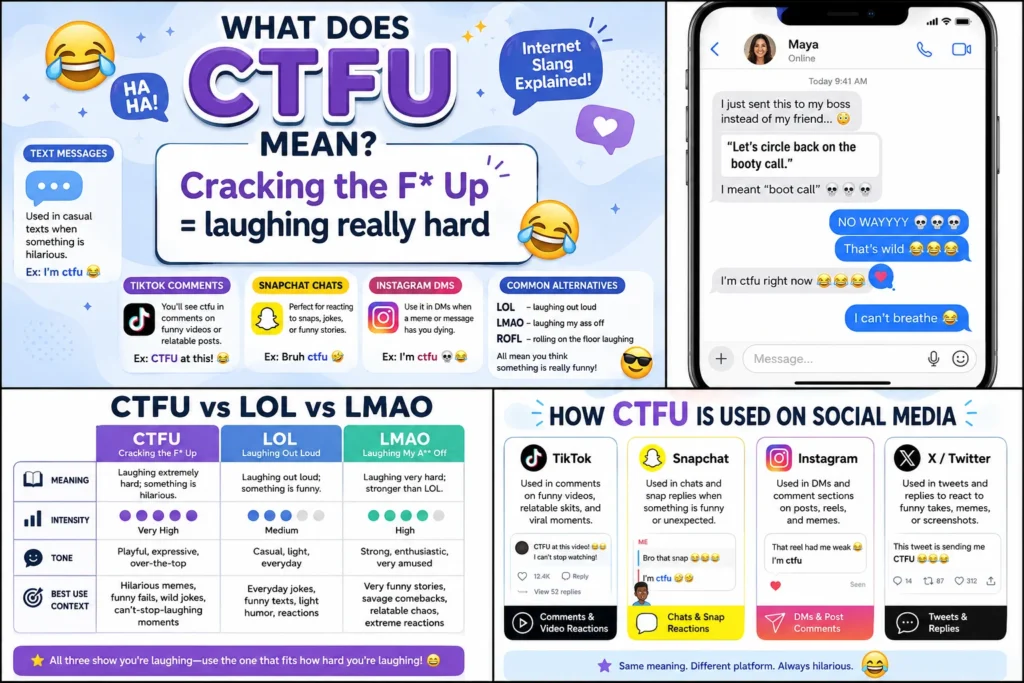
CTFU is internet slang used to show that something is extremely funny. It usually means “cracking the f* up”** or “crack the f* up,”** which is a stronger, more exaggerated way of saying laughing really hard. People use it in texts, memes, TikTok comments, Snapchat chats, X posts, and group messages when something is hilarious.
If you’ve seen CTFU in a text, meme comment, Snapchat message, or TikTok caption and wondered what it means, you’re not alone. Internet slang changes fast, and some abbreviations can be confusing if you don’t already know the vibe behind them. CTFU is one of those expressions that shows up in casual online conversations, especially when someone is reacting to something funny.
In simple terms, CTFU meaning is usually “cracking the f* up”**basically a dramatic way to say “I’m laughing really hard.” It’s used when something is funnier than a normal “lol” or even “lmao.” Depending on the context, it can sound playful, exaggerated, chaotic, or very Gen Z/social-media-coded.
In this guide, you’ll learn:
- the exact meaning of CTFU
- what it stands for in texting and online slang
- how people use it on TikTok, Snapchat, Instagram, and in DMs
- whether it’s rude, offensive, or safe to use
- examples of real conversations
- how it compares to LOL, LMAO, LMFAO, and similar slang
- when not to use it
If you want a clear, natural US-English explanation without the confusion, this article breaks it all down.
Quick Answer Box
| Topic | Answer |
|---|---|
| CTFU meaning | Usually “cracking the f* up”** |
| Main use | To show that something is extremely funny |
| Tone | Casual, slangy, expressive, sometimes vulgar |
| Where it’s used | Texts, TikTok, Snapchat, Instagram, X/Twitter, memes, group chats |
| Similar terms | LOL, LMAO, LMFAO, dead, I’m weak, crying |
| Example | “That video has me ctfu 😭” |
| Good for formal writing? | No |
| Can it be offensive? | It includes profanity, so yes, depending on the audience |
What Does CTFU Mean?
CTFU usually means “cracking the f* up.”** It’s a slang abbreviation people use to say that something is really, really funny more intense than just saying “lol.”
Think of it as a reaction word. If someone sends a hilarious meme, tells a ridiculous story, or posts a chaotic video, another person might reply with:
- “CTFU”
- “I’m ctfu rn”
- “Why am I ctfu at this?”
- “Nah this got me ctfu”
In all of those examples, the meaning is basically:
- I’m laughing hard
- This is hilarious
- I can’t stop laughing
- This is way funnier than I expected
The short version
If you want the easiest possible definition:
CTFU = laughing extremely hard at something funny
It’s a reaction slang term used to express strong amusement.
Full Definition of CTFU
To understand CTFU meaning more fully, it helps to break down both the literal expansion and the actual social meaning.
Literal meaning
CTFU is most commonly expanded as:
- Cracking The F* Up**
The phrase “cracking up” in English already means bursting into laughter or laughing uncontrollably. Adding the profanity intensifier makes it stronger and more dramatic.
So:
- cracking up = laughing hard
- cracking the f* up** = laughing extremely hard / losing it laughing
Practical meaning in real conversations
In everyday online use, CTFU often means one of these:
- That’s hilarious
- I’m dying laughing
- I’m losing it
- This is way too funny
- I was not expecting that and now I’m crying laughing
- This joke/video/message absolutely got me
It doesn’t always mean the person is literally laughing out loud in real life. Sometimes it’s just a strong way to signal amusement, the same way people use “I’m dead” even when they obviously don’t mean it literally.
Is CTFU always spelled in caps?
No. You might see:
- CTFU
- ctfu
- Ctfu
All mean the same thing. Lowercase is extremely common in texting and social media.
Context and Usage: How CTFU Is Actually Used
The biggest mistake people make with slang is learning the dictionary meaning without learning the context. With CTFU, context matters a lot because it’s not just about laughter it’s about the level of reaction and the vibe of the conversation.
CTFU is used as a strong laughter reaction
People use it when:
- a joke is unexpectedly funny
- a meme is chaotic or relatable
- someone says something wild in a group chat
- a video clip is ridiculous
- a friend roasts someone in a funny way
- an autocorrect fail turns into comedy
- a story gets more absurd as it goes on
Examples:
- “That ending has me ctfu.”
- “Bro I’m ctfu at your typo.”
- “Why did your mom say that 😭 ctfu.”
- “This comment section got me ctfu.”
It’s more intense than “lol”
Here’s the rough emotional scale:
- haha = mild laugh
- lol = casual amusement
- lmao = stronger laughter
- ctfu = intense, dramatic, very-online laughter reaction
That doesn’t mean everyone uses it the exact same way, but in general, CTFU feels stronger and more expressive than LOL.
It often appears with emojis and other slang
You’ll commonly see CTFU combined with:
- 😂
- 😭
- 💀
- “nah”
- “bro”
- “yo”
- “I’m weak”
- “dead”
- “fr”
- “no because”
Examples:
- “nahhh I’m ctfu 😭”
- “broooo ctfu 💀”
- “why is this so funny omg ctfu”
- “I’m dead, this got me ctfu”
These combinations help show tone. CTFU by itself already means “I’m laughing hard,” but the extra emojis or slang can make it feel even more dramatic.
What Tone Does CTFU Have?
The tone of CTFU is usually:
- casual
- playful
- informal
- internet-native
- emotionally expressive
- sometimes slightly vulgar
It can also feel:
- sarcastic
- chaotic
- dramatic in a funny way
- very familiar/friendly
- meme-heavy or Gen Z-coded
Is it rude?
Not automatically, but it does include profanity. The “F” in CTFU stands for a swear word, so the phrase is not considered formal or polished.
That means it may be fine in:
- texts with friends
- group chats
- TikTok comments
- meme pages
- Snapchat streak chats
- gaming chats
- casual DMs
But it’s not a good fit for:
- work emails
- professional Slack messages unless your team is extremely casual
- school assignments
- messages to teachers, clients, or older relatives who may dislike profanity
- brand copy unless the brand voice is intentionally edgy
What Does CTFU Mean in Text Messages?
In texting, CTFU almost always means the sender thinks something is really funny.
Common texting uses
Someone might use it after:
- reading a joke
- seeing a photo
- reacting to gossip or a funny story
- watching a short clip you sent
- hearing an embarrassing but hilarious moment
Examples:
- “Your cousin really said that? I’m ctfu.”
- “That picture is taking me out, ctfu 😭”
- “Stopppp I’m ctfu at this”
- “No because why did you send me this at 2 am? ctfu”
What it usually implies in a text
If someone texts “ctfu,” they’re usually communicating one of these things:
- I think this is hilarious
- I’m reacting strongly to the joke/story
- I want you to know I found this genuinely funny
- This is more than just a polite “lol”
That last point matters. Sometimes lol can be used almost automatically, even when something isn’t that funny. CTFU usually feels more intentional and stronger.
What Does CTFU Mean on Social Media?
On social media, CTFU works as a reaction marker. It tells everyone: this post, comment, video, or reply is funny enough to make me lose it.
You’ll see it in:
- captions
- comment sections
- replies
- repost reactions
- meme pages
- screenshot posts
- quote tweets/posts
- reaction videos
Why people use CTFU online
Social platforms reward short, emotional, recognizable reactions. CTFU works well because it is:
- short
- dramatic
- easy to type
- familiar to people who know internet slang
- stronger than “lol”
- perfect for funny content
It also fits the current style of online communication where reactions are fast, exaggerated, and emotionally loaded.
Platform-Specific Meaning of CTFU
The core meaning of CTFU stays the same across platforms laughing really hard but the way it feels can change depending on where it’s used.
TikTok
On TikTok, CTFU is often used in comments when a video is unexpectedly funny, chaotic, or painfully relatable.
How it appears on TikTok
- “I’m ctfu at the way he ran”
- “nah this whole video got me ctfu”
- “the grandma in the back is sending me ctfu 😭”
- “why did no one warn me the ending was this funny? ctfu”
TikTok vibe
On TikTok, CTFU often carries a high-energy reaction tone. It can mean:
- the creator said something wild
- the editing made the video funnier
- the comment section is funnier than the video itself
- the user is reacting in a dramatic meme-style way
Because TikTok language is fast and expressive, CTFU fits naturally there.
Snapchat
On Snapchat, CTFU is common in private chats, streak conversations, or reactions to pictures/videos friends send.
How it appears on Snapchat
- “bro I’m ctfu at your face in that snap”
- “why did you send that 💀 ctfu”
- “your dog in the background has me ctfu”
- “I just opened your snap and I’m ctfu”
Snapchat vibe
On Snapchat, it often feels more personal because it’s used between friends rather than for a public audience. It’s usually reacting to:
- goofy selfies
- bad camera angles
- voice notes
- accidental screenshots
- weird things happening in the background
- inside jokes
On Instagram, CTFU appears in DMs, meme page comments, reels comments, and story replies.
Common Instagram uses
- replying to a meme: “ctfu this is literally you”
- reacting to a reel: “I’m ctfu at the comments”
- story reply: “nahhh ctfu why would you post this 😭”
- group DM reaction: “this has me ctfu”
Instagram vibe
Instagram usage is often a mix of meme culture + friend chat culture. It can be playful, teasing, or dramatic.
X / Twitter
On X/Twitter, CTFU is often used in quote posts, replies, and reactions to viral jokes or hot takes.
Common X uses
- “I’m ctfu because why would he say that publicly”
- “this app got me ctfu every day”
- “the replies are ctfu”
- “nah the internet is undefeated ctfu”
X vibe
On X, it can feel a little sharper, more sarcastic, and more commentary-driven. People use it not just for jokes, but for absurd public posts, awkward takes, or messy internet moments.
Discord and Gaming Chats
In gaming chats or Discord servers, CTFU is usually a live reaction to something funny that happened during a game, in voice chat, or in a meme channel.
Examples
- “yo I’m ctfu at that fail”
- “he missed every shot 😭 ctfu”
- “that clip is wild, ctfu”
- “nah our team chat is ctfu tonight”
Gaming vibe
It often feels fast, unfiltered, and very casual.
Real-Life Conversation Examples Using CTFU
Below are realistic dialogue examples showing how CTFU works in natural conversation.
Conversation Example 1: Funny typo in a group chat
Chat
Ava: I meant to text “I’m on my way” but I sent “I’m on my wife.”
Mia: PLEASE 😭
Jordan: I’m ctfu why would autocorrect do that
Ava: I can never show my face again
Mia: no fr that’s the funniest typo I’ve seen all week
Why CTFU works here
Jordan uses ctfu because the typo is unexpectedly hilarious. A plain “lol” would feel weaker than the reaction they want to show.
Conversation Example 2: Reacting to a meme
Chat
Friend 1: sends meme about being broke after payday
Friend 2: Nah this is way too accurate 💀
Friend 3: I’m ctfu because this is literally me by Friday
Friend 1: same, my account balance is fighting for its life
Why CTFU works here
The meme is funny because it’s relatable. CTFU signals strong amusement + recognition.
Conversation Example 3: TikTok reaction
Chat
Lena: Did you watch the TikTok I sent?
Sam: YES 😭
Sam: I’m ctfu at the way he just stared at the camera after falling
Lena: the pause made it 10x funnier
Sam: exactly, I replayed it three times
Why CTFU works here
The reaction is specifically about a funny visual moment. It sounds natural because the laughter is intense and immediate.
Conversation Example 4: Teasing a friend
Chat
Nina: Be honest, is this outfit bad?
Kay: Not bad but the shoes are fighting the dress a little
Nina: wow fake friend
Kay: I’m ctfu because you asked for honesty and now you’re mad
Why CTFU works here
CTFU adds a playful, teasing tone rather than sounding mean. It works because the conversation is already casual.
Conversation Example 5: Storytime in a DM
Chat
Eli: I waved back at someone who wasn’t waving at me
Tara: nooooo
Eli: and then I tried to recover by pretending I was stretching
Tara: I’m actually ctfu at the image of that
Eli: it was the worst moment of my life
Why CTFU works here
The phrase shows the story painted such a funny mental picture that Tara is laughing hard.
More Example Sentences Using CTFU
Here are more natural examples you might see online:
- “This comment section got me ctfu.”
- “I was trying to stay serious and then I saw your message ctfu.”
- “Why is your little brother roasting everyone? I’m ctfu.”
- “That plot twist in the video had me ctfu.”
- “Stop sending me these at work, I’m ctfu and trying not to laugh out loud.”
- “Nah, your caption is taking me out. ctfu.”
- “I’m still ctfu about what happened last night.”
- “The way she said it so seriously has me ctfu.”
- “This is not even that deep but I’m ctfu.”
- “Bro I opened the app and the first thing I see has me ctfu already.”
Alternative Meanings of CTFU
Although “cracking the f* up”** is by far the most common meaning, internet acronyms can sometimes have alternate interpretations depending on niche communities or specific contexts.
The main meaning is still the one you should know
If you see CTFU in:
- a text message
- TikTok comments
- Instagram DMs
- Snapchat
- meme culture
- general internet slang
it almost always means laughing really hard.
Could it ever mean something else?
Technically, some acronyms can be reused in different communities, but for mainstream texting and social media, CTFU = cracking the f* up** is the standard meaning people are looking for.
So if you’re searching ctfu meaning in text, ctfu meaning on Snapchat, or what does ctfu mean in chat, the answer is almost always the same.
Related Terms and NLP Variations
To fully understand CTFU meaning, it helps to compare it with other slang people use when reacting to something funny.
LOL
LOL = laughing out loud
Tone
- very common
- mild to moderate reaction
- sometimes used automatically without much real laughter
Example
- “lol that’s funny”
Compared to CTFU, LOL feels much lighter.
LMAO
LMAO = laughing my ass off
Tone
- stronger than lol
- common in casual texting
- can show genuine laughter
Example
- “I’m lmao at this video”
Compared to CTFU, LMAO is similar in meaning, but CTFU can feel more dramatic or more internet-slanged depending on the person.
LMFAO
LMFAO = laughing my f***ing ass off
Tone
- more intense
- more vulgar
- dramatic reaction
Example
- “LMFAO that was wild”
CTFU lives in the same intensity range.
I’m dead / dead
Tone
- hyperbolic
- meme-heavy
- means something is so funny it “killed” you with laughter
Example
- “I’m dead 😭”
This is very close to CTFU in vibe.
I’m weak
Tone
- means something is hilariously ridiculous
- often used in Black internet slang and wider internet slang spaces
- expressive but less explicitly profane than CTFU
Example
- “I’m weak, why would he say that?”
Crying / in tears
Tone
- visual and emotional
- often paired with emojis like 😭
Example
- “I’m crying at this”
- “in tears rn”
Where CTFU fits among them
If we rank them by casual internet intensity, it might look like this:
- haha
- lol
- lmao
- I’m weak / I’m dead
- ctfu / lmfao
This isn’t a strict rule, but it’s a useful way to understand the emotional strength of the term.
Emotional Meaning Behind CTFU
Slang isn’t only about dictionary definitions. It also signals social emotion. When someone says CTFU, they’re often communicating more than just “this is funny.”
It can signal surprise
Sometimes the joke or moment catches the person off guard:
- “I was not expecting that and now I’m ctfu”
It can signal bonding
When friends laugh together in a chat, slang like CTFU helps create a shared tone. It says:
- “I’m in on the joke”
- “I get why this is funny”
- “we’re having the same reaction”
It can signal internet fluency
Using terms like ctfu, dead, weak, or crying can show familiarity with online speech patterns, meme culture, and casual digital conversation.
It can soften teasing
If you tease a friend and add “ctfu,” it can make the comment sound more playful rather than harsh.
Example:
- “You really wore that to the airport? ctfu”
Depending on your relationship, that can sound like affectionate teasing rather than criticism.
How to Respond When Someone Says CTFU
If someone texts you CTFU, the correct reply depends on what they’re reacting to and the tone of the conversation.
If they’re laughing at something you sent
You can keep the joke going:
- “I knew that would get you”
- “wait the ending is the funniest part”
- “I had to send it immediately”
- “bro I was crying when I saw it too”
If they’re laughing at your story
You can respond with more details:
- “You think that’s bad? It got worse.”
- “No because I actually wanted to disappear.”
- “I’m telling you, it was so embarrassing.”
- “I wish I was exaggerating.”
If they’re teasing you playfully
You can tease back:
- “Leave me alone 😭”
- “You’re fake for laughing”
- “Mind your business lmao”
- “It wasn’t even that bad”
If you don’t know what they mean
If you receive CTFU and you’re not sure why, you can simply ask:
- “Wait what part has you ctfu?”
- “What are you laughing at 😭”
- “Okay explain because I’m missing it”
Sample reply scenarios
Scenario 1
Them: “I’m ctfu at that voice note”
You: “It was the accidental whisper at the end, wasn’t it?”
Scenario 2
Them: “nah this got me ctfu”
You: “I had a feeling you’d lose it at that one”
Scenario 3
Them: “ctfu you really said that to her?”
You: “Listen I panicked and committed to the bit”
Misinterpretations of CTFU
Because slang is messy online, people sometimes misunderstand CTFU. Here are the most common mistakes.
Misinterpretation 1: Thinking it’s an insult
Sometimes people see the profanity and assume it means something angry or rude. But in most cases, CTFU is not an insult. It’s usually a laughter reaction.
Example:
- “I’m ctfu at this” = “this is hilarious”
- not “I’m mad at this”
Misinterpretation 2: Assuming it’s always literal
When someone says “I’m ctfu,” they may not literally be doubled over laughing. It can just be a strong internet reaction.
Just like:
- “I’m dead”
- “I’m screaming”
- “I’m crying”
CTFU can be exaggerated for effect.
Misinterpretation 3: Using it in formal settings
Because it’s an acronym, some people assume it’s harmless or professional-looking. It isn’t. If your boss, professor, or client doesn’t know the slang or if they do know it the profanity makes it risky in formal communication.
Misinterpretation 4: Thinking it always means the same emotional intensity
Some people use CTFU very casually. Others reserve it for only the funniest moments. So the exact intensity can vary by person, age group, region, and online culture.
When Not to Use CTFU
Even though CTFU is common in casual internet language, there are definitely situations where it’s better not to use it.
Professional settings
Avoid it in:
- work emails
- job applications
- messages to clients
- academic writing
- customer service communication
- professional networking messages
Why? Because it contains profanity and can come across as immature or inappropriate.
Conversations with people who dislike slang
If you’re texting:
- a teacher
- a parent who hates internet abbreviations
- a formal coworker
- someone older who may not know what it means
it may create confusion or feel disrespectful.
Serious or sensitive situations
Don’t use CTFU in conversations about:
- grief
- illness
- serious conflict
- apologies
- emergencies
- sensitive family issues
Even if you’re trying to lighten the mood, it can easily feel out of place.
Brand or business communication
If you run a business account or content brand, use caution. CTFU can work only if:
- your audience is young and slang-friendly
- your brand voice is intentionally casual
- the platform is informal, like TikTok comments or meme content
It’s usually a bad fit for polished brand messaging.
Usage Tips for Using CTFU Naturally
If you want to use CTFU without sounding awkward, these tips help.
Use it when the moment is actually funny
CTFU works best when the reaction is strong. If something is only mildly amusing, “lol” or “lmao” may fit better.
Better fit
- friend sends a chaotic video
- someone posts a ridiculous typo
- a meme is painfully relatable
- the joke catches you off guard
Less natural fit
- “Thanks for the update, ctfu”
- “The weather looks nice ctfu”
- random serious conversation with no joke involved
Match the other person’s tone
If the chat already includes:
- emojis
- lowercase texting
- meme language
- slang
then ctfu will feel more natural.
If the conversation is polished or serious, it may feel random.
Know your audience
Use it with people who are comfortable with slang and casual profanity. If you’re unsure, safer alternatives include:
- “lol”
- “lmao”
- “that’s hilarious”
- “I’m crying”
- “I’m dead”
Don’t force it
Internet slang sounds natural only when it matches your normal texting style. If ctfu doesn’t feel like something you’d say, you don’t need to use it just because it’s popular.
Is CTFU a Gen Z Term?
CTFU is definitely part of internet slang culture, and younger users may use it more often in casual chats and social media. But it isn’t limited to one age group.
Why it feels Gen Z-coded
It often appears alongside expressions like:
- “I’m weak”
- “I’m dead”
- “crying”
- “nahhh”
- “fr”
- “no because”
That makes it feel very current and online-native.
But it’s not brand new
CTFU has been around in online and text slang for years. It isn’t a brand-new TikTok-only expression. Different generations of internet users may recognize it, especially if they spend time in meme culture, Black internet slang spaces, group chats, gaming communities, or social platforms where expressive slang is common.
Is CTFU the Same as “Cracking Up”?
Yes CTFU is basically an intensified slang version of cracking up.
Compare them
- I’m cracking up = I’m laughing hard
- I’m ctfu = I’m laughing really hard, with a more slangy and profane tone
If you want a cleaner version without profanity, you can just say:
- “I’m cracking up”
- “I’m dying laughing”
- “I’m laughing so hard”
Is CTFU Offensive?
Not necessarily, but it can be inappropriate depending on who you’re talking to.
Why it can be risky
The phrase includes a censored swear word. Even though many people type only the abbreviation and not the full phrase, the meaning is still understood.
Safe audience examples
Usually okay with:
- close friends
- siblings
- casual group chats
- meme pages
- gaming friends
- social media mutuals who already use slang
Less safe audience examples
Use caution with:
- professors
- managers
- clients
- older relatives
- formal acquaintances
- public-facing professional posts
CTFU vs LOL vs LMAO: Which One Should You Use?
If you’re trying to choose the right reaction word, here’s a simple guide.
Use “lol” when
- something is mildly funny
- you want to sound casual but not intense
- you’re softening a message
- the chat isn’t super expressive
Example: “lol that’s actually funny”
Use “lmao” when
- something is genuinely funny
- you want stronger energy than lol
- you’re in a casual chat
Example: “lmao why would he do that”
Use “ctfu” when
- something is hilarious
- the moment feels chaotic or meme-worthy
- you want a stronger, more slang-heavy reaction
- the audience is comfortable with casual profanity
Example: “nah I’m ctfu at this whole situation”
FAQs
What does CTFU mean in text?
In texting, CTFU usually means “cracking the f* up,”** which is another way of saying laughing really hard.
What does CTFU stand for?
CTFU most commonly stands for Cracking The F* Up**.
Is CTFU a bad word?
The abbreviation itself is not a curse word on its own, but it represents a phrase that includes profanity. So it’s casual and potentially inappropriate in formal settings.
What does CTFU mean on Snapchat?
On Snapchat, CTFU usually means the sender found a snap, message, or joke extremely funny.
What does CTFU mean on TikTok?
On TikTok, people use CTFU in comments or captions to show they’re laughing hard at a video, a creator’s joke, or something funny in the comment section.
Is CTFU the same as LOL?
No. LOL usually signals lighter amusement, while CTFU is a much stronger reaction that means something is very funny.
Can I use CTFU in school or at work?
It’s better not to. Since it contains implied profanity and is very informal slang, it’s not appropriate for professional or academic communication.
Is CTFU positive or negative?
It’s usually positive because it means someone thinks something is funny. However, it can be used while teasing someone, so the tone depends on the conversation.
How do you reply to CTFU?
You can respond by continuing the joke, reacting with emojis, or asking what part was funniest. For example:
- “I knew you’d laugh at that”
- “wait till you see the ending”
- “leave me alone 😭”
Do people still say CTFU?
Yes, people still use it in texts, group chats, memes, TikTok comments, Instagram DMs, and casual online conversation especially when reacting to something hilarious.
Common Sentence Patterns With CTFU
If you want to recognize or use the phrase naturally, these patterns are common.
“I’m ctfu at”
- “I’m ctfu at this video”
- “I’m ctfu at your story”
- “I’m ctfu at the comments”
“This got me ctfu”
- “This meme got me ctfu”
- “Your caption got me ctfu”
- “That ending got me ctfu”
“Why am I ctfu?”
- “Why am I ctfu at a dog wearing sunglasses?”
- “Why am I ctfu at this foolish joke?”
“Had me ctfu”
- “The way she said it had me ctfu”
- “That autocorrect had me ctfu”
These patterns show how the term functions grammatically in real chat.
Mini Guide: If You Don’t Want to Use CTFU, What Can You Say Instead?
If you like the meaning but not the profanity, here are cleaner alternatives:
Casual alternatives
- that’s hilarious
- I’m cracking up
- I’m dying laughing
- I’m crying
- I’m weak
- I’m dead
- lmao
- that took me out
Safer workplace-friendly alternatives
- that made me laugh
- that’s really funny
- I needed that laugh
- that’s hilarious
- I’m still laughing at that
These alternatives can help if you want the same reaction without the slang-heavy tone.
Conclusion
CTFU is a casual internet slang term that usually means “cracking the f* up.”** In plain English, it means laughing really hard or finding something extremely funny. You’ll mostly see it in texts, TikTok comments, Snapchat chats, Instagram DMs, meme pages, and other informal online spaces.
The key things to remember are simple:
- CTFU is a laughter reaction
- it’s stronger than “lol”
- it usually means something is hilarious
- it’s informal and includes implied profanity
- it’s best used with friends or in casual online conversations
- it’s not a good choice for professional or serious situations
If you see someone type “I’m ctfu” or “this got me ctfu,” the meaning is almost always the same: they think something is very funny and they’re reacting hard to it.
So if you were searching for ctfu meaning, what does ctfu mean in text, or ctfu meaning on TikTok/Snapchat, the short answer is this:
CTFU = “cracking the f* up” = laughing really hard.**

Justin Powell is a writer at GramBrix.com who focuses on grammar, clarity and effective communication, helping readers strengthen their language skills.