Last Updated on August 16, 2026
An ai text generator is a software system that uses large language models to produce natural language text based on user input. These tools analyze vast amounts of existing content books, articles, and websites to recognize patterns and predict the most likely sequence of words to follow a prompt. Leading tools in 2026 include ChatGPT (most versatile), Claude (best for long, coherent documents), Gemini (integrated with Google Workspace), and Jasper (best for brand consistency in marketing). Open source options like Llama 2, Falcon 180B, and PaLM 2 offer powerful free alternatives. An ai text generator can produce essays, reports, proposals, social media posts, and more. However, they have limitations readability scores are often insufficient, AI detection tools consistently flag outputs, and content quality depends heavily on prompt quality and setup. The best approach is to start with one or two tools that fit your workflow, invest in prompt engineering, and always keep a human editor in the loop.
What Is an AI Text Generator?
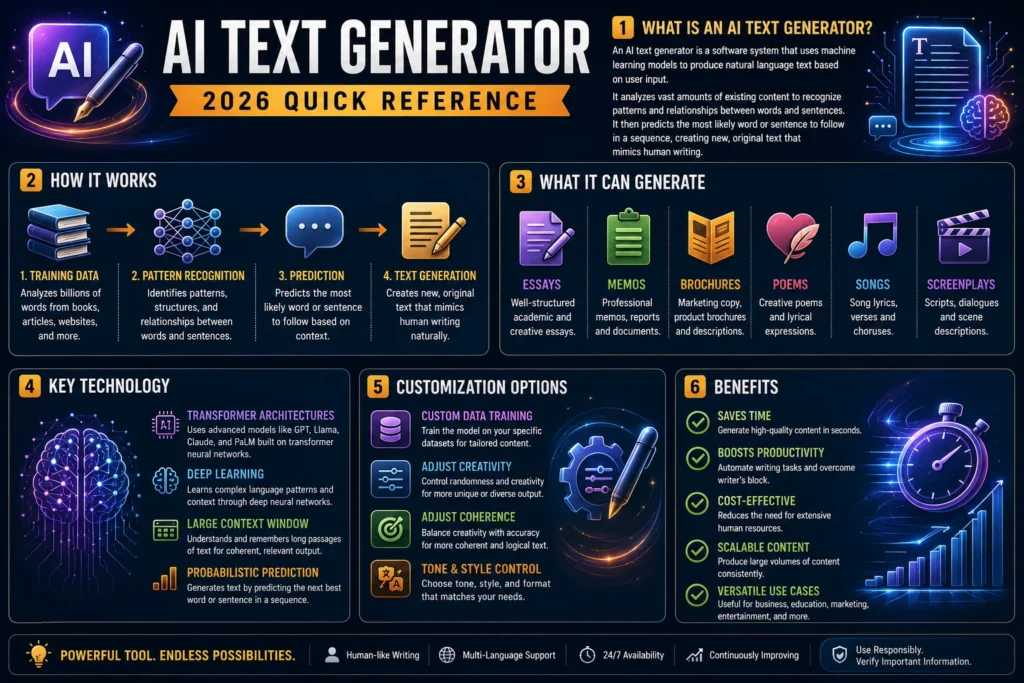
An ai text generator is a software system that uses machine learning models to produce natural language text based on user input. It works by analyzing vast amounts of existing content books, articles, websites, and other text sources to recognize patterns and relationships between words and sentences. Based on what people have written, an ai text generator can predict the word or sentence most likely to follow another in a sequence, creating new, original text that mimics human writing.
These tools can produce a wide variety of content including essays, memos, brochures, poems, songs, and screenplays. The technology uses deep learning techniques, particularly transformer based architectures, to generate language that resembles human-written text. Some ai text generator tools offer customization options, including training the model on specific datasets or adjusting the creativity and coherence levels in generated text.
How AI Text Generation Works: The Technology Behind the Magic
At its core, an ai text generator relies on large language models (LLMs) that have been trained on enormous datasets. These models learn the statistical relationships between words, phrases, and concepts, enabling them to generate coherent, contextually appropriate text.
The process works like this:
- Training phase: The model analyzes hundreds of thousands of texts—books, articles, websites, and other sources—to understand word relationships and language patterns.
- Pattern recognition: It learns that certain words frequently appear together (like “Chesapeake” and “Bay”) and develops an understanding of context and meaning.
- Generation phase: When you provide a prompt, the model predicts the most likely sequence of words to follow, generating new text based on its training.
The result is what we call a generative pretrained transformer (GPT) —generative because it creates new text, pretrained because it’s already done all its homework before you interact with it, and transformer because of the specific architecture used.
Top AI Text Generators in 2026
The ai text generator landscape has evolved dramatically. Here’s what each major tool excels at.
ChatGPT (OpenAI)
ChatGPT remains the most widely used ai text generator and starting point for text generation, and for good reason: its strength is versatility. The same interface handles contracts, memos, meeting summaries, and marketing one-pagers with minimal setup. Its familiarity is also part of its appeal—most people have already spent months or years learning how to prompt it effectively.
Custom GPTs push this further by letting teams bake in templates, formatting rules, and even company-specific context, so the same base model can be configured to produce a legal memo one day and a client-facing proposal the next.
- Ideal for: Quick first drafts, templated documents, and teams that want one tool for many document types
- Pricing: ChatGPT Plus costs around $34 per month
Claude (Anthropic)
Claude has built a reputation as an ai text generator that produces long, coherent documents without losing the thread. Where many generators start strong and drift by page three, Claude holds onto the structure and argument of a piece from the first paragraph to the last. It keeps terminology, tone, and logic consistent even across documents that run into thousands of words, making it a natural fit for reports, proposals, and any document where the reader needs to follow a chain of reasoning.
It also handles research-heavy drafts particularly well. Rather than flattening source material into generic summary language, it weaves context and evidence into the narrative in a way that still reads like something a person would write.
- Ideal for: Reports, business proposals, research summaries, and any document that needs to stay coherent over several pages
- Pricing: Similar to ChatGPT Plus
Gemini (Google)
Gemini (formerly Bard) offers similar text generation capabilities to ChatGPT with the addition of image generation functionality. Its biggest advantage as an ai text generator is integration with Google’s ecosystem. Gemini Advanced integrates deeply with Google Docs and Google Sheets, creating a seamless workflow between research and writing.
- Ideal for: Users heavily invested in Google Workspace who want AI writing integrated into their existing tools
- Pricing: Available through Google’s ecosystem
Copilot (Microsoft)
Developed by Microsoft, Copilot is an AI platform that uses multiple data models, including OpenAI’s GPT-4, GPT-4 Turbo, and DALL-E 3, to generate written and visual content based on a prompt. It’s integrated into Microsoft’s ecosystem, making it ideal for users of Office applications.
- Ideal for: Microsoft 365 users who want an ai text generator directly in their workflow
- Pricing: Included with Microsoft 365 subscriptions
Jasper
Jasper has become the gold standard ai text generator for professional marketing teams in 2026. Its edge is brand and style consistency at scale. Its memory system learns an organization’s terminology, tone, and messaging guidelines from existing material, then applies them automatically across every document it generates.
Jasper is built with marketing and sales workflows specifically in mind, so it tends to understand the shape of those documents—pain point, solution, proof, call to action—without needing to be walked through the structure each time.
- Ideal for: Sales collateral, client proposals, and any document that needs to sound like the same brand every time
- Pricing: Starts at $39 per month
Notion AI
Notion AI’s biggest advantage as an ai text generator isn’t the quality of what it generates in isolation—it’s that it works where documents already live. Instead of drafting content in a separate window that then has to be copied and reformatted, it writes directly inside a shared workspace, pulling context from existing pages, notes, and databases as it goes.
This connection to context makes it particularly strong for internal documents—specs, meeting notes, onboarding guides, project briefs—that need to stay accurate and up to date as the underlying work evolves.
- Ideal for: Internal documentation, project briefs, and teams that already manage their work in Notion
- Pricing: Starting at $10/month
Additional Tools Worth Mentioning
| Tool | Best For | Starting Price |
|---|---|---|
| Grammarly Business | Tone optimization and clarity | Varies |
| GravityWrite | Fast content drafting and templates | $8.00/month |
| QuillBot | Paraphrasing and sentence refinement | $9.95/user/month |
| Gamma | Visual, skimmable documents and presentations | Varies |
| Wordtune | Sentence rewriting and tone adjustment | $9.99/month |
Free and Open-Source AI Text Generation Models
For users seeking a cost-effective ai text generator, open-source models offer a compelling alternative to commercial tools. Here are the leading options:
Llama 2
Llama 2 comprises pre-trained and finely-tuned generative text models with parameters ranging from 7 billion to 70 billion. Llama-2-Chat models demonstrate superior performance compared to open-source chat models across several benchmark tests and remain on par with select closed-source models like ChatGPT and PaLM.
PaLM 2 (Google)
PaLM 2 (Pathways Language Model) boasts exceptional prowess in advanced reasoning, coding, and mathematics. It’s offered in diverse sizes, facilitating easy deployment across a wide range of usage scenarios.
Falcon 180B LLM
Falcon 180B is a large language model with 180 billion parameters trained on a vast amount of data. It’s the best open-source model available and one of the top models overall, superior to LLaMA-2, StableLM, RedPajama, MPT, and others.
Other Open-Source Options
- GPT-NeoX-20B: 20 billion parameters, trained using the GPT-NeoX library
- GPT-J: Created by EleutherAI in 2021, aims to generate text that sounds like a human being speaking
- BLOOM: Can accurately replicate human writing in 46 languages and 13 programming languages
- OPT-175B: Developed by Meta, the most extensive pre-trained language model accessible with 175 billion parameters
Cons of Open-Source Models
While open-source models offer many advantages as an ai text generator, they also come with some drawbacks:
- Not entirely cost-free: Users often need to bear expenses related to hosting and server usage
- Lack of support: May not come with official support channels or dedicated customer support teams
- Limited documentation: Some models may have incomplete or poorly maintained documentation
- Security concerns: Vulnerabilities may take longer to address compared to commercially supported models
- Scalability challenges: May not be as optimized for performance and scalability as commercial models
What to Look For in an AI Text Generator
Based on expert evaluations, here are the key criteria for selecting an ai text generator:
| CriterionWhat It Means in Practice | |
|---|---|
| Output quality and coherence | Generated content should need minimal cleanup. Prioritize tools that produce structured, readable drafts |
| Prompt responsiveness and control | Tools should follow instructions well without drifting off-topic or losing context |
| Use-case versatility | Can handle multiple tasks like long-form content, paraphrasing, summarization, and social media copy |
| Ease of use and workflow fit | Fits naturally into existing workflows without disrupting productivity |
| Editing and rewriting capabilities | Improves clarity, tone, and readability for existing content |
| Speed and efficiency gains | Consistently speeds up outlining, drafting, or summarizing without sacrificing quality |
| Customization and tone control | Allows flexibility in tone, style, and output length based on different writing needs |
| Reliability and consistency | Delivers predictable results across multiple prompts and use cases |
AI Text Generator Use Cases
AI text generators have applications across virtually every industry:
Business and Marketing
- Document generation: Draft reports, proposals, and contracts in minutes rather than hours
- Content creation: Produce marketing copy, articles, and social media posts with consistent brand voice
- Sales outreach: Generate personalized email sequences from prospect data
Writing and Publishing
- Overcoming writer’s block: Generate ideas and overcome creative blocks effortlessly
- Content refinement: Polish and refine existing content with intelligent suggestions
- Multilingual content: Translate content into any language while keeping formatting intact
Education and Academia
- Research summarization: Generate summaries of complex academic texts
- Writing assistance: Help students and researchers with drafting and editing
- Language learning: Practice and improve writing skills
Productivity and Workflow
- Meeting notes: Generate summaries and action items from meetings
- Document automation: Create standardized documents quickly
- Code generation: Assist with programming tasks
AI Text Generator Limitations and Challenges
Quality and Readability Concerns
A 2025 study on AI in academic writing found that while these models generate substantial and semantically accurate content, readability assessments indicated the texts were insufficient in terms of clarity and accessibility. AI detection tools also consistently identified all outputs as AI-generated.
Plagiarism and Originality
The same study revealed that paraphrased abstracts showed higher similarity rates to original texts, and question-based responses also exceeded acceptable levels. This raises concerns about originality and the need for proper attribution when using an ai text generator.
Overreliance and Critical Thinking
The best ai text generator doesn’t replace writing; it removes friction. The right tool is one that helps you move from idea to usable draft faster without stripping away control over the final output. Tools alone don’t create valuable content; they’re amplifiers of creativity and organizational abilities.
Best Practices for Using AI Text Generators
Start Simple
The golden rule is to begin with only two or three tools that cover your essential needs, then gradually add more when you discover genuine workflow gaps. Ask yourself what type of content you create most frequently, and choose the ai text generator tools specialized in that area.
Invest in Prompt Engineering
Teams that invest in reusable prompts and templates usually see much more consistent results than those relying on ad hoc requests. Take time to develop effective prompts that produce the output you need from your ai text generator.
Keep a Human in the Loop
Valuable content comes from deeply understanding your audience, sharing authentic experiences, and presenting a unique perspective people cannot find elsewhere. Tools help you reach those goals faster, but they cannot replace honesty, originality, hard work, and continuous learning.
Verify and Edit
AI-generated content often needs human editing. Tool output quality can vary, especially without careful setup. Always review and refine content before publishing.
Frequently Asked Questions
What is an AI text generator?
An ai text generator is a software system that uses machine learning models to produce natural language text based on user input. It analyzes vast amounts of existing content to recognize patterns and predict the most likely sequence of words to follow a prompt.
Which AI text generator is the best?
The best ai text generator depends on your specific needs. Claude excels at long, coherent documents; ChatGPT is the most versatile; Jasper ensures brand consistency in marketing content; and Notion AI works best for internal documentation. Most users benefit from starting with one or two tools that cover their essential needs.
Are there free AI text generators?
Yes. Open-source models like Llama 2, Falcon 180B, and PaLM 2 are free to use as an ai text generator, though they may come with hosting and support costs. ChatGPT also offers a free basic version.
Can I use AI text generators for commercial content?
Yes. Most commercial tools like ChatGPT, Claude, and Jasper permit commercial use. However, check each platform’s terms of service for specific usage rights and restrictions.
How accurate is AI-generated content?
AI-generated content is semantically accurate but may have readability issues. AI detection tools consistently identify outputs as AI-generated, and content should always be reviewed and edited by a human before publication.
Conclusion
AI text generators have evolved from novelty to necessity. In 2026, these tools are no longer just about generating text they’re about removing friction from the writing process. Whether you’re drafting a business proposal, creating marketing content, or writing a research summary, the right ai text generator can cut production time from hours to minutes.
But these tools aren’t magic. They work best when you understand their strengths and limitations. Claude excels at long, coherent documents. ChatGPT offers unmatched versatility. Jasper ensures consistent brand voice. Notion AI integrates seamlessly with existing workspaces. Open source models like Llama 2 provide powerful free alternatives.
The key is to start with one or two tools that fit your workflow and gradually expand as you discover genuine gaps. Invest in prompt engineering teams that do get far more consistent results. And always keep a human editor in the loop. AI text generators are amplifiers of your creativity, not replacements for it.
The question is no longer whether to use an ai text generator, but which one fits your workflow. With the tools and best practices in this guide, you’re equipped to make the right choice.

Kevin Brooks is a grammar specialist at GramBrix.com, dedicated to helping readers understand language rules with clarity and confidence. He simplifies complex grammar concepts through practical examples and easy explanations.