Last Updated on August 4, 2026
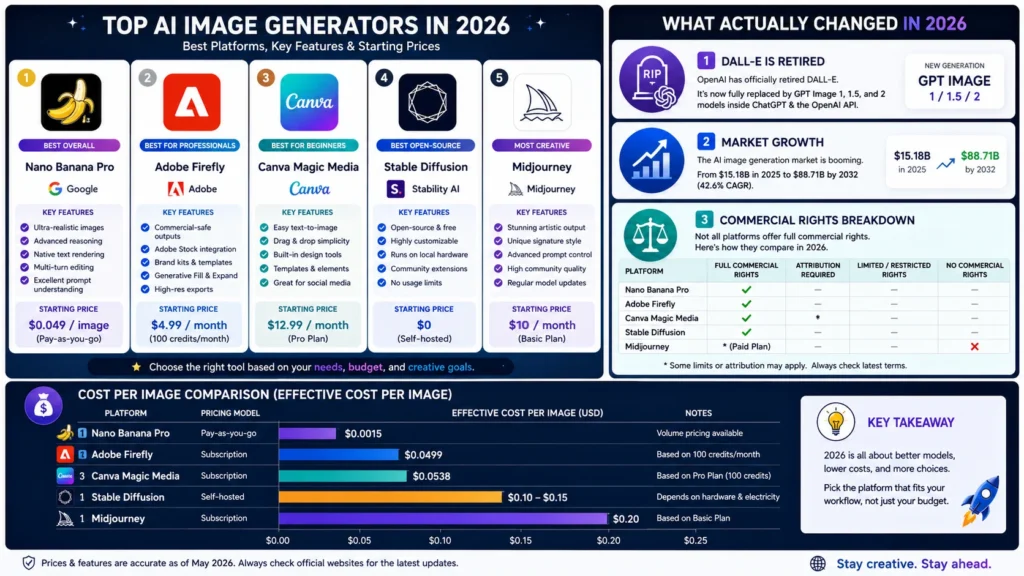
An AI image generator is a machine learning tool that creates images from text prompts, photos, or reference clips. The market is projected to hit $15.18 billion in 2026, growing at over 33% CAGR to $88.71 billion by 2032 . Top tools include Google’s Nano Banana Pro (best for photorealism), Adobe Firefly (best for professionals with commercial safety), Canva Magic Media (best for beginners), Stable Diffusion (best open-source), and Midjourney (most creative) . OpenAI retired DALL-E 3 in March 2026, replacing it with GPT Image 1, 1.5, and 2 models . GPT Image 2 supports 4K resolution up to 3840 pixels . Cost-effectiveness varies widely—effective per-image costs range from $0.0015 to over $0.20 . Key features to evaluate include prompt adherence, generation quality, speed, editing capabilities, commercial rights, and privacy policies . User satisfaction averages 6.3 out of 7 for image quality . The ecosystem is shifting toward integrated solutions embedded in enterprise software, with increasing focus on ethical AI and commercial safety .
The AI Image Generator Market in 2026: What’s Really Happening
The AI image generator space is moving at breakneck speed. Market researchers project the global market will reach $15.18 billion in 2026, growing at a staggering 33.63% compound annual growth rate to hit $88.71 billion by 2032 . That’s not hype. That’s real money flowing into a technology that’s fundamentally changing how visual content gets made.
G2’s recent report, analyzing over 2,000 user reviews, shows customers rate image quality at a remarkable 6.3 out of 7 . Core features like model accuracy, generation quality, and copyright options all score above 6. The technology has come a long way from generating hands with seven fingers .
But here’s the reality check: an AI image generator is only as good as your specific use case. The best tool for a professional designer looks very different from what a social media marketer needs. Let’s cut through the noise and look at what actually works in 2026.
What Is an AI Image Generator, Really?
An AI image generator uses machine learning algorithms—primarily diffusion models and Generative Adversarial Networks (GANs)—to synthesize visual content from natural language descriptions or existing image inputs . The technology has evolved rapidly from producing low-resolution, abstract interpretations to generating photorealistic, high-fidelity images that rival human artistic output.
How the Technology Works
The process starts with your prompt. You type a description of what you want to see. The AI model then processes that text through a neural network trained on millions of labeled images. The model generates an image by starting with random noise and gradually refining it to match your description.
Different models have different strengths. OpenAI’s GPT Image 1.5 excels at photorealism and instruction following . Midjourney produces creative, visually striking results with vivid colors and surreal expressions . Stable Diffusion focuses on realistic details and refined, precise images .
Key Features to Look For
When evaluating an AI image generator, consider these factors:
| Feature | Why It Matters |
|---|---|
| Prompt adherence | How well the tool follows your instructions |
| Generation quality | Resolution, detail, and realism of outputs |
| Speed | How long you wait for each image |
| Editing capabilities | Can you modify existing images? |
| Commercial rights | Can you use images for business purposes? |
| Privacy policy | Does the company train on your content? |
| Price | Free tier availability and effective cost per image |
The Top AI Image Generators in 2026
Nano Banana Pro (Gemini 3) – Best Overall
Google’s Nano Banana models took the AI industry by storm in 2025 . The original model earned praise for maintaining character consistency across multiple generations. The new Pro model is even more capable.
What makes it special:
- Excellent character consistency and realism
- Can edit existing images as well as generate new ones
- Creates legible text in images (infographics, signs, and labels)
The catch: Longer generation times. Information in graphics may be inaccurate, so check facts carefully .
Price: Free with limited generations. Upgrades start at $20 per month .
Best for: Anyone who wants photorealistic images with consistent characters across multiple generations.
Canva Magic Media – Best for Beginners
Canva’s AI image generator is the ultimate user-friendly option . It’s built directly into Canva’s design platform, making it seamless to create and edit images without leaving your workflow.
What makes it special:
- Extremely easy to create and edit images
- Handles many aesthetics and styles
- Privacy policy is notably secure—Canva does not train on your content
- Images are always private, unlike many competitors
The catch: Free plan has a hard generation limit .
Price: Free with limited generations. Pro plans start at $13 per month .
Best for: Beginners and Canva users who want a simple, no-fuss experience.
Adobe Firefly – Best for Professionals
Adobe Firefly is built directly into Adobe Creative Cloud, including Photoshop . It’s a natural choice for professionals already using Adobe’s ecosystem.
What makes it special:
- Commercially safe outputs guaranteed
- Integrated with and exportable to other Adobe programs
- Trained on Adobe’s own Stock catalog with licensed and public domain content
- Adobe won’t train on your content
The catch: Struggles with photorealistic images compared to competitors .
Price: Plans start at $10 per month. Credits may already be included in existing Adobe subscriptions .
Best for: Professional creatives who need commercial safety and integration with Adobe tools.
Stable Diffusion – Best Open-Source Option
Stable Diffusion is a household name in AI image generation . The open-source nature gives users flexibility that closed platforms can’t match.
What makes it special:
- Fast generation time
- Extensive editing tools through Stability AI
- Can run locally on your own device
- Lets you opt out of model training
The catch: Complicated availability due to the open-source nature. Privacy policy and price depend on how you access it .
Price: $10 per month through Stability AI. Free if you run it locally .
Best for: AI enthusiasts who want control and flexibility.
Midjourney – Most Creative
Midjourney stands above the rest for creative output. It’s the most imaginative option available .
What makes it special:
- Extremely creative results with versatile styling
- Community focus with an active Discord server
- Useful for brainstorming and storyboarding
The catch: Too realistic generations of protected characters have led to lawsuits from Disney, Universal, and Warner Bros. . All images are public unless you pay for stealth mode.
Price: Paid-only, beginning at $10 per month .
Best for: Creative professionals needing artistic inspiration rather than ultrarealistic stock imagery.
The Shifting Landscape: What Changed in 2026
DALL-E Is Gone
OpenAI retired DALL-E 3 on March 4, 2026 . Existing deployments no longer work. The replacement is the GPT Image series—GPT Image 1, 1.5, and 2 . This represents a significant shift in OpenAI’s approach to image generation.
The GPT Image Family
| Model | Best For | Key Features |
|---|---|---|
| GPT Image 1 | General use | 1024×1024 resolution, editing support, face preservation |
| GPT Image 1.5 | Photorealism and instruction following | Enhanced speed and efficiency over GPT Image 1 |
| GPT Image 2 | High resolution and 4K | Up to 3840 pixels, advanced editing, multiple aspect ratios |
Model Comparisons
| Aspect | GPT Image 2 | GPT Image 1.5 | GPT Image 1 | GPT Image 1 Mini |
|---|---|---|---|---|
| Availability | Generally available | Limited preview | Limited preview | Limited preview |
| Strength | 4K resolution, advanced editing | Photorealism, speed | Quality, instruction following | Fast, cost-effective |
| Resolution | Up to 3840px | 1024×1024 | 1024×1024 | 1024×1024 |
| Face Preservation | Advanced | Advanced | Advanced | Not supported |
Pricing: What You Actually Pay
The cost-effectiveness of an AI image generator depends on four factors: effective cost per usable image, free tier volume, annual discount depth, and marginal cost at scale .
Most Cost-Effective Options in 2026
| Rank | Platform | Cheapest Paid Entry | Effective $/Image | Free Tier |
|---|---|---|---|---|
| 1 | Chat Image | $14.9/mo (annual) | $0.12–$0.20 | 3 credits |
| 2 | Nano Banana Bingo | $19.9/mo (annual) | $0.015–$0.037/credit | 3 credits |
| 3 | Krea AI | $5/mo (annual) | ~$0.08 | 100 units/day |
| 4 | Hailuo AI | $7.99/mo (annual) | $0.012–$0.02 | Trial credits |
| 5 | getimg.ai | $8/mo (annual) | $0.0015–$0.0033/credit | 100 free credits |
What “Cost-Effective” Really Means
A freelancer producing 20 client images a week defines cost-effectiveness differently from a solo creator making three social posts a day . A $5 plan that only lets you generate 30 usable images is worse value than a $30 plan giving you 3,000.
The key metric is effective cost per image. Some platforms charge a fixed price per generation regardless of complexity. Others use credit systems where the cost varies by model tier and quality setting .
Ethical Concerns and Legal Considerations
AI image generation remains controversial. Creators, artists, and copyright owners have voiced serious concerns about how AI models are trained on their copyright-protected work without permission or compensation.
What You Need to Know
Training Data: Many models were trained on images scraped from the internet. Some of that content was copyrighted. Lawsuits are ongoing.
Commercial Safety: Adobe Firefly is unique in offering commercially safe guarantees because it trains on licensed Adobe Stock and public domain content . Other platforms vary.
Copyright Protection: Midjourney has faced lawsuits from Disney, Universal, and Warner Bros. for generating AI versions of recognizable characters .
Privacy: Canva does not train on your content and keeps your images private .
Commercial Rights Breakdown
| Platform | Commercial Use | Key Policy |
|---|---|---|
| Nano Banana Pro | Included with paid plans | Pro plans and above include commercial rights |
| Adobe Firefly | Included | Trained on licensed content |
| Canva | Included | Does not train on your content |
How to Choose the Right AI Image Generator
If You’re a Professional Designer
Adobe Firefly is the obvious choice. It offers commercial safety, integrates with tools you already use, and Adobe won’t train on your content .
If You’re a Beginner
Canva Magic Media is your best bet. It’s extremely user-friendly, has a secure privacy policy, and makes integration into other projects easy .
If You Need Photorealism
Google’s Nano Banana Pro delivers the most realistic results with excellent character consistency . Just double-check text for accuracy.
If You’re on a Budget
Krea AI offers the cheapest paid entry at $5 per month on annual billing . getimg.ai has the lowest per-credit rate . Hailuo AI provides access to frontier models for $7.99 per month .
If You’re an AI Enthusiast
Stable Diffusion gives you maximum control. Run it locally for free or pay $10 per month through Stability AI for access to editing tools .
The Future of AI Image Generation
The market is shifting from novelty to integration. AI image generation is being embedded directly into enterprise software suites, marketing platforms, and design tools . The demand is for scalability, brand consistency, and legal safety.
Key Trends to Watch
Platform Consolidation: AI generation is becoming a feature, not a separate product. Canva’s dominance with 724 reviews and 98% satisfaction shows the power of integration .
Model Warfare: OpenAI’s GPT Image 1.5 directly competes with Google’s Nano Banana, raising the bar for photorealism and text rendering .
3D Expansion: The technology is branching beyond 2D static images into 3D asset generation and video production .
Frequently Asked Questions
What’s the best AI image generator in 2026?
Google’s Nano Banana Pro is CNET’s best overall choice for its photorealism and character consistency. Adobe Firefly is best for professionals needing commercial safety. Canva is best for beginners .
Is there a free AI image generator?
Yes. Canva offers a free tier with generation limits. Nano Banana Pro offers limited free generations through Gemini .
What happened to DALL-E?
OpenAI retired DALL-E 3 on March 4, 2026. It has been replaced by GPT Image 1, 1.5, and 2 models. GPT Image 2 supports 4K resolution up to 3840 pixels .
Can I use AI-generated images for commercial projects?
Yes, but check the platform’s policy. Adobe Firefly guarantees commercial safety. Canva allows commercial use. Check your specific plan for details .
How much does an AI image generator cost?
Prices start at $5 per month for Krea AI’s annual plan. Nano Banana Pro starts at $20 per month. Adobe Firefly starts at $10 per month. Effective per-image costs range from $0.0015 to over $0.20 depending on the platform .
Conclusion
AI image generators have become essential tools for anyone creating visual content. The technology has matured rapidly, with models like Nano Banana Pro delivering photorealistic results that rival professional photography. But the market is fragmented, and choosing the right platform means understanding your specific needs.
If you need photorealism, choose Nano Banana Pro. If you need commercial safety and integration with professional tools, choose Adobe Firefly. If you’re a beginner or Canva user, Magic Media is your best bet. If you want creativity and artistic flair, Midjourney delivers. And if you value control and open-source flexibility, Stable Diffusion is the way to go.
The key is to start with your use case, test the tools with free trials, and scale up once you know what delivers results for your workflow. The technology is only getting better, and the cost is coming down. There’s never been a better time to start using an AI image generator.

Justin Powell is a writer at GramBrix.com who focuses on grammar, clarity and effective communication, helping readers strengthen their language skills.