
Last Updated on August 4, 2026
An AI humanizer is software that rewrites AI-generated text to sound more natural and human-like. These tools modify vocabulary, sentence structure, rhythm, and phrasing to remove the statistical fingerprints that AI detectors like GPTZero, Turnitin, and Originality.ai look for. In August 2025, Turnitin launched AI bypasser detection specifically designed to catch text modified by leading humanizer tools. The academic research paper DAMAGE studied 19 AI humanizer tools and found that many existing detectors fail to catch humanized text, but also demonstrated robust models that can detect it while maintaining low false positive rates. Free open-source humanizers like StealthHumanizer use sophisticated 4-layer pipelines with a BERTScore of 0.924, while premium tools offer tone control and multi-language support across 130+ languages. Marketing professionals report improved engagement rates by over 30% using humanized content, with one fashion retailer seeing a 40% increase in email open rates. However, using humanizers to conceal AI use in academic work when disclosure is required is considered academic misconduct, as it undermines learning and erodes trust between educators and students. The ethics debate centers on intent – the issue isn’t the tool itself but the deception behind its misuse.
What Is an AI Humanizer?
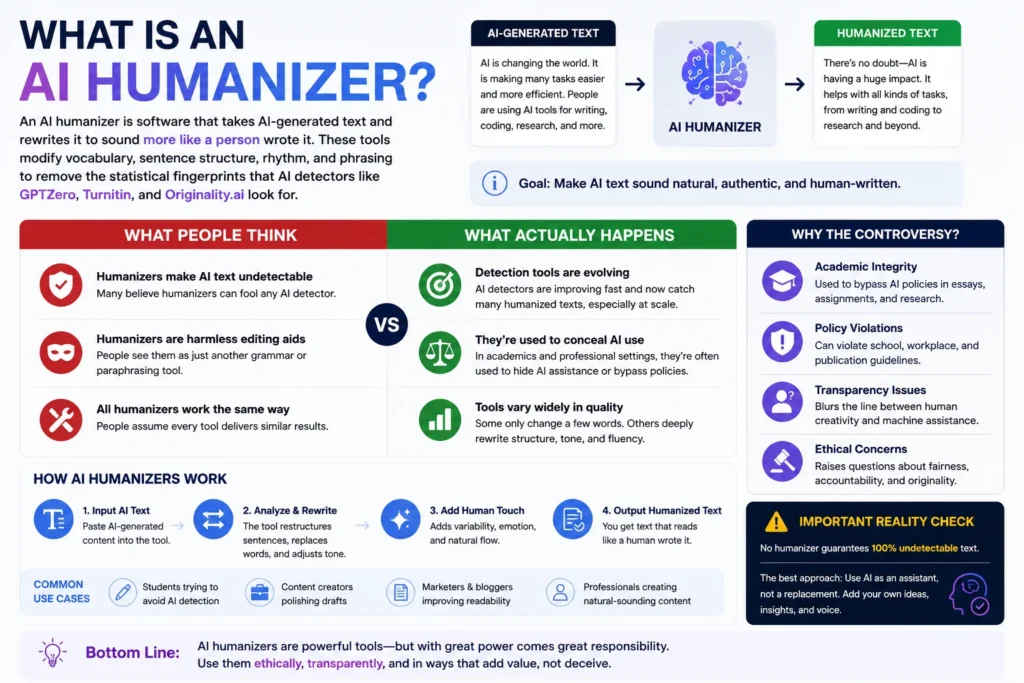
An AI humanizer is software that takes AI-generated text and rewrites it to sound more like a person wrote it. These tools modify vocabulary, sentence structure, rhythm, and phrasing to remove the statistical fingerprints that AI detectors like GPTZero, Turnitin, and Originality.ai look for .
Here’s the reality check:
| What People Think | What Actually Happens |
|---|---|
| Humanizers make AI text undetectable | Detection tools are evolving and now catch many humanized texts |
| Humanizers are harmless editing aids | They’re increasingly used to conceal AI use, especially in academic settings |
| All humanizers work the same way | Tools vary wildly in quality and sophistication |
If you’re here because you want to understand the AI humanizer landscape—how these tools work, why they’re controversial, and whether they actually deliver—you’re in the right place.
How AI Humanizers Actually Work
AI detectors catch AI-generated text through specific statistical fingerprints :
- Low perplexity – predictable, boring word choices
- Low burstiness – uniform sentence lengths
- AI-typical phrases – “furthermore,” “it is important to note,” “delve into”
- Rigid structure – same paragraph pattern throughout
AI humanizers disrupt all these signals. The more sophisticated ones use multi-layer pipelines to transform text .
The Technical Stack
Open-source humanizers like StealthHumanizer use a 4-layer pipeline :
- LLM Rewrite – Your chosen AI provider rewrites the text using anti-detection prompts that enforce burstiness, perplexity injection, and structural disruption
- Non-LLM Post-Processing – Hundreds of synonym swaps, collocation replacements, AI vocabulary removal, sentence length manipulation, and typographic variation
- Multi-Model Chain – Passing text through multiple AI providers to mix statistical fingerprints
- Final Polish – Light cleanup pass with readability guard
Other tools like AI-Humanizer-Pro use four distinct transformation techniques working in tandem to modify text structure, vocabulary, and encoding. Some use transformer models like T5 and Pegasus for paraphrasing .
What Humanizers Actually Change
The humanizer rule set from one open-source project reveals exactly what these tools target :
Punctuation & Formatting
- Replace em dashes “—” with normal hyphens “-” or commas (em dashes are the #1 AI tell)
- Remove multiple exclamation marks
- No emoji in the middle of sentences
Filler and Stock Phrases
- Cut openers like “It’s worth noting that,” “In today’s fast-paced world”
- Remove “plays a crucial role,” “serves as a testament to”
Buzzword Soup
- Drop “delve,” “tapestry,” “realm,” “leverage” (as filler), “game-changer,” “synergy”
Hollow Authority Hedges
- Delete “Essentially,” “At its core,” “The truth is” – state the point directly
Symmetric Hedging
- “On one hand… on the other hand” gets replaced with a clear stance
Mechanical Rule of Three
- “Fast, reliable, and easy” gets restructured – if there are really two or four points, write that many
The Free vs Premium Debate
Free AI humanizers exist and some are genuinely effective. StealthHumanizer is completely free, open-source, and uses a specialized BART model (406M parameters) for short text and Gemma3:4b for long text . It processes up to 150 words on a purpose-built humanizer backed by a peer-reviewed paper with a BERTScore of 0.924 .
Premium tools offer tone control (Standard, Professional, Casual, Academic) and developer APIs with usage analytics . Some mobile app versions offer subscriptions for features like deep restructuring and multi-language support across 130+ languages.
The Academic Reality: Turnitin and the Detection Arms Race
Here’s where things get serious. AI bypasser detection is now a reality.
In August 2025, Turnitin launched AI bypasser detection . This feature helps educators detect text that may have been intentionally modified by AI humanizer tools. The detection works seamlessly with Turnitin’s existing AI writing detection capabilities – when educators enable AI writing detection, submissions are automatically checked for likely AI-generated content as well as content that may have been further modified by leading bypassers .
What This Means
Turnitin’s own words: “The past two years has seen a rise in AI bypasser tools, or ‘humanizers,’ which allow students to disguise AI-generated text as human-written, evading detection by both teachers and AI tools. The easy availability of these tools poses a growing threat to academic integrity” .
Annie Chechitelli, chief product officer at Turnitin, stated: “While cheating has always been a concern of educators, with the rise of AI, there has been a new category formed of cheating providers. These companies exist to profit from students’ misuse of AI by providing free and easy access to humanizers to conceal AI-generated content” .
The Academic Research Perspective
Nature magazine covered the humanizer phenomenon in July 2026 . The article highlighted an academic humanizer tool developed by Jie Ding at the University of Minnesota, tailored for “papers and grant proposals” .
Reactions from academics were mixed :
- Francisco Maria Calisto, a health-informatics researcher: “It’s the best I have ever used”
- Miguel Angel Blazquez Rodriguez, a plant biologist: “It’s deceiving”
- Cassidy Sugimoto, an information scientist: “I fear that the use case is harmful for science”
The Research Findings
The academic research paper DAMAGE: Detecting Adversarially Modified AI Generated Text studied 19 AI humanizer and paraphrasing tools. The researchers found that many existing AI detectors fail to detect humanized text – but they also demonstrated a robust model that can detect humanized AI text while maintaining a low false positive rate.
Max Spero, CEO of Pangram (an AI-detection platform), tested the academic humanizer and found: “In his initial tests of ‘humanized’ text, Pangram caught most of the AI-generated language – although not all of it” . He also noted that upgraded versions of Pangram are being designed specifically to detect humanizer use.
Who’s Using AI Humanizers and Why
The Marketing Use Case
Marketers are turning to AI humanizers because audiences can sense when writing feels synthetic. The best brands realize that connection – not quantity – drives loyalty.
Real-world results:
- One fashion retailer revamped their newsletters using a humanized marketing setup. Open rates jumped 40%. Customers said the messages “sounded like a person, not a bot”
- A campaign doubled response rates after rewriting product descriptions through an AI humanizer tool
- Marketers report improved engagement rates by over 30% with humanized content
The hybrid marketing team workflow:
- AI Drafting – The machine creates an outline and rough text
- Humanization Pass – A tool smooths tone and adds natural flow
- Editorial Review – Humans tweak cultural references or humor
- Publication – The final copy feels personal, not programmed
The Student Use Case
Students are the primary users of humanizers in academic settings . The workflow is straightforward:
- A student enters a prompt into ChatGPT or Claude
- The AI generates a full response
- Instead of submitting directly, the student runs it through a bypasser tool
- The bypasser rephrases the content just enough to pass as original human writing
- The student submits the final version without further edits
The concern from educators: “Bypassers aren’t just about efficiency; they’re about deception. Unlike students who may use generative AI as a brainstorming tool or writing aid, those who rely on bypassers often aim to submit AI-generated work undetected. This sidesteps the learning entirely” .
The Professional Writer Use Case
Content writers and bloggers use humanizers to refine AI drafts, improve readability, and remove robotic phrasing. This use case is less controversial because the goal is improving quality, not deception.
The Ethics Debate
The ethics of AI humanizers are hotly contested.
The Deceit Argument
Cassidy Sugimoto’s concern – “I fear that the use case is harmful for science” – reflects a broader worry. Humanizers allow people to present AI-generated work as their own original writing. This undermines trust, distorts assessment of actual ability, and erodes the integrity of academic and professional work.
The Editing Aid Argument
Jie Ding, developer of the academic humanizer, pushes back: “I’d separate the tool from the behaviour. The ethical issue is the non-disclosure and the intent behind it, not the existence of an editing aid” .
After receiving criticism, Ding updated his tool’s description from “removes the usual AI tells” to “sharpens clarity and voice” and added an ethics note clarifying “that the tool is an editing aid and does not remove the author’s obligation to disclose AI assistance” .
The Reality Check from Turnitin
“At their core, AI bypassers aren’t tools that support learning—they’re shortcuts that work against it. Rather than helping students build foundational writing skills, bypassers allow them to skip over the very processes that lead to growth: researching, analyzing, drafting, revising, and, perhaps the most important, making mistakes to signal an area for improvement” .
The consequences of bypasser use:
- Undermines skill development in research, communication, and critical thinking
- Erodes trust between educators and students
- Distorts a student’s true abilities and understanding of the subject
- Makes personalized feedback difficult, if not impossible, to deliver effectively
The Future: What’s Coming
Detection Will Get Better
Turnitin’s AI bypasser detection is just the beginning. The research paper DAMAGE showed that robust detection models exist . Max Spero’s team at Pangram is actively developing upgraded versions designed specifically to detect humanizer use .
The Arms Race Continues
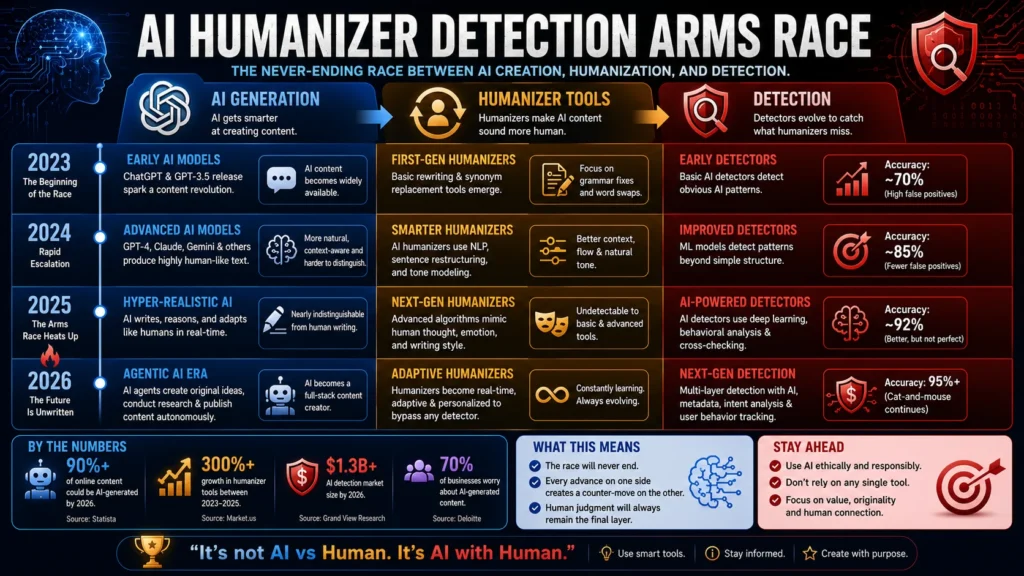
The pattern is clear: AI generation creates content, humanizers modify it, detectors catch it, and humanizers adapt. This is an arms race, and it’s not slowing down .
What’s at Stake
For students, the stakes are high. Using AI bypassers risks:
- Academic penalties
- Erosion of trust with educators
- Missed learning opportunities
- A distorted understanding of their own abilities
For businesses and professionals, the stakes are about authenticity and trust. Audiences can increasingly sense when content feels synthetic. The best brands realize that connection drives loyalty.
Key Takeaways
| Takeaway | Why It Matters |
|---|---|
| AI humanizers modify AI text to evade detection | They target statistical fingerprints like low perplexity and burstiness |
| Turnitin now detects AI bypasser use | Academic consequences are real and growing |
| Not all humanizers are equal | Free open-source tools like StealthHumanizer use sophisticated 4-layer pipelines |
| Ethical use is the dividing line | The intent behind using a humanizer matters more than the tool itself |
| The arms race continues | Detection tools are evolving to catch humanized text |
Frequently Asked Questions
What is an AI humanizer?
An AI humanizer takes AI-generated content and rewrites it into something that sounds more like a natural human being, while still preserving the original meaning of the text .
Do AI humanizers actually work?
Some do. Many existing AI detectors fail to detect humanized text – but detection tools are evolving and now catch many humanizers .
Can Turnitin detect AI humanizers?
Yes. In August 2025, Turnitin launched AI bypasser detection designed to detect text modified by leading AI humanizer tools .
Is using an AI humanizer cheating?
It depends on the context and disclosure. Using humanizers to conceal AI use in academic work when disclosure is required is considered academic misconduct .
Are there legitimate uses for AI humanizers?
Yes. Marketers use them to improve AI-generated copy for blogs, ads, and campaigns. Content writers use them to refine readability and remove robotic phrasing .
Are free AI humanizers any good?
Yes. StealthHumanizer is completely free, open-source, and uses specialized models for humanization. It processes text through a 4-layer pipeline and includes built-in detection .
Conclusion
The AI humanizer landscape is messy. These tools work to varying degrees but they’re caught in a detection arms race that’s escalating fast. Turnitin now catches many humanizers. Academic researchers are developing robust detection models. And the ethics around using these tools are genuinely complex .
Here’s the bottom line: humanizers exist because AI writing is still too robotic. The underlying problem isn’t detection it’s that machine generated text lacks the rhythm, voice, and imperfect spontaneity of real human writing. The smartest approach isn’t trying to outrun detectors with a humanizer tool. It’s learning to use AI as an assistant rather than a substitute drafting with AI, then editing with human judgment, making real improvements that add value. That’s the approach that builds skills, maintains trust, and produces work that genuinely connects with readers .
The tools will keep evolving. The detection will keep improving. But the human element the voice, the judgment, the ethical choice that’s still yours.

Victoria Lane is a grammar-focused writer at GramBrix.com, passionate about helping readers master the rules of language. She provides clear explanations and practical examples that make writing more accurate, polished and confident.