
Last Updated on August 1, 2026
The artificial intelligence stock market represents one of the most significant investment opportunities of the decade. Leading AI stocks to buy include NVIDIA for AI chips, Palantir for enterprise AI software, and Nebius for AI cloud infrastructure. Investors should focus on companies with strong revenue growth, sustainable competitive advantages, and reasonable valuations relative to their growth trajectories.
The AI Investment Revolution Has Only Just Begun
Let’s cut through the noise right now.
You’ve seen the headlines. Asian chip stocks tumbling. Questions swirling about whether the AI spending spree can possibly sustain itself. The pundits love to scream “bubble” at every market dip.
Here’s what they miss.
This isn’t 1999.
Morgan Stanley’s Applied Equity team recently made a crucial distinction that every investor needs to hear. During the dot-com peak, technology stocks traded at wildly inflated valuations with zero earnings to back them up. Today’s AI beneficiaries actually contain numerous very reasonably priced companies.
That’s not bubble behavior. That’s rationality.
The real question isn’t whether AI will transform the economy. Stanford’s 2026 AI Index Report confirms the technology is accelerating, not plateauing. Industry produced over 90% of frontier models in 2025. Organizational adoption hit 88%.
The question is which companies will capture that value without making you overpay for the privilege.
This guide walks you through the entire AI stock landscape. We’ll separate genuine opportunity from speculative froth. We’ll identify under-the-radar winners. And we’ll give you a framework for buying with conviction.
Understanding the AI Stock Ecosystem
Before we dive into specific picks, let’s map the territory.
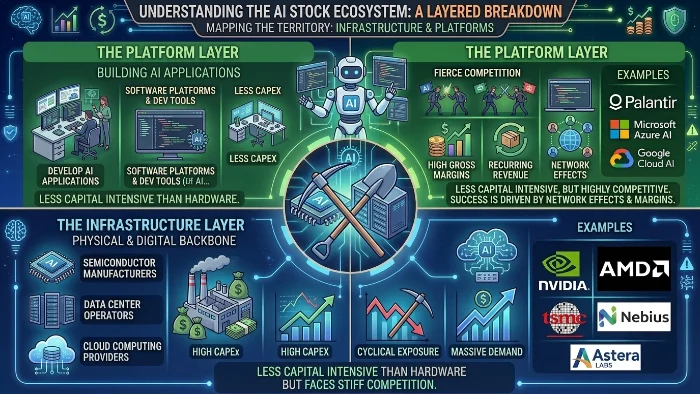
The artificial intelligence stocks market isn’t monolithic. It breaks down into several distinct layers, each with different risk profiles and growth trajectories.
The Infrastructure Layer
These are the companies building the physical and digital backbone of AI.
Think semiconductor manufacturers, data center operators, and cloud computing providers. They sell picks and shovels to the AI gold rush. Their revenue comes from hardware sales and compute services.
Key characteristics: High capital expenditure, cyclical exposure, but massive and growing demand.
Examples: NVIDIA, AMD, TSMC, Nebius, Astera Labs.
The Platform Layer
These companies provide the software platforms and development tools that let businesses build AI applications.
They’re less capital intensive than hardware companies but face fierce competition from both established tech giants and agile startups.
Key characteristics: High gross margins, recurring revenue, network effects.
Examples: Palantir, Microsoft Azure AI, Google Cloud AI.
The Application Layer
These are the companies using AI to transform specific industries or business functions.
They include healthcare AI, fintech AI, autonomous vehicles, and enterprise automation software.
Key characteristics: High growth potential, but also high risk of disruption.
Examples: Waymo (Alphabet), Tesla (autonomous driving), C3.ai.
Key Players
The landscape includes established tech giants with massive AI investments and pure-play AI companies focused exclusively on this market.
| Category | Companies | Key Differentiator |
|---|---|---|
| Chip Manufacturers | NVIDIA, AMD, TSMC, Broadcom | Hardware performance and scale |
| Cloud Providers | Microsoft, Alphabet, Amazon, Nebius | Compute infrastructure and services |
| Enterprise AI | Palantir, Oracle, IBM | Industry-specific solutions |
| Memory and Storage | SanDisk, Micron, Samsung | Data handling and capacity |
Understanding these distinctions helps you build a diversified portfolio that captures AI growth while managing risk.
The Macro View: No Bubble, But Plenty of Volatility
Let’s address the elephant in the room.
Are we in an AI bubble?
The evidence says no.
Morgan Stanley’s analysis suggests we’re not in an AI bubble. Companies with historically cyclical earnings actually trade at lower forward P/E ratios. That suggests investors are being cautious rather than euphoric.
That’s the opposite of bubble psychology.
However, the momentum crowd has crowded into AI beneficiaries. These are investors buying purely because prices are going up. They’ll turn tail at the first sign of weakness. That’s what triggered the recent volatility. And it creates buying opportunities for those with genuine conviction.
The Fed remains the wild card. If rates rise, Morgan Stanley would reduce its AI exposure. But that’s not the base case. And even the Fed can’t predict its own policy direction with confidence.
Here’s what you need to know.
AI spending is accelerating, not decelerating. Tech leaders are unanimous: AI will be much bigger than many imagine. Capex investments are generating strong returns. Usage is growing faster than capacity.
The AI investment cycle will likely last longer than most pundits suggest.
The Best AI Stocks to Buy Right Now
NVIDIA: The Undisputed AI Chip King
No list of top AI stocks is complete without NVIDIA.
The company reported $81.6 billion in fiscal Q1 2027 revenue. That’s 85% year-over-year growth. Data center revenue hit a record $75.2 billion. Management projects $91 billion for Q2.
The forward P/E sits at just 22. That’s less than the S&P 500. Analysts expect 82% revenue growth this year.
So why has the stock barely moved?
Expectations are astronomically high. Export curbs on chip sales to China create ongoing uncertainty. Investors are hedging that growth will eventually slow.
But here’s the overlooked angle.
NVIDIA’s physical AI business is quietly becoming a major growth driver. This includes autonomous vehicles and robotics. Jensen Huang says it’s generating $10 billion in annual run-rate revenue. He projects it could grow to $100 billion within a decade.
Waymo alone is now handling 500,000 weekly paid rides. That’s just one customer in one segment.
This is a software-adjacent, recurring-revenue business. It should command higher multiples than NVIDIA’s hardware segment. If it reaches $100 billion in revenue, the physical AI business alone could be worth $2 trillion or more.
At $5 trillion market cap, NVIDIA reaching $10 trillion isn’t wild talk. It’s a plausible scenario.
Why NVIDIA belongs in your portfolio: Market leadership, massive growth runway, physical AI upside.
Risk to watch: Export restrictions, extreme expectations, competition from custom chips.
Nebius: The NVIDIA-Endorsed Cloud Disruptor
If you want one AI stock that captures the infrastructure opportunity without the concentration risk of pure-chip plays, Nebius deserves your attention.
This AI-native cloud provider just achieved NVIDIA Exemplar Cloud status for GB300 training workloads. That puts it in an elite group of providers recognized across multiple GPU generations. NVIDIA also took a significant equity stake.
That’s not just an endorsement. It’s a strategic alignment.
The numbers tell a compelling story. Q1 2026 group revenue grew 684% year-over-year. The Nebius AI business posted 841% growth. It hit a $1.9 billion annualized run-rate. Adjusted EBITDA margin for the AI business hit 45%.
The company reaffirmed 2026 guidance for $7-9 billion annualized run-rate revenue.
Nebius is executing across four pillars.
Capacity: They’ve expanded contracted power capacity from 2+ gigawatts to 3.5+ gigawatts. A new Pennsylvania facility supports 1.2 gigawatts. Over 75% of that capacity is now owned.
Product: Acquisitions of Tavily, Eigen AI, and Clarifai added experienced AI engineers. They improved inference optimization and agentic search capabilities.
Customers: Demand is so strong that several customers typically compete for every GPU brought online.
Capital: The balance sheet is fortified with $9.3 billion in cash.
Risk to watch: They’ve increased 2026 capex guidance to $20-25 billion. Margins will fluctuate quarterly as they invest ahead of capacity deployment. This is a growth-at-all-costs story.
Why Nebius belongs in your portfolio: 800%+ revenue growth, NVIDIA endorsement, massive addressable market.
Palantir: The Agnostic AI Orchestrator
Palantir’s stock is down 30% year-to-date. The “SaaSpocalypse” fears that AI models would make software companies obsolete have rattled investors.
Here’s the reality. Those fears are overblown.
D.A. Davidson’s Gil Luria called Palantir “the best company in the world” and “at least the best software company.” He raised his target to $175. That’s 42% upside from current levels. The median Wall Street target is $200. That’s 62% upside.
What makes Palantir special?
The ontology. Think of it as a digital twin that connects data to real-world assets and processes. Their Artificial Intelligence Platform (AIP) is an agnostic LLM orchestration tool. Customers can apply any AI model to the ontology data.
This agnosticism is becoming critical.
When a U.S. government directive forced Anthropic to temporarily suspend access to its Fable model, companies realized they need someone like Palantir who can seamlessly swap in alternative models.
The numbers are extraordinary.
Q1 revenue increased 85% to $1.6 billion. That’s the 11th consecutive acceleration. Non-GAAP earnings grew 153%. The company raised full-year guidance to 71% revenue growth.
At 128 times earnings, it’s not cheap. But earnings are expected to grow 56% annually through 2027. Palantir beats consensus estimates by 15% on average.
Why Palantir belongs in your portfolio: Leading AI orchestration platform, accelerating revenue, mission-critical software.
Risk to watch: High valuation, government contract concentration, competition from established software giants.
Advanced Micro Devices: The Anti-NVIDIA Trade
AMD has been the forgotten child of the AI chip boom. That’s precisely what makes it interesting.
The stock is down 16% over the past month. Yet AMD recently signed a deal with Anthropic to deploy up to 2 gigawatts of AMD chips for training and inference. That’s meaningful validation.
The bigger opportunity lies in CPUs.
Agentic AI is driving soaring demand for server CPUs. This is a market where AMD has been steadily gaining share from Intel. This isn’t the GPU story, but it may be the more durable one.
AMD isn’t trying to beat NVIDIA at their own game. They’re playing a different game entirely. That makes them a hedge against NVIDIA concentration while still capturing the AI spending wave.
Why AMD belongs in your portfolio: AI chip validation, CPU share gains, reasonable valuation.
Risk to watch: Competition from Intel and NVIDIA, execution risk in GPU market.
SanDisk: The 4,000% Gainer That Still Has Room
This is the AI stock nobody saw coming.
SanDisk has surged 457.4% this year. Revenue almost doubled sequentially in fiscal Q3 2026, reaching $5.95 billion. That’s up 251% year-over-year. Management projects $7.75-8.25 billion for Q4.
What’s driving this?
NAND flash chips have become critical components of the AI infrastructure build-out. Every data center needs memory. SanDisk is securing multi-year strategic partnerships through their “New Business Model” agreements. These provide revenue visibility and minimize exposure to cyclicality.
Brokers see an average short-term price target of $2,389. That’s 135% upside from current levels.
The comparison with Micron is instructive. Micron recently beat its own guidance by 25%. SanDisk has achieved even higher growth rates. If Micron’s earnings are a preview, SanDisk’s next report could be stellar.
Why SanDisk belongs in your portfolio: Massive growth acceleration, AI memory demand, strategic partnerships.
Risk to watch: Cyclical memory market, competition from other memory manufacturers.
Alphabet: The Underrated AI Beneficiary
Alphabet is quietly becoming an AI powerhouse. Investors aren’t fully pricing it in.
Google Cloud revenue grew 63% year-over-year. Backlog nearly doubled sequentially. Gemini Enterprise saw 40% sequential growth in paid monthly active users.
The SaaSpocalypse fears that ChatGPT would dethrone Google now seem like a distant memory.
But the real underappreciated story is Waymo.
Alphabet’s self-driving vehicle business now exceeds 500,000 fully autonomous rides per week. It operates in 10 metro areas and is expanding rapidly.
This is a legitimate business with significant revenue potential. Most investors treat it as an expensive science experiment. Waymo could be to autonomous vehicles what Android was to smartphones. A strategic hedge with massive upside.
At a P/E of 27, Alphabet is reasonably priced for a company with 22% year-over-year revenue growth and a cloud business that’s accelerating.
Why Alphabet belongs in your portfolio: Cloud AI growth, Waymo upside, reasonable valuation.
Risk to watch: Regulatory scrutiny, search competition, ad market cyclicality.
Astera Labs: The Connectivity Specialist
Here’s a name that doesn’t get enough attention.
Astera Labs designs specialized connectivity solutions like PCIe and Ethernet for rack-scale AI infrastructure. It serves major hyperscalers and is profitable on a net basis with a 25.7% net margin.
Revenue reached nearly $852.5 million in FY 2025. That’s 115% growth year-over-year.
The balance sheet is pristine. Zero debt. Current ratio of 10.2x. Positive free cash flow of $281.8 million.
But there’s a catch.
Three customers represent about 86% of revenue. One end customer accounted for over 70% in 2025. That concentration risk is the primary reason the stock trades at a reasonable valuation relative to its growth.
If you’re comfortable with that risk, Astera offers pure-play exposure to the data center connectivity bottleneck. Hyperscalers can’t easily bypass this critical layer.
Why Astera belongs in your portfolio: High growth, profitability, critical infrastructure niche.
Risk to watch: Extreme customer concentration, limited market diversification.
Marvell Technology: The Custom Chip Enabler
Marvell is down 38% over the past month. That’s a dramatic pullback.
The company designs custom AI chips tailored to specific workloads. The value proposition is straightforward. Hyperscalers are increasingly seeking alternatives to NVIDIA’s expensive GPUs. Custom chips can be highly cost-effective at scale.
Beyond custom chips, Marvell makes the networking, connectivity, storage, and data-processing chips that data centers need to handle AI workloads. This diversified exposure makes it a way to play the infrastructure build-out without betting on any single chip category.
Why Marvell belongs in your portfolio: Custom chip opportunity, diversified exposure, pullback creates entry point.
Risk to watch: Execution risk on custom designs, competition from other chip designers.
AI Stocks to Avoid
Not every artificial intelligence stock is a buy.
Model Providers
Companies like Anthropic and OpenAI aren’t publicly traded. But if they were, the valuations would require earnings growth that will take years to materialize. These are great companies at the wrong price.
Recent AI IPOs
The price discovery is at the mercy of sentiment rather than fundamentals. Walking away from a party still going strong is the hardest call in active management. Sometimes it’s the smartest one.
C3.ai
Management itself described recent performance as “unacceptable.” They cited “poor sales discipline.” Quarterly revenue of $51.6 million with negative free cash flow of $54.8 million isn’t a growth story. It’s a red flag.
Companies With Declining Revenue
| Company | Red Flag |
|---|---|
| Cloudflare | Growth slowing from 55% to 30% |
| UiPath | Revenue growth dropped from 30% to single digits |
| Snowflake | Slowing growth with rising competition |
How to Evaluate Any AI Stock
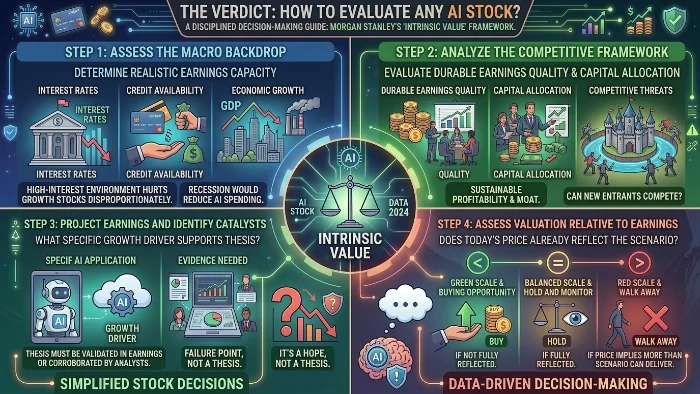
Morgan Stanley’s “Intrinsic Value” framework offers a disciplined approach.
Step 1: Assess the Macro Backdrop
Interest rates, credit availability, and economic growth determine what companies can realistically earn. A high-interest-rate environment hurts growth stocks disproportionately. A recession would reduce AI spending.
Step 2: Analyze the Competitive Framework
Evaluate durable earnings quality, capital allocation, and competitive threats. Can the company sustain its profitability? Does it have a moat? Can new entrants compete?
Step 3: Project Earnings and Identify Catalysts
What specific growth driver supports your thesis? What evidence would prove you wrong? If the thesis can’t be validated in earnings or corroborated by analysts, it’s a hope, not a thesis.
Step 4: Assess Valuation Relative to Earnings
Does today’s price already reflect the earnings scenario? If not, it may be a buying opportunity. If fully reflected, hold and monitor. If the price implies more than the scenario can deliver, walk away.
Building Your AI Portfolio
The AI trade isn’t monolithic. It’s a diverse ecosystem with wildly different earnings trajectories and current valuations.
For Growth Investors
Nebius offers the most asymmetric upside. The NVIDIA endorsement and 800%+ revenue growth suggest this is the early-stage winner in a massive addressable market.
For Value-Conscious Investors
SanDisk and AMD offer reasonable valuations relative to their growth trajectories. Both have pullback. Both have catalysts that the market is underappreciating.
For Long-Term Holders
Alphabet and NVIDIA are the foundational AI plays. They’re already winners that continue to accelerate. Their physical AI businesses are upside optionality that’s not fully priced in.
For Software Exposure
Palantir is the clear leader in AI decisioning platforms. The valuation is rich, but the earnings growth is even richer. This is a bet on an enduring software moat.
Sample Portfolio Allocation
| Category | Allocation | Examples |
|---|---|---|
| AI Chip Leaders | 30% | NVIDIA, AMD |
| AI Infrastructure | 20% | Nebius, Astera Labs |
| AI Software | 25% | Palantir, Alphabet |
| AI Memory | 15% | SanDisk |
| AI Diversified | 10% | Marvell |
FAQs
What are the best AI stocks to buy for beginners?
Alphabet and Microsoft offer the lowest risk entry points. Both have diversified revenue streams, massive AI investments, and reasonable valuations. They’re less volatile than pure-play AI stocks.
Are AI stocks overvalued in 2026?
It depends on the stock. NVIDIA at 22 times forward earnings is actually cheaper than the S&P 500. Palantir at 128 times earnings is expensive but growing 85%. The market is efficient. Some are overvalued. Some are fairly valued. Others are undervalued.
What are the risks of investing in AI stocks?
Key risks include export restrictions, competition, slowing growth, and valuation corrections. Regulatory action against major tech companies could also impact the sector.
How much of my portfolio should be in AI stocks?
That depends on your risk tolerance. A 15-25% allocation to technology and AI stocks is reasonable for a growth-oriented portfolio. Never put all your eggs in one basket.
Should I invest in AI ETFs instead of individual stocks?
AI ETFs offer diversification and lower risk. The Global X Robotics & AI ETF (BOTZ) and the iShares Robotics and AI ETF (IRBO) provide broad exposure. However, they can’t match the upside of picking the right individual stocks.
Conclusion
The key insight is simple. We’re not in a bubble. We’re in a rational growth cycle where valuations matter and fundamentals drive returns. The volatility creates opportunity.
Nobody is very good at predicting the top of the AI spending cycle. Not even Wall Street.
The best investors acknowledge their limitations. They stay disciplined. They buy quality at reasonable prices.
That’s the playbook for 2026.
Remember the four-part framework. Assess the macro. Analyze the competitive landscape. Project earnings and identify catalysts. Assess valuation relative to earnings.
Do your own homework. Build conviction. And buy AI stocks that offer genuine value, not just hype.
The artificial intelligence revolution is real. It’s transforming industries. It’s creating massive wealth. And it’s still in its early innings.
The question isn’t whether to invest in AI. The question is which AI stocks to buy.
Now you have the framework to answer that question with confidence.

Justin Powell is a writer at GramBrix.com who focuses on grammar, clarity and effective communication, helping readers strengthen their language skills.